
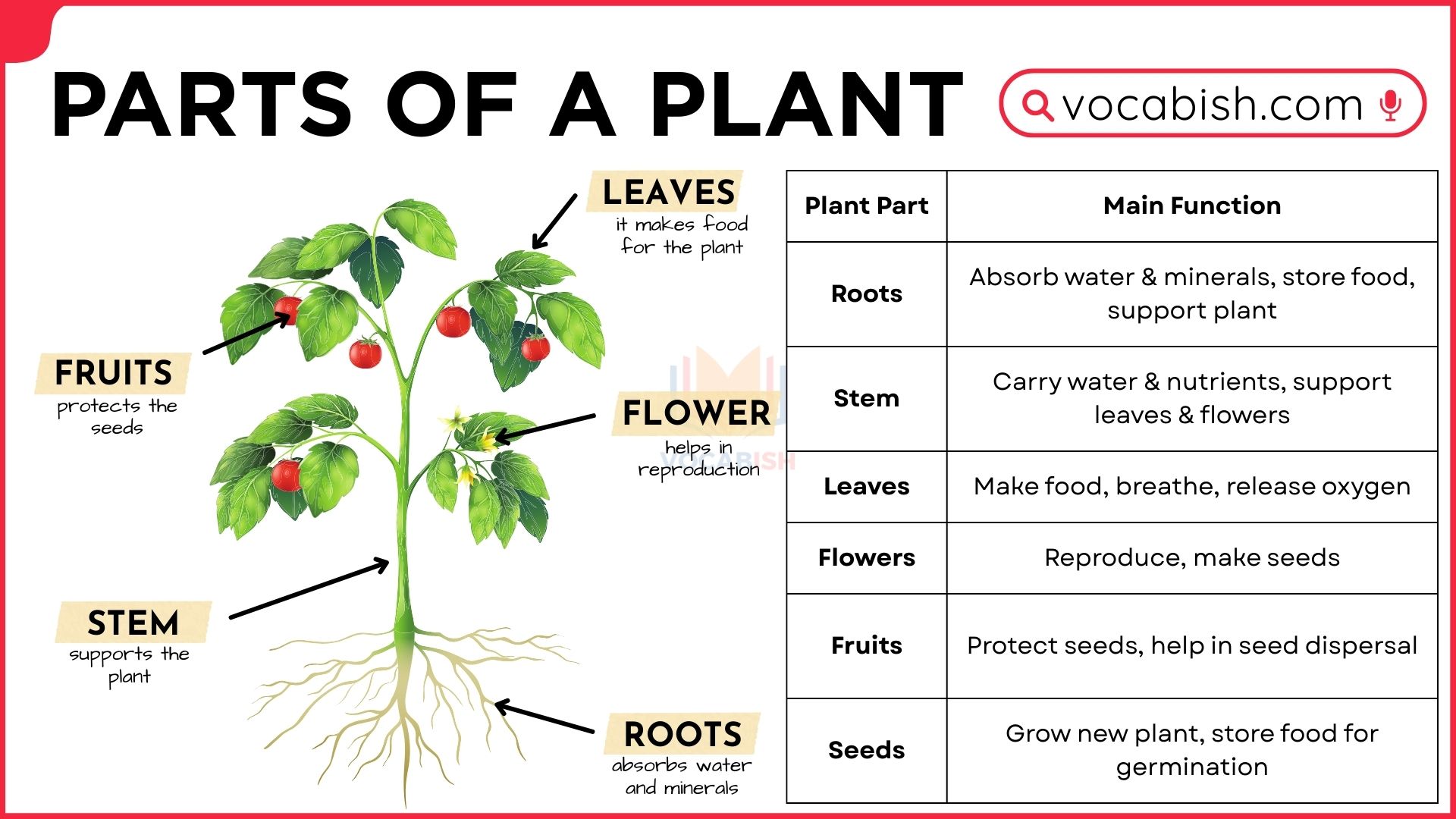
In this blog post, you will learn the different Parts of a Plant, their Functions, and how they work together to help the plant grow, reproduce, and survive. Understanding these parts helps students, gardeners, and science learners observe plants better and understand their life cycle. When you know the function of each part, your reading, writing, and speaking about plants becomes more accurate. Step by step, you will master plant vocabulary and understand how each part contributes to the plant’s growth.
What is a Plant?
A plant is a living organism that grows in soil or water. Plants use sunlight, water, and air to make their own food through photosynthesis. Plants have different parts, each with a special function. Knowing these parts helps us understand how plants survive, grow, and produce fruits and seeds.
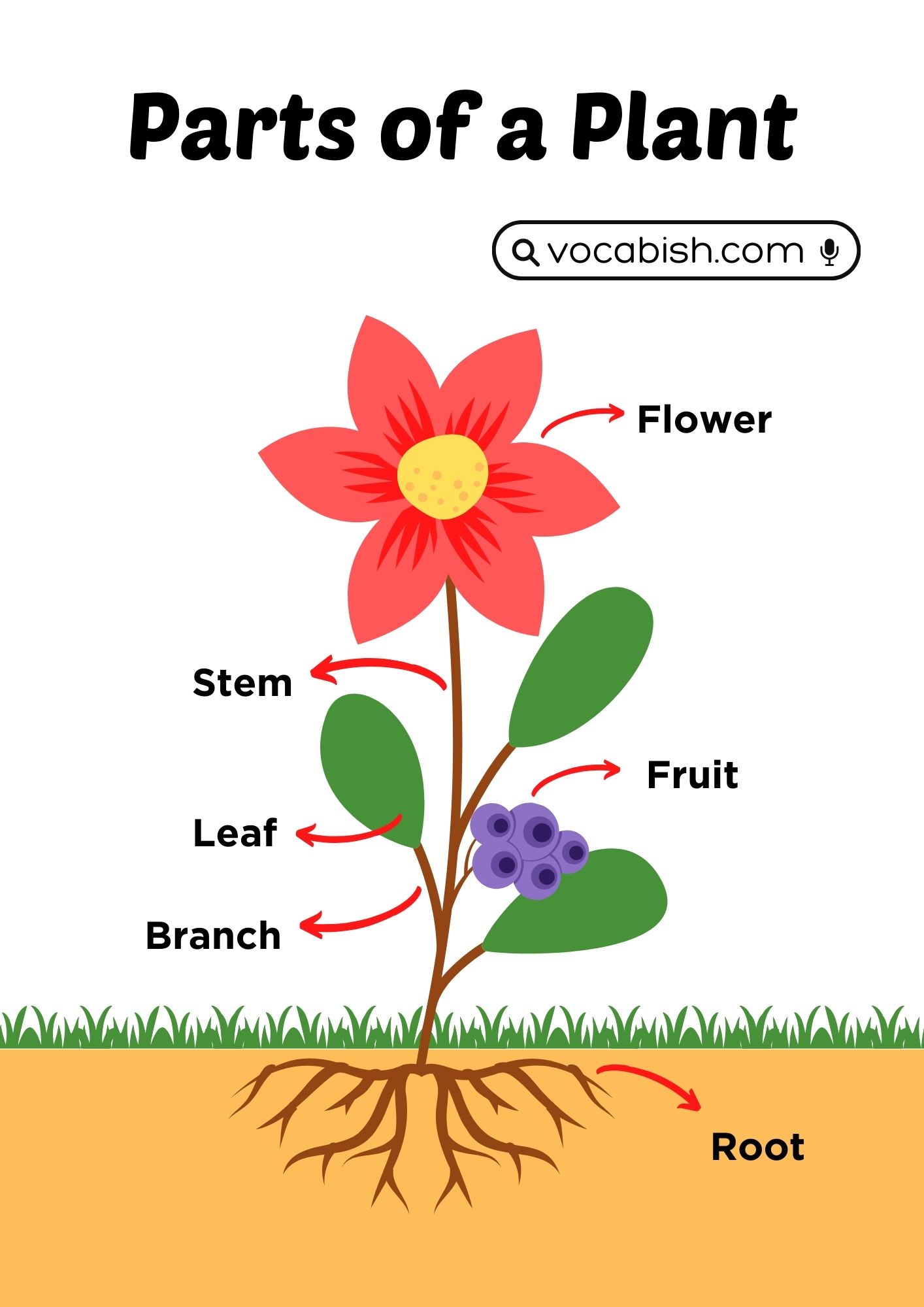
Main Parts of a Plant
1. Roots
- Roots grow under the soil.
- They hold the plant and absorb water and minerals.
- Some roots store food for the plant.
Types of Roots
| Root Type | Description | Example |
|---|---|---|
| Taproot | Main thick root with small branches | Carrot, Radish |
| Fibrous | Thin, hair-like roots | Grass, Wheat |
| Adventitious | Grow from stem or leaf | Corn, Banyan tree |
2. Stem
- Stem is the main support of the plant.
- It carries water and nutrients from roots to leaves.
- Stems hold leaves and flowers upright.
Types of Stems
- Herbaceous: Soft and green (e.g., Sunflower)
- Woody: Hard and strong (e.g., Mango tree)
3. Leaves
- Leaves make food for the plant using sunlight and air.
- They help in breathing through small holes called stomata.
Types of Leaves
| Leaf Type | Description | Example |
|---|---|---|
| Simple | Single leaf blade | Mango, Guava |
| Compound | Many small leaflets | Rose, Neem |
| Needle | Thin, long leaves | Pine |
4. Flowers
- Flowers are the reproductive part of plants.
- They make seeds for new plants.
- Flowers can be colourful to attract insects for pollination.
Parts of a Flower
- Petals: Colourful part
- Sepals: Protect young flowers
- Stamen: Male part (makes pollen)
- Pistil: Female part (makes seeds)
5. Fruits
- Fruits grow from flowers and carry seeds.
- They protect seeds and help in dispersal.
Types of Fruits
| Type | Example |
|---|---|
| Fleshy | Apple, Mango |
| Dry | Nuts, Peas |
6. Seeds
- Seeds are the beginning of a new plant.
- They contain stored food for the young plant.
- Seeds germinate under suitable conditions (water, air, soil).
Types of Seeds
- Monocot: Single leaf (e.g., Corn, Wheat)
- Dicot: Two leaves (e.g., Beans, Pea)
Functions of Parts of Plant
| Plant Part | Main Function |
|---|---|
| Roots | Absorb water & minerals, store food, support plant |
| Stem | Carry water & nutrients, support leaves & flowers |
| Leaves | Make food, breathe, release oxygen |
| Flowers | Reproduce, make seeds |
| Fruits | Protect seeds, help in seed dispersal |
| Seeds | Grow new plant, store food for germination |
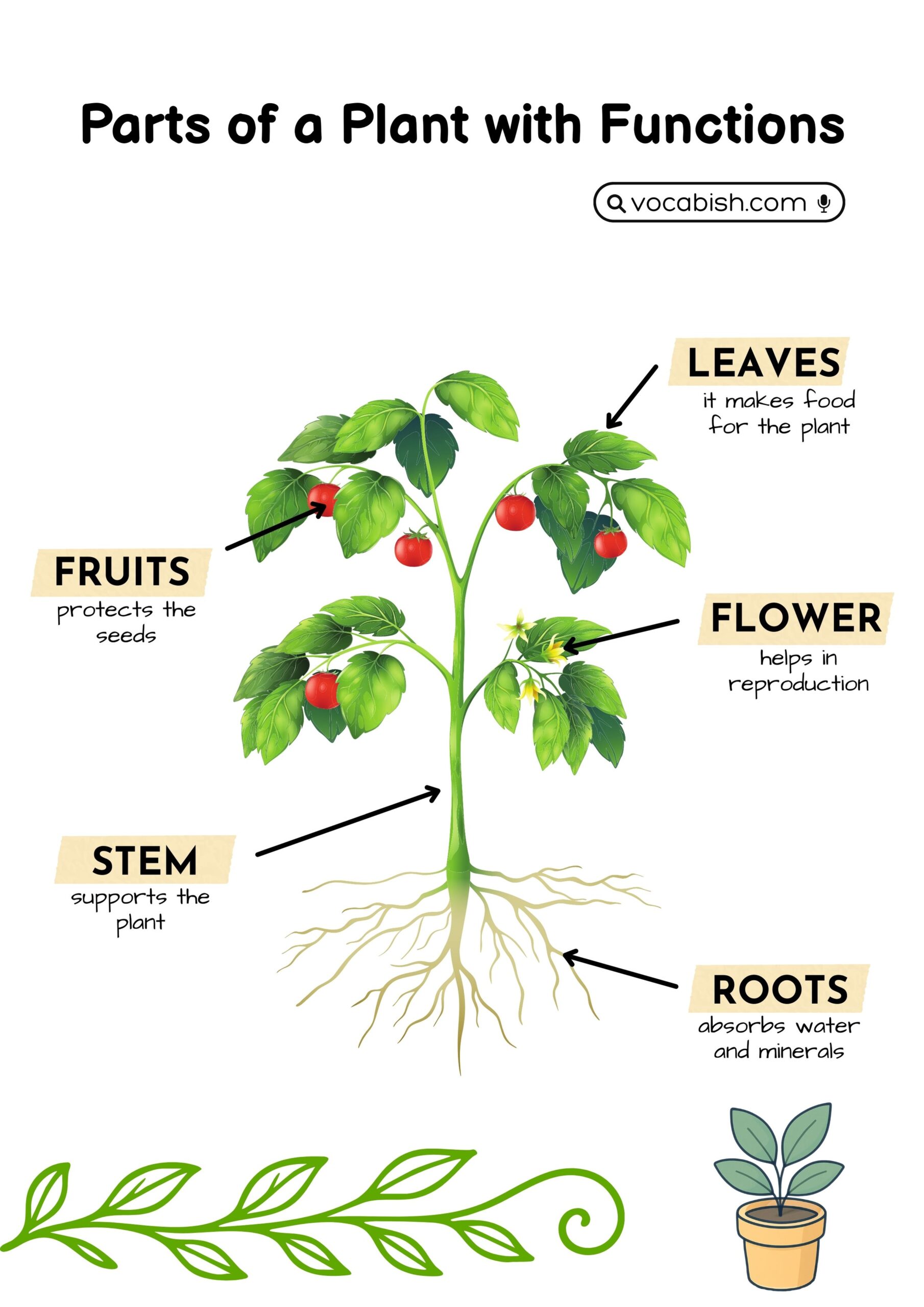
Plants are made of roots, stems, leaves, flowers, fruits, and seeds. Each part has a specific role to help the plant grow and survive. By knowing plant parts, students can understand how nature works and why plants are important for life.
FAQs
What are the main parts of a plant?
Roots, stems, leaves, flowers, fruits, and seeds are the main parts.
What is the function of roots?
Roots absorb water, minerals, store food, and hold the plant.
How do leaves make food?
Leaves use sunlight, water, and air to make food through photosynthesis.
Why are flowers important?
Flowers make seeds and help in reproduction.
What do fruits do for seeds?
Fruits protect seeds and help in seed dispersal.
What is a stem’s main role?
Stems support the plant and carry water and nutrients.
What types of roots exist?
Taproot, fibrous, and adventitious roots.
Which part stores food for the plant?
Roots and seeds store food for growth.
What is the difference between monocot and dicot seeds?
Monocot seeds have one leaf, dicot seeds have two leaves.