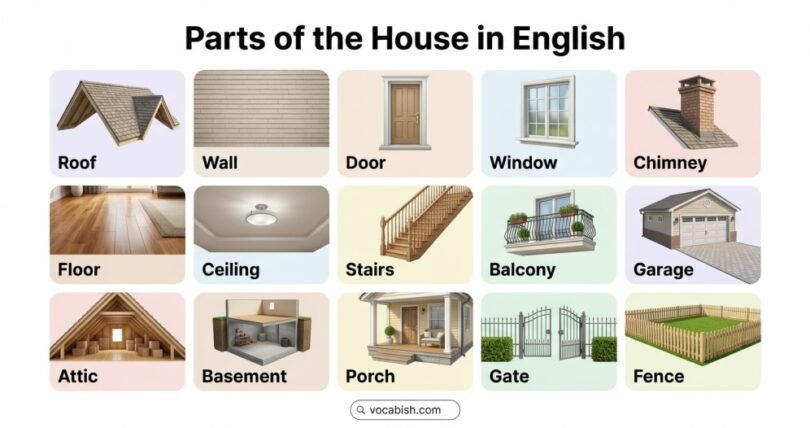

Parts of the house include the roof, walls, doors, windows, floors, ceilings, and stairs. Each part has a different purpose. The roof protects the building from rain, walls divide spaces, and doors allow people to enter or leave. A house also has interior areas, exterior features, and rooms for sleeping, cooking, washing, and relaxing.
Learning house vocabulary helps you describe your home, identify building features, and talk about everyday activities in English. In this lesson, you will find house parts names with pictures, short meanings, organised vocabulary tables, and example sentences. You can also use the labelled diagrams and practice questions to remember new words.
Common Parts of the House with Names
A house contains different structural parts and connecting spaces. Some protect the building, while others help people move between rooms or reach different floors.
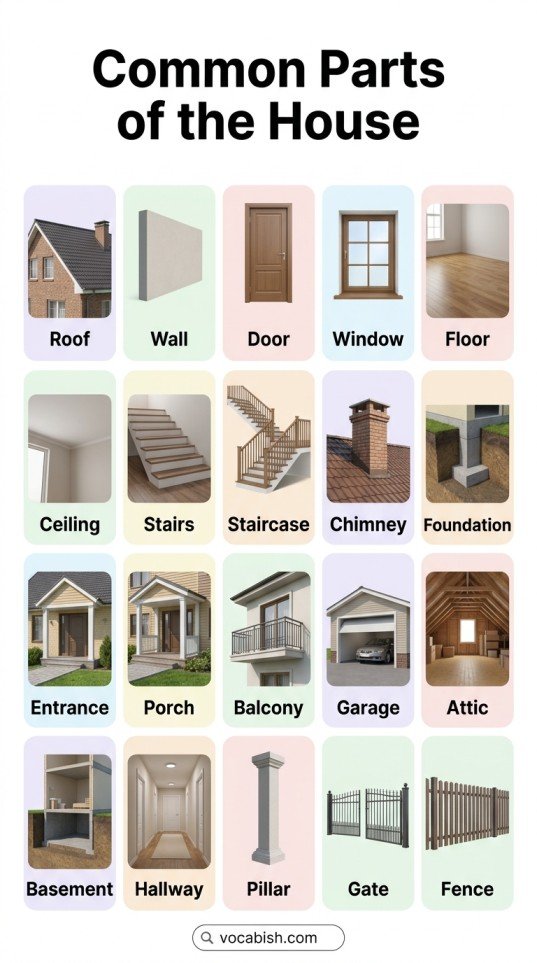
These 20 common names are useful when learning English house vocabulary.
- Roof: Covers the top and protects against weather.
- Wall: Supports the building or separates different spaces.
- Door: Opens and closes an entrance to a space.
- Window: Lets natural light and sometimes fresh air inside.
- Floor: Surface people stand and walk on indoors.
- Ceiling: Upper inside surface of a room, above your head.
- Stairs: Steps used to move between different levels.
- Staircase: Complete structure containing stairs and their supports.
- Chimney: Carries smoke and gases safely out of the house.
- Foundation: Supports the building and transfers weight into the ground.
- Entrance: Place where people enter or leave a building.
- Porch: Sheltered area near the entrance of a house.
- Balcony: Raised outdoor platform accessed from an upper level.
- Garage: Covered space used mainly for parking vehicles.
- Attic: Space located directly below the house’s roof.
- Basement: Lower level partly or completely below ground.
- Hallway: Passage connecting rooms and other indoor spaces.
- Pillar: Upright support that can hold part of a building.
- Gate: Movable barrier controlling entry through a fence.
- Fence: Outdoor barrier marking or enclosing an area.
A roof, foundation, and wall are building components. A bedroom is a room, while a chair is movable furniture. These words describe different things.
Parts of the House Diagram
A labelled house diagram helps learners recognise where different parts are located. An outside view shows the roof, chimney, windows, and entrance, while a cutaway view reveals the rooms and structures inside.
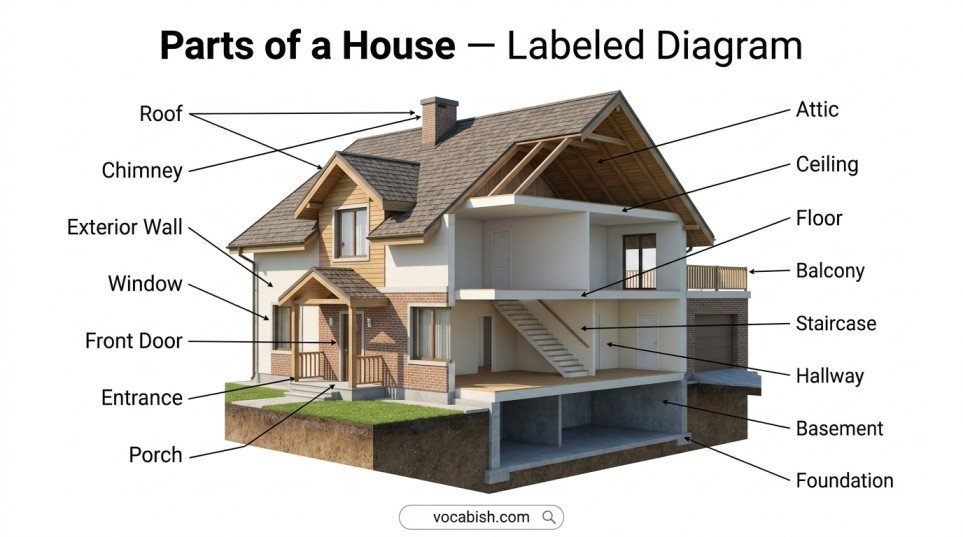
Look at the roof at the top, the foundation at the bottom, and the walls around the rooms. Inside the house, find the ceiling above each room, the floor below it, and the staircase connecting different levels.
Exterior Parts of a House
Exterior means the outside of a building. Exterior house parts protect the home from weather, provide access, and help direct rainwater away from the structure.
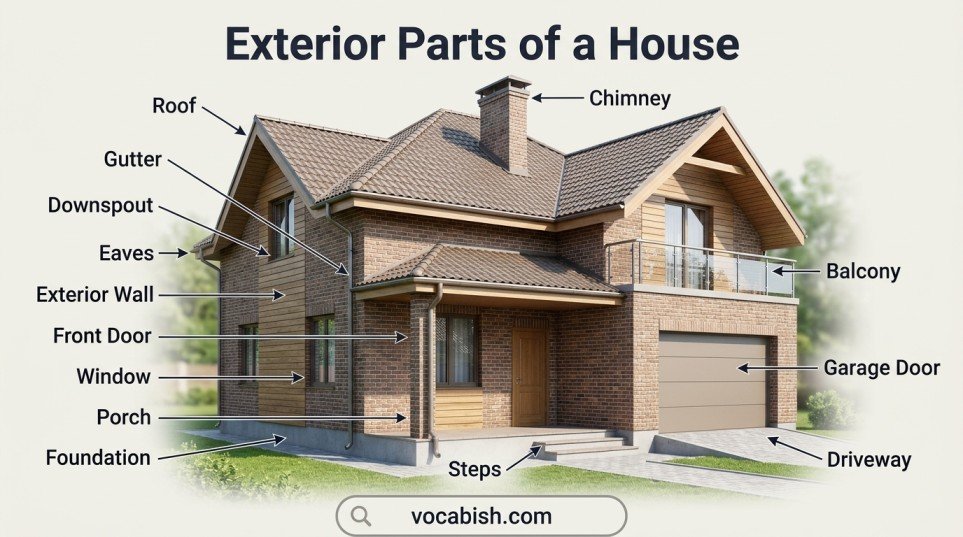
Exterior Part | Description |
|---|---|
Roof | Covers the building from above. |
Chimney | Releases smoke and gases from a fireplace or heating system. |
Gutter | Collects rainwater flowing off the roof. |
Downspout | Carries rainwater down from the gutter. |
Eaves | Lower edges of a roof extending beyond the walls. |
Exterior Wall | Forms the outside boundary of the building. |
Front Door | Provides the main entrance to the house. |
Window | Allows daylight into indoor rooms. |
Porch | Provides a sheltered entrance area. |
Steps | Allow people to reach a raised entrance. |
Driveway | Provides a route for vehicles to reach parking areas. |
Garage Door | Opens and closes the vehicle entrance. |
Balcony | Provides outdoor space above ground level. |
Foundation | Supports the weight of the house. |
Siding | Covers and protects the outside walls. |
A house may have brick walls, wooden siding, or another exterior finish. Not every house has a chimney, porch, or balcony.
Parts of a Roof
A roof has several parts that protect a building and help rainwater drain away. Their names are useful when describing a house or discussing repairs.
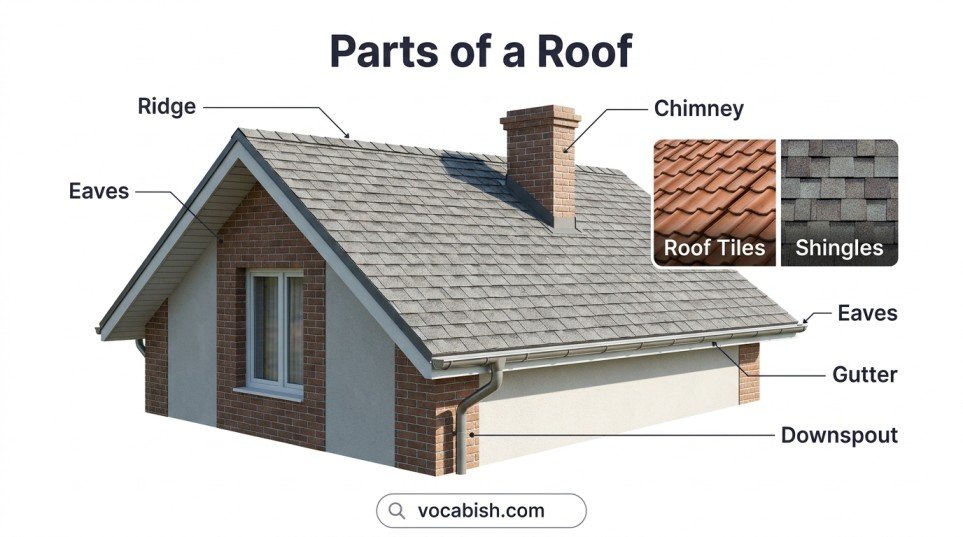
Roof Part | Main Function |
|---|---|
Ridge | Forms the highest line where sloping roof surfaces meet. |
Eaves | Extend beyond the walls at the roof’s lower edge. |
Gutter | Collects rainwater from the roof. |
Downspout | Directs collected rainwater towards the ground. |
Roof Tiles | Cover the roof with overlapping protective pieces. |
Shingles | Form overlapping layers of roofing material. |
Chimney | Provides an outlet for smoke and combustion gases. |
Roof tiles and shingles are different types of roof covering. A roof usually uses one main covering material, depending on its design.
Interior Parts of a House
Interior means the inside of a building. Interior parts include surfaces, passages, and structures that divide rooms or connect different levels.
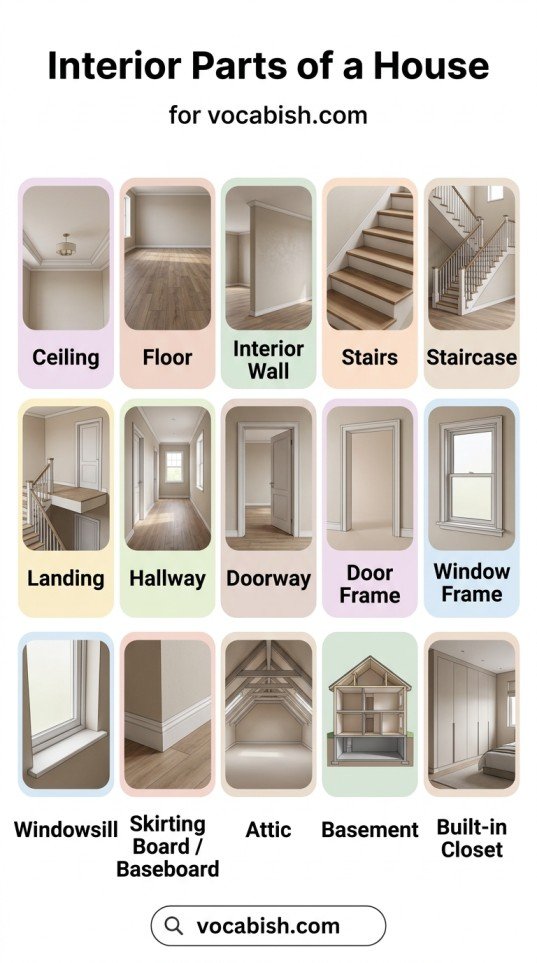
Interior Part | Description |
|---|---|
Ceiling | Covers the upper inside surface of a room. |
Floor | Provides a surface for walking and placing objects. |
Interior Wall | Separates rooms or other indoor areas. |
Stairs | Allow movement between different levels. |
Staircase | Contains the steps and supporting stair structure. |
Landing | Flat area at the top or between flights of stairs. |
Hallway | Connects rooms through an indoor passage. |
Doorway | Opening through which people pass between spaces. |
Door Frame | Surrounds and supports a fitted door. |
Window Frame | Holds and surrounds the window assembly. |
Windowsill | Forms the horizontal surface at the bottom of a window. |
Skirting Board / Baseboard | Covers the joint between a wall and floor. |
Attic | Occupies space directly beneath the roof. |
Basement | Provides a level below or partly below ground. |
Built-in Closet | Offers storage space fitted into the building. |
Skirting board is common in British English, while baseboard is common in American English. Both refer to the trim along the bottom of an interior wall.
Rooms in a House and Their Uses
Rooms in a house have different purposes. People use them to sleep, cook, eat, wash, work, or spend time together.
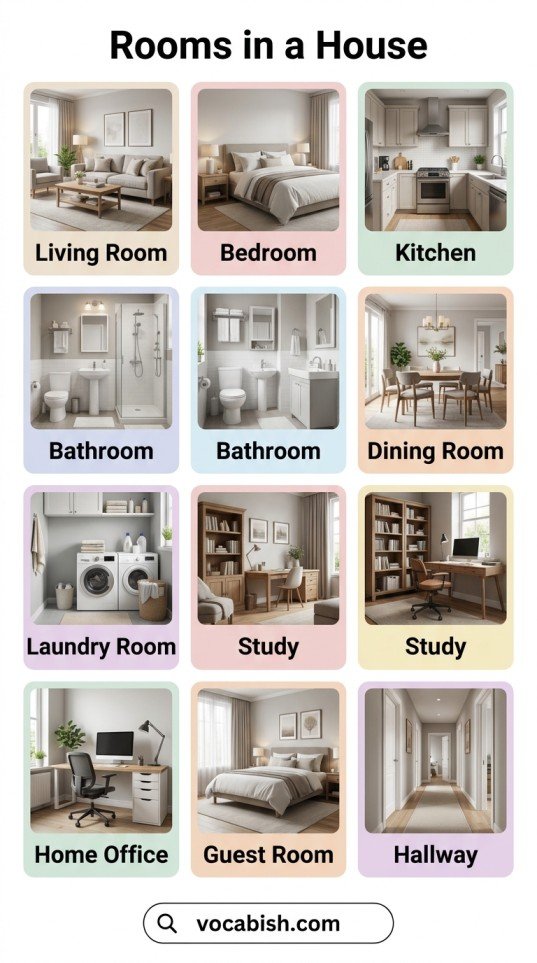
Learning room names also helps you describe where everyday activities take place.
Room Name | Main Use | Example Sentence |
|---|---|---|
Living Room | Relaxing and spending time together | We watch television in the living room. |
Bedroom | Sleeping and resting | My bedroom is on the first floor. |
Kitchen | Preparing and cooking food | Mum is cooking dinner in the kitchen. |
Bathroom | Washing and using the toilet | The bathroom is next to my bedroom. |
Dining Room | Eating meals | We eat lunch in the dining room. |
Laundry Room | Washing and drying clothes | The washing machine is in the laundry room. |
Study | Reading and studying | I do my homework in the study. |
Home Office | Working from home | My father works in his home office. |
Guest Room | Providing sleeping space for visitors | Our guests sleep in the guest room. |
Hallway | Moving between rooms | Leave your shoes in the hallway. |
A house does not need a separate room for every activity. For example, some homes have a combined kitchen and dining area.
Other Rooms and Storage Spaces
Some houses have extra spaces for storage, household equipment, or other activities. These areas depend on the size and design of the building.
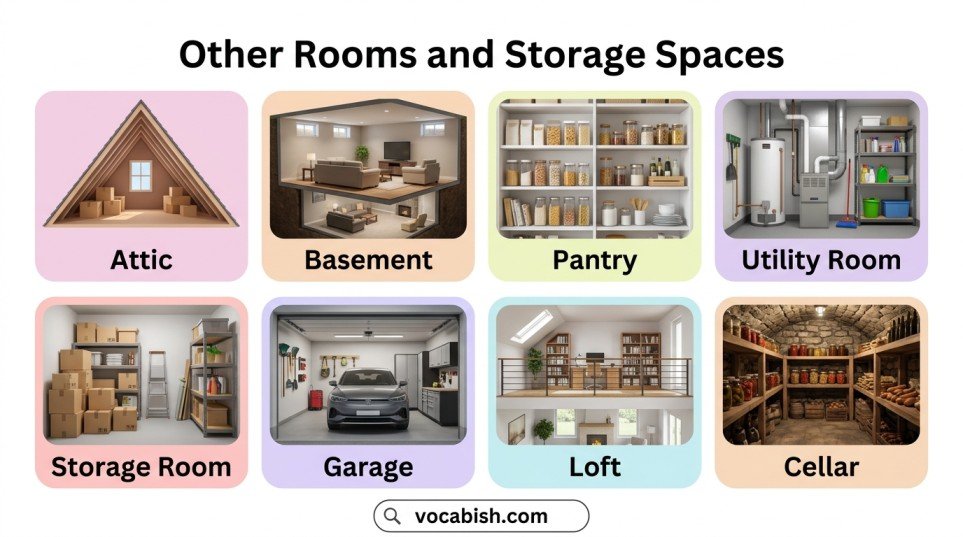
Space | Main Purpose |
|---|---|
Attic | Stores items or provides converted living space below the roof. |
Basement | Provides additional space below ground level. |
Pantry | Stores food and kitchen supplies. |
Utility Room | Houses equipment for washing, heating, or other household tasks. |
Storage Room | Keeps items that are not regularly used. |
Garage | Shelters vehicles and sometimes stores tools. |
Loft | Provides an upper open area or roof space, depending on usage. |
Cellar | Provides below-ground storage, often for food or drinks. |
An attic is under the roof, while a basement is below the main living level. A cellar is generally a below-ground space used for storage.
Parts of a Door and Window
Doors and windows contain smaller components with their own English names. Learning these words helps you describe everyday actions, such as turning a handle, locking a door, or opening a window.
Parts of a Door
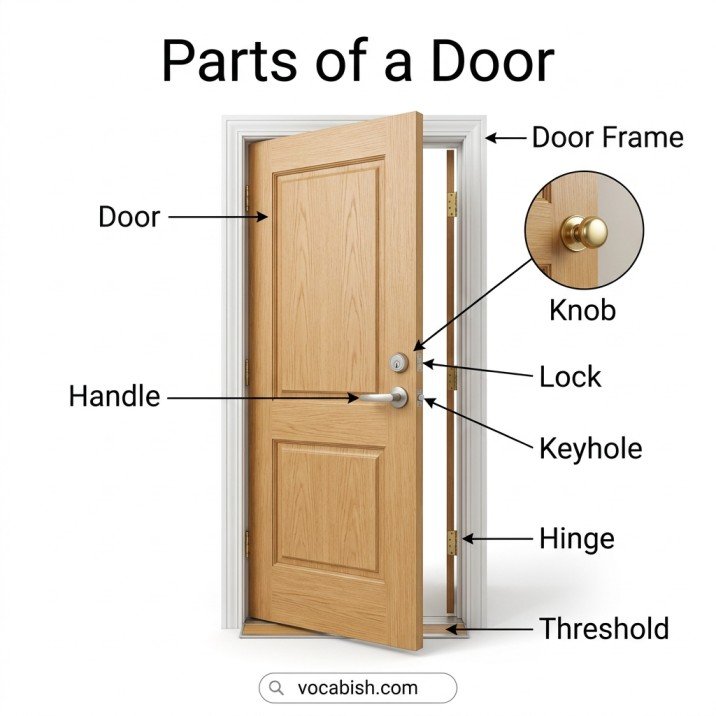
Door Part | Function |
|---|---|
Door | Opens or closes access to a room or building. |
Door Frame | Surrounds the door and holds its fittings. |
Handle | Allows someone to pull or operate the door. |
Knob | Round fitting used to operate a door. |
Lock | Secures the door against unwanted opening. |
Keyhole | Opening where a key enters a suitable lock. |
Hinge | Allows the door to swing open and closed. |
Threshold | Forms the bottom edge of a doorway. |
Example: Turn the door handle and push the door open.
Here’s a detailed guide on Parts of a Door in English with Pictures.
Parts of a Window
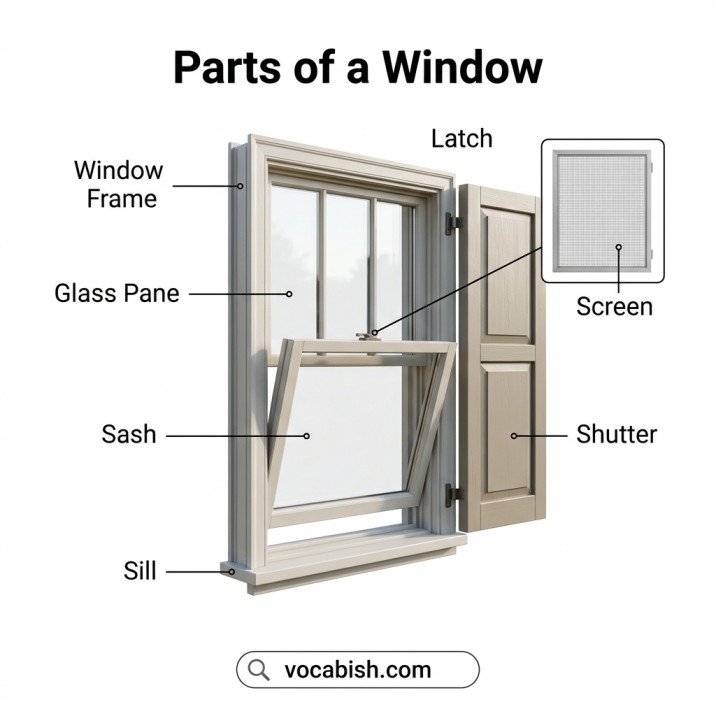
Window Part | Function |
|---|---|
Window Frame | Supports the window assembly. |
Glass Pane | Allows light through while covering the opening. |
Sill | Forms the horizontal bottom part of the window opening. |
Sash | Holds the glass in a movable window section. |
Latch | Keeps a window closed or secured. |
Screen | Helps prevent insects from entering through an open window. |
Shutter | Covers or protects a window from outside or inside. |
Example: Open the window and close the insect screen.
Not every window has a movable sash, screen, or shutter.
Walls, Floors, Ceilings, and Stairs
These are important indoor surfaces and connecting structures. Their positions help learners distinguish similar house parts.
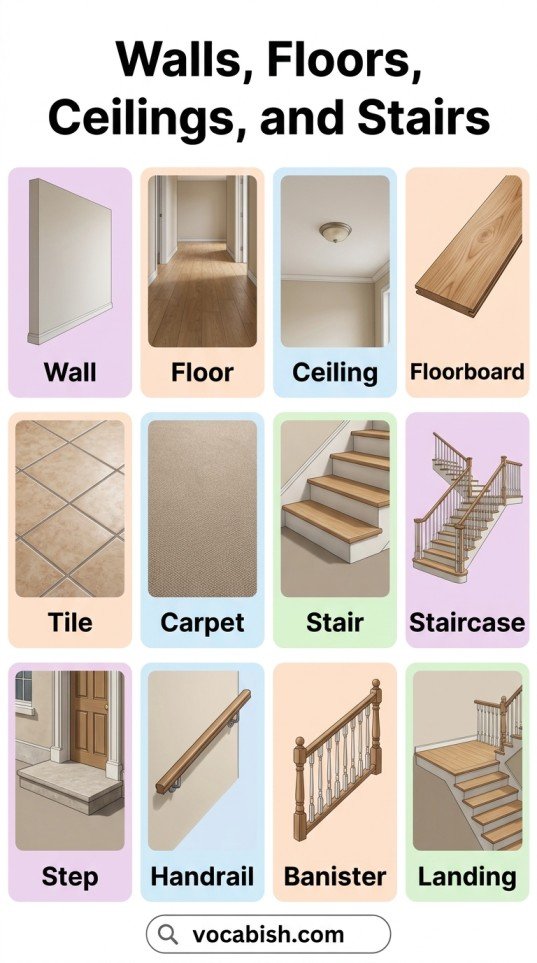
Part | Meaning | Example |
|---|---|---|
Wall | Upright surface enclosing or dividing a space | There is a clock on the wall. |
Floor | Lower surface of a room | The floor is clean. |
Ceiling | Upper surface inside a room | A light hangs from the ceiling. |
Floorboard | Wooden board forming part of a floor | One floorboard makes a noise. |
Tile | Hard piece used to cover floors or walls | The bathroom has white tiles. |
Carpet | Textile covering placed over a floor | The bedroom has a soft carpet. |
Stair | One step in a flight of stairs | Be careful on the last stair. |
Staircase | Complete set of stairs and supporting structure | The staircase leads upstairs. |
Step | Raised surface used when moving up or down | Watch your step. |
Handrail | Rail held for support when using stairs | Hold the handrail. |
Banister | Railing beside a staircase | The banister is made of wood. |
Landing | Flat area between stair flights or at their end | The bedrooms open onto the landing. |
A wall stands upright, the floor is beneath your feet, and the ceiling is above your head.
Outdoor Areas Around a House
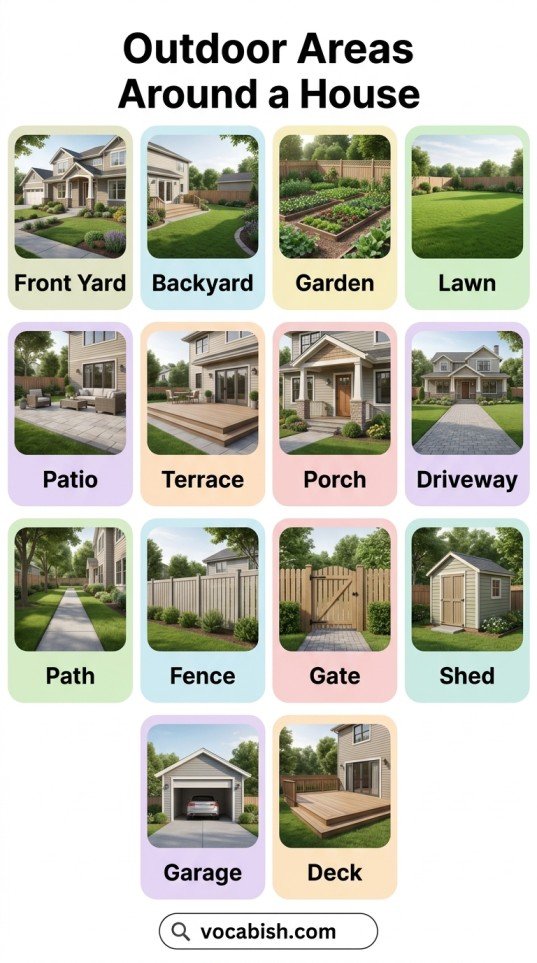
Outdoor areas are spaces around a home rather than rooms inside it. Some are covered, while others are open to the sky.
Outdoor Area | Meaning |
|---|---|
Front Yard | Outdoor area in front of a house. |
Backyard | Outdoor area behind a house. |
Garden | Area where flowers, vegetables, or other plants grow. |
Lawn | Ground covered with regularly cut grass. |
Patio | Outdoor paved area used for sitting or dining. |
Terrace | Level outdoor area, sometimes raised or adjoining a building. |
Porch | Covered or partly covered space near an entrance. |
Driveway | Private route or parking area for vehicles. |
Path | Walkway connecting outdoor places. |
Fence | Barrier enclosing or dividing outdoor land. |
Gate | Opening barrier in a fence or wall. |
Shed | Small outdoor building used mainly for storage. |
Garage | Building or attached space for vehicles. |
Deck | Raised outdoor platform, often made from timber or composite boards. |
In British English, garden often refers to the outdoor area around a house, including grass and plants. In American English, yard commonly describes that area.
Common Household Fixtures
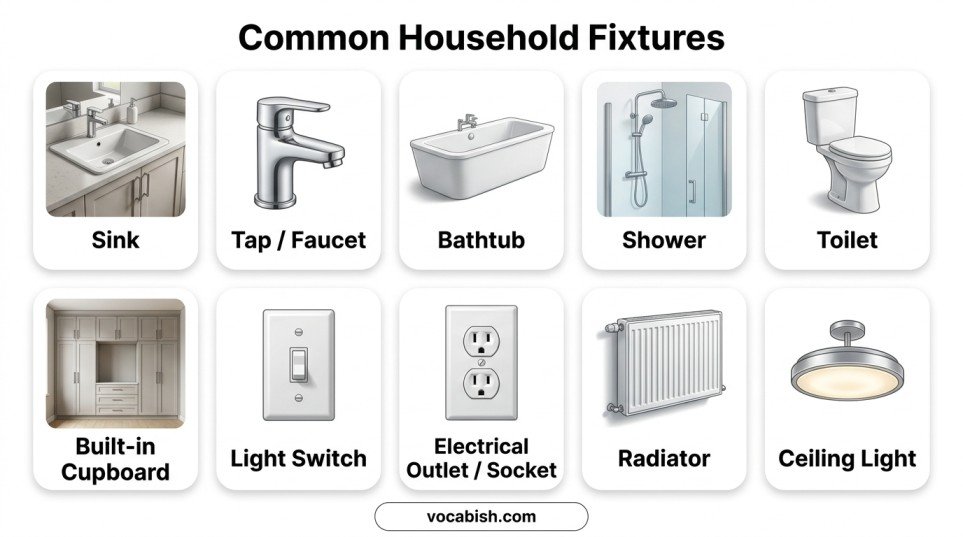
Fixtures are items installed or attached to a house for regular use. Unlike movable furniture, they usually remain in place when people move out.
Fixture | Use |
|---|---|
Sink | Holds water for washing hands, dishes, or other items. |
Tap / Faucet | Controls water flowing into a sink or bathtub. |
Bathtub | Holds water for bathing. |
Shower | Sprays water for washing the body. |
Toilet | Receives and flushes away human waste. |
Built-in Cupboard | Provides fixed storage for household items. |
Light Switch | Turns an electrical light on or off. |
Electrical Outlet / Socket | Provides a connection for electrical appliances. |
Radiator | Transfers heat into a room. |
Ceiling Light | Illuminates a room from above. |
Tap is common in British English, while faucet is more common in American English. Similarly, electrical socket and electrical outlet are regional alternatives.
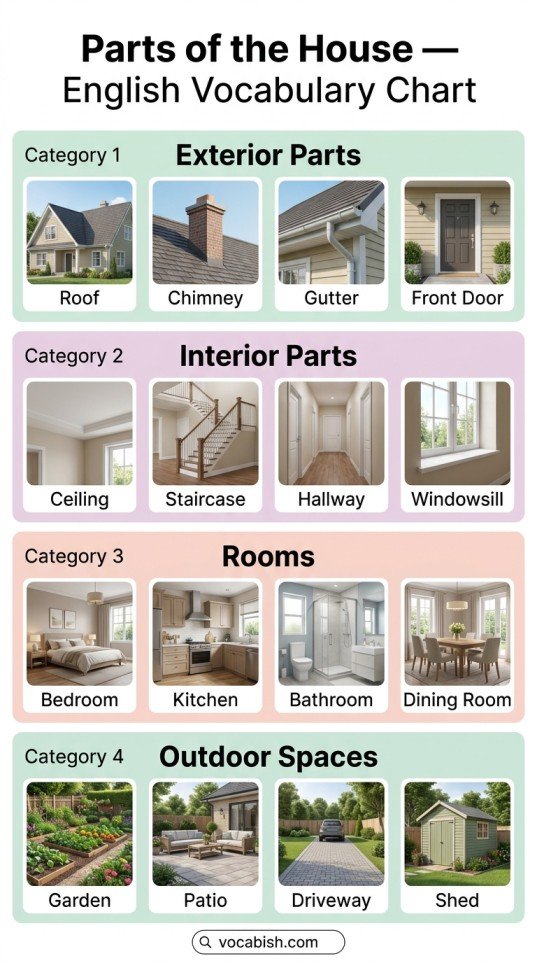
Parts of the House — English Vocabulary Chart
Parts of the House in English Sentences
These short sentences show how to use house vocabulary naturally. Notice the verbs and prepositions that describe actions and locations.
- The roof protects the house from rain.
- Please close the front door.
- My bedroom is upstairs.
- The kitchen is next to the dining room.
- We keep our car in the garage.
- There is a picture on the wall.
- The cat is sleeping on the floor.
- A lamp hangs from the ceiling.
- Hold the handrail when you go downstairs.
- Open the window to let fresh air inside.
- The children are playing in the backyard.
- We eat breakfast on the patio in summer.
- The bathroom is opposite the guest room.
- There are old boxes in the attic.
- The basement is below the living room.
Useful position words: Above means at a higher position, below means at a lower position, and next to means beside something.
Commonly Confused House Vocabulary
Some English words describe similar areas but have different meanings. These comparisons help you choose the correct term.
Words | Main Difference | Example |
|---|---|---|
Roof vs. Ceiling | Roof covers the building; ceiling is inside a room. | The roof is above the bedroom ceiling. |
Floor vs. Ground | Floor is an indoor surface; ground is the earth’s surface. | My shoes are on the floor, not outside on the ground. |
Stairs vs. Staircase | Stairs are the steps; staircase is the complete structure. | The wooden staircase has twelve stairs. |
Balcony vs. Terrace | Balcony projects from an upper level; terrace is a level outdoor area. | We stood on the balcony above the terrace. |
Attic vs. Basement | Attic is under the roof; basement is below ground level. | Old boxes are in the attic, and tools are in the basement. |
Porch vs. Patio | Porch is near an entrance; patio is an outdoor sitting area. | Wait on the front porch; dinner is on the patio. |
House vs. Home | House refers to a building; home is where someone lives. | This house became our home last year. |
A home can also be an apartment or another type of dwelling. It does not have to be a separate house.
Parts of the House Practice Exercise
Test your knowledge of house parts, rooms, and their uses.
Your Exercise Results
Answer Review
FAQs
The main parts of a house include the foundation, walls, roof, floors, ceiling, doors, and windows. These form and protect the building.
Exterior parts are found outside a house. They include the roof, chimney, gutters, exterior walls, front door, windows, porch, and siding.
Interior parts include floors, ceilings, interior walls, staircases, doorways, and hallways. These create indoor spaces and allow movement between rooms.
Common rooms include the living room, bedroom, kitchen, bathroom, and dining room. Larger houses may also have a study or laundry room.
A roof covers the outside top of a building and protects it from weather. A ceiling forms the upper inside surface of a room.
A house is a building designed for people to live in. A home is the place where someone lives and feels a sense of belonging.
Study labelled pictures, identify parts around your home, and practise short sentences. Review room names and building features regularly to remember them.
Conclusion
Learning the parts of the house helps you describe buildings, identify rooms, and talk about everyday activities in English. Start with familiar words such as roof, wall, door, window, floor, and ceiling. Then practise names for rooms, outdoor spaces, and household fixtures. Use the labelled pictures, vocabulary tables, and example sentences to improve your recognition and speaking skills.