
Many English learners get confused between past and passed because they sound the same but have different meanings and uses. This short and simple guide will help you understand when to use past and when to use passed — with easy examples and clear explanations.
You can explore our 100 confusing words list to expand your vocabulary skills!
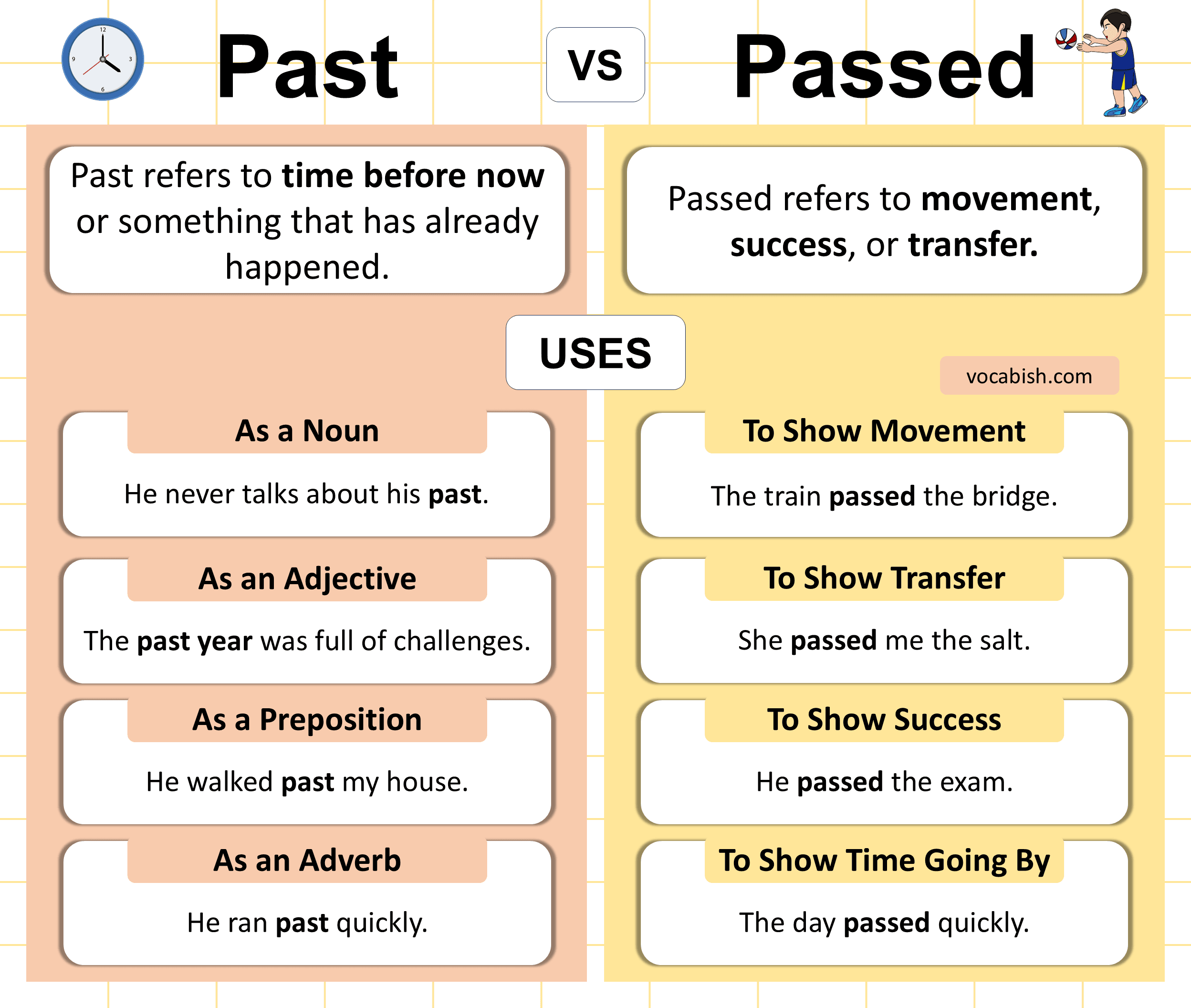
Meanings of Past and Passed
Past
Refers to time before now or something that has already happened.
Example:
- We should learn from the past.
Passed
Refers to movement, success, or transfer.
Example
- He passed his English test.
Usage of Past
The word past talks about a time that is gone or before the present. It can be used in different ways — as a noun, adjective, preposition, or adverb.
| Function | Meaning | Example |
|---|---|---|
| Noun | Time before now | Forget the past. |
| Adjective | Something earlier | The past month was busy. |
| Preposition | Beyond or after something | She walked past the park. |
| Adverb | Movement beyond | He ran past fast. |
- She doesn’t like to talk about her past.
- It happened in the past.
- The shop is just past the park.
- He worked hard in the past years.
In short:
Past = Time before now
Usage of Passed
The word passed is the past tense of the verb “pass.” It means to move, go by, transfer something, or succeed in a test.
| Use | Meaning | Example |
|---|---|---|
| Movement | Went by | The car passed the shop. |
| Transfer | Gave something | She passed the note. |
| Success | Completed or succeeded | He passed his test. |
| Time | Time moved forward | The holidays passed fast. |
| Death | Died (politely) | His uncle passed away. |
Examples:
- He passed his exam easily.
- The train passed through the tunnel.
- She passed the ball to her friend.
- Time passed so quickly.
In short:
Passed = Action already done
Difference Between Past and Passed
| Feature | Past | Passed |
|---|---|---|
| Type of Word | Noun / Adjective / Preposition / Adverb | Verb (Past form of pass) |
| Refers to | Time before now | Action or movement |
| Used for | Talking about time | Talking about action |
| Example | Don’t think about the past. | He passed the exam. |
Formal and Informal Uses of Past and Passed
Formal Uses
- Past: In the past decade, technology has grown rapidly.
- Passed: The new law was passed by the government.
Informal Uses
- Past: Forget the past and enjoy your life.
- Passed: She passed by my house yesterday.
Example Sentences for Past
- The past cannot be changed.
- He learned many lessons from his past.
- In the past, people used letters to communicate.
- The past year was full of challenges.
- We all have a past.
- Don’t live in the past.
- The museum displays things from the past.
- It’s all in the past now.
- Past mistakes help us grow.
- She remembers her past life.
- The past teaches valuable lessons.
- It happened sometime in the past.
- My past experiences were tough.
- He doesn’t talk about his past much.
- She walked past the shop.
- The past few weeks have been busy.
- The past is gone forever.
- He looked back at his past.
- Let’s move on from the past.
- We can’t bring back the past.
Example Sentences for Passed
- She passed her driving test.
- The bus passed the station.
- He passed the ball to his friend.
- The time passed quickly.
- They passed by my house.
- The law was passed last month.
- The train passed through the tunnel.
- The teacher passed the papers to the students.
- He passed his exam easily.
- The storm passed without damage.
- She passed the salt at dinner.
- The days passed slowly.
- He passed me in the race.
- The message passed from one person to another.
- The years passed peacefully.
- She passed the interview.
- The opportunity passed quickly.
- He passed away last night.
- The parade passed through the street.
- The holiday passed too fast.
The words past and passed may sound the same, but their meanings are completely different.
Use past when talking about time before now, and use passed when describing an action already done.
FAQs on Passed and Past
What is the difference between past and passed?
Past refers to time before now, while passed means an action that already happened (the past tense of pass).
Is past a verb?
❌ No. Past is not a verb. It can be a noun, adjective, preposition, or adverb.
Is passed a verb?
✅ Yes. Passed is the past form of the verb pass.
When should I use past in a sentence?
Use past when talking about time — for example, In the past, people didn’t use smartphones.
How can I remember the difference easily?
Remember:
Past = Time
Passed = Action
Read More