

Many English learners use ability and capacity as if they mean exactly the same thing. While both words relate to what someone or something can do, they are not always interchangeable.
A simple way to understand the difference is this:
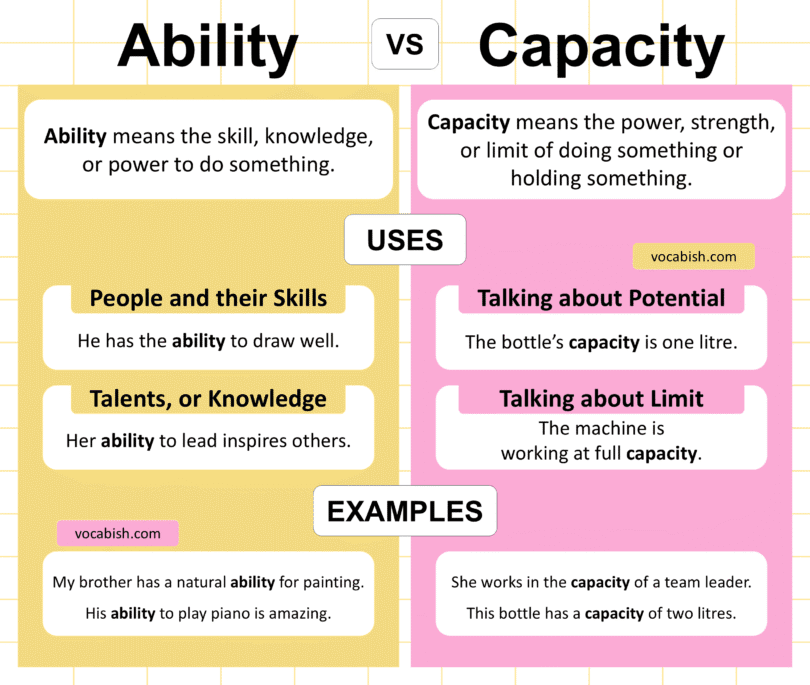
- Ability usually refers to a person’s skill, talent, or power to do something.
- Capacity usually refers to the amount, limit, or potential that a person, machine, organization, or container has.
Think of it this way:
Ability is about being able to do something.
Capacity is about how much can be done, held, or handled.
You can explore our 100 confusing words list to expand your vocabulary skills!
Meaning of Ability
Ability means having the skill, knowledge, talent, or physical power to do something.
It often describes what a person can do because of learning, experience, intelligence, or natural talent.
Examples:
- She has the ability to speak three languages.
- His ability to solve problems impressed everyone.
- The athlete lost the ability to compete after the injury.
- I admire her ability to stay calm in difficult situations.
In all these examples, ability refers to a person’s capability or skill.
Common Mistake:
❌ The bottle has a large ability of water.
✅ The bottle has a large capacity for water.
Why?
A bottle does not have skills or talents. It can hold a certain amount of water, so capacity is the correct word.
Meaning of Capacity
Capacity refers to the maximum amount that something can contain, produce, receive, or handle.
It can be used for physical space, mental limits, organizational limits, or potential.
Examples:
- This stadium has a capacity of 50,000 people.
- The machine is operating at full capacity.
- The company lacks the capacity to handle more orders.
- Children have a remarkable capacity to learn languages.
Notice that capacity often focuses on limits or volume rather than skill.
Common Mistake:
❌ She has the capacity to play the piano beautifully.
✅ She has the ability to play the piano beautifully.
Why?
Playing the piano is a skill. Skills are usually described with ability, not capacity.
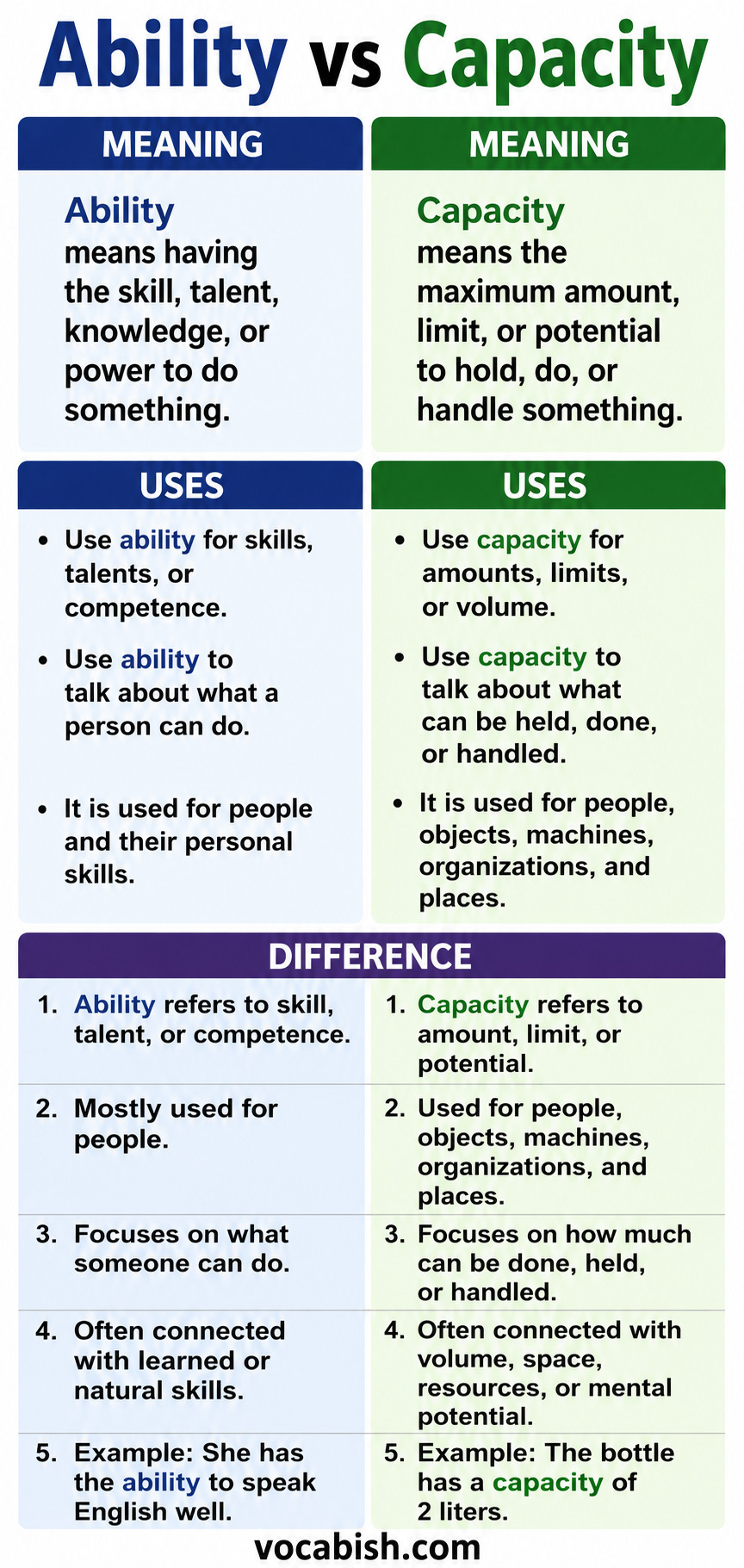
Differences Between Ability and Capacity
Although these words are related, they are used in different situations.
Ability | Capacity |
|---|---|
Refers to skill or talent | Refers to amount, limit, or potential |
Mostly used for people | Used for people, machines, organizations, and containers |
Focuses on what someone can do | Focuses on how much can be done or handled |
Often connected with learned or natural skills | Often connected with volume, space, resources, or mental potential |
Compare These Sentences:
- Sarah has the ability to teach children effectively.
- Sarah has the capacity to teach six classes a day.
In the first sentence, we talk about her teaching skill.
In the second sentence, we talk about how much work she can handle.
Another example:
- The engineer has the ability to design complex systems.
- The factory has the capacity to produce 5,000 units per day.
One talks about skill. The other talks about production limits.
Usage of Ability
Use ability when talking about skills, talents, competence, or physical and mental powers.
Ability + to + verb
- He has the ability to lead a team.
- She has the ability to learn quickly.
Natural Ability
- He has a natural ability for music.
- She has a natural ability to communicate with people.
Special Ability
- The superhero has the ability to fly.
- Some animals have the ability to survive in harsh conditions.
Situations Where Ability Is Best
Use ability when discussing:
- Language skills
- Academic skills
- Professional skills
- Athletic skills
- Mental skills
- Natural talents
Examples:
- Her ability to write clearly helped her career.
- My grandfather still has the ability to remember old stories.
- The student showed an ability to think creatively.
Usage of Capacity
Use capacity when discussing limits, volume, potential, or resources.
Capacity of Something
- The tank has a capacity of 1,000 liters.
- The hall has a seating capacity of 300.
At Full Capacity
- The hospital is operating at full capacity.
- The server is running at full capacity.
Capacity to Do Something
Sometimes capacity is used for mental or emotional potential.
- Humans have the capacity to adapt.
- She has the capacity to forgive others.
Here, capacity means potential rather than skill.
Situations Where Capacity Is Best
Use capacity when talking about:
- Size
- Volume
- Storage
- Production limits
- Workload limits
- Human potential
- Organizational resources
Examples:
- The company increased its production capacity.
- The classroom has a capacity of forty students.
- He lacks the capacity to manage such a large project alone.
Formal and Informal Uses of Ability and Capacity
Another reason learners get confused is that these words have different levels of formality.
Ability in Everyday English
Ability is more common in daily conversations.
- She has the ability to solve problems quickly.
- I don’t have the ability to swim well.
These sound natural in both spoken and written English.
Capacity in Formal English
Capacity appears more often in business, academic, technical, and professional contexts.
- The organization expanded its operational capacity.
- The plant reached maximum production capacity.
- The government lacks the capacity to implement the policy.
Comparing Formality
Informal:
- She has the ability to manage the team.
More formal:
- She has the capacity to manage the team.
Both can be correct, but ability sounds more natural in everyday conversation.
Example Sentences with Ability
Here are some practical examples you can learn from:
- She has the ability to motivate others.
- His ability to concentrate is impressive.
- The doctor’s ability to remain calm saved lives.
- They admired her ability to speak confidently.
- I doubt my ability to finish the project alone.
- The child showed an ability to learn quickly.
- His artistic ability developed over time.
- The athlete regained his ability after months of training.
- She has the ability to work under pressure.
- Their ability to cooperate improved the results.
Example Sentences with Capacity
Now let’s look at examples with capacity.
- The theater has a capacity of 2,000 seats.
- The battery has a larger capacity than the old one.
- The factory increased its production capacity.
- The hospital is working at full capacity.
- This suitcase has enough capacity for a week’s clothing.
- The company lacks the capacity to meet demand.
- Humans have a great capacity for learning.
- The network reached maximum capacity during the event.
- The storage facility has limited capacity.
- She demonstrated an impressive capacity for patience.
Common Corrections Learners Should Know
Skill vs Limit
❌ He has the capacity to play chess very well.
✅ He has the ability to play chess very well.
Amount vs Talent
❌ This water tank has a huge ability.
✅ This water tank has a huge capacity.
Workload vs Skill
❌ The company does not have the ability to handle 10,000 orders.
✅ The company does not have the capacity to handle 10,000 orders.
Personal Skill
❌ Her capacity for speaking English is excellent.
✅ Her ability to speak English is excellent.
Remember this simple rule:
If you are talking about a skill, use ability.
If you are talking about an amount, limit, volume, workload, or potential, use capacity.
FAQs on Capacity vs Ability
Sometimes they can be similar, especially when talking about what someone is capable of doing. However, ability usually emphasizes skill, while capacity emphasizes potential or limits.
Ability means skill, talent, or competence. Capacity means the amount, limit, or potential to do, hold, or handle something.
Use ability when discussing skills, talents, knowledge, intelligence, or physical powers.
Use capacity when discussing volume, size, limits, resources, production levels, workload, or potential.
Yes. Capacity often appears in formal, business, technical, and academic writing, while ability is common in everyday English.
Yes. It can refer to a person’s mental, emotional, or intellectual potential.
Example:
She has a great capacity for empathy.
Ability is generally more common in everyday speech because people often talk about skills and talents.
Conclusion
Many learners confuse ability and capacity because both involve the idea of being capable of something. The key difference is focus.
- Ability focuses on skill, talent, or competence.
- Capacity focuses on limits, volume, resources, workload, or potential.
When you are unsure, ask yourself:
- Am I talking about a skill? → Use ability.
- Am I talking about an amount, limit, or potential? → Use capacity.
Once you start noticing this distinction in real English, choosing the correct word becomes much easier.
You May Also Like:
