
Prepositions are small but important words that show the relationship between a noun and other words in a sentence. They tell us about place, time, direction, cause, and more. In this blog post, you will learn 100 preposition examples in sentences to see how these words are used in real contexts. When you understand prepositions, you can build correct sentences and avoid common grammar mistakes. With practice, you will master how to use prepositions confidently in speaking, reading, writing, and listening. Keep reading to explore useful sentence examples and improve your English step by step.
What Are Prepositions?
Prepositions are small connecting words that show the relationship between a noun or pronoun and other words in a sentence. They often tell us about place, time, direction, or movement.
Common idea:
A preposition usually comes before a noun.
Example:
- The book is on the table.
Why Prepositions Are Important
Prepositions help you:
- Speak clearly
- Write correct sentences
- Understand daily conversations
- Avoid confusion in meaning
Without prepositions, sentences sound incomplete or unclear.
100 Preposition Examples in Sentences
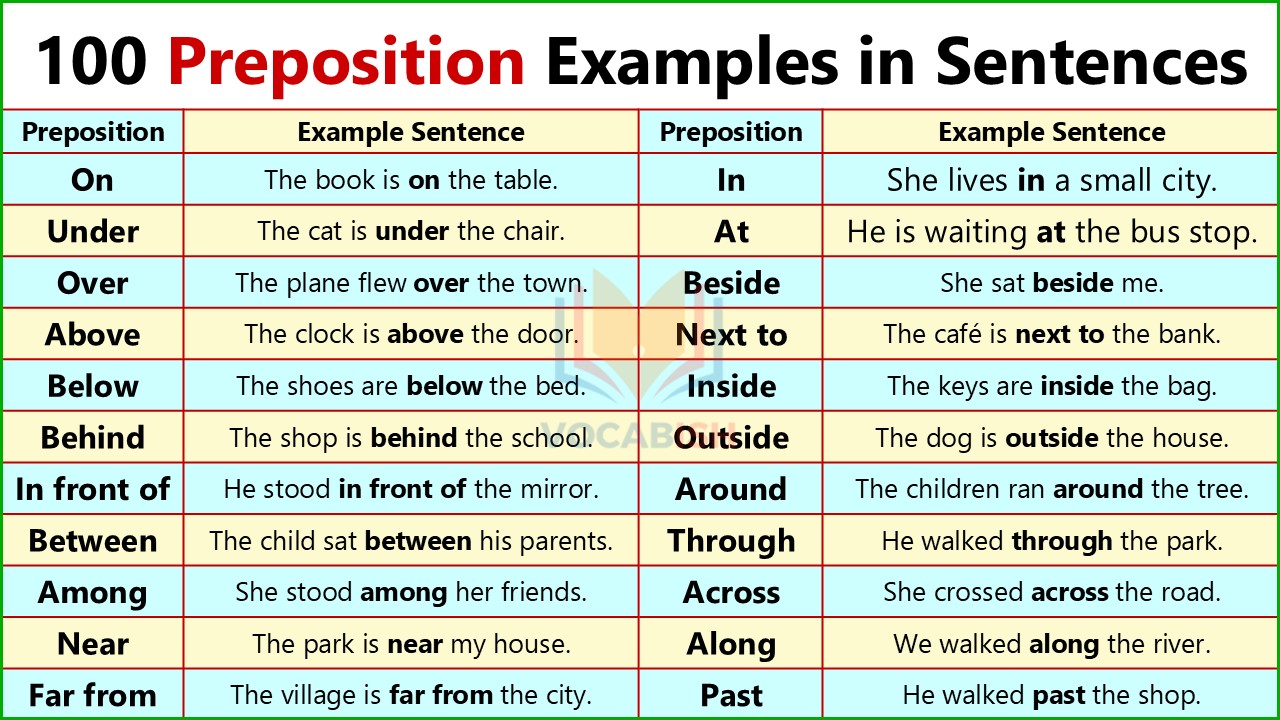
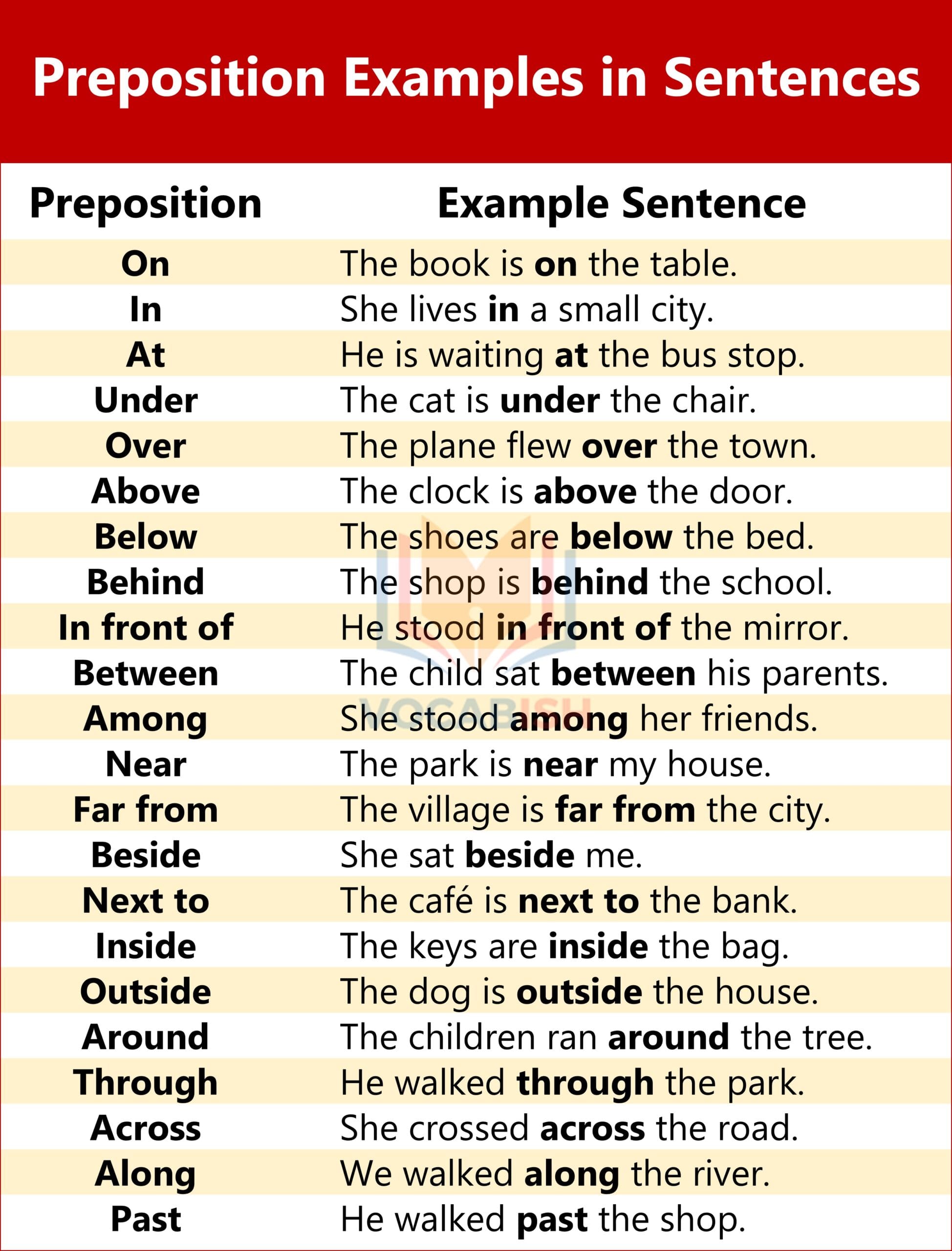
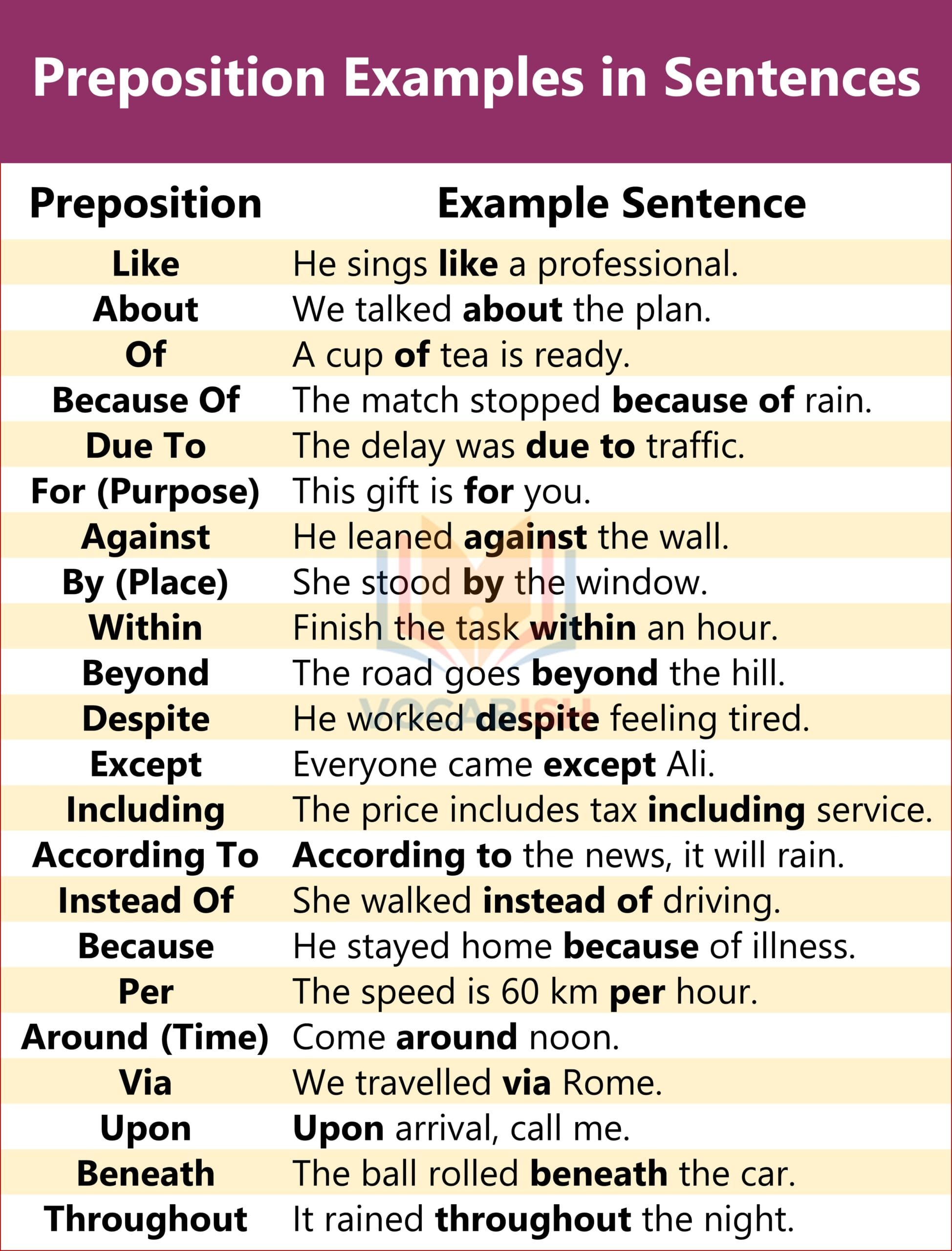
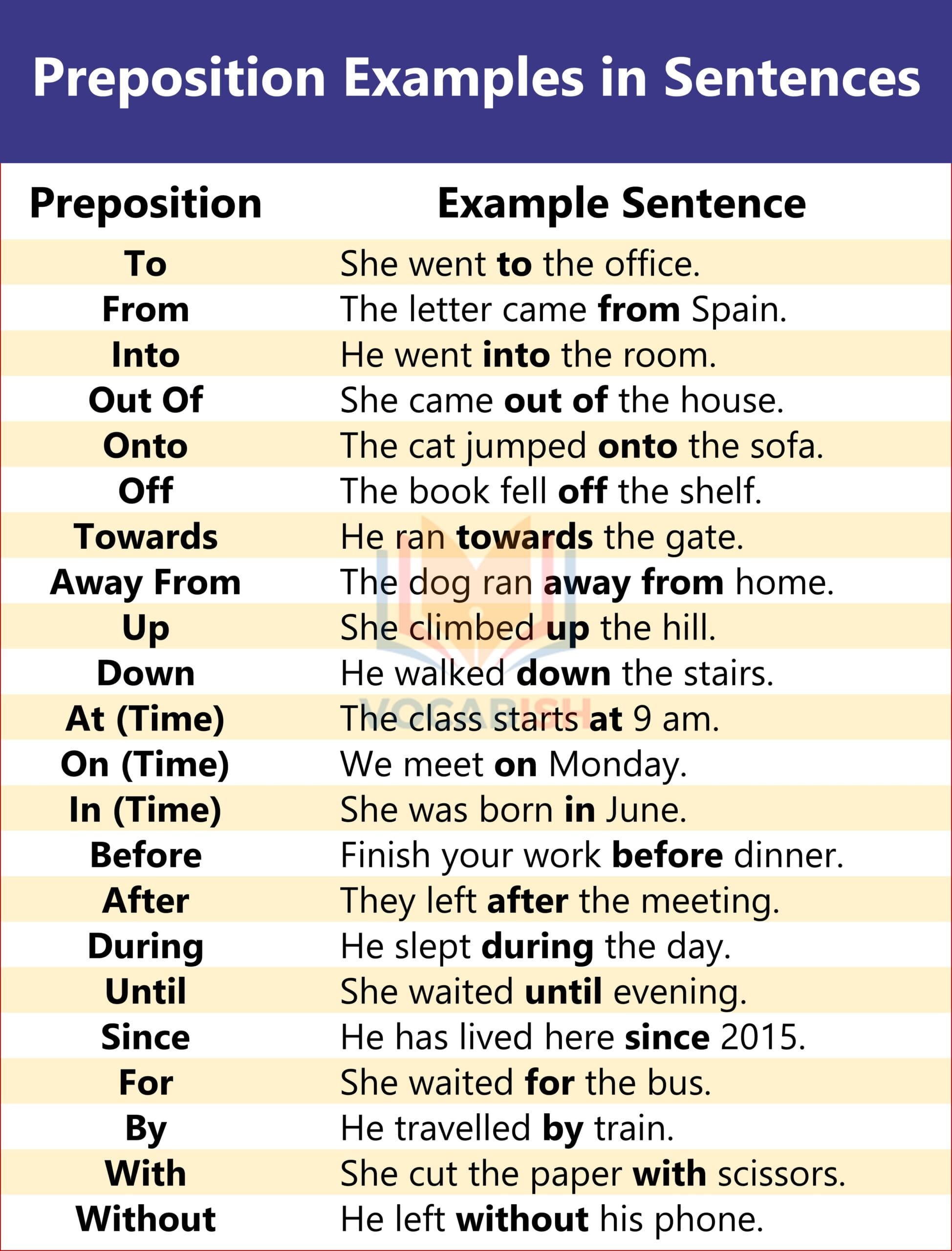
Here’s the list of 100 preposition words with their examples in sentences:
| Preposition | Example Sentence |
|---|---|
| on | The book is on the table. |
| in | She lives in a small city. |
| at | He is waiting at the bus stop. |
| under | The cat is under the chair. |
| over | The plane flew over the town. |
| above | The clock is above the door. |
| below | The shoes are below the bed. |
| behind | The shop is behind the school. |
| in front of | He stood in front of the mirror. |
| between | The child sat between his parents. |
| among | She stood among her friends. |
| near | The park is near my house. |
| far from | The village is far from the city. |
| beside | She sat beside me. |
| next to | The café is next to the bank. |
| inside | The keys are inside the bag. |
| outside | The dog is outside the house. |
| around | The children ran around the tree. |
| through | He walked through the park. |
| across | She crossed across the road. |
| along | We walked along the river. |
| past | He walked past the shop. |
| to | She went to the office. |
| from | The letter came from Spain. |
| into | He went into the room. |
| out of | She came out of the house. |
| onto | The cat jumped onto the sofa. |
| off | The book fell off the shelf. |
| towards | He ran towards the gate. |
| away from | The dog ran away from home. |
| up | She climbed up the hill. |
| down | He walked down the stairs. |
| at (time) | The class starts at 9 am. |
| on (time) | We meet on Monday. |
| in (time) | She was born in June. |
| before | Finish your work before dinner. |
| after | They left after the meeting. |
| during | He slept during the day. |
| until | She waited until evening. |
| since | He has lived here since 2015. |
| for | She waited for the bus. |
| by | He travelled by train. |
| with | She cut the paper with scissors. |
| without | He left without his phone. |
| like | He sings like a professional. |
| about | We talked about the plan. |
| of | A cup of tea is ready. |
| because of | The match stopped because of rain. |
| due to | The delay was due to traffic. |
| for (purpose) | This gift is for you. |
| against | He leaned against the wall. |
| by (place) | She stood by the window. |
| within | Finish the task within an hour. |
| beyond | The road goes beyond the hill. |
| despite | He worked despite feeling tired. |
| except | Everyone came except Ali. |
| including | The price includes tax including service. |
| according to | According to the news, it will rain. |
| instead of | She walked instead of driving. |
| because | He stayed home because of illness. |
| per | The speed is 60 km per hour. |
| around (time) | Come around noon. |
| via | We travelled via Rome. |
| upon | Upon arrival, call me. |
| beneath | The ball rolled beneath the car. |
| throughout | It rained throughout the night. |
| plus | The bill is ten pounds plus tax. |
| minus | Five minus two is three. |
| past (time) | It is ten past five. |
| till | Wait till tomorrow. |
| among (group) | He was popular among students. |
| inside of | The cat stayed inside of the box. |
| outside of | He waited outside of the gate. |
Prepositions of Place
These show where something is.
Examples: in, on, under, behind, near, between
| No. | Sentence |
|---|---|
| 1 | The keys are on the table. |
| 2 | She is waiting at the bus stop. |
| 3 | The cat is under the chair. |
| 4 | He lives in a small town. |
| 5 | The park is near my house. |
| 6 | The shop is behind the school. |
| 7 | The ball rolled between the cars. |
| 8 | The picture is above the bed. |
| 9 | The shoes are below the shelf. |
| 10 | She sat beside her friend. |
| 11 | The hotel is opposite the station. |
| 12 | He stood among the crowd. |
| 13 | The child hid inside the room. |
| 14 | The bike is outside the house. |
| 15 | The mouse ran around the box. |
Prepositions of Time
These show when something happens.
Examples: at, on, in, during, before, after
| No. | Sentence |
|---|---|
| 16 | The class starts at 9 o’clock. |
| 17 | She was born in July. |
| 18 | We meet on Monday. |
| 19 | He sleeps during the day. |
| 20 | Finish your work before dinner. |
| 21 | They left after the meeting. |
| 22 | I woke up early in the morning. |
| 23 | The shop closes at night. |
| 24 | She called me during lunch. |
| 25 | He arrived on time. |
Prepositions of Direction
These show where someone or something is going.
Examples: to, into, onto, towards
| No. | Sentence |
|---|---|
| 26 | She walked to the office. |
| 27 | The child ran into the room. |
| 28 | He jumped onto the stage. |
| 29 | They moved towards the exit. |
| 30 | The dog ran away from home. |
| 31 | We travelled from London to Paris. |
| 32 | She looked up at the sky. |
| 33 | He went down the stairs. |
Prepositions of Movement
These show movement from one place to another.
Examples: through, across, along, past
| No. | Sentence |
|---|---|
| 34 | The train passed through the tunnel. |
| 35 | She walked across the road. |
| 36 | He ran along the river. |
| 37 | The car drove past the school. |
| 38 | The bird flew over the house. |
| 39 | The child crawled under the table. |
| 40 | He climbed up the hill. |
| 41 | She moved around the room. |
Prepositions of Manner
These show how something is done.
Examples: by, with, without, like
| No. | Sentence |
|---|---|
| 42 | She travelled by train. |
| 43 | He cut the paper with scissors. |
| 44 | She spoke without fear. |
| 45 | He runs like a professional. |
| 46 | The letter was written by hand. |
| 47 | He fixed it with care. |
| 48 | She worked without help. |
Prepositions of Cause and Purpose
These show reason or purpose.
Examples: because of, due to, for
| No. | Sentence |
|---|---|
| 49 | The match was cancelled because of rain. |
| 50 | The delay was due to traffic. |
| 51 | This gift is for you. |
| 52 | He was fined for speeding. |
| 53 | She stayed home because of illness. |
Common Uses of Prepositions in Daily English
Prepositions are used:
- In daily conversation
- In school writing
- In emails and messages
- In travel and directions
- In workplace communication
Learning them improves both speaking and writing skills.
Conclusion
Prepositions are easy but powerful words. By practising these 100 preposition examples in sentences, you can understand English better and use it with confidence. Keep reading, practising, and using them in real sentences to improve faster.
Frequently Asked Questions
What is a preposition in English?
A preposition is a small word that shows the relationship between other words in a sentence. It often tells place, time, or direction, such as in the sentence: The book is on the table.
Why are prepositions important in sentences?
Prepositions help make sentences clear and meaningful. For example, She arrived at the station on time. Without prepositions, the sentence would sound incomplete.
Where is a preposition placed in a sentence?
A preposition is usually placed before a noun or pronoun. Example: He sat between his friends during the meeting.
What are common examples of prepositions used daily?
Some common prepositions are in, on, at, to, from, and with. Example: She lives in a small town and works at a school.
How do prepositions show time in sentences?
Prepositions like at, on, and in are used to show time. Example: The class starts at 9 am on Monday in July.
How do prepositions show place in English?
Prepositions show where something is located. Example: The cat is under the chair and the bag is behind the door.
Can one sentence have more than one preposition?
Yes, a sentence can use more than one preposition. Example: He walked from the office to the bus stop after work.
Read More