
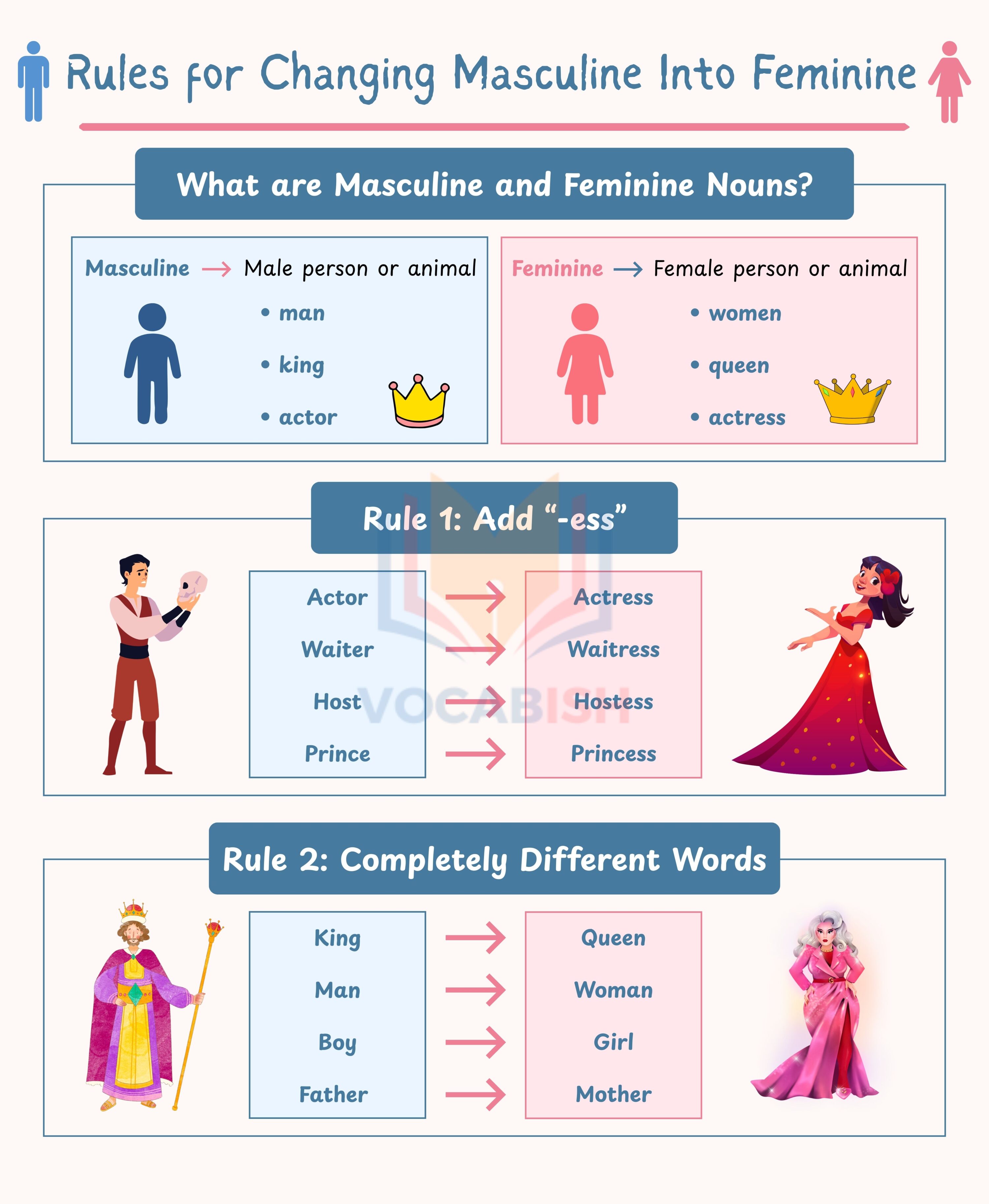
In English, some nouns show gender. A masculine noun refers to a male person or animal, while a feminine noun refers to a female. For example, king is masculine and queen is feminine.
Learning the rules for changing masculine into feminine helps English learners understand vocabulary better. It also improves speaking, reading, writing, and listening skills. When learners know these patterns, they can easily recognize words in conversations, books, and daily communication.
English does not always change gender with the same rule. Sometimes we add a suffix, sometimes we change the word completely, and sometimes we simply add words like female or woman. This guide explains the most common and useful rules with clear examples.
What Are Masculine and Feminine Nouns?
A noun names a person, animal, place, or thing. Some nouns clearly show whether the subject is male or female.
Examples:
- Masculine: man, king, actor
- Feminine: woman, queen, actress
Many English nouns today are gender-neutral, but learning traditional masculine and feminine forms is still useful. You will often see them in books, conversations, and exams.
Rules for Changing Masculine Into Feminine
Rule No. 1: Adding –ess to Form the Feminine
One common rule is to add the suffix –ess to a masculine noun. This ending shows that the person is female.
Examples:
- actor → actress
- waiter → waitress
- host → hostess
- prince → princess
- steward → stewardess
This rule is simple and easy to remember. However, modern English sometimes prefers gender-neutral words such as actor for both men and women.
Rule No. 2: Changing the Ending of the Word
Sometimes the spelling changes slightly before adding the feminine ending.
Examples:
- duke → duchess
- prince → princess
- tiger → tigress
- god → goddess
Notice how the spelling adjusts to make the word easier to pronounce.
Rule No. 3: Completely Different Words
Some masculine and feminine nouns are completely different words. These pairs must be memorized.
Examples:
- king → queen
- man → woman
- boy → girl
- father → mother
- uncle → aunt
These words do not follow a spelling rule, so practice and repetition help you remember them.
Rule No. 4: Adding Female, Woman, or Girl
For some nouns, English does not change the spelling. Instead, we add another word to show gender.
Examples:
- male teacher → female teacher
- police officer → woman police officer
- doctor → female doctor
- lion → female lion
This method is very common in modern English.
Rule No. 5: Gender-Neutral Words in Modern English
Today, English often prefers gender-neutral nouns. These words can describe both men and women.
Examples:
- actor (male or female)
- teacher
- doctor
- student
- police officer
Learning these words helps you speak naturally in modern conversations.
Common Masculine and Feminine Word Pairs
Here are important vocabulary pairs that English learners should know.
- King — Queen
- Prince — Princess
- Actor — Actress
- Waiter — Waitress
- Host — Hostess
- Tiger — Tigress
- Lion — Lioness
- God — Goddess
- Duke — Duchess
- Emperor — Empress
- Father — Mother
- Brother — Sister
- Uncle — Aunt
- Husband — Wife
- Boy — Girl
- Man — Woman
- Son — Daughter
- Nephew — Niece
Learning these pairs strengthens everyday vocabulary.
Useful Gender Vocabulary for Learners
Below are common gender-related words that appear in everyday English.
- King – the male ruler of a country or kingdom
- Queen – the female ruler or wife of a king
- Prince – the son of a king or queen
- Princess – the daughter of a king or queen
- Actor – a man who performs in movies or plays
- Actress – a woman who performs in movies or plays
- Waiter – a man who serves food in a restaurant
- Waitress – a woman who serves food in a restaurant
- Host – a man who welcomes guests
- Hostess – a woman who welcomes guests
- Lion – a male lion animal
- Lioness – a female lion
- Tiger – a male tiger
- Tigress – a female tiger
- Emperor – a male ruler of an empire
- Empress – a female ruler of an empire
- Duke – a male noble ruler
- Duchess – the female form of duke
These words appear often in stories, news, and literature.
Why Learning Gender Vocabulary Is Important
Understanding masculine and feminine nouns helps learners:
- expand English vocabulary
- understand stories and conversations
- recognize grammar patterns
- speak and write more accurately
- improve reading comprehension
Even though modern English often uses gender-neutral terms, knowing these traditional forms helps learners understand many texts and real-life situations.
Practice Questions
1. What is the feminine form of “actor”?
Answer: Actress
2. What is the feminine form of “king”?
Answer: Queen
3. What is the feminine form of “lion”?
Answer: Lioness
4. What is the feminine form of “duke”?
Answer: Duchess
5. What is the feminine form of “prince”?
Answer: Princess
Final Tips for Learners
Learning the rules for changing masculine into feminine in English becomes easier with practice. Start by memorizing common word pairs. Then notice how books, movies, and conversations use these words.
Focus on understanding the meaning, spelling, and real-life usage of each word. Over time, this knowledge will strengthen your vocabulary and help you communicate more confidently in English.
FAQs
The rules include adding –ess, changing the spelling of the word, using completely different words, or adding terms like female or woman to show feminine gender.
The easiest rule is adding the suffix –ess to some masculine nouns. For example: actor–actress, waiter–waitress, host–hostess, and lion–lioness. This pattern is common in traditional English vocabulary.
Common examples include king–queen, prince–princess, actor–actress, waiter–waitress, uncle–aunt, and brother–sister. These pairs show how English words change to indicate male and female gender.
Yes. Modern English often adds female, woman, or girl before a noun to show gender. For example: female doctor, woman police officer, or girl student.
The four genders in grammar are masculine, feminine, common, and neuter. Masculine means male, feminine means female, common means either gender, and neuter refers to objects or things.
To change masculine to feminine in English, add –ess (actor–actress), change the spelling (duke–duchess), use a different word (king–queen), or add words like female or woman.
Related Articles:
- 100 Examples of Masculine and Feminine
- Masculine and Feminine Definition and Examples
- Masculine and Feminine of Animals