
Have you ever asked a student to write a summary, only to hear, “I don’t know how to start”? You’re not alone. Many children—and even adults—struggle with beginning a summary paragraph. That’s where sentence starters for a summary come in.
Sentence starters are simple phrases that help writers begin their ideas clearly and confidently. They guide students to organize thoughts and focus on the main points of a text.
In this article, you’ll learn what summary sentence starters are, explore different types, and discover over 100 examples you can use right away. You’ll also find teaching tips, practice exercises, and answers to common questions.
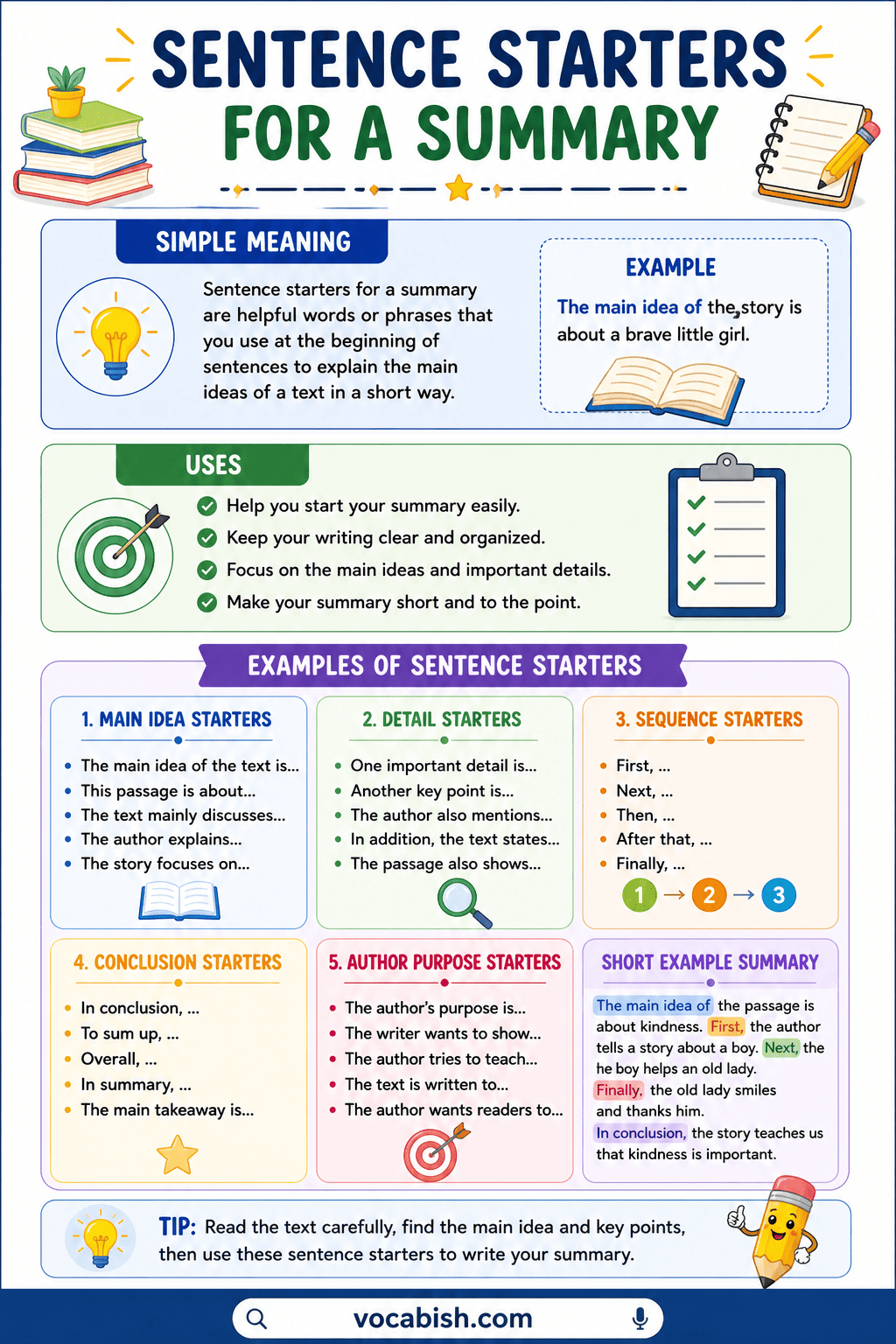
What Are Sentence Starters for a Summary?
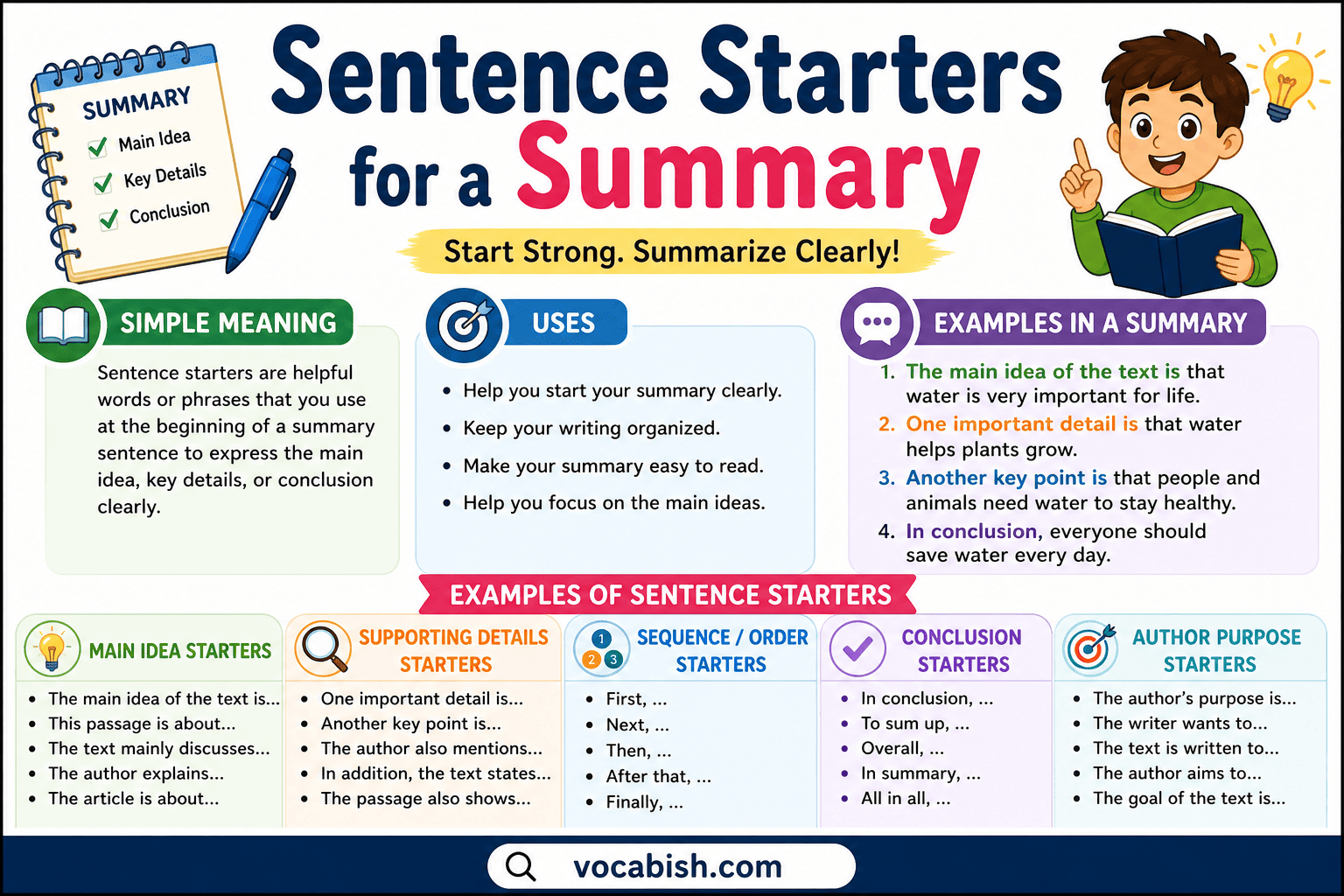
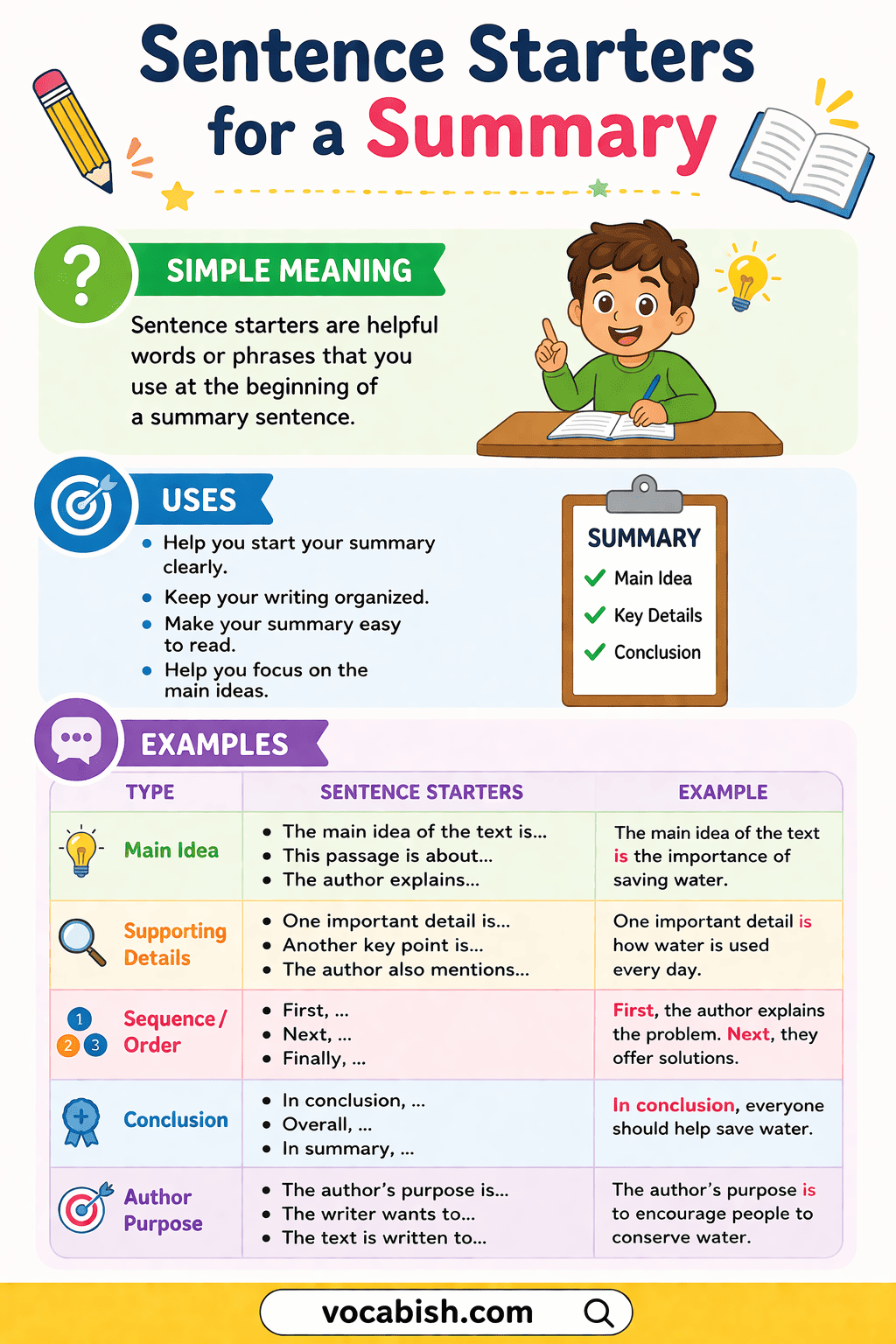
Sentence starters for a summary paragraph are short beginning phrases that help you start writing a summary. They guide your ideas and make your writing clear and organized.
Simple Definition:
A sentence starter is a phrase like “This text is about…” or “The main idea is…” that helps you begin your summary.
Example 1:
- Original text: A story about a boy who learns to ride a bike.
- Summary starter: “This story is about a boy who learns an important skill.”
Example 2:
- Original text: An article about saving water.
- Summary starter: “The article explains how to save water at home.”
These starters help you focus on the main idea instead of copying everything.
Types of Sentence Starters for a Summary
1. Main Idea Starters
Use these to introduce the central idea.
- The main idea of the text is…
- This passage is about…
- The text mainly discusses…
- The story focuses on…
- The article explains…
- The author talks about…
- This text describes…
- The central theme is…
- The key point is…
- The text highlights…
2. Supporting Details Starters
Use these to add important points.
- One important detail is…
- Another key point is…
- The author also mentions…
- In addition, the text states…
- The text further explains…
- Another example is…
- The passage also shows…
- The author adds that…
- A second detail is…
- The text includes…
3. Sequence/Order Starters
Use these when summarizing events in order.
- First, …
- Next, …
- Then, …
- After that, …
- Finally, …
- In the beginning, …
- Later, …
- At the end, …
- Following this, …
- Soon after, …
4. Conclusion Starters
Use these to wrap up your summary.
- In conclusion, …
- To sum up, …
- Overall, …
- In summary, …
- All in all, …
- To conclude, …
- The text ends by…
- In the end, …
- This shows that…
- The main takeaway is…
5. Author Purpose Starters
Use these to explain why the author wrote the text.
- The author’s purpose is…
- The writer wants to show…
- The author explains that…
- The goal of the text is…
- The author tries to teach…
- The writer aims to inform…
- The author’s message is…
- The text is written to…
- The author wants readers to…
- The purpose of this passage is…
100+ Sentence Starters for a Summary (Examples List)
Beginner Level (Easy Starters)
# | Sentence Starter |
|---|---|
1 | This text is about… |
2 | The story is about… |
3 | The author says… |
4 | The main idea is… |
5 | This passage shows… |
6 | The text explains… |
7 | The story tells… |
8 | The article is about… |
9 | This text talks about… |
10 | The author explains… |
Intermediate Level
# | Sentence Starter |
|---|---|
11 | The main idea of the text is… |
12 | In this passage, the author describes… |
13 | The text mainly focuses on… |
14 | One key detail is… |
15 | Another important point is… |
16 | The author also mentions… |
17 | The text highlights… |
18 | The passage explains that… |
19 | The writer discusses… |
20 | The text gives examples of… |
Advanced Level
# | Sentence Starter |
|---|---|
21 | The central idea revolves around… |
22 | The author emphasizes… |
23 | A significant point is… |
24 | The text illustrates… |
25 | The passage outlines… |
26 | The author elaborates on… |
27 | The writer demonstrates… |
28 | The text provides insight into… |
29 | The author conveys… |
30 | The passage explores… |
Sequence-Based Starters
# | Sentence Starter |
|---|---|
31 | First, … |
32 | Next, … |
33 | Then, … |
34 | After that, … |
35 | Finally, … |
36 | In the beginning, … |
37 | Later, … |
38 | At the end, … |
39 | Soon after, … |
40 | Following this, … |
Conclusion Starters
# | Sentence Starter |
|---|---|
41 | In conclusion, … |
42 | To sum up, … |
43 | Overall, … |
44 | In summary, … |
45 | All in all, … |
46 | To conclude, … |
47 | The main point is… |
48 | This shows that… |
49 | The takeaway is… |
50 | In the end, … |
Example of Sentence Starters in a Summary: Paragraph
The main idea of the text is that sentence starters help writers create clear and organized summaries. First, the author explains that these starters give a simple way to begin writing. Next, the text shows how they help students focus on key ideas and important details. Another important point is that sentence starters make summaries easier to understand. In conclusion, using sentence starters improves writing skills and helps learners write better summaries with confidence.
How to Teach Sentence Starters for a Summary
If you are a teacher or parent, here are easy ways to help kids learn:
1. Use Highlighting Activities
Have students highlight the main idea in a paragraph before writing a summary.
2. Sentence Starter Cards
Create flashcards with sentence starters and let students pick one randomly.
3. Group Practice
Let students work in groups to summarize a short story together.
4. “Finish the Sentence” Game
Start a sentence and let students complete it.
5. Daily Summary Writing
Give one short paragraph daily and ask students to write a summary.
Practice Exercises
Fill in the blank…….
- ________ is about a boy who loves reading.
- The main idea ________ that animals need care.
- In conclusion, ________ shows the importance of friendship.
- This article ________ how plants grow.
- The story begins with ________.
Choose the best starter……
- (a) The dog ran fast. (b) This story is about a dog.
- (a) In summary, the text explains water. (b) The water is blue.
- (a) The main idea is that exercise is healthy. (b) Exercise is fun.
Write your own…..
- Write a summary of your favorite book using a starter.
- Summarize your school day in one sentence.
Answer Key:
- This text
- is
- the story
- explains
- a situation
- b
- a
- a
9–10. (Answers will vary)
FAQs about Sentence Starters for a Summary
Sentence starters for a summary paragraph are short phrases used to begin a summary clearly. They help students introduce the main idea without copying the original text.
Common sentence starters include “This text is about…,” “The main idea is…,” and “In summary…”. These phrases help students begin summaries in a simple, effective way.
The best sentence starter is “The main idea is…” because it clearly introduces the central point of the text and works for both fiction and nonfiction writing tasks.
Yes, “In conclusion” is a good closing sentence starter for summaries. It helps signal the end and restates the main idea in a clear and simple way.
Easy sentence starters for beginners include “This story is about…,” “We learn that…,” and “The text explains…”. These help young learners write simple and correct summaries.
A good sentence starter for a summary is “This text is about…” or “The main idea is…”. These phrases clearly introduce the topic and help focus on key points.
Seven common ways to start a sentence are: “This text is about…”, “The main idea is…”, “In summary…”, “The article explains…”, “We learn that…”, “The passage shows…”, and “To conclude…”.
Related Articles: