
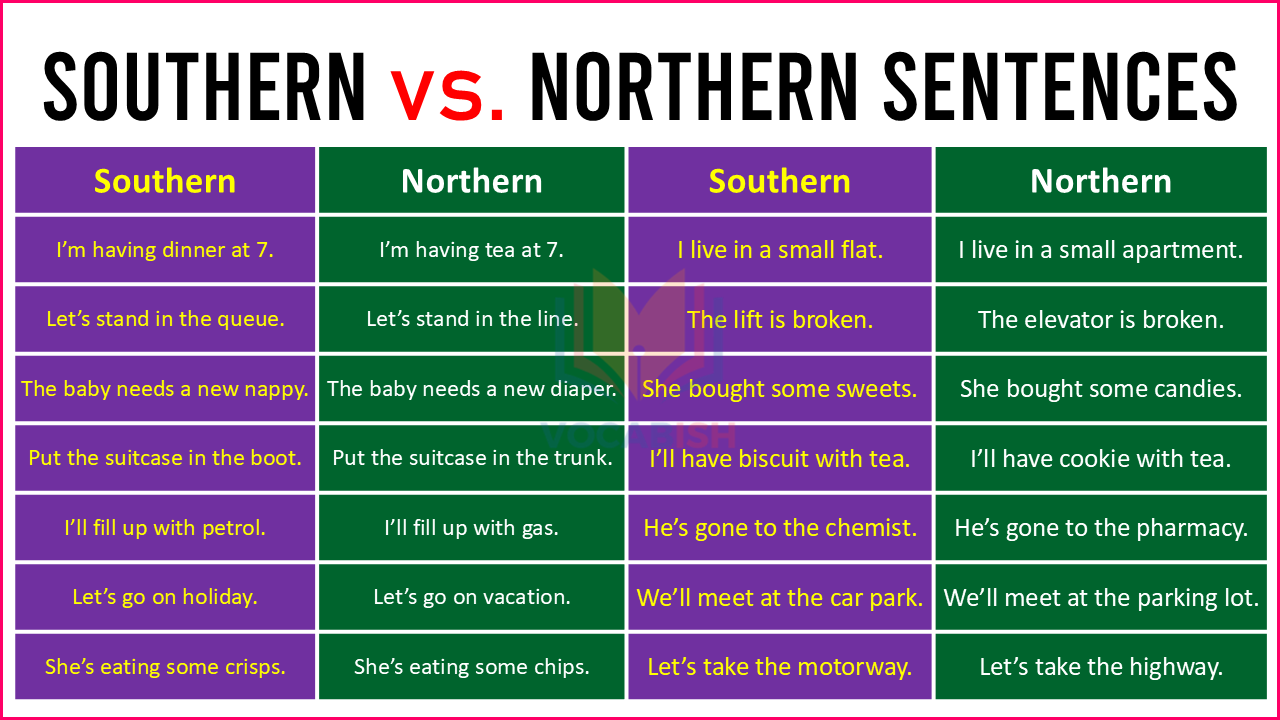
Learning how people speak in different regions can make your English more natural and easy to understand. Sentences from the Southern and Northern regions of English-speaking countries often sound different, even if they mean the same thing. In this blog post, you will explore 50 Southern vs Northern sentences for daily use, with examples showing how each version is used in everyday conversation. Understanding these differences will help you improve your listening, speaking, and reading skills, and make your English more fluent and confident.
What Are Southern and Northern Sentences?
Southern sentences use words and phrases common in the southern regions, while Northern sentences are used more in the northern areas.
- The meaning stays the same, but the vocabulary and tone are different.
- These sentences show how regional culture and habits affect the way people talk.
Examples of Southern vs Northern Sentences
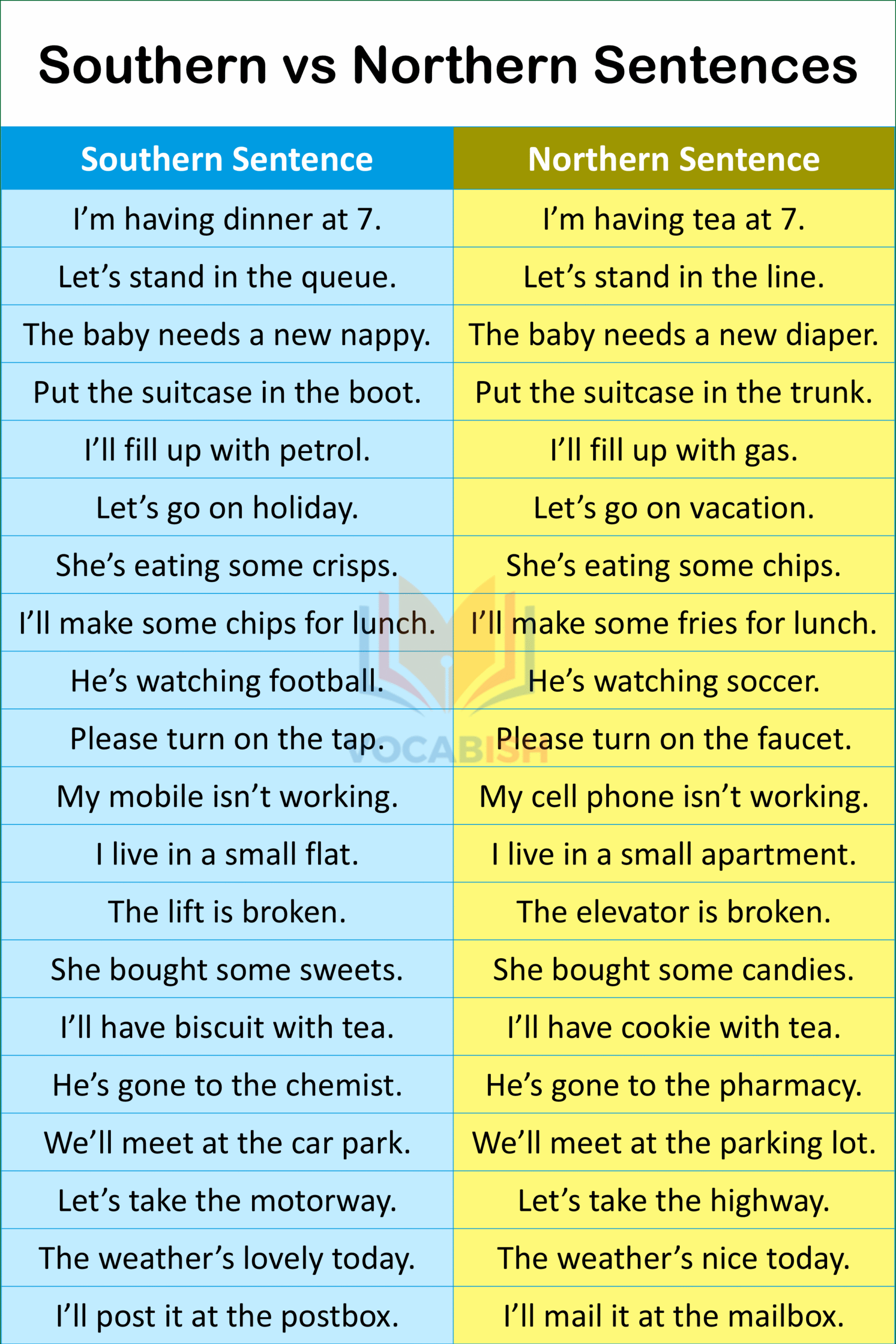
Below is a list of 50 simple sentences used in daily life. Each pair shows how people from Southern and Northern regions might say the same thing differently.
| No. | Southern Sentence | Northern Sentence |
|---|---|---|
| 1 | I’m having dinner at 7. | I’m having tea at 7. |
| 2 | Let’s stand in the queue. | Let’s stand in the line. |
| 3 | The baby needs a new nappy. | The baby needs a new diaper. |
| 4 | Put the suitcase in the boot. | Put the suitcase in the trunk. |
| 5 | I’ll fill up with petrol. | I’ll fill up with gas. |
| 6 | Let’s go on holiday. | Let’s go on vacation. |
| 7 | She’s eating some crisps. | She’s eating some chips. |
| 8 | I’ll make some chips for lunch. | I’ll make some fries for lunch. |
| 9 | He’s watching football. | He’s watching soccer. |
| 10 | Please turn on the tap. | Please turn on the faucet. |
| 11 | My mobile isn’t working. | My cell phone isn’t working. |
| 12 | I live in a small flat. | I live in a small apartment. |
| 13 | The lift is broken. | The elevator is broken. |
| 14 | She bought some sweets. | She bought some candies. |
| 15 | I’ll have biscuit with tea. | I’ll have cookie with tea. |
| 16 | He’s gone to the chemist. | He’s gone to the pharmacy. |
| 17 | We’ll meet at the car park. | We’ll meet at the parking lot. |
| 18 | Let’s take the motorway. | Let’s take the highway. |
| 19 | The weather’s lovely today. | The weather’s nice today. |
| 20 | I’ll post it at the postbox. | I’ll mail it at the mailbox. |
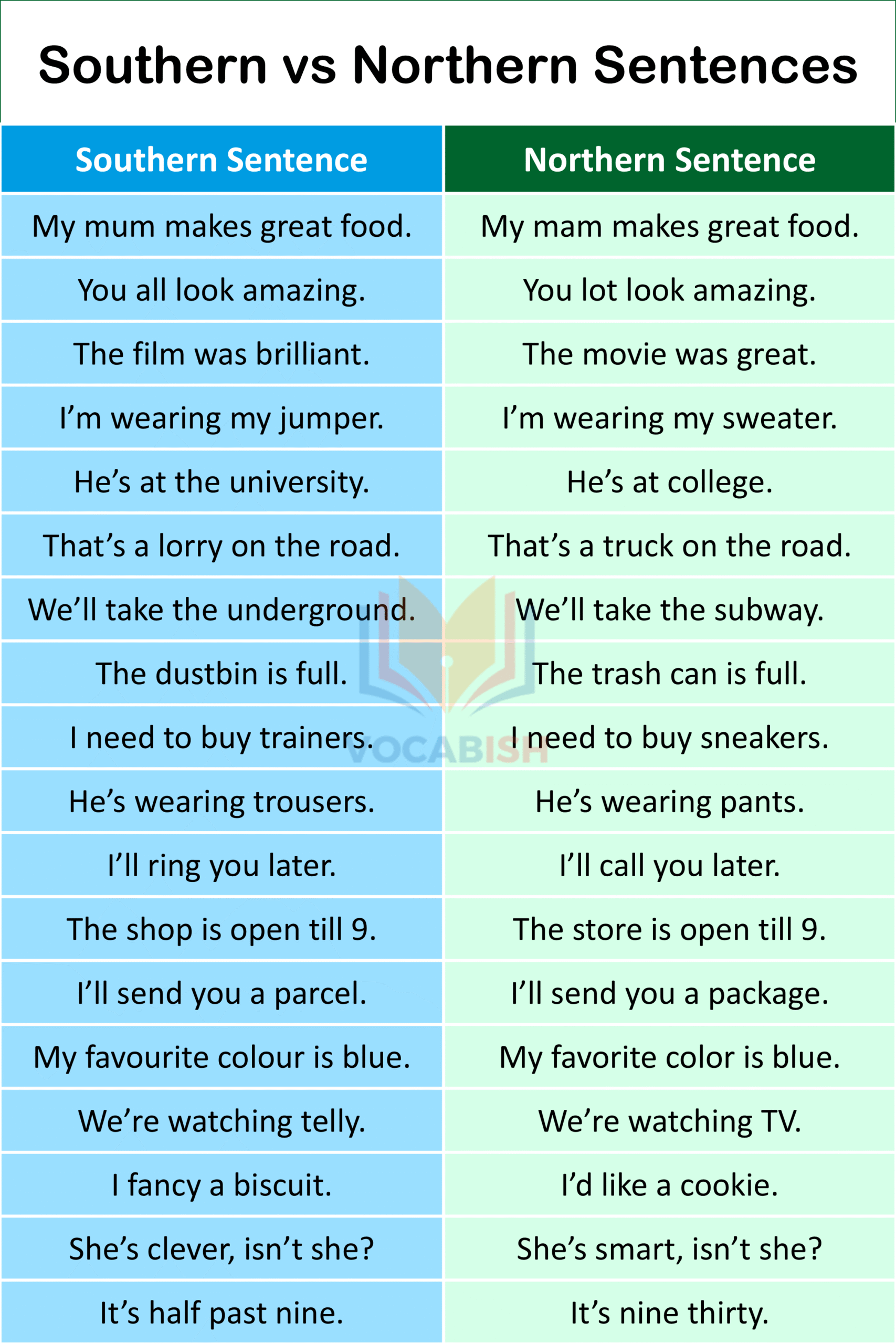
| 21 | My mum makes great food. | My mam makes great food. |
| 22 | You all look amazing. | You lot look amazing. |
| 23 | The film was brilliant. | The movie was great. |
| 24 | I’m wearing my jumper. | I’m wearing my sweater. |
| 25 | He’s at the university. | He’s at college. |
| 26 | We’re having pudding after dinner. | We’re having dessert after dinner. |
| 27 | That’s a lorry on the road. | That’s a truck on the road. |
| 28 | She left her torch at home. | She left her flashlight at home. |
| 29 | We’ll take the underground. | We’ll take the subway. |
| 30 | The dustbin is full. | The trash can is full. |
| 31 | I need to buy trainers. | I need to buy sneakers. |
| 32 | He’s wearing trousers. | He’s wearing pants. |
| 33 | I’ll ring you later. | I’ll call you later. |
| 34 | The shop is open till 9. | The store is open till 9. |
| 35 | I’ll send you a parcel. | I’ll send you a package. |
| 36 | My favourite colour is blue. | My favorite color is blue. |
| 37 | We’re watching telly. | We’re watching TV. |
| 38 | I fancy a biscuit. | I’d like a cookie. |
| 39 | She’s clever, isn’t she? | She’s smart, isn’t she? |
| 40 | He’s in hospital. | He’s in the hospital. |
| 41 | Let’s have a chat. | Let’s have a talk. |
| 42 | I’m knackered after work. | I’m exhausted after work. |
| 43 | It’s raining cats and dogs! | It’s pouring down! |
| 44 | He’s a cheeky little boy. | He’s a bold little boy. |
| 45 | I need some plasters. | I need some band-aids. |
| 46 | Take the lift to the top floor. | Take the elevator to the top floor. |
| 47 | I’ll meet you in the car park. | I’ll meet you in the parking lot. |
| 48 | He’s got a flat tyre. | He’s got a flat tire. |
| 49 | My neighbour is kind. | My neighbor is kind. |
| 50 | It’s half past nine. | It’s nine thirty. |
How These Sentences Differ
- Southern English prefers traditional and British-style vocabulary.
- Northern English often uses American-influenced or modern forms.
- Both are correct — just different ways of expressing the same idea.
Understanding Tips
- Learn both versions — it will help you understand movies, songs, and conversations from different regions.
- Practice speaking both — this improves listening and pronunciation skills.
- Remember: English is flexible; there’s no single right way to say things.
Summary on Southern and Northern English
| Feature | Southern English | Northern English |
|---|---|---|
| Style | Softer, more traditional | Direct, modern tone |
| Vocabulary | More British words | Mix of global or American words |
| Common Phrase | “Fancy a cuppa?” | “Want a brew?” |
| Meal Word | Dinner | Tea |
| Tone | Polite and formal | Friendly and relaxed |
The 50 Southern vs Northern sentences show that English is full of variety and colour. These small differences make the language richer and more enjoyable. Whether you say “boot” or “trunk,” or “mum” or “mam,” it’s all still English — just spoken in different styles.
Keep practising, listen to different accents, and you’ll become confident in understanding and using both Southern and Northern English!
FAQs
Are both Southern and Northern sentences correct?
Yes! They are just regional differences, not mistakes.
Which version should learners use?
Use the version that suits your speaking environment — but understand both.
Do people mix both forms?
Yes, many people use a mix of Southern and Northern words naturally.
Are these differences big in meaning?
No, they mean the same — only the words and tone change.
Why is it useful to learn both?
It helps you understand speakers from different regions and improves your listening and vocabulary skills.
Read More