
English can sound different depending on the region. Southern words and Northern words sometimes have different meanings or pronunciations, even though they are used for the same things. In this blog post, you will explore a list of Southern vs Northern words with examples, showing how each word is used in daily life. Learning these differences will help you understand conversations better, improve your speaking and listening skills, and make your English more natural and confident.
Southern and Northern Words in English
Southern words and Northern words are regional variations of English used in different parts of a country.
They show how people in the South and the North express the same ideas using different vocabulary or speech styles.
These words often come from local history, culture, or accents that have developed over time.
Example:
People in the North might say “lass” for girl, while people in the South may simply say “girl”.
Why Do These Differences Exist?
The English language developed from different historical roots, including Old English, Norse, and Norman influences. Over time, people in the North and South formed unique words and accents. Today, these words reflect local culture, pronunciation, and traditions.
Difference Between Southern and Northern Words
Aspect | Southern Words | Northern Words |
|---|---|---|
Tone | Often softer and slower | Often sharper and faster |
Vocabulary | Has more local slang | Has strong traditional terms |
Pronunciation | Stressed vowels (like “ah” and “oo”) | Shorter vowel sounds |
Example Word | “Ain’t” | “Nowt” |
Southern Words List with Meanings
Southern Word | Meaning | Example Sentence |
|---|---|---|
Ain’t | Isn’t / aren’t / haven’t | I ain’t going out today. |
Y’all | You all (group of people) | How are y’all doing? |
Fixin’ to | Getting ready to | I’m fixin’ to cook dinner. |
Bless your heart | Expression of sympathy or kindness | Oh, bless your heart for helping. |
Howdy | Hello / Hi | Howdy, nice to see you again! |
Hush up | Be quiet | Hush up, we’re in the library! |
Sugar | A kind nickname | Thanks, sugar, that was sweet. |
Northern Words List with Meanings
Northern Word | Meaning | Example Sentence |
|---|---|---|
Lass | Girl | That lass works in the shop. |
Lad | Boy / young man | He’s a good lad. |
Nowt | Nothing | I’ve got nowt to do today. |
Owt | Anything | Do you need owt from the shop? |
Gaffer | Boss / manager | Our gaffer is kind and fair. |
Chuffed | Pleased / happy | I’m chuffed with my new job! |
Bairn | Child | The bairn is sleeping quietly. |
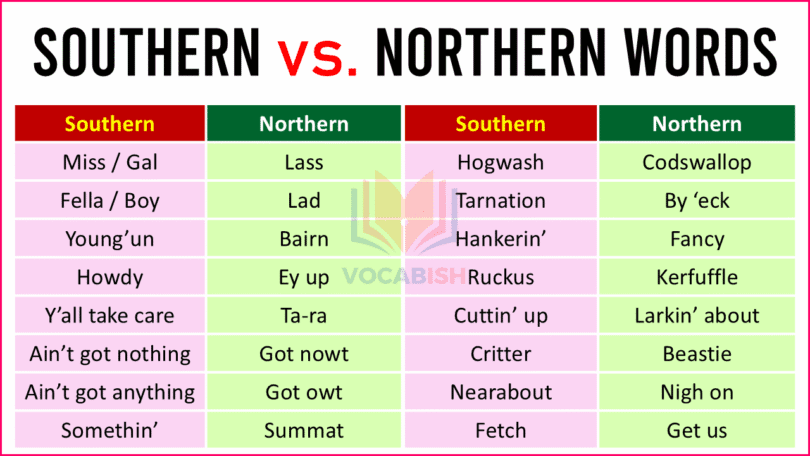
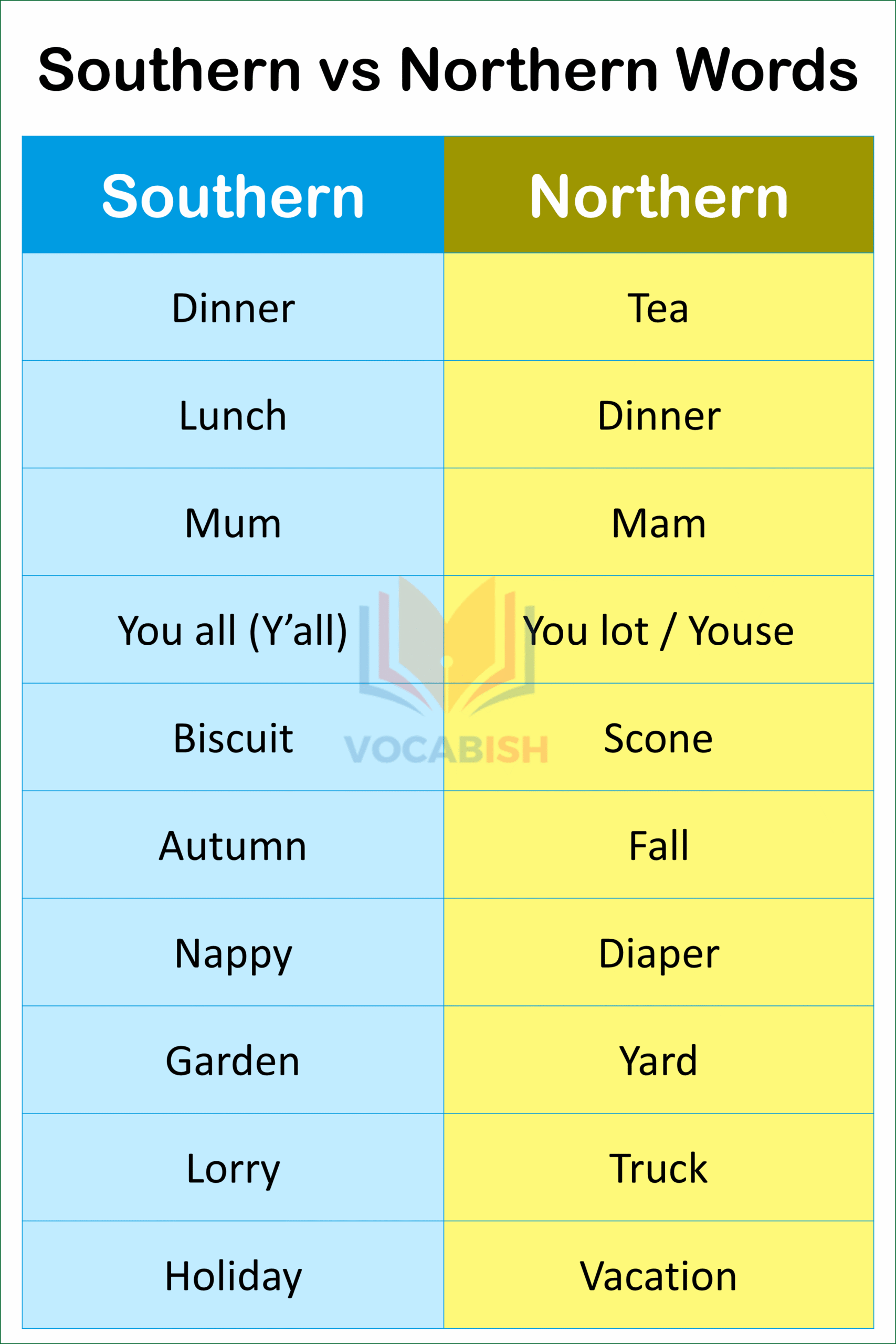
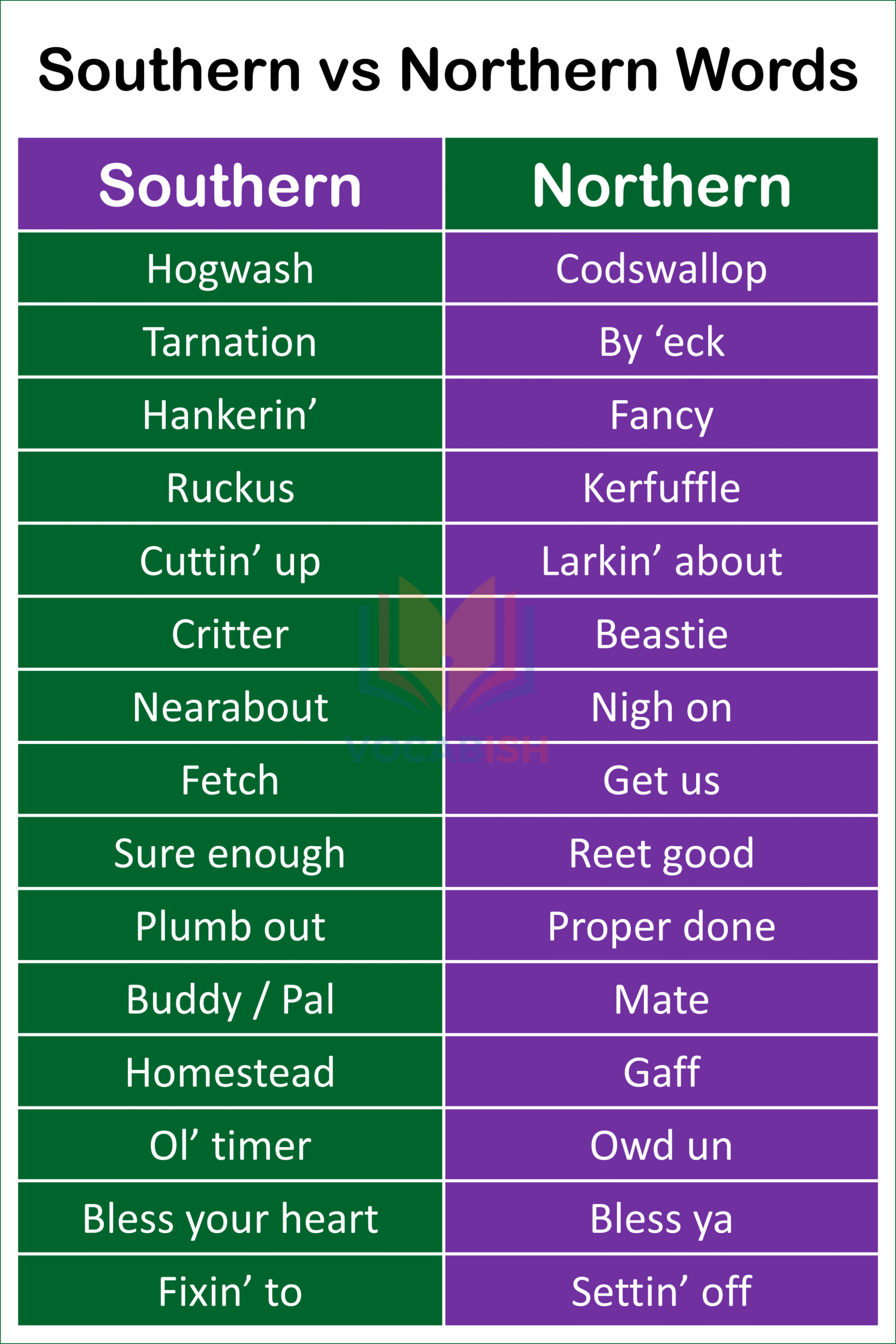
Southern vs Northern Words
English Word / Idea | Southern Word | Northern Word |
|---|---|---|
Girl | Miss / Gal | Lass |
Boy / Young Man | Fella / Boy | Lad |
Child | Young’un | Bairn |
Hello / Greeting | Howdy | Ey up |
Goodbye / Farewell | Y’all take care | Ta-ra |
Nothing | Ain’t got nothing | Got nowt |
Anything | Ain’t got anything | Got owt |
Something | Somethin’ | Summat |
Yes / Agreement | Sho’nuff | Aye |
Thank You | Much obliged | Ta / Cheers |
Be Quiet | Hush up | Belt up |
Term of Affection | Darlin’ / Sugar | Pet / Love |
Over There | Over yonder | Down t’road / Yon |
Completely / Totally | Plumb | Proper |
Very / Truly | Big ol’ / Plumb | Reet / Proper |
Tired | Tuckered out | Knackered |
Nonsense | Hogwash | Codswallop |
Surprise Expression | Tarnation | By ‘eck |
Craving / Desire | Hankerin’ | Fancy |
Argument / Fuss | Ruckus | Kerfuffle |
Joking / Playing Around | Cuttin’ up | Larkin’ about |
Animal / Creature | Critter | Beastie |
Almost / Nearly | Nearabout | Nigh on |
Fetching / Getting | Fetch | Get us |
Right / Very Good | Sure enough | Reet good |
Totally Empty | Plumb out | Proper done |
Friend | Buddy / Pal | Mate |
House / Home | Homestead | Gaff |
Old Person | Ol’ timer | Owd un |
Expression of Care | Bless your heart | Bless ya |
Ready / Preparing | Fixin’ to | Settin’ off |
Examples in Daily Conversations
Greeting / Saying Hello
- Southern: Howdy! How are y’all doing today?
- Northern: Ey up! How’s it going, mate?
Asking How Someone Is
- Southern: How are you, darlin’?
- Northern: You alright, love?
Saying Goodbye
- Southern: Y’all take care now, see you soon!
- Northern: Ta-ra! See you later!
Talking About Nothing
- Southern: I ain’t got nothing to do this afternoon.
- Northern: I’ve got nowt to do today.
Asking for Something
- Southern: Do you want somethin’ to eat?
- Northern: Do you fancy summat to eat?
Showing Surprise
- Southern: What in tarnation is going on here?
- Northern: By ‘eck! What’s all this about?
Showing Affection / Kindness
- Southern: Bless your heart for helping me, sugar.
- Northern: Bless ya, pet. That was kind of you.
Joking / Playing Around
- Southern: Stop cuttin’ up and focus!
- Northern: Stop larkin’ about and get on with it!
Expressing Agreement / Yes
- Southern: Sho’nuff, that’s the right way to do it.
- Northern: Aye, that’s the right way to do it.
Asking for a Lift / Help
- Southern: I’m fixin’ to go downtown, can you give me a ride?
- Northern: I’m settin’ off to town, can you get us there?
Different Contexts of Southern and Northern Words
Greeting / Hello
- Southern: Howdy, Y’all good?
- Northern: Ey up, Alright mate?
Talking About People (Girl / Boy / Child)
- Southern: Gal, Fella, Young’un
- Northern: Lass, Lad, Bairn
Expressing Surprise / Emotions
- Southern: Tarnation, Bless your heart
- Northern: By ‘eck, Ta
Food / Cravings
- Southern: Hankerin’, Fixin’ to eat
- Northern: Fancy, Sett’n off to eat
Tiredness / Effort
- Southern: Tuckered out
- Northern: Knackered
Nonsense / Arguments
- Southern: Hogwash, Ruckus
- Northern: Codswallop, Kerfuffle
Location / Distance
- Southern: Over yonder, Down the lane
- Northern: Down t’road, Yon, Top o’ hill
Affection / Endearment
- Southern: Sugar, Darlin’
- Northern: Pet, Love
Daily Activity / Doing Things
- Southern: Fixin’ to, Go fetch me
- Northern: Settin’ off, Get us
Emphasis / Totally
- Southern: Plumb, Big ol’
- Northern: Proper, Reet
Cultural Influence on Language
The culture of a region affects the words people use. Things like traditions, lifestyle, work, environment, and social habits shape Southern and Northern English.
1. Lifestyle and Daily Life
- Southern English
People in rural or farming areas use words that match their home and farm life.
Example: “Fixin’ to eat” → getting ready for a meal. - Northern English
People in towns or industrial areas use shorter, practical words.
Example: “Sett’n off for a bite” → going to eat.
Work and Occupation
- Southern English
Everyday work at home or small farms influenced casual, friendly words.
Example: “Darlin’ / Sugar” → terms of affection from home culture. - Northern English
Mining, factories, and manual work shaped words that are direct and simple.
Example: “Gaffer” → boss or manager, still used in daily talk.
Geography and Environment
- Southern English
Rural areas created phrases for open spaces.
Example: “Over yonder” → over there, used for fields or distant places. - Northern English
Towns and villages shaped short, practical directions.
Example: “Down t’road” → over there, used in villages or towns.
Humour and Expressions
- Southern English
People use friendly and playful phrases.
Example: “Bless your heart” → can mean kindness or gentle teasing. - Northern English
People use short, humorous words.
Example: “Codswallop” → nonsense, often said jokingly.
Tips for English Learners
- Learn both versions — they are often used in movies, songs, and real-life conversations.
- When speaking, use the version that matches the area or people you’re talking to.
- Don’t worry about “right or wrong” — both are correct and natural.
FAQs about Southern and Northern Words
Southern and Northern words are regional vocabulary differences used in different parts of a country, especially in the UK, where word choice changes based on location and local speech habits.
A common example is “bap,” “bun,” or “roll” for bread. Different regions use different words for the same item, showing how vocabulary varies across locations.
Yes, both Southern and Northern words are correct. They are standard within their regions and accepted in everyday communication, though they may differ from formal or standardized English.
Northern words are regional terms used in Northern England, such as “bairn” (child), “aye” (yes), “lass” (girl), and “ginnel” (alley), reflecting local speech and culture.
Commonly mispronounced words include “pronunciation,” “comfortable,” “vegetable,” “library,” “February,” “often,” “espresso,” “nuclear,” “clothes,” and “mischievous,” usually due to silent letters or incorrect stress.
Common Southern words in England include “loo” (toilet), “biscuit” (cookie), “boot” (car trunk), and “holiday” (vacation), showing differences in everyday vocabulary usage.
Southerners and Northerners often use different words for the same thing, like “bread roll” vs “bap,” “yes” vs “aye,” and vary in pronunciation and accent patterns.
Related Articles: