
Using the right words in English helps you describe people and situations more clearly. Synonyms are words that have similar meanings, and learning them makes your speaking and writing stronger. In this blog post, you will explore different ways to say poor in English, with examples that show how each word is used. Mastering these alternatives will help you understand texts better, improve your listening and speaking skills, and express your ideas more accurately. By learning these words, you can make your English more natural and confident.
Want to learn more helpful synonyms? Visit our synonyms category for simple and practical lessons.
Synonyms for Poor with Meanings and Examples
1. Needy
Meaning: Having little money and needing help.
Example: The charity helps needy families during the winter.
2. Impoverished
Meaning: Extremely poor, without enough resources.
Example: Many impoverished villages need clean drinking water.
3. Penniless
Meaning: Having no money at all.
Example: After losing his job, he was left penniless.
4. Destitute
Meaning: Without food, money, or basic needs.
Example: The flood left hundreds of people destitute.
5. Indigent
Meaning: Very poor, often in need of support or charity.
Example: The hospital provides free treatment for indigent patients.
6. Underprivileged
Meaning: Having fewer advantages than others, especially in education or money.
Example: The school offers scholarships to underprivileged children.
7. Broke (informal)
Meaning: Having no money at the moment.
Example: I can’t go out tonight—I’m completely broke.
8. Bankrupt
Meaning: Having no money and unable to pay debts.
Example: The company went bankrupt after the market crash.
9. Poverty-stricken
Meaning: Suffering from extreme poverty.
Example: The poverty-stricken village had no proper roads or electricity.
10. Insolvent
Meaning: Not having enough money to pay debts (formal, used for businesses or people).
Example: The firm became insolvent after several bad investments.
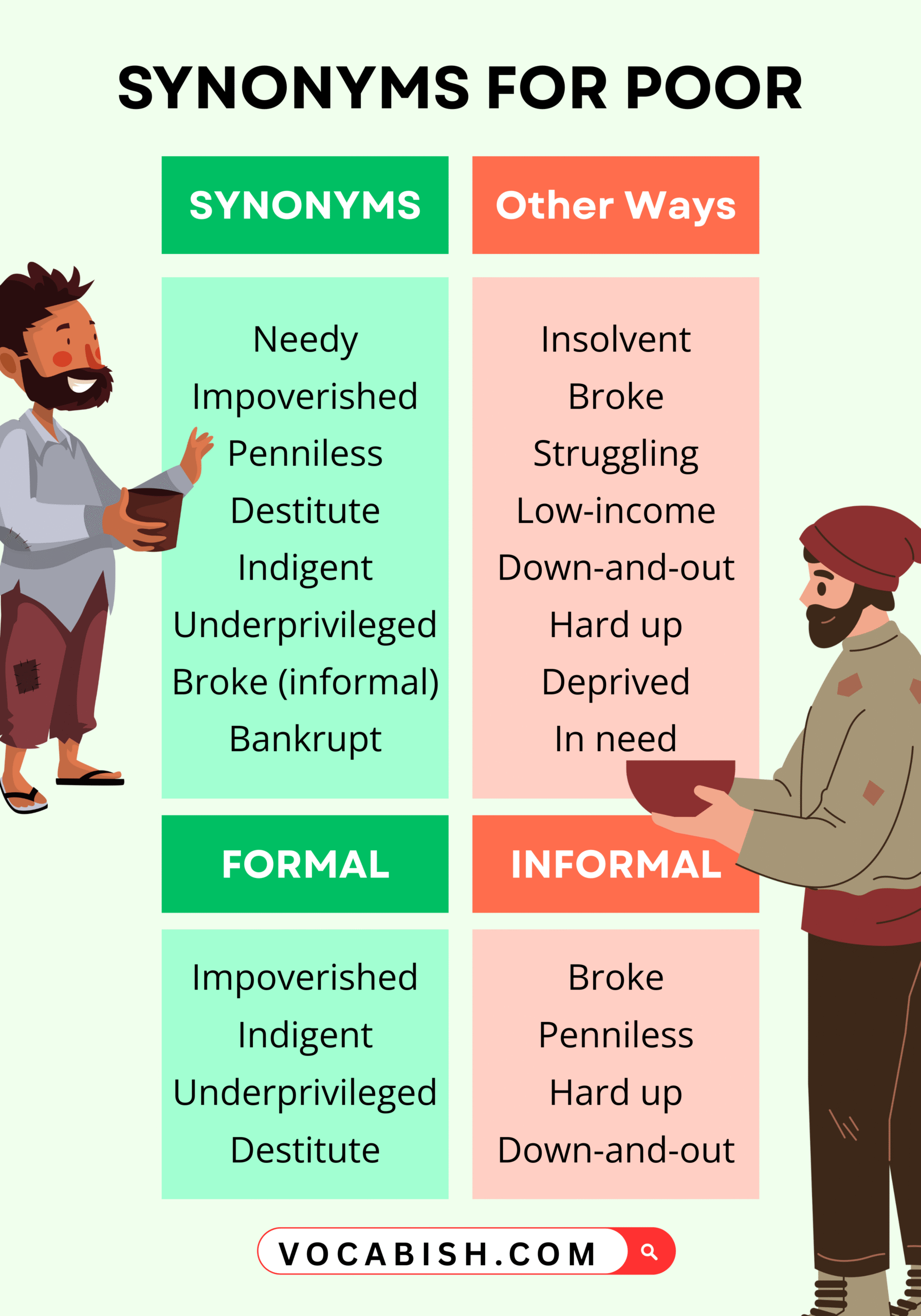
Other Ways to Say Poor
Here are different words you can use instead of poor:
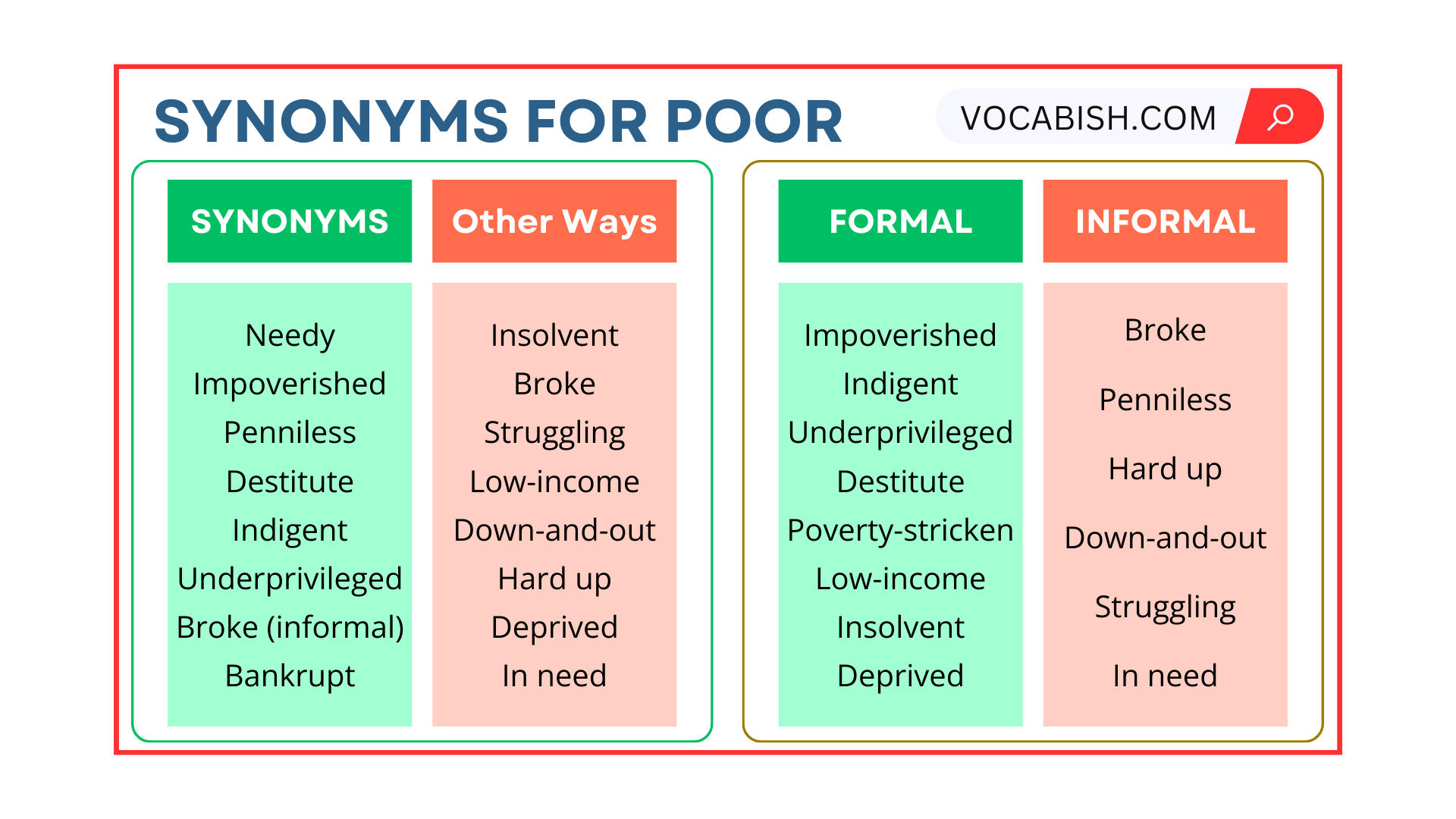
- Needy
- Impoverished
- Penniless
- Destitute
- Indigent
- Underprivileged
- Bankrupt
- Poverty-stricken
- Insolvent
- Broke
- Struggling
- Low-income
- Down-and-out
- Hard up
- Deprived
- In need
Formal Ways to Say Poor
(Use these in writing, news, reports, or serious speech.)
- Impoverished → Many impoverished families need food.
- Indigent → The hospital gives free care to indigent patients.
- Underprivileged → Scholarships are given to underprivileged children.
- Destitute → The storm left hundreds of people destitute.
- Poverty-stricken → The poverty-stricken town had no schools.
- Low-income → The government supports low-income households.
- Insolvent → The company became insolvent last year.
- Deprived → He grew up in a deprived neighborhood.
Informal Ways to Say Poor
(Use these in daily conversation or casual talk.)
- Broke → Sorry, I can’t go out, I’m broke.
- Penniless → He left home penniless.
- Hard up → I’m a bit hard up until payday.
- Down-and-out → He was down-and-out but trying to rebuild his life.
- Struggling → They are struggling to pay their bills.
- In need → She is in need of financial help.
Use formal words (like impoverished, destitute, underprivileged) when speaking in class, exams, or writing essays.
Use informal words (like broke, hard up, struggling) when talking with friends or in everyday life.
Using synonyms for poor will make your English more expressive and stronger. Instead of repeating poor, you can say needy, broke, destitute, or underprivileged depending on the context. Some of these words are more formal, while others are casual, so it’s important to choose the right one for each situation. Keep practicing these synonyms in your own sentences, and your English will soon sound more natural and confident.
Read More