
Many English learners get confused between waive and wave because they sound almost the same, but their meanings are very different. Understanding the difference helps you master your speaking, writing, reading, and listening skills. Using them correctly makes your English more precise and natural. In this blog post, you will learn the meanings of waive and wave, see examples, and understand how to use them in everyday sentences.
Meanings of Waive and Wave
Waive
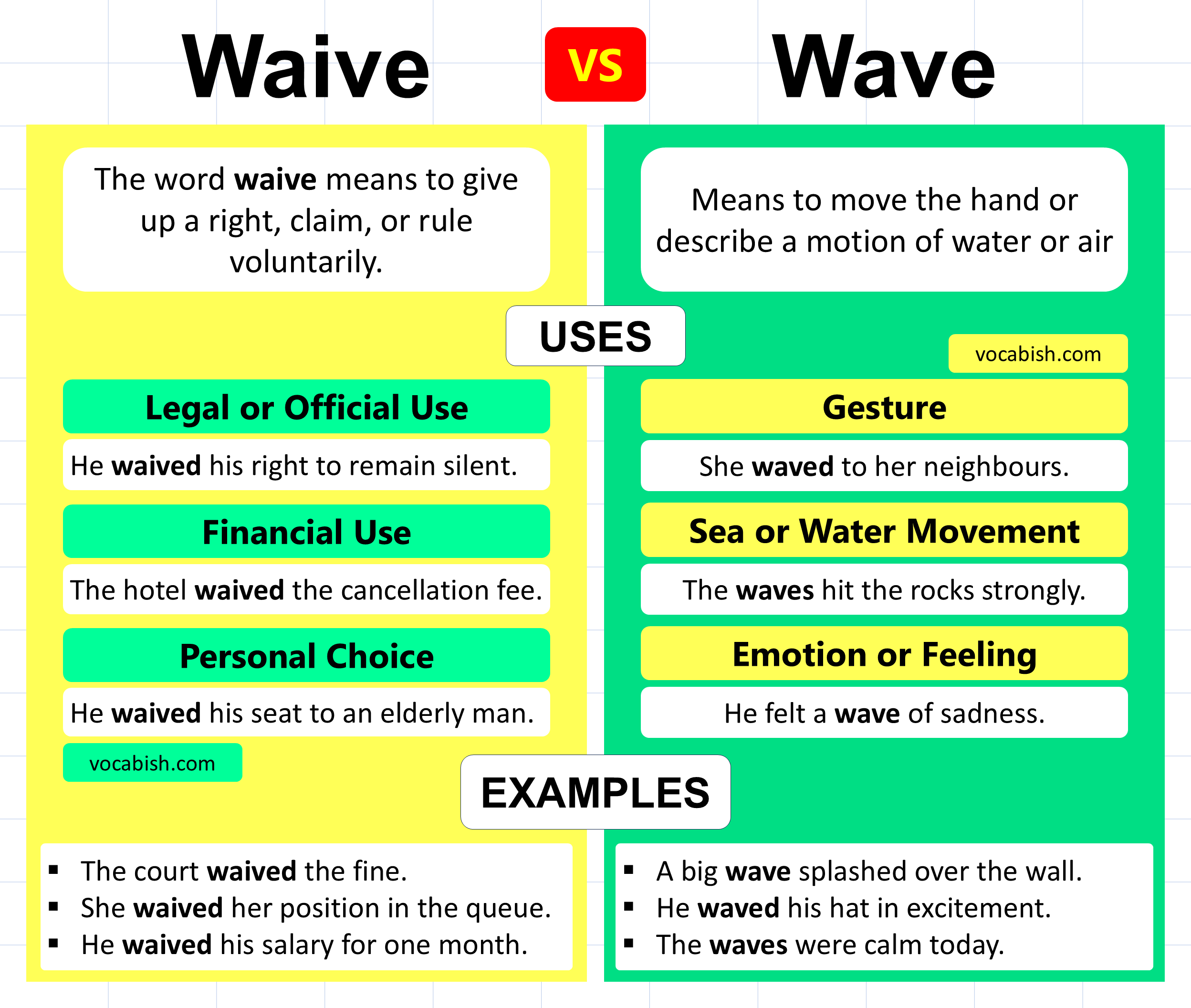
The word waive means to give up a right, claim, or rule voluntarily. It is commonly used in legal, official, or formal situations.
Example:
- He decided to waive his right to appeal.
- The bank waived the late payment fee.
Wave
The word wave has several meanings. It can mean to move your hand back and forth, a movement of water, or something that rises and falls like the sea.
Example:
- She waved goodbye at the train station.
- The waves crashed onto the beach.
Differences Between Waive and Wave
| Waive | Wave |
|---|---|
| Means to give up a right or claim | Means to move the hand or describe a motion of water or air |
| Used mostly in formal or legal contexts | Used in daily, informal communication |
| Example: The manager waived the fee. | Example: He waved at his friend. |
| Has no physical movement | Involves physical movement or natural motion |
Usage of Waive
1. Legal or Official Use:
Used to show the cancellation of a right, fee, or rule.
- The company waived the registration charge.
- He waived his right to remain silent.
2. Financial Use:
Used when a charge or fee is cancelled.
- The hotel waived the cancellation fee.
- My bank waived the overdraft charges.
3. Personal Choice:
Used when someone decides to give up something voluntarily.
- She waived her opportunity to lead the team.
- He waived his seat to an elderly man.
4. Legal Documents:
Used in contracts or agreements to show something is not applied.
- The terms allow clients to waive certain rights.
- You can waive confidentiality under this clause.
Usage of Wave
1. Gesture:
Moving your hand to greet or signal.
- She waved to her neighbours.
- They waved goodbye after the meeting.
2. Sea or Water Movement:
Used for the motion of the sea or large water bodies.
- The waves hit the rocks strongly.
- A big wave splashed over the boat.
3. Emotion or Feeling:
Used to show a sudden strong feeling.
- A wave of happiness filled the room.
- He felt a wave of sadness.
4. Technology or Science:
Used to describe energy movement like sound or light.
- The radio sends signals through sound waves.
- Light waves travel faster than sound waves.
Formal and Informal Usage
Formal Usage
Waive (Formal Context):
Used in legal, business, or official writing.
- The court decided to waive the penalty.
- Employees may waive certain benefits if they choose.
Wave (Formal Context):
Used in academic or descriptive writing.
- The waves of innovation transformed industries.
- A wave of migration changed the city’s structure.
Informal Usage
Waive (Informal Context):
Used casually when giving up something.
- I’ll waive my turn for you.
- Let’s waive the rules this time.
Wave (Informal Context):
Used in everyday conversation.
- She waved at me from across the street.
- We waved goodbye before leaving.
Sentences with Waive
- The manager waived the service charge.
- He waived his right to complain.
- They waived the rule for new members.
- She waived the fee for late submission.
- The university waived tuition for top students.
- He waived his claim to the property.
- The doctor waived the consultation fee.
- They waived the entry requirements.
- The court waived the fine.
- She waived her position in the queue.
- He waived his salary for one month.
- The company waived the delivery fee.
- You may waive your right to privacy.
- The bank waived charges for seniors.
- He waived the need for approval.
- The organisers waived the age limit.
- She waived her right to object.
- The government waived import taxes.
- They waived the admission fee.
- He waived his right to vote.
Sentences with Wave
- She waved her hand to say hello.
- The waves hit the shore gently.
- He waved goodbye at the airport.
- A wave of joy spread through the crowd.
- The flag waved in the wind.
- Children waved at the passing cars.
- The boat rocked with the waves.
- She waved her arms to get attention.
- A big wave splashed over the wall.
- He waved his hat in excitement.
- The waves were calm today.
- A wave of laughter filled the hall.
- The crowd waved flags during the match.
- The wave knocked him off balance.
- She waved from the balcony.
- A wave of cold air entered the room.
- They waved to the camera.
- The waves sparkled in the sunlight.
- He waved off the taxi.
- A wave of relief passed over him.
Summary on Waive and Wave
- Waive means to give up a right or claim voluntarily.
- Wave means to move the hand or describe a motion of water or energy.
- Waive is formal; wave is mostly used in daily life.
- To remember easily:
Waive = Give up (rights)
Wave = Move (hand or water)
FAQs
What is the meaning of waive?
Waive means to give up or cancel a right, claim, or rule voluntarily.
What is the meaning of wave?
Wave means to move your hand back and forth or describe a natural motion like that of water.
What is the difference between waive and wave?
Waive means to give up something formally, while “wave” refers to movement, usually of a hand or water.
How can I easily remember the difference between waive and wave?
Think: Waive = Give up, Wave = Move.
Can waive and wave be used in both formal and informal English?
Yes, but waive is mostly formal, while wave is common in daily, informal use.
Read More