
Many English learners feel confused about Who’s, Whose, and how to use them correctly. These words look similar, but they have different meanings and uses. In this blog post, you will learn how “who’s” is a short form of “who is” or “who has,” and how “whose” shows possession. Understanding this difference helps you write correct sentences, speak more confidently, and avoid common mistakes. It also improves your reading and listening because you can quickly recognize what each word means in a sentence. By the end, you will understand when to use each word with easy examples and real-life sentences.
Meanings of Who’s and Whose
Who’s
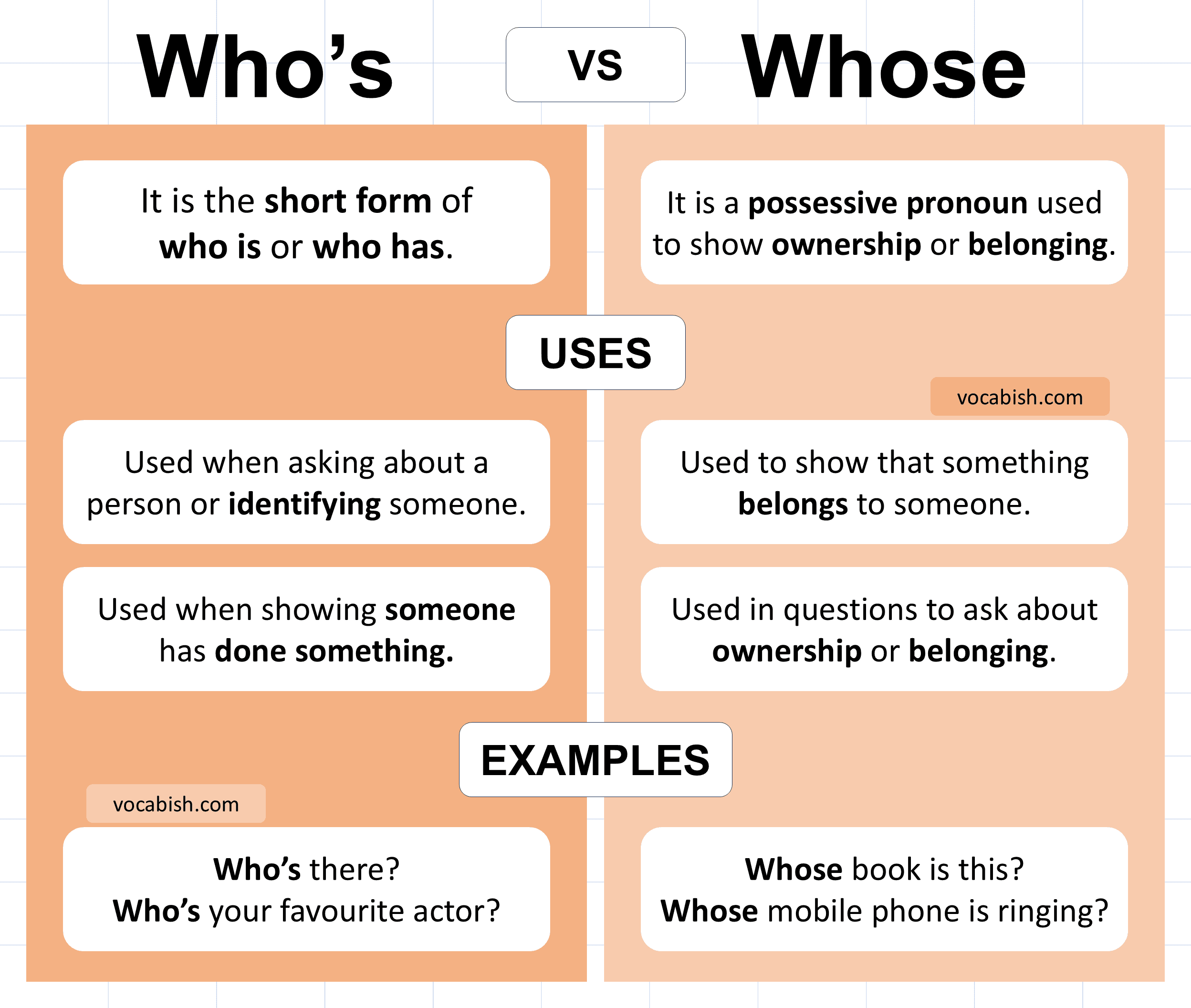
It is the short form (contraction) of who is or who has.
Example:
- Who’s coming to the party? (= Who is coming?)
- Who’s finished their work? (= Who has finished?)
Whose
It is a possessive pronoun used to show ownership or belonging.
Example:
- Whose book is this? (= To whom does this book belong?)
- That’s the boy whose father is a doctor.
Differences Between Who’s and Whose
| Feature | Who’s | Whose |
|---|---|---|
| Type | Contraction | Possessive Pronoun |
| Full Form | Who is / Who has | Belongs to whom |
| Use | Shows identity or action | Shows possession or belonging |
| Example | Who’s at the door? (Who is) | Whose bag is this? (Belongs to whom) |
| Sound | Same pronunciation | Same pronunciation |
| Meaning | Verb-based | Ownership-based |
- If you can replace it with “who is” or “who has,” use who’s.
- If it shows possession or belonging, use whose.
Usage of Who’s
Contraction for “Who is”
Used when asking about a person or identifying someone.
- Who’s there? (Who is there?)
- Who’s your favourite actor? (Who is your favourite actor?)
- Who’s at the door? (Who is at the door?)
Contraction for “Who has”
Used when showing someone has done something.
- Who’s been to London before? (Who has been…)
- Who’s finished their homework? (Who has finished…)
- Who’s taken my pen? (Who has taken…)
Informal Contexts
Who’s is often used in spoken English and informal writing because it sounds natural and conversational.
- Who’s ready for lunch?
- Who’s coming with me?
Usage of Whose
Indicates Possession
Used to show that something belongs to someone.
- Whose shoes are these?
- I met a girl whose brother is a pilot.
- Whose mobile phone is ringing?
Ownership Inquiry
Commonly used in questions to ask about ownership or belonging.
- Whose car is parked outside?
- Whose idea was this?
- Do you know whose pencil this is?
Formal and Informal Usage
- In formal writing, whose is used to show possession in relative clauses.
Example: The student whose project won the prize is very talented. - In informal speech, it’s often used in direct questions.
Example: Whose turn is it to clean the room?
Summary on Who’s vs Whose
Who’s = Who is / Who has
Example:
Who’s coming to dinner?
Who’s done the homework?
Whose = Belongs to whom / Shows possession
Example:
Whose book is on the table?
That’s the man whose car broke down.
Easy Rule to Remember:
- If you can replace the word with who is or who has, use who’s.
- If you can replace it with his / her / their, use whose.
FAQs about Who’s and Whose
“Who’s” is a contraction of “who is” or “who has.” “Whose” shows possession. This is the key difference learners need to understand for correct usage.
Correct phrase: “whose baby.” It asks who the baby belongs to. “Who’s baby” means “who is baby,” which is incorrect and not used in proper English.
Use “who’s” when you mean “who is” or “who has.” Use “whose” to ask or show ownership. This rule helps you choose the correct word easily.
Yes, “whose” is used to show possession. It asks or tells who owns something, such as “Whose book is this?” which means who owns the book.
A simple trick is to expand “who’s” into “who is.” If the sentence still makes sense, use “who’s.” If not, “whose” is the correct choice.
Correct phrase: “whose birthday.” “Whose” shows possession, meaning the birthday belongs to someone. “Who’s birthday” is incorrect because it means “who is birthday,” which does not make sense.
Correct phrase: “whose dad.” “Whose” asks about ownership or relation. “Who’s dad” means “who is dad,” which is grammatically incorrect in normal sentences.
Correct phrase: “whose funeral.” It shows possession, meaning the funeral is for someone. “Who’s funeral” means “who is funeral,” which is incorrect in standard English.
Related Articles: