
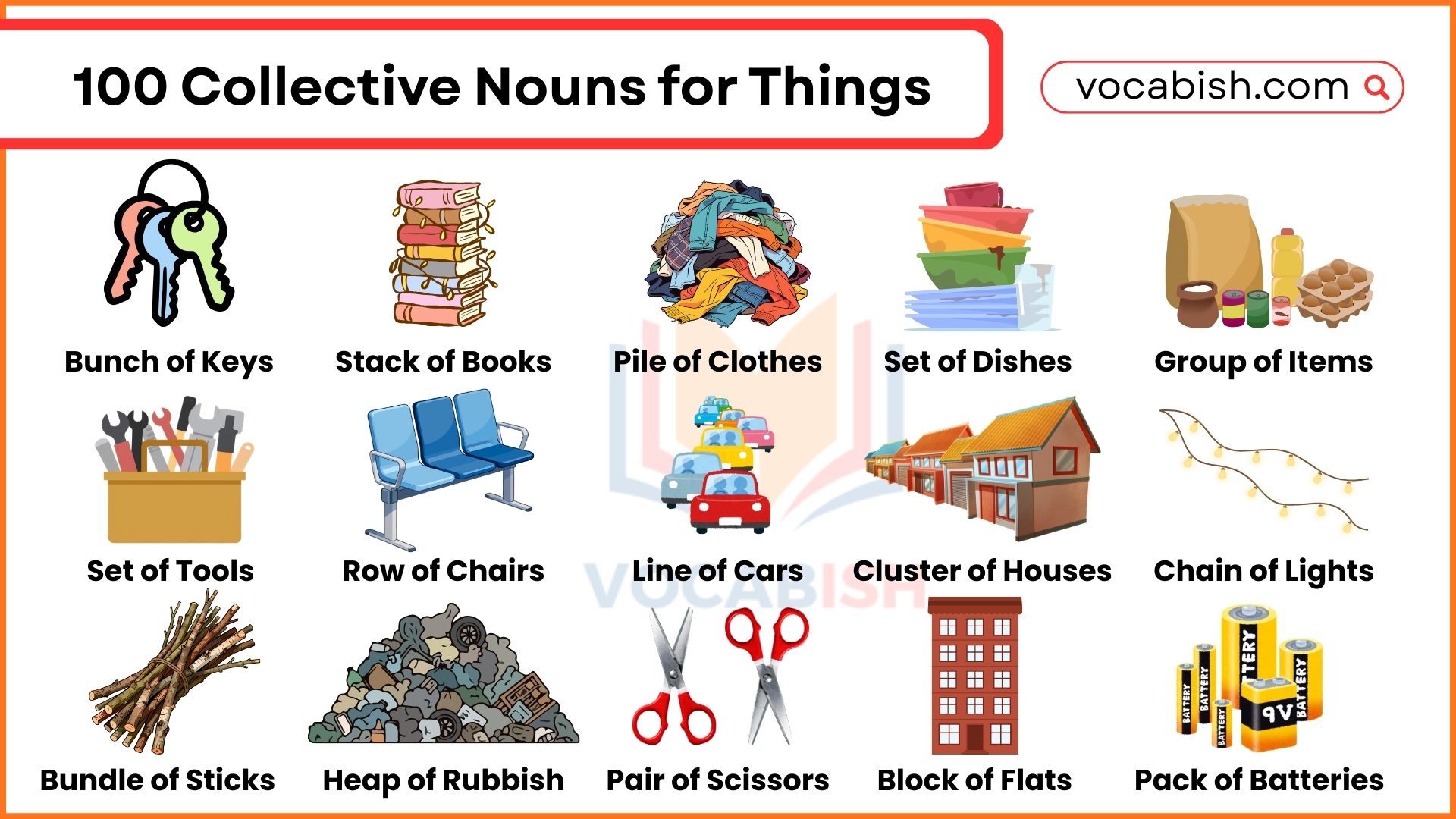
In this blog post, you will learn collective nouns, special words used to name a group of things as one unit, such as a stack of books or a bunch of keys. These words are important because they help you speak and write more naturally. When you understand collective nouns, you improve your vocabulary, sentence building, and reading skills. You will notice them in conversations, books, and exams. By studying the 100 collective nouns for things with pictures, you can build stronger English skills and use everyday expressions with confidence.
What Are Collective Nouns for Things?
A collective noun is a word that refers to a group of items or objects together.
Instead of saying:
- many papers
We can say:
- a stack of papers
The word stack is the collective noun.
Collective nouns make your English sound more natural, specific, and fluent.
Why Learning Collective Nouns Is Important
Learning collective nouns helps you:
- Speak more naturally in daily conversation
- Improve writing skills
- Understand books and articles better
- Expand your English vocabulary
- Avoid repeating simple words like “many” or “a lot of”
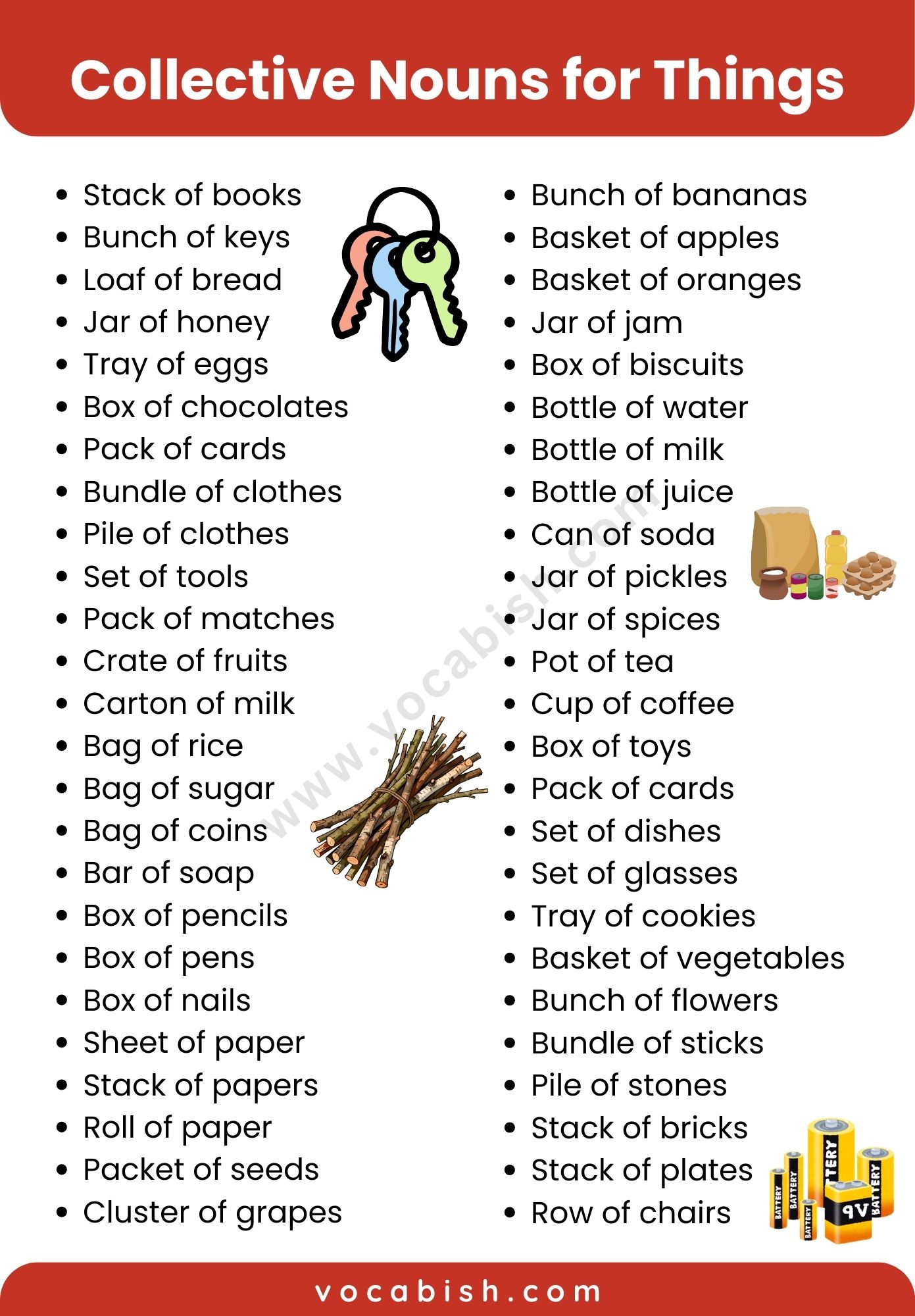
Now let’s explore 100 useful collective nouns for things, grouped by category.
Collective Nouns for Everyday Objects
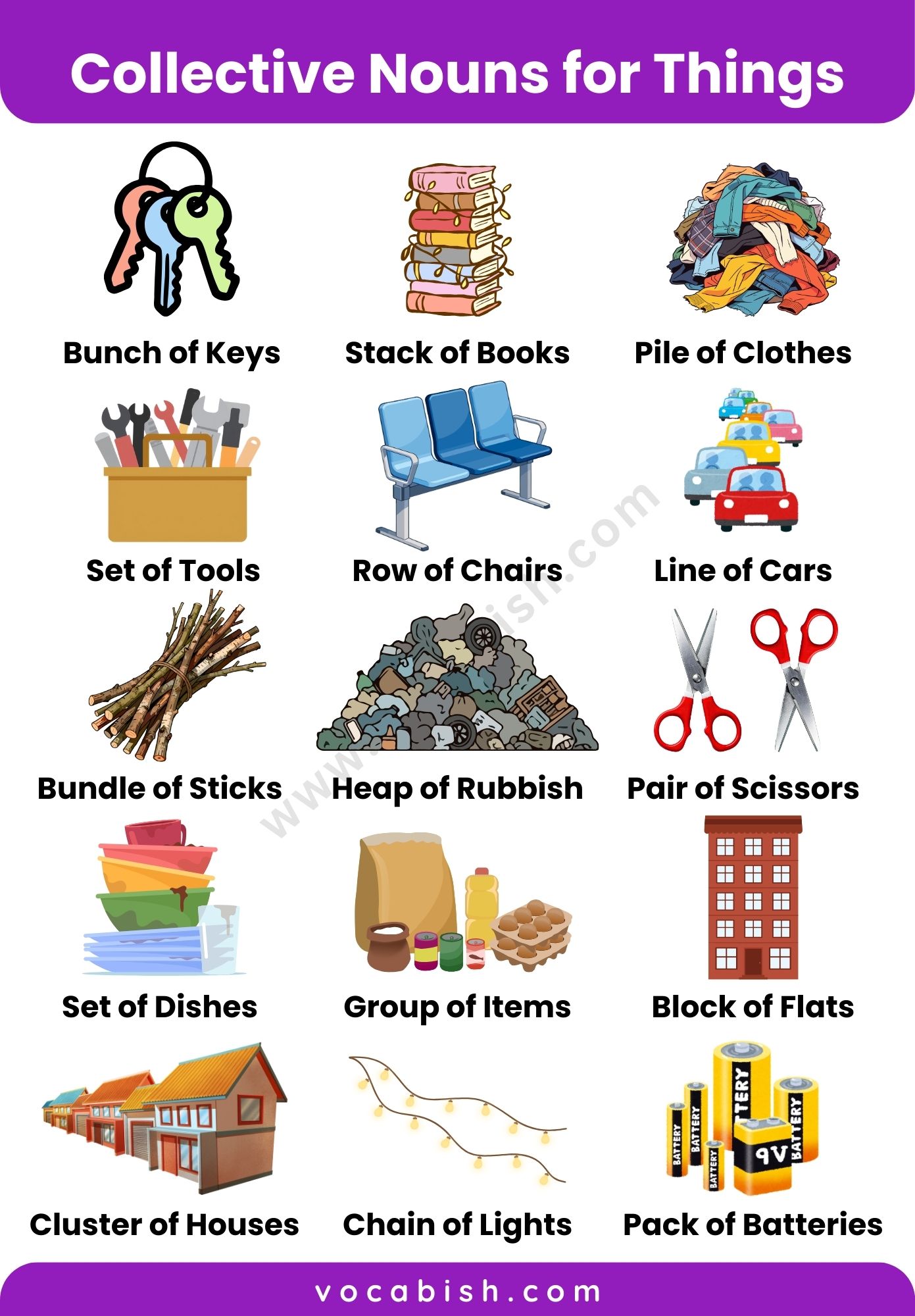
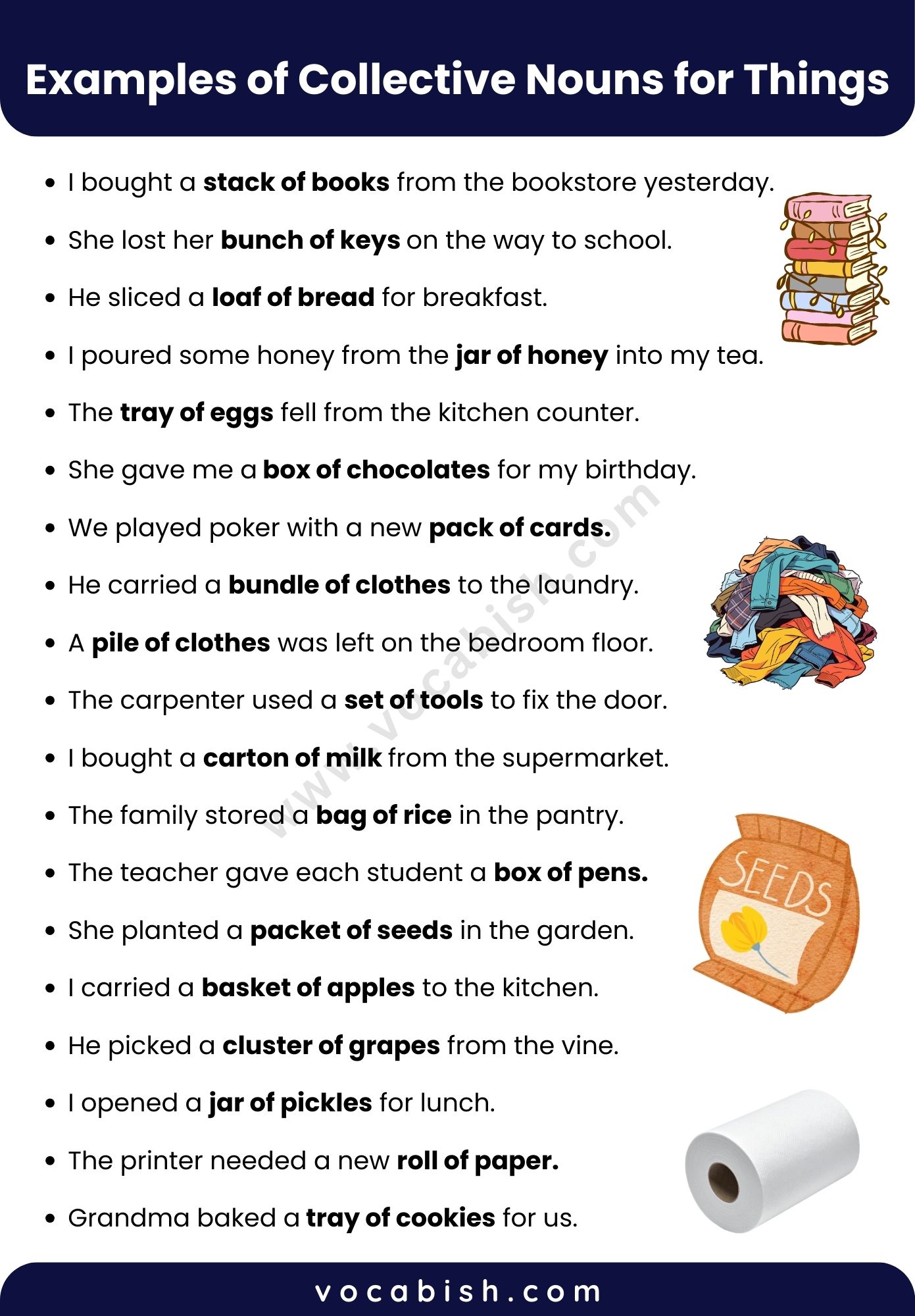
Bunch of keys
Several keys fastened together on one key ring.
Example: I misplaced my bunch of keys.
Stack of books
Books arranged neatly one above another.
Example: A stack of books is on my table.
Pile of clothes
Clothes lying together without neat folding.
Example: There’s a pile of clothes on the bed.
Set of tools
Complete group of tools for repair work.
Example: He bought a new set of tools.
Row of chairs
Chairs placed side by side in straight line.
Example: A row of chairs filled the room.
Line of cars
Cars standing one behind another on road.
Example: A long line of cars waited outside.
Bundle of sticks
Sticks tied together for easy carrying.
Example: He carried a bundle of sticks.
Heap of rubbish
Large untidy collection of waste materials.
Example: Workers cleared a heap of rubbish.
Pair of scissors
Two joined blades used for cutting.
Example: Pass me the pair of scissors.
Set of dishes
Matching plates and bowls used together.
Example: She bought a new set of dishes.
Group of items
Several objects placed together in one place.
Example: A group of items lay on shelf.
Block of flats
Building divided into several apartments.
Example: She lives in a block of flats.
Chain of lights
Lights connected together in long line.
Example: They hung a chain of lights.
Cluster of houses
Houses built closely together in area.
Example: A cluster of houses stood nearby.
Pack of batteries
Several batteries sold together in packet.
Example: I bought a pack of batteries.
Bundle of wires
Wires gathered and tied together tightly.
Example: He fixed a bundle of wires.
Box of tools
Tools stored together inside container.
Example: The box of tools is heavy.
Set of cups
Matching cups used for serving drinks.
Example: She arranged a set of cups.
Collection of toys
Toys gathered and kept by someone.
Example: The child has a collection of toys.
Pair of gloves
Two matching gloves worn on hands.
Example: He wore a pair of gloves.
Collective Nouns for Paper, Books, and Written Work
Stack of papers
Papers arranged neatly one above another.
Example: She carried a stack of papers.
Pack of cards
Complete set of playing cards for games.
Example: We opened a pack of cards.
Bundle of letters
Letters tied together for storage.
Example: She found a bundle of letters.
Collection of poems
Poems gathered together inside one book.
Example: I read a collection of poems.
File of documents
Important papers kept together for record.
Example: Check the file of documents.
Folder of assignments
Schoolwork papers stored inside protective cover.
Example: Submit your folder of assignments.
Set of notes
Written study material grouped together.
Example: I revised my set of notes.
List of names
Names written one below another clearly.
Example: Read the list of names.
Series of articles
Related writings published one after another.
Example: The newspaper ran a series of articles.
Volume of encyclopedia
Single book within larger reference series.
Example: He borrowed a volume of encyclopedia.
Edition of newspaper
Specific printed version released on date.
Example: Today’s edition of newspaper arrived early.
Archive of records
Stored historical documents kept safely.
Example: The archive of records is secure.
Batch of forms
Forms processed together at same time.
Example: She checked a batch of forms.
Pile of magazines
Magazines placed loosely together in stack.
Example: There’s a pile of magazines here.
Shelf of books
Books arranged together on one shelf.
Example: A shelf of books looks neat.
Bundle of newspapers
Newspapers tied together for delivery.
Example: He carried a bundle of newspapers.
Copy of report
Single printed version of official report.
Example: I need a copy of report.
Collection of essays
Essays gathered inside one published book.
Example: She bought a collection of essays.
Packet of envelopes
Envelopes packed together inside wrapper.
Example: He opened a packet of envelopes.
Roll of certificates
Certificates rolled together for carrying safely.
Example: He carried a roll of certificates.
Collective Nouns for Nature and Outdoor Things
Cluster of stars
Stars appearing close together in sky.
Example: We saw a cluster of stars.
Range of mountains
Long connected line of mountains.
Example: The range of mountains looked amazing.
Grove of trees
Small group of trees growing closely.
Example: We rested in a grove of trees.
Bed of flowers
Flowers planted together in garden soil.
Example: She watered the bed of flowers.
Pile of leaves
Leaves gathered together after falling.
Example: Kids jumped into pile of leaves.
Bank of clouds
Thick mass of clouds forming together.
Example: A bank of clouds covered sky.
Sheet of ice
Wide flat surface of frozen water.
Example: The lake became sheet of ice.
Patch of grass
Small area covered with green grass.
Example: The dog lay on patch of grass.
Chain of islands
Islands arranged in long line.
Example: The country has chain of islands.
Field of crops
Large land area growing plants.
Example: Farmers worked in field of crops.
Cluster of rocks
Rocks grouped closely in one place.
Example: We sat near cluster of rocks.
Row of trees
Trees planted in straight line.
Example: A row of trees lined road.
Layer of snow
Snow covering ground in thin level.
Example: A layer of snow covered roof.
Block of stone
Large solid piece of stone.
Example: Workers moved block of stone.
Bunch of grapes
Grapes attached together on stem.
Example: She bought a bunch of grapes.
Heap of sand
Sand gathered loosely in pile.
Example: Children played near heap of sand.
Stack of firewood
Firewood arranged neatly for storage.
Example: A stack of firewood stood outside.
Bed of roses
Roses planted closely in garden.
Example: The bed of roses smelled sweet.
Collection of shells
Sea shells gathered from beach.
Example: She keeps collection of shells.
Wave of heat
Sudden strong increase in temperature.
Example: A wave of heat hit city.
Collective Nouns for Money and Valuables
Stack of money
Paper currency placed neatly together.
Example: He counted stack of money.
Pile of coins
Coins gathered loosely in one place.
Example: There’s pile of coins here.
Bar of gold
Solid rectangular piece of gold.
Example: The safe held bar of gold.
Collection of antiques
Valuable old objects gathered together.
Example: Museum owns collection of antiques.
Roll of coins
Coins wrapped together in paper.
Example: He deposited roll of coins.
Bundle of cash
Paper money tied tightly together.
Example: She held bundle of cash.
Chest of treasure
Box filled with valuable items.
Example: Pirates found chest of treasure.
Stock of goods
Products stored ready for sale.
Example: Shop has stock of goods.
Batch of payments
Payments processed together at once.
Example: Bank cleared batch of payments.
Set of jewelry
Matching jewelry pieces worn together.
Example: She received set of jewelry.
Collective Nouns for Clothes and Personal Items
Bundle of laundry
Clothes gathered together for washing.
Example: He carried bundle of laundry.
Stack of towels
Towels placed neatly one above another.
Example: A stack of towels is ready.
Collection of shoes
Shoes owned and kept together.
Example: She has collection of shoes.
Set of earrings
Matching earrings worn together.
Example: She wore set of earrings.
Box of accessories
Small fashion items stored together.
Example: She opened box of accessories.
Pair of socks
Two matching socks worn together.
Example: I found pair of socks.
Row of hats
Hats arranged in straight line.
Example: A row of hats looked colorful.
Chain of beads
Beads connected forming necklace.
Example: She wore chain of beads.
Set of uniforms
Matching clothes worn for work.
Example: Students received set of uniforms.
Collection of bags
Different bags owned by person.
Example: She keeps collection of bags.
Pile of shirts
Shirts placed loosely together.
Example: Fold pile of shirts please.
Stack of jeans
Jeans arranged neatly in store.
Example: Stack of jeans looks tidy.
Set of pajamas
Matching clothes worn for sleeping.
Example: He bought set of pajamas.
Pair of sandals
Two matching sandals worn together.
Example: She bought pair of sandals.
Bundle of clothes
Clothes tied together for carrying.
Example: He packed bundle of clothes.
Collective Nouns for Food and Household Items
Loaf of bread
Single shaped baked bread portion.
Example: She bought loaf of bread.
Tray of eggs
Eggs placed carefully in tray.
Example: He carried tray of eggs.
Jar of honey
Sweet liquid stored in jar.
Example: Jar of honey is empty.
Bag of rice
Rice grains packed in sack.
Example: We purchased bag of rice.
Bar of chocolate
Flat piece of sweet chocolate.
Example: He shared bar of chocolate.
Bottle of juice
Juice stored inside sealed bottle.
Example: She drank bottle of juice.
Packet of chips
Chips packed inside small bag.
Example: He opened packet of chips.
Carton of milk
Milk packed inside paper container.
Example: Buy carton of milk please.
Box of cereal
Breakfast cereal stored in box.
Example: Open box of cereal.
Slice of cake
Thin piece cut from cake.
Example: She ate slice of cake.
Piece of cheese
Portion cut from larger cheese block.
Example: Add piece of cheese here.
Block of butter
Solid rectangular portion of butter.
Example: Melt block of butter.
Bunch of bananas
Bananas attached together on stem.
Example: She bought bunch of bananas.
Can of soda
Carbonated drink packed in metal can.
Example: He opened can of soda.
Basket of fruit
Fruits gathered together in basket.
Example: Basket of fruit looks fresh.
Frequently Asked Questions
What are collective nouns for things in English?
Collective nouns for things are words that name a group of objects as one unit. For example, a stack of books, a bunch of keys, or a loaf of bread. Instead of saying many items, you use one group word.
What are common examples of collective nouns for everyday objects?
Common examples include a pile of clothes, a set of tools, a pack of cards, a tray of eggs, and a bar of chocolate. These expressions are widely used in daily conversation.
What is the difference between collective nouns and plural nouns?
Plural nouns simply show more than one item, such as books or coins. Collective nouns name the group as one unit, such as a stack of books or a pile of coins.
What is the collective noun for keys?
The collective noun for keys is a bunch of keys. “Bunch” describes several keys fastened together on a ring.
What is the collective noun for clothes?
Common collective nouns for clothes include a pile of clothes or a bundle of clothes. “Pile” means clothes lying loosely together. “Bundle” suggests they are tied or gathered.
What is the collective noun for bread?
The standard collective noun for bread is a loaf of bread. A loaf refers to one shaped baked unit. This term is used in markets, recipes, and daily speech.
Read More