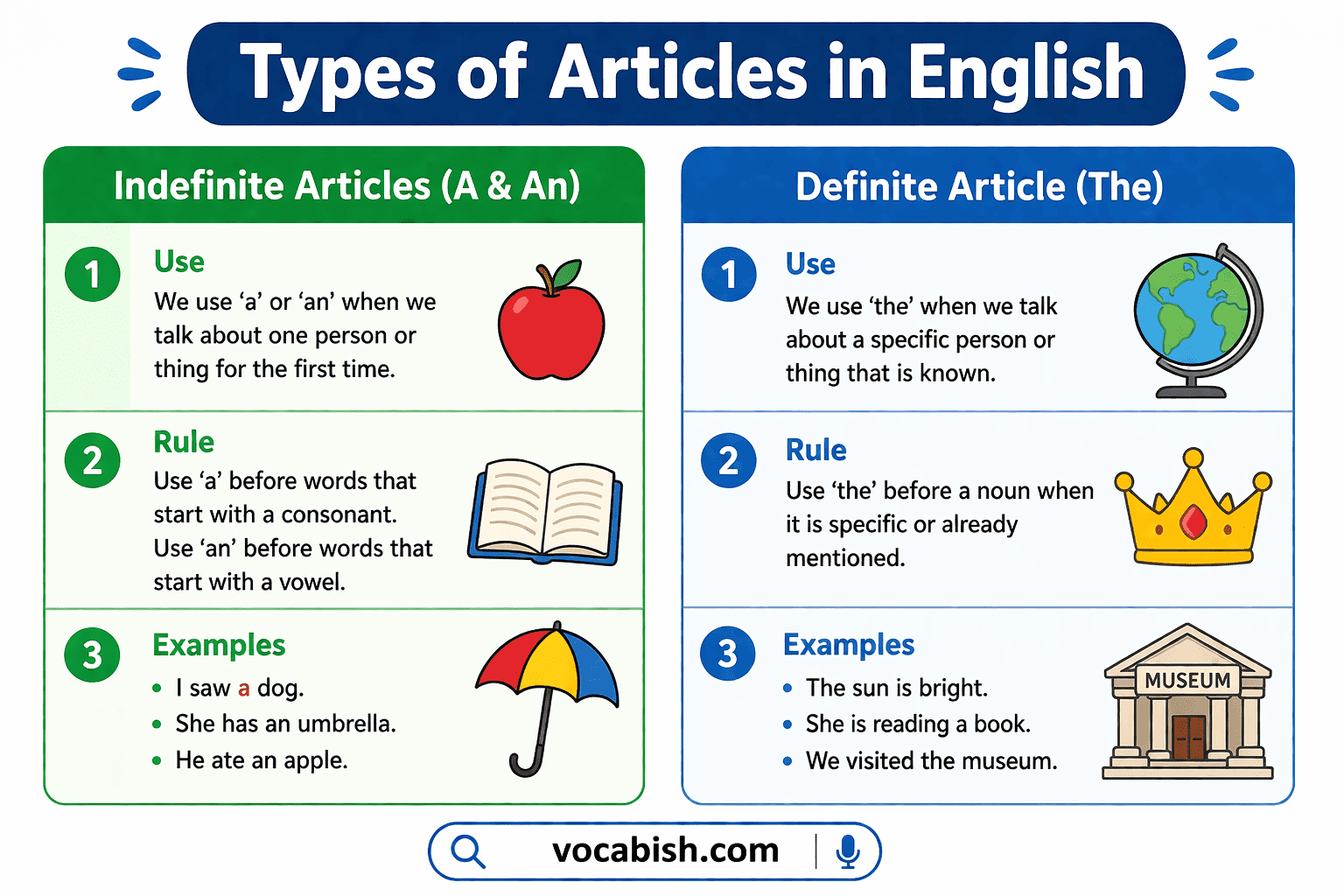

Learning Articles A, An, The in English with Uses and Examples is an important step for anyone who wants to speak and write English correctly. These small words may look easy, but they often change the meaning of a sentence. In this blog post, you will understand how A, An, and The work, when to use them, and why choosing the right one matters in real communication. Many learners feel confused because their native language may not use articles in the same way, but English depends on them to show whether something is general or specific. Once you learn this topic, you will notice improvement in your speaking, reading, writing, and listening because you will be able to understand sentences more accurately and express your ideas with better precision.
Introduction to Articles in English
If you’ve ever wondered whether to say “a apple” or “an apple,” or when to use “the” at all, you’re dealing with articles. Articles in English are small words, but they cause big confusion for learners because their use doesn’t always translate directly from other languages.
The good news is this: once you understand the logic behind articles, they become predictable. You don’t have to memorize endless rules—you just need to understand how English speakers “see” nouns.
What are Articles? (Definition and Meaning)
Articles are words that come before nouns to show whether the noun is specific or general.
In English, there are three articles:
- A
- An
- The
They help us answer a simple question:
Are we talking about something general or something specific?
Think of articles as “signposts” for nouns. They guide your listener or reader so they understand exactly what you mean.
- A and An = general (not specific)
- The = specific (known or identified)
Without articles, sentences can sound incomplete or confusing in English.
Why Articles are Important in English Grammar
Articles are important because they change meaning more than learners expect.
Look at this difference:
- I saw a dog.
- I saw the dog.
The first sentence means any dog. The second means a specific dog you and the listener already know about.
English speakers use articles automatically in everyday speech. If you miss them, your sentence may still be understood, but it will sound unnatural or unclear.
Common problems learners face:
- Forgetting articles completely
- Using “the” too often
- Confusing “a” and “an”
- Translating directly from their native language
Once you understand the system, these mistakes become easy to fix.
Types of Articles
1. Indefinite Articles (A & An)
Indefinite articles are used when we talk about something general, not specific.
- A is used before words that start with a consonant sound.
- An is used before words that start with a vowel sound (a, e, i, o, u).
The key point here is sound, not spelling.
Why? Because English is spoken based on pronunciation, not just writing.
2. Definite Article (The)
The definite article refers to something specific or already known.
We use the when:
- The listener knows what we are talking about
- There is only one of something
- We have already mentioned it before
It works like pointing: “this one specifically.”
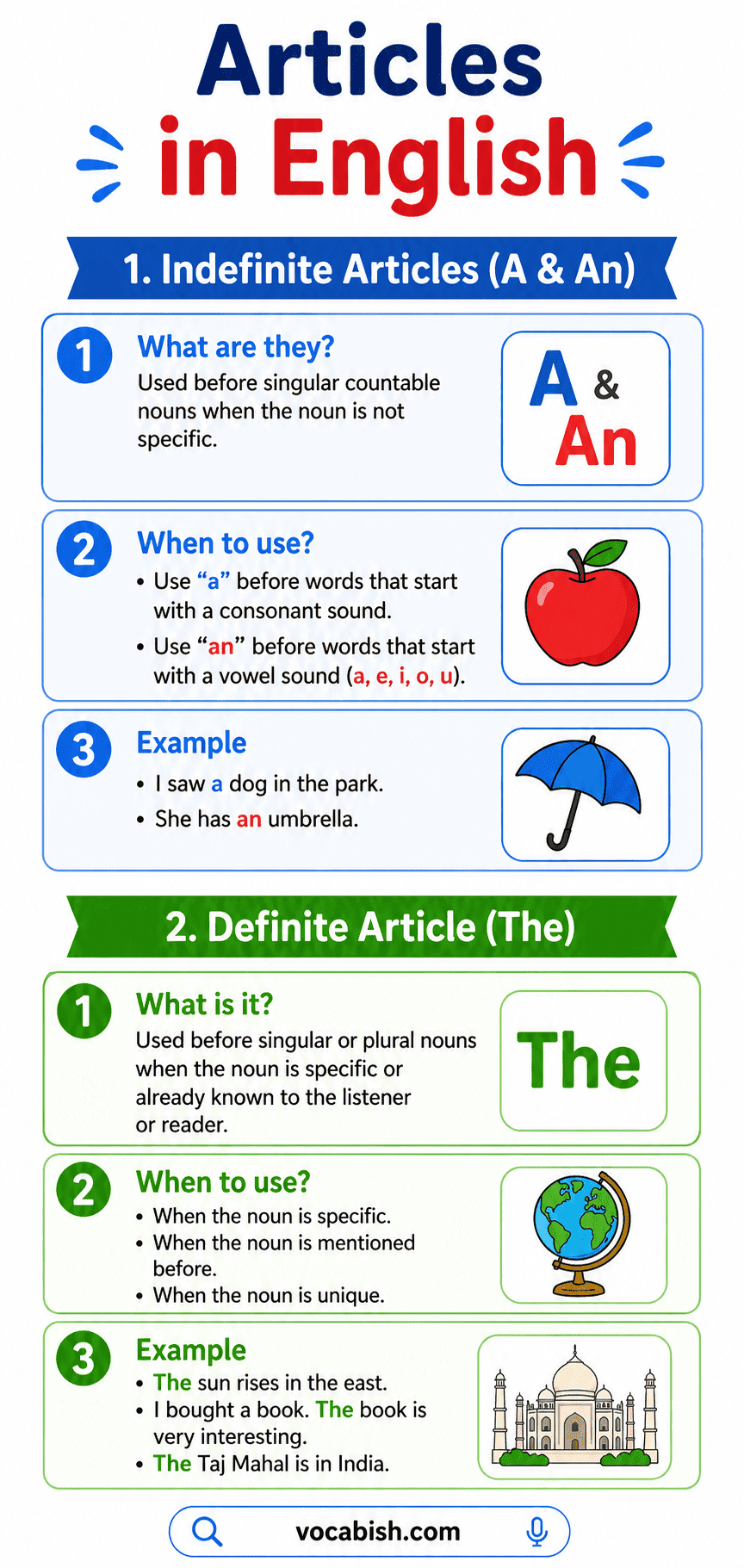
Uses of “A” in English
1. Rules for Using “A”
Use a before singular nouns that start with a consonant sound.
Important idea: it’s about sound, not letters.
We use a when:
- Talking about something for the first time
- Referring to any one item from a group
- Describing jobs or professions
- Talking about frequency (a day, a week, etc.)
2. Examples of “A” in Sentences
- I saw a bird in the garden.
- She is a doctor at the local hospital.
- He bought a new car yesterday.
- We need a pen to write this down.
- I have a meeting in the afternoon.
Common mistake: learners often forget that “a” is used for singular, not plural nouns.
Uses of “An” in English
1. Rules for Using “An”
Use an before singular nouns that start with a vowel sound (a, e, i, o, u).
But remember: sound matters more than spelling.
We use an when:
- The word begins with a vowel sound
- The word starts with a silent consonant (like “hour”)
- Talking about something non-specific and singular
2. Examples of “An” in Sentences
- She ate an apple after lunch.
- He is an engineer working in Dubai.
- I waited for an hour at the station.
- They found an old coin in the garden.
- We watched an interesting movie last night.
Common mistake: students often say “a hour,” but the “h” is silent, so it becomes an hour.
Uses of “The” in English
1. Rules for Using “The”
Use the when talking about something specific or already known.
We use the when:
- The noun has been mentioned before
- There is only one in the world (sun, moon, earth)
- Both speaker and listener know the object
- It is clear from context which one we mean
2. Examples of “The” in Sentences
- I saw a cat. The cat was black.
- Please close the door.
- The sun rises in the east.
- We went to the park near my house.
- She is sitting in the car outside.
Common mistake: overusing “the” with general nouns.
Difference Between A, An, and The
Article | Type | Meaning | Example Use |
|---|---|---|---|
A | Indefinite | One of many, general | a book |
An | Indefinite | One of many, general | an apple |
The | Definite | Specific, known | the book |
Simple way to remember:
- A/An = any one
- The = this one
When Not to Use Articles
There are times when English uses no article at all. This is called the “zero article.”
We do NOT use articles with:
- Plural general nouns: Dogs are friendly.
- Uncountable nouns (in general meaning): Water is important.
- Proper names: John is here.
- Languages and subjects: She studies English.
Examples:
- I love music.
- Students need help.
- He speaks French.
- We need advice.
Common mistake: adding “the” unnecessarily before general ideas.
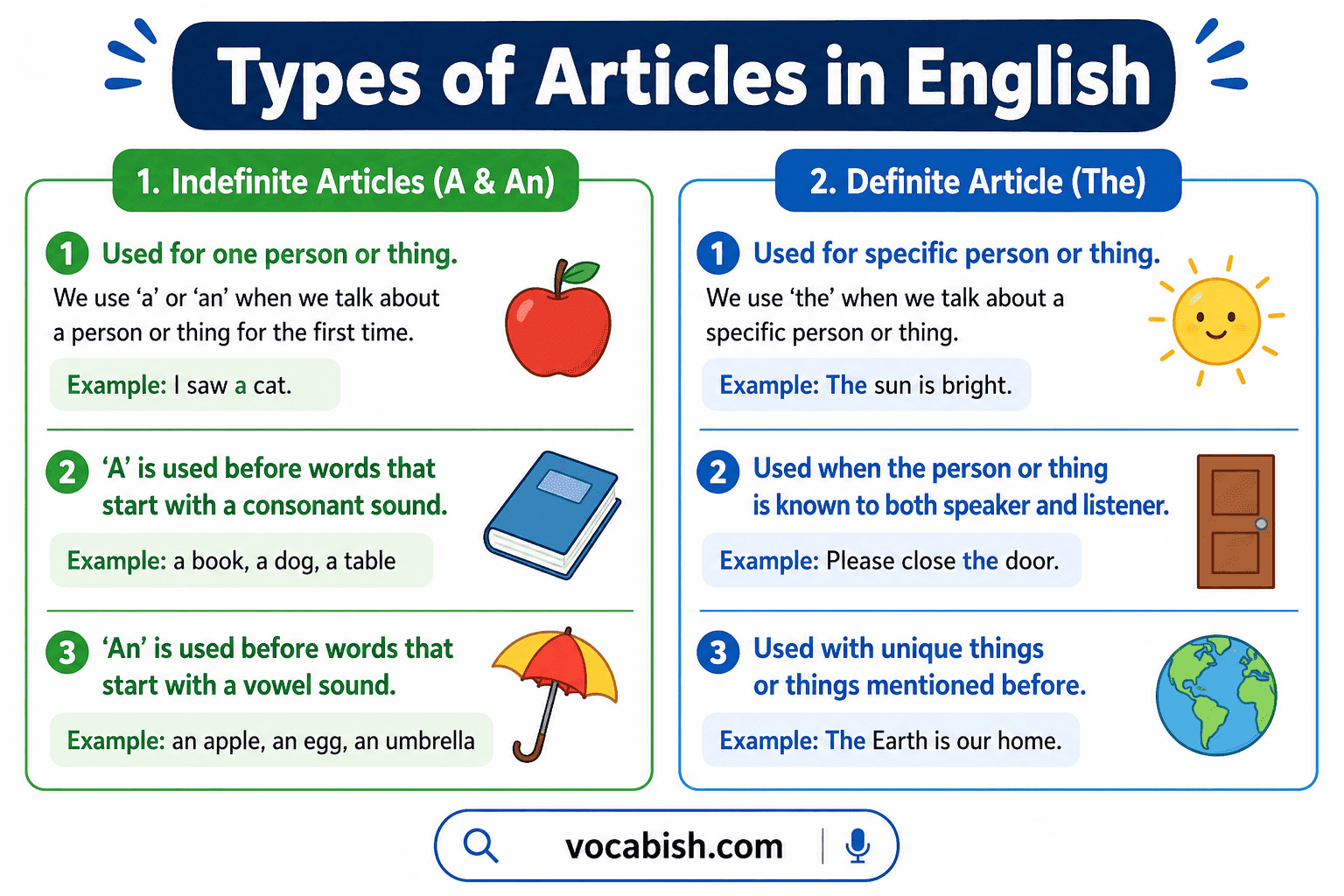
Common Mistakes with Articles
1. Wrong: I saw a elephant
Correct: I saw an elephant
Why: “Elephant” starts with a vowel sound.
2. Wrong: She is an teacher
Correct: She is a teacher
Why: “Teacher” starts with a consonant sound.
3. Wrong: I went to the school (when talking generally)
Correct: I went to school
Why: No article needed for general purpose.
4. Wrong: The water is important (general meaning)
Correct: Water is important
Why: We don’t use “the” with general uncountable nouns.
5. Wrong: He is a honest man
Correct: He is an honest man
Why: “h” is silent here.
How to Identify Correct Articles in Sentences
Choosing the right article becomes easier when you follow a mental checklist:
- Is the noun singular or plural?
- Is it specific or general?
- Does the word start with a vowel sound?
- Is this the first time I mention it?
If you’re unsure, try replacing the noun with “one” or “this one.” It often reveals the correct article.
Articles Worksheet for Practice
1. Fill in the Blanks Worksheet
Fill in with a / an / the:
- I saw ___ lion in the zoo.
- She bought ___ umbrella.
- He is ___ honest man.
- ___ sun is bright today.
- I need ___ pen.
2. Match the Correct Article
Match the correct article:
Word | Article |
|---|---|
apple | a / an |
hour | a / an |
car | a / an |
moon | the |
3. Sentence Correction Worksheet
Correct the sentences:
- I saw a elephant.
- She is a engineer.
- I went to the school (general meaning).
- He bought an car.
- The water is important for life (general meaning).
Articles Exercises with Answers
1. Beginner Exercises
- I need ___ book. → a
- She has ___ idea. → an
- ___ dog is barking. → The
2. Intermediate Exercises
- He is ___ artist. → an
- I saw ___ movie last night. → a
- ___ moon looks bright. → The
3. Advanced Exercises
- I waited for ___ hour. → an
- She is ___ university student. → a
- ___ information you gave me is useful. → The
Articles Test in English
1. Multiple Choice Questions
- I saw ___ elephant.
a) a b) an c) the - ___ sun rises in the east.
a) a b) an c) the - She is ___ doctor.
a) a b) an c) the
2. True or False Questions
- We use “an” before vowel sounds.
- “The” is used for general things.
- Articles are always optional in English.
3. Short Quiz for Practice
Fill in the blanks:
- I need ___ answer.
- He saw ___ owl at night.
- ___ water is cold today.
FAQs about Articles in English
Articles are small words like a, an, and the used before nouns to show whether something is general or specific. They help clarify meaning in sentences.
The three articles are a, an, and the. A and an are indefinite articles for general nouns, while the is a definite article for specific nouns.
Use a before words starting with a consonant sound and an before vowel sounds. The choice depends on pronunciation, not spelling of the word.
A and an refer to non-specific nouns, while the refers to specific nouns known to the speaker and listener. The defines particular people or things.
Do not use articles with plural nouns in general meaning, uncountable nouns, languages, or proper names. Example: Water is important, not The water is important.
The is used to refer to specific nouns that are already known, unique, or previously mentioned in conversation, such as the sun or the book I gave you.
Articles in English grammar (a, an, the) are used to define nouns. A and an are general, while the specifies particular nouns understood by both speaker and listener.
Conclusion
Articles in English may look small, but they carry a lot of meaning. Once you understand the difference between general and specific nouns, choosing between a, an, and the becomes much easier.
The key is practice and exposure. Pay attention to how native speakers use articles in real conversations, and you’ll start noticing patterns naturally.