
Figurative language is a creative way of using words, phrases, and expressions to communicate ideas beyond their literal meaning. Instead of saying something directly, speakers use comparisons, exaggeration, or imagination to make language more interesting and powerful.
English learners often hear figurative language in conversations, books, songs, and movies. Understanding it helps you recognize hidden meanings and express ideas clearly. It also improves reading, speaking, listening, and writing skills.
Learning figurative language helps you sound more natural and understand how native speakers communicate emotions, ideas, and experiences.
What Is Figurative Language in English
Figurative language uses creative expressions to describe ideas in a non-literal way.
Instead of saying something directly, speakers use comparisons or imagery to explain meaning.
Example:
- She runs like the wind.
The sentence does not mean she is wind. It means she runs very fast.
Figurative language helps communication become more vivid, expressive, and memorable.
Why Figurative Language Is Important for English Learners
Understanding figurative language helps learners communicate naturally.
Benefits include:
- understanding real conversations
- improving reading comprehension
- expanding vocabulary knowledge
- recognizing hidden meanings
- making speech more interesting and expressive
Without this knowledge, learners may misunderstand many everyday expressions.
Types of Figurative Language
Several types of figurative language appear in English communication.
The most common types include:
- Simile
- Metaphor
- Personification
- Hyperbole
- Idiom
Each type expresses meaning in a creative way.
Examples of Simile in Sentences
A simile compares two things using like or as.
Examples:
| No. | Sentence |
|---|---|
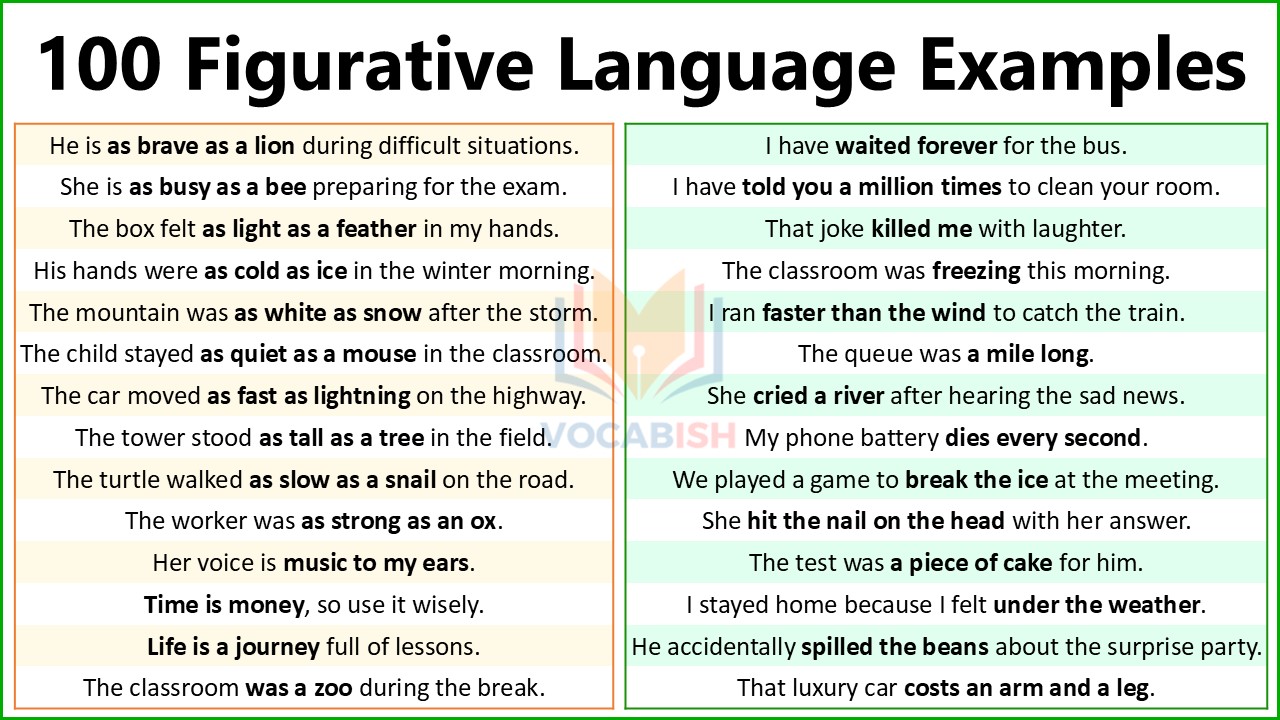
| 1 | He is as brave as a lion in difficult situations. |
| 2 | She is as busy as a bee preparing for exams. |
| 3 | The box felt as light as a feather. |
| 4 | His hands were as cold as ice in winter. |
| 5 | The mountain was as white as snow. |
| 6 | The child stayed as quiet as a mouse. |
| 7 | The car moved as fast as lightning. |
| 8 | The tower stood as tall as a tree. |
| 9 | The turtle walked as slow as a snail. |
| 10 | The worker was as strong as an ox. |
| 11 | Her smile was as bright as the sun. |
| 12 | The baby’s skin was as soft as cotton. |
| 13 | The lake was as calm as glass. |
| 14 | The metal felt as hard as rock. |
| 15 | Her voice was as sweet as honey. |
| 16 | He is as proud as a peacock. |
| 17 | The wind blew as gently as a feather. |
| 18 | The soup was as hot as lava. |
| 19 | The sky looked as dark as night. |
| 20 | The road was as smooth as silk. |
These comparisons make descriptions clearer and more interesting.
Metaphor Examples in Sentences
A metaphor compares two things without using like or as.
Examples:
| No. | Sentence |
|---|---|
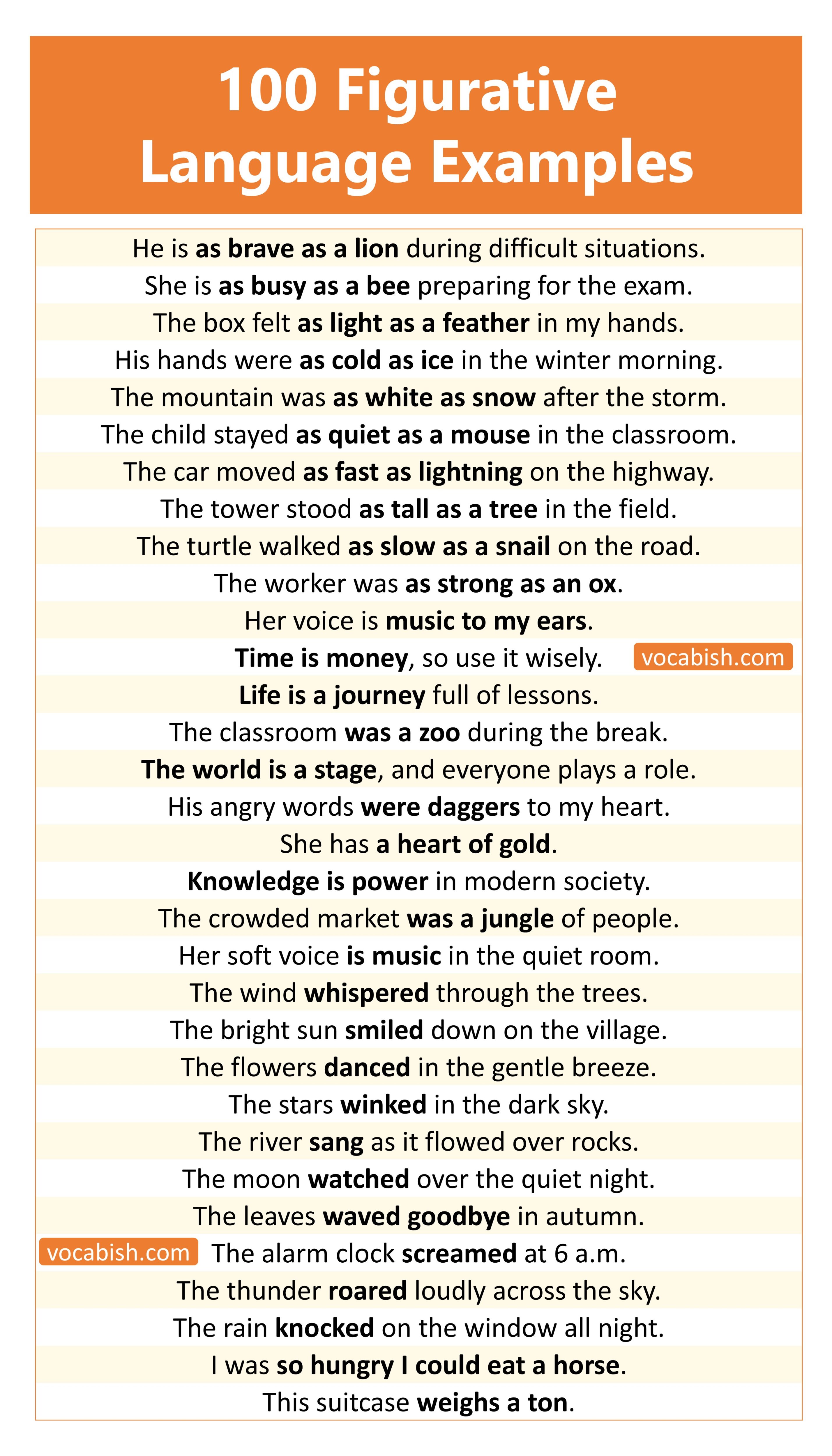
| 1 | Time is money, so use it wisely. |
| 2 | Life is a journey full of lessons. |
| 3 | The classroom was a zoo during break. |
| 4 | The world is a stage, and everyone plays a role. |
| 5 | His angry words were daggers to my heart. |
| 6 | She has a heart of gold. |
| 7 | Knowledge is power in modern life. |
| 8 | The crowded market was a jungle of people. |
| 9 | Her soft voice is music in a quiet room. |
| 10 | His mind is a computer processing information. |
| 11 | The internet is a highway of information. |
| 12 | Books are windows to the world. |
| 13 | Hope is a light in difficult times. |
| 14 | Fear is a shadow that follows doubt. |
| 15 | Her words built a bridge between the friends. |
| 16 | The classroom was a battlefield during the exam. |
| 17 | Love is a fire that warms the heart. |
| 18 | Success is a ladder we must climb. |
| 19 | The city was a jungle at night. |
| 20 | His determination was stronger than steel. |
Metaphors help explain ideas through vivid comparisons.
Personification Examples in Sentences
Personification gives human qualities to animals, objects, or nature.
Examples:
| No. | Sentence |
|---|---|
| 1 | The wind whispered through the trees. |
| 2 | The sun smiled down on us. |
| 3 | The flowers danced in the breeze. |
| 4 | The stars winked in the night sky. |
| 5 | The river sang as it flowed. |
| 6 | The moon watched silently over the town. |
| 7 | The leaves waved goodbye in autumn. |
| 8 | The clock screamed midnight. |
| 9 | The thunder roared angrily. |
| 10 | The rain tapped on the window. |
| 11 | The tree hugged the ground with its roots. |
| 12 | The fire swallowed the wood. |
| 13 | The ocean called to the sailors. |
| 14 | The sky cried with rain. |
| 15 | The book spoke wisdom to its readers. |
| 16 | The snow covered the earth like a blanket. |
| 17 | The road welcomed travelers. |
| 18 | The wind chased the clouds across the sky. |
| 19 | Darkness swallowed the city. |
| 20 | The storm attacked the village. |
Personification makes descriptions more vivid and imaginative.
Hyperbole Examples in Sentences
Hyperbole uses exaggeration to emphasize meaning.
Examples:
| No. | Sentence |
|---|---|
| 1 | I am so hungry I could eat a horse. |
| 2 | This bag weighs a ton. |
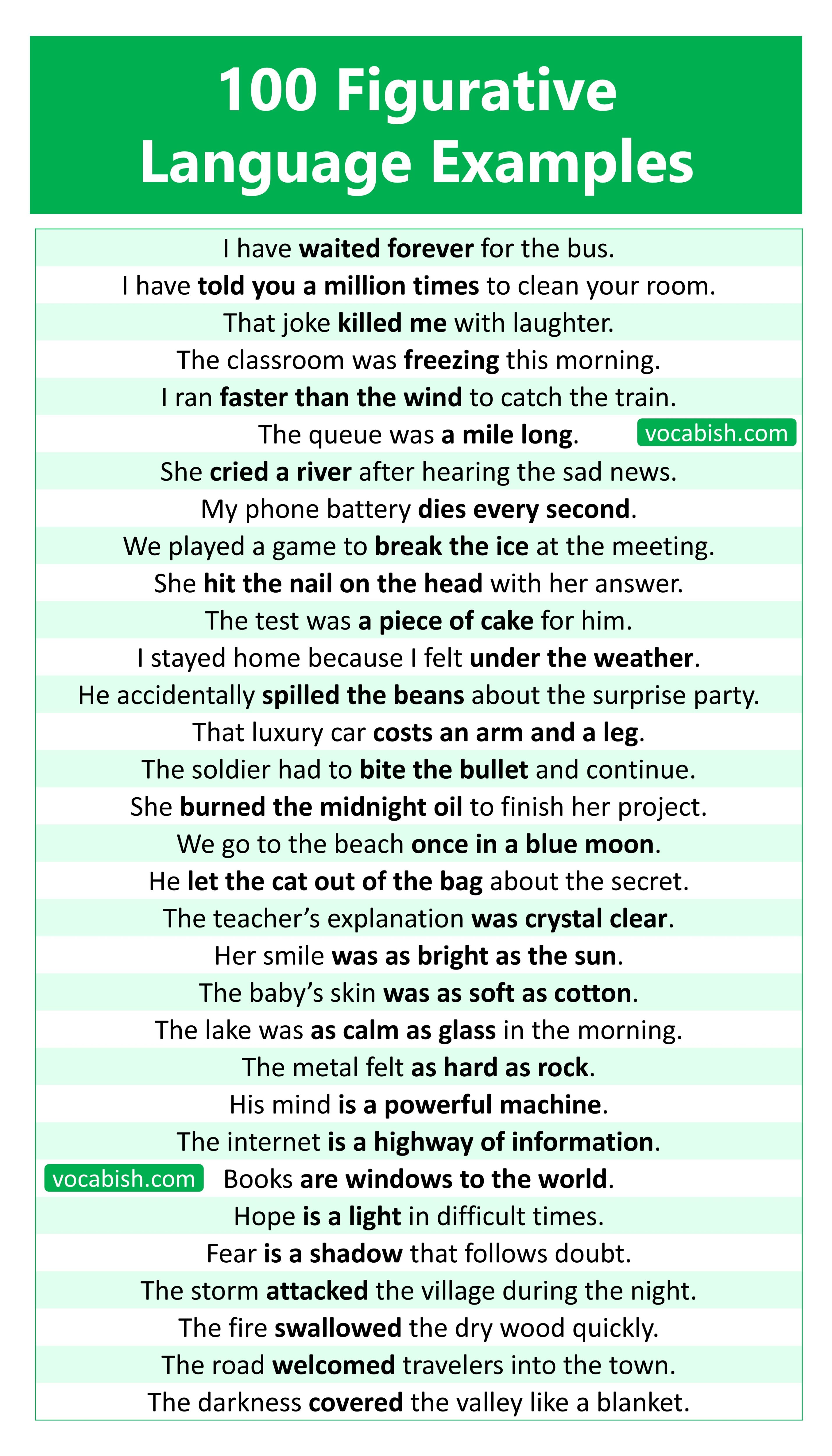
| 3 | I have waited forever for the bus. |
| 4 | I have told you a million times to clean your room. |
| 5 | That joke killed me with laughter. |
| 6 | The classroom was freezing. |
| 7 | I ran faster than the wind. |
| 8 | The line was a mile long. |
| 9 | She cried a river of tears. |
| 10 | My phone battery dies every second. |
| 11 | The homework took ages to finish. |
| 12 | The sun was blazing like fire. |
| 13 | He talks nonstop forever. |
| 14 | I am buried in work. |
| 15 | The noise was deafening. |
| 16 | I nearly died laughing. |
| 17 | This book weighs a thousand pounds. |
| 18 | The crowd roared like thunder. |
| 19 | I was drowning in homework. |
| 20 | My backpack is a mountain on my shoulders. |
Idiom Examples in Sentences
An idiom is a phrase whose meaning is different from the literal words.
Examples:
| No. | Sentence |
|---|---|
| 1 | We played a game to break the ice. |
| 2 | She hit the nail on the head with her answer. |
| 3 | The test was a piece of cake. |
| 4 | I felt under the weather yesterday. |
| 5 | He accidentally spilled the beans about the party. |
| 6 | That car costs an arm and a leg. |
| 7 | He had to bite the bullet and finish the work. |
| 8 | She burned the midnight oil studying. |
| 9 | We go to the beach once in a blue moon. |
| 10 | He let the cat out of the bag. |
| 11 | They jumped the gun and started early. |
| 12 | She always beats around the bush instead of answering. |
| 13 | The mistake turned out to be a blessing in disguise. |
| 14 | He tried to cut corners on the project. |
| 15 | She got cold feet before the exam. |
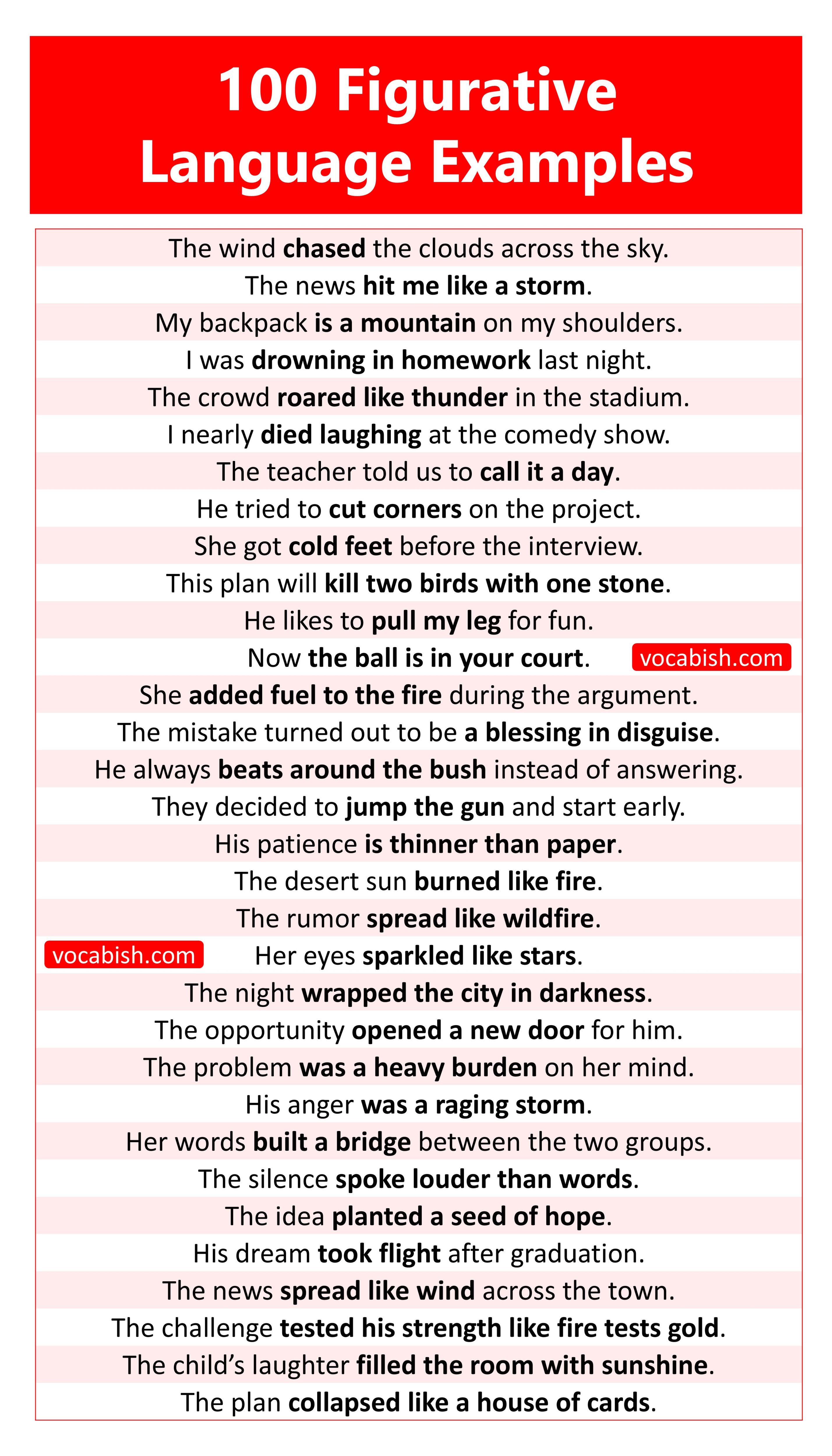
| 16 | This plan will kill two birds with one stone. |
| 17 | He likes to pull my leg for fun. |
| 18 | Now the ball is in your court. |
| 19 | She added fuel to the fire during the argument. |
| 20 | The plan collapsed like a house of cards. |
Idioms appear very often in everyday English conversation.
Figurative Language Vocabulary Words
Important vocabulary related to figurative language helps learners understand how these expressions work.
- Comparison – showing similarities between things
- Imagery – descriptive language that creates pictures in the mind
- Symbol – something representing a deeper meaning
- Expression – a phrase used to communicate ideas
- Meaning – what a word or sentence communicates
- Emotion – feelings expressed through language
- Description – explaining something with words
- Creativity – using imagination in language
- Interpretation – understanding hidden meaning
- Context – the situation that helps explain meaning
- Tone – the attitude of the speaker or writer
- Narrative – storytelling language
- Style – the way language is used
- Communication – sharing ideas with others
- Understanding – recognizing the intended meaning
Tips for Understanding Figurative Language
Follow these simple tips when learning figurative language.
- Look at the context of the sentence
- Identify comparisons or exaggerations
- Think about the intended meaning, not the literal words
- Practice with common expressions
- Read stories and conversations to see real examples
With practice, recognizing figurative language becomes easier.
Figurative Language Examples PDF
Conclusion
Figurative language adds color, emotion, and creativity to English communication. It allows speakers and writers to describe ideas in vivid and memorable ways.
By learning these 100 figurative language examples, English learners can improve vocabulary, understand deeper meanings, and communicate more confidently.
FAQs
Figurative language is a way of using words and expressions to convey meaning beyond the literal sense, making writing and speech more vivid, imaginative, and interesting.
Examples of figurative language include similes like “as brave as a lion,” metaphors like “time is money,” hyperbole like “I waited forever,” and idioms like “break the ice.”
The main types of figurative language are simile, metaphor, personification, hyperbole, and idioms, each used to express ideas in creative, non-literal ways.
Literal language means exactly what it says, while figurative language uses creative expressions like metaphors, similes, and idioms to convey deeper or imaginative meaning.
A simile is a type of figurative language that compares two things using “like” or “as”, such as “as brave as a lion,” to make descriptions more vivid.
Hyperbole is an exaggerated statement used for emphasis or effect, such as “I waited forever,” to make ideas stronger or more dramatic.
Related Articles: