
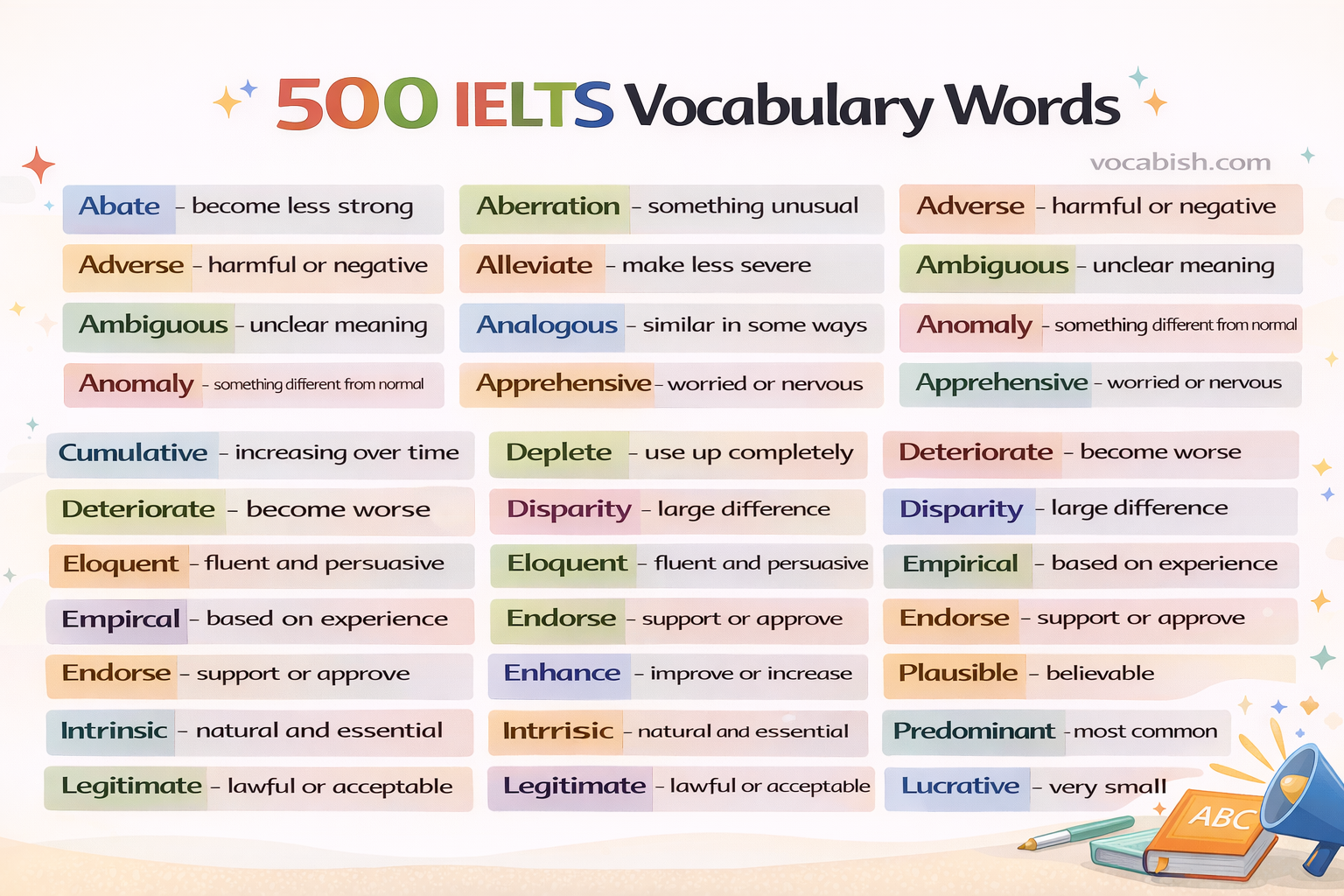
Building a strong vocabulary is key to success in IELTS, and knowing the right words helps you learn English more effectively. In this blog post, you will explore 500+ IELTS vocabulary words with meanings and a PDF, which makes it easier to understand, remember, and use them in reading, writing, speaking, and listening. Learning these words improves your English skills and gives you the confidence to score higher in the IELTS exam.
What Are IELTS Vocabulary Words?
IELTS vocabulary words are commonly used words that appear in reading passages, listening tests, writing tasks, and speaking questions.
These words help you:
- Explain ideas better
- Show clear understanding
- Sound more confident
They are often used in academic, social, and daily life contexts.

Why Vocabulary is Important for IELTS
Vocabulary improves:
- Clarity of ideas
- Accuracy in writing
- Fluency in speaking
Using the right words shows language control and strong understanding.
Academic IELTS Vocabulary Words
| Word | Meaning |
|---|---|
| Analyse | Study something carefully |
| Approach | A way of doing something |
| Concept | An idea |
| Data | Information |
| Factor | Something that affects a result |
| Function | Purpose |
| Identify | Find or recognise |
| Method | Way of doing something |
| Process | Series of actions |
| Research | Careful study |
Opinion and Viewpoint Words
| Word | Meaning |
|---|---|
| Believe | Think something is true |
| Claim | Say something is true |
| Argue | Give reasons |
| Suggest | Put forward an idea |
| Agree | Have same opinion |
| Disagree | Have different opinion |
| View | Opinion |
| Perspective | Way of seeing something |
| Attitude | Feeling or thinking |
| Assume | Think without proof |
Cause and Effect Vocabulary
| Word | Meaning |
|---|---|
| Cause | Reason |
| Effect | Result |
| Lead to | Make something happen |
| Result in | End with |
| Due to | Because of |
| Therefore | For this reason |
| Consequently | As a result |
| Impact | Strong effect |
| Influence | Affect |
| Outcome | Final result |
Comparison and Contrast Words
| Word | Meaning |
|---|---|
| Compare | Find similarities |
| Contrast | Show differences |
| Similar | Almost same |
| Different | Not the same |
| Whereas | While |
| However | But |
| Although | Even if |
| Likewise | In same way |
| Unlike | Not like |
| In contrast | Opposite idea |
Problem and Solution Vocabulary
| Word | Meaning |
|---|---|
| Problem | Difficulty |
| Issue | Important problem |
| Challenge | Difficult task |
| Solution | Answer to a problem |
| Solve | Find an answer |
| Improve | Make better |
| Reduce | Make smaller |
| Prevent | Stop from happening |
| Deal with | Handle |
| Overcome | Successfully face |
Environment Vocabulary
| Word | Meaning |
|---|---|
| Pollution | Dirty air or water |
| Climate | Weather pattern |
| Environment | Natural world |
| Recycle | Use again |
| Waste | Rubbish |
| Protect | Keep safe |
| Global warming | Rise in earth temperature |
| Natural resources | Materials from nature |
| Renewable | Can be used again |
| Conservation | Protection of nature |
Education Vocabulary
| Word | Meaning |
|---|---|
| Education | Learning system |
| Student | Learner |
| Teacher | Instructor |
| Curriculum | Course content |
| Knowledge | Information |
| Skill | Ability |
| Study | Learn |
| Degree | University qualification |
| Training | Learning practice |
| Academic | Related to study |
Technology Vocabulary
| Word | Meaning |
|---|---|
| Technology | Use of machines |
| Internet | Online network |
| Device | Electronic tool |
| Software | Computer programs |
| Digital | Computer-based |
| Online | On the internet |
| Data | Stored information |
| Innovation | New idea |
| System | Connected parts |
| Automation | Work done by machines |
Health Vocabulary
| Word | Meaning |
|---|---|
| Health | Physical condition |
| Disease | Illness |
| Treatment | Medical care |
| Exercise | Physical activity |
| Diet | Food habit |
| Mental health | Emotional well-being |
| Stress | Pressure |
| Patient | Sick person |
| Medical | Related to health |
| Cure | Make well again |
Society and Culture Vocabulary
| Word | Meaning |
|---|---|
| Society | Group of people |
| Culture | Traditions and beliefs |
| Tradition | Long-followed custom |
| Population | Number of people |
| Community | Local group |
| Lifestyle | Way of living |
| Values | Important beliefs |
| Equality | Same rights |
| Diversity | Differences |
| Social | Related to people |
List of High-Value IELTS Words
- Benefit – Advantage
- Disadvantage – Weak point
- Significant – Important
- Minor – Small
- Majority – Most people
- Minority – Small group
- Trend – General direction
- Increase – Grow
- Decrease – Become less
- Maintain – Keep same
- Achieve – Reach goal
- Develop – Grow or improve
- Efficient – Work well
- Limited – Small amount
- Essential – Very important

500+ IELTS Vocabulary Words with Meanings
A Words
- Active – energetic
- Antique – old item
- Agility – quick movement
- Attire – clothes
- Awful – very bad
- Assets – useful things you own
- Ample – enough, plenty
- Amateur – beginner
- Abroad – overseas
- Adversity – difficulty
- Allure – attract
- Admit – confess
- Amiable – friendly
- Aggressive – assertive
- Achieve – accomplish
- Aid – help
- Amount – quantity
- Adequate – enough, sufficient
- Allow – permit
- Agree – consent
- Appropriate – suitable
B Words
- Brave – bold
- Beneficial – helpful
- Before – prior
- Brief – short
- Blunder – big mistake
- Bottom – base
- Broad – wide
- Believe – trust
- Beautiful – pretty
- Blend – mix
- Begin – start
C Words
- Close – near, shut
- Calamity – disaster
- Chiefly – mainly
- Considerate – thoughtful
- Correct – right, accurate
- Connect – join
- Contemporary – modern
- Courage – bravery
- Change – transform
- Collect – gather
- Chaos – noisy mess
- Clarify – explain
- Confirm – verify
- Cruel – mean
- Candid – honest
D Words
- Dirty – messy
- Diverse – different
- Despise – hate
- Delicate – fragile
- Daybreak – dawn
- Dubious – doubtful
- Dusk – sunset
- Disagree – differ
- Defend – protect
- Divide – separate
- Destiny – fate
E Words
- Elevate – lift
- Exit – leave
- Enormous – huge
- Encourage – support
- Envisage – imagine
- Evaluate – assess
- Expand – enlarge
- Essential – necessary
- Exact – precise
- Enjoy – like
F Words
- Finish – complete
- Fill – load, pack
- Fatal – deadly
- Function – work, operate
- Future – coming time
- Famous – well-known
- Fantastic – great
- Fast – quick
- False – untrue
- Fragile – delicate
G Words
- Gain – obtain
- Great – very good
- Gaunt – thin, skinny
- Gloomy – dark, sad
- Grasp – understand
- Glad – happy
- Generous – giving
- Glance – quick look
- Gesture – body movement
H Words
- Hazard – danger
- Hire – recruit
- Huge – very large
- Hurry – rush
- Humble – modest
- Hint – tip
- Hard – difficult
- Hall – corridor
- Help – assist
I Words
- Insomnia – sleeplessness
- Inferior – lesser
- Instant – immediate
- Intend – mean to do
- Innocent – harmless
- Impartial – neutral
- Impact – effect
- Ignore – overlook
- Identify – recognise
- Inspect – examine
J Words
- Joy – delight
- Jolly – cheerful
- Join – connect
K and L Words
- Kind – friendly, good
- Kid – child
- Listen – hear
- Logical – sensible
- Long – lengthy
- Little – small
- Lots – many

M Words
- Maintain – preserve
- Meeting – assembly
- Modern – contemporary
- Mostly – mainly
- Minor – small or less
- Magnify – enlarge
- Make – build
- Manage – control
- Meaning – sense, definition
- Miser – stingy person
N and O Words
- Near – close
- Native – local
- New – recent
- Normal – usual
- Notice – observe
- Obey – follow order
- Observe – watch carefully
- Opportunity – chance
- Ordinary – usual
- Optional – not required
P Words
- Part – section
- Provide – supply
- Praise – compliment
- Perfect – flawless
- Primary – main, first
- Plan – prepare
- Prevent – stop something
Q, R, S, T Words
- Quite – fairly
- Quit – stop
- Receive – get
- Regret – remorse
- Reliable – dependable
- Reluctant – hesitant
- Rest – relax
- Respond – reply
- Sustain – keep going
- Sad – unhappy
- Strong – powerful
- Sure – certain
- Teach – instruct
- Tidy – clean
Advanced-level IELTS Vocabulary List
- Abate: become less strong
- Aberration: something unusual
- Adverse: harmful or negative
- Alleviate: make less severe
- Ambiguous: unclear meaning
- Analogous: similar in some ways
- Anomaly: something different from normal
- Apprehensive: worried or nervous
- Arbitrary: random or without reason
- Assumption: belief without proof
- Catalyst: something that causes change
- Coherent: clear and logical
- Constrain: limit or restrict
- Contentious: causing disagreement
- Conventional: traditional
- Corroborate: confirm with evidence
- Cumulative: increasing over time
- Deplete: use up completely
- Deteriorate: become worse
- Disparity: large difference
- Eloquent: fluent and persuasive
- Empirical: based on experience
- Endorse: support or approve
- Enhance: improve or increase
- Erosion: gradual destruction
- Exacerbate: make a problem worse
- Feasible: possible to do
- Fluctuate: change often
- Formidable: very difficult
- Futile: useless or pointless
- Hypothesis: proposed explanation
- Impartial: fair and neutral
- Inevitable: cannot be avoided
- Infer: reach a conclusion
- Inhibit: prevent or slow down
- Intrinsic: natural and essential
- Justification: reason or explanation
- Legitimate: lawful or acceptable
- Lucrative: very profitable
- Marginal: very small
- Mitigate: reduce the impact
- Notion: idea or belief
- Obsolete: no longer used
- Paradigm: model or example
- Plausible: believable
- Predominant: most common
- Prevalent: widespread
- Proponent: supporter of an idea
- Prudent: careful and wise
- Radical: extreme or major
- Resilient: able to recover
- Scrutinise: examine closely
- Significant: important
- Sustainable: able to continue long-term
- Tentative: not certain
- Transient: temporary
- Unprecedented: never happened before
- Viable: workable or practical
- Vulnerable: easily harmed
- Widespread: found in many places

IELTS Vocabulary Words PDF
Tips to Learn IELTS Vocabulary Faster
- Learn 5–10 words daily
- Use words in simple sentences
- Group words by topic
- Revise weekly
- Practice speaking and writing
Learning IELTS vocabulary does not need to be difficult. With simple meanings, clear categories, and regular practice, you can improve your reading, writing, listening, and speaking skills.
This 500+ IELTS vocabulary list gives you a strong base to understand questions, share ideas clearly, and feel confident in the IELTS exam.
Frequently Asked Questions
How can I improve my IELTS vocabulary?
You can improve your IELTS vocabulary by learning new words daily, reading IELTS-level texts, and using words in simple sentences. Focus on common academic words, synonyms, and topic-based vocabulary. Regular revision and practice in speaking and writing help you remember words better.
What vocabulary do I need for IELTS?
For IELTS, you need general English words and academic vocabulary. This includes words related to education, health, environment, technology, society, and daily life. Learning a list of 500+ IELTS vocabulary words with meanings gives you enough range to understand questions and answer clearly.
How can I get 7.5 in IELTS speaking?
To get 7.5 in IELTS speaking, use accurate vocabulary, speak clearly, and avoid repeating basic words. Use topic-related words, simple collocations, and correct grammar. Practice answering questions fully and explain ideas using natural and clear language.
What are 20 tricky IELTS words with meaning?
Here are 20 tricky but useful IELTS words with easy meanings:
- Ambiguous – unclear
- Alleviate – make less severe
- Deteriorate – become worse
- Resilient – able to recover
- Scarce – limited
- Subtle – not obvious
- Coherent – clear and logical
- Plausible – believable
- Arbitrary – random
- Inevitable – cannot be avoided
- Fluctuate – change often
- Redundant – unnecessary
- Significant – important
- Marginal – small
- Exceed – go beyond
- Adequate – enough
- Sustainable – long-lasting
- Controversial – causing debate
- Reluctant – unwilling
- Notion – idea
Is learning 500+ IELTS vocabulary words enough for a high band score?
Yes, learning 500+ IELTS vocabulary words with meanings is enough if you know how to use them correctly. Quality matters more than quantity. Use words in context, not memorisation only, to score well in writing and speaking.
How should I practise IELTS vocabulary for long-term memory?
Practise IELTS vocabulary by grouping words by topic, writing short paragraphs, and speaking aloud. Revise weekly and use words in real examples. This method helps words stay in your memory and improves overall language confidence.
Read More