
Building a strong vocabulary is key to success in IELTS, and knowing the right words helps you learn English more effectively. In this blog post, you will explore 500+ IELTS vocabulary words with meanings and a PDF, which makes it easier to understand, remember, and use them in reading, writing, speaking, and listening. Learning these words improves your English skills and gives you the confidence to score higher in the IELTS exam.
What Are IELTS Vocabulary Words?
IELTS vocabulary words are commonly used words that appear in reading passages, listening tests, writing tasks, and speaking questions.
These words help you:
- Explain ideas better
- Show clear understanding
- Sound more confident
They are often used in academic, social, and daily life contexts.

Why Vocabulary is Important for IELTS
Vocabulary improves:
- Clarity of ideas
- Accuracy in writing
- Fluency in speaking
Using the right words shows language control and strong understanding.
Academic IELTS Vocabulary Words
Word | Meaning |
|---|---|
Analyse | Study something carefully |
Approach | A way of doing something |
Concept | An idea |
Data | Information |
Factor | Something that affects a result |
Function | Purpose |
Identify | Find or recognise |
Method | Way of doing something |
Process | Series of actions |
Research | Careful study |
Opinion and Viewpoint Words
Word | Meaning |
|---|---|
Believe | Think something is true |
Claim | Say something is true |
Argue | Give reasons |
Suggest | Put forward an idea |
Agree | Have same opinion |
Disagree | Have different opinion |
View | Opinion |
Perspective | Way of seeing something |
Attitude | Feeling or thinking |
Assume | Think without proof |
Cause and Effect Vocabulary
Word | Meaning |
|---|---|
Cause | Reason |
Effect | Result |
Lead to | Make something happen |
Result in | End with |
Due to | Because of |
Therefore | For this reason |
Consequently | As a result |
Impact | Strong effect |
Influence | Affect |
Outcome | Final result |
Comparison and Contrast Words
Word | Meaning |
|---|---|
Compare | Find similarities |
Contrast | Show differences |
Similar | Almost same |
Different | Not the same |
Whereas | While |
However | But |
Although | Even if |
Likewise | In same way |
Unlike | Not like |
In contrast | Opposite idea |
Problem and Solution Vocabulary
Word | Meaning |
|---|---|
Problem | Difficulty |
Issue | Important problem |
Challenge | Difficult task |
Solution | Answer to a problem |
Solve | Find an answer |
Improve | Make better |
Reduce | Make smaller |
Prevent | Stop from happening |
Deal with | Handle |
Overcome | Successfully face |
Environment Vocabulary
Word | Meaning |
|---|---|
Pollution | Dirty air or water |
Climate | Weather pattern |
Environment | Natural world |
Recycle | Use again |
Waste | Rubbish |
Protect | Keep safe |
Global warming | Rise in earth temperature |
Natural resources | Materials from nature |
Renewable | Can be used again |
Conservation | Protection of nature |
Education Vocabulary
Word | Meaning |
|---|---|
Education | Learning system |
Student | Learner |
Teacher | Instructor |
Curriculum | Course content |
Knowledge | Information |
Skill | Ability |
Study | Learn |
Degree | University qualification |
Training | Learning practice |
Academic | Related to study |
Technology Vocabulary
Word | Meaning |
|---|---|
Technology | Use of machines |
Internet | Online network |
Device | Electronic tool |
Software | Computer programs |
Digital | Computer-based |
Online | On the internet |
Data | Stored information |
Innovation | New idea |
System | Connected parts |
Automation | Work done by machines |
Health Vocabulary
Word | Meaning |
|---|---|
Health | Physical condition |
Disease | Illness |
Treatment | Medical care |
Exercise | Physical activity |
Diet | Food habit |
Mental health | Emotional well-being |
Stress | Pressure |
Patient | Sick person |
Medical | Related to health |
Cure | Make well again |
Society and Culture Vocabulary
Word | Meaning |
|---|---|
Society | Group of people |
Culture | Traditions and beliefs |
Tradition | Long-followed custom |
Population | Number of people |
Community | Local group |
Lifestyle | Way of living |
Values | Important beliefs |
Equality | Same rights |
Diversity | Differences |
Social | Related to people |
List of High-Value IELTS Words
- Benefit – Advantage
- Disadvantage – Weak point
- Significant – Important
- Minor – Small
- Majority – Most people
- Minority – Small group
- Trend – General direction
- Increase – Grow
- Decrease – Become less
- Maintain – Keep same
- Achieve – Reach goal
- Develop – Grow or improve
- Efficient – Work well
- Limited – Small amount
- Essential – Very important

500+ IELTS Vocabulary Words with Meanings
A Words
- Abandon — to leave something completely.
- Abundant — available in a large quantity.
- Accurate — correct and free from mistakes.
- Adapt — to change according to new conditions.
- Adequate — enough for a particular purpose.
- Advocate — to publicly support an idea or policy.
- Affect — to cause a change in something.
- Alternative — another possible choice or option.
- Analyse — to examine something carefully.
- Annual — happening once every year.
- Apparent — clear or easy to notice.
- Approach — a method of dealing with something.
B Words
- Balance — a fair or equal condition between things.
- Barrier — something that prevents movement or progress.
- Basic — simple and most important.
- Behaviour — the way a person or animal acts.
- Belief — an idea that someone accepts as true.
- Benchmark — a standard used for comparison.
- Benefit — an advantage or positive result.
- Bias — an unfair preference for one side.
- Brief — short in time or length.
- Broaden — to make something wider or more varied.
- Boost — to increase or improve something.
- Burden — a difficult responsibility or problem.
C Words
- Capacity — the ability or maximum amount something can hold.
- Challenge — a difficult task or problem.
- Clarify — to make something easier to understand.
- Coherent — clear, logical, and well organised.
- Collapse — to fall down or fail suddenly.
- Combine — to join two or more things together.
- Compensate — to provide something for a loss or disadvantage.
- Complex — difficult because it has many connected parts.
- Conclude — to reach a final decision or opinion.
- Conduct — to organise or carry out an activity.
- Consequence — a result of an action or situation.
- Consume — to use, eat, or drink something.
D Words
- Decline — to decrease or become less.
- Define — to explain the exact meaning of something.
- Demonstrate — to show something clearly.
- Dense — containing many things in a small area.
- Derive — to obtain or develop something from a source.
- Detect — to discover or notice something.
- Deteriorate — to become worse over time.
- Distinct — clearly different from something else.
- Distribute — to give or spread something among people.
- Diverse — including many different types.
- Domestic — related to a particular country or home.
- Duration — the amount of time something continues.
E Words
- Efficient — working well without wasting time or resources.
- Eliminate — to remove something completely.
- Emerge — to appear or become known.
- Emphasise — to give special importance to something.
- Enable — to make something possible.
- Encounter — to meet or experience something unexpectedly.
- Enhance — to improve the quality or value of something.
- Ensure — to make certain that something happens.
- Establish — to create or start something permanently.
- Evaluate — to judge the quality or importance of something.
- Evidence — facts or information that prove something.
- Exceed — to be greater than a particular amount.
F Words
- Facilitate — to make a process easier.
- Factor — something that influences a result.
- Feasible — possible and practical to achieve.
- Flexible — able to change easily when needed.
- Fluctuate — to rise and fall irregularly.
- Focus — to give attention to one particular thing.
- Forecast — a prediction about a future situation.
- Formulate — to develop a plan or idea carefully.
- Framework — a basic structure supporting a system.
- Function — the purpose or role of something.
- Fundamental — basic and extremely important.
- Furthermore — in addition to what has already been said.
G Words
- Gap — a difference or empty space between things.
- Generate — to produce or create something.
- Geographic — related to places and physical areas.
- Genuine — real, honest, or authentic.
- Global — relating to the whole world.
- Goal — something a person wants to achieve.
- Govern — to control or manage a country or organisation.
- Gradual — happening slowly over time.
- Grant — to officially give or allow something.
- Growth — an increase in size, number, or development.
- Guarantee — to promise that something will happen.
- Guideline — advice or a rule explaining what to do.
H Words
- Habitat — the natural home of an animal or plant.
- Harmful — causing damage or injury.
- Healthcare — services that maintain or improve health.
- Hesitate — to pause because of uncertainty.
- Hierarchy — a system with different levels of importance.
- Highlight — to draw attention to something important.
- Holistic — considering all parts of a situation together.
- Hostile — unfriendly, harmful, or aggressive.
- Household — all the people living in one home.
- Huge — extremely large.
- Humanitarian — concerned with improving people’s lives.
- Hypothesis — an idea that can be tested through research.
I Words
- Identify — to recognise or name something.
- Illustrate — to explain something by using examples.
- Impact — a strong effect on someone or something.
- Implement — to put a plan into action.
- Imply — to suggest something without saying it directly.
- Improve — to make something better.
- Incentive — something that encourages a person to act.
- Indicate — to show or point out something.
- Inevitable — certain to happen and impossible to avoid.
- Infer — to form a conclusion from available information.
- Infrastructure — basic systems such as roads and electricity.
- Innovative — introducing new ideas or methods.
J Words
- Jeopardise — to put something in danger.
- Jobless — without paid employment.
- Joint — shared or done by two or more parties.
- Journal — a publication containing academic or professional articles.
- Journey — the act of travelling from one place to another.
- Judgement — an opinion formed after careful consideration.
- Judicial — related to courts and legal decisions.
- Justice — fair treatment according to law or morality.
- Justifiable — having a good or acceptable reason.
- Justify — to give reasons showing something is right.
K Words
- Keen — highly interested or enthusiastic.
- Key — extremely important.
- Keynote — the main idea or speech at an event.
- Kilogram — a unit used to measure weight.
- Kindle — to cause a feeling or interest to begin.
- Kingdom — a country ruled by a king or queen.
- Kinship — a family connection or close relationship.
- Kinetic — related to movement.
- Knowledge — information and understanding gained through learning.
- Knowledgeable — having a great deal of information.
L Words
- Labour — physical or mental work.
- Lack — the absence of something necessary.
- Legal — allowed or required by law.
- Legislation — laws made by a government.
- Limit — the greatest amount that is allowed.
- Link — a connection between two things.
- Literacy — the ability to read and write.
- Livelihood — a way of earning money to live.
- Locate — to find the position of something.
- Logical — based on clear and sensible reasoning.
- Long-term — continuing for a long period.
- Lower — to reduce the amount or level of something.
M Words
- Maintain — to keep something in good condition.
- Major — large, serious, or important.
- Marginal — small or limited in importance.
- Measure — to calculate the size or amount of something.
- Mechanism — a system or process that produces a result.
- Method — a particular way of doing something.
- Migrate — to move from one place to another.
- Minimal — extremely small in amount.
- Modify — to make small changes to something.
- Monitor — to watch and check something regularly.
- Motivate — to encourage someone to take action.
- Mutual — shared equally by two or more people.
N Words
- Narrow — limited in size, range, or meaning.
- Necessary — needed for a particular purpose.
- Negative — harmful, unwanted, or lacking positive qualities.
- Neglect — to fail to give proper care or attention.
- Network — a connected system of people or things.
- Nevertheless — despite what has already been mentioned.
- Neutral — not supporting either side.
- Norm — an accepted standard of behaviour.
- Notable — important or deserving attention.
- Notion — an idea, belief, or opinion.
- Numerous — existing in large numbers.
- Nutrition — the process of obtaining food for health and growth.
O Words
- Objective — a goal or purpose.
- Obtain — to get or receive something.
- Obvious — easy to see or understand.
- Occupy — to fill or use a place or period.
- Occur — to happen or take place.
- Offset — to reduce the effect of something negative.
- Omit — to leave something out.
- Ongoing — continuing at the present time.
- Oppose — to disagree with or resist something.
- Outcome — the final result of an action.
- Overall — including everything or considered as a whole.
- Overcome — to successfully deal with a problem.
P Words
- Participate — to take part in an activity.
- Perceive — to understand or notice something.
- Persist — to continue despite difficulty.
- Perspective — a particular way of viewing something.
- Policy — an official plan or set of rules.
- Potential — the possibility of developing or succeeding.
- Predict — to say what is likely to happen.
- Prevent — to stop something from happening.
- Primary — first or most important.
- Principle — a basic rule, belief, or idea.
- Promote — to encourage or support something.
- Proportion — a part or percentage of a total amount.
Q Words
- Qualified — having the required skills or education.
- Qualitative — based on qualities rather than numbers.
- Quality — the standard of how good something is.
- Quantitative — based on numbers and measurable information.
- Quantity — the amount or number of something.
- Quarterly — happening once every three months.
- Query — a question or request for information.
- Questionable — doubtful or possibly incorrect.
- Quota — a fixed amount that is officially allowed.
- Quote — to repeat someone’s exact words.
R Words
- Range — a variety or group of different things.
- React — to respond to an event or situation.
- Recover — to return to a normal condition.
- Reduce — to make something smaller or less.
- Refer — to mention or direct someone to something.
- Reform — to improve a system by changing it.
- Regulate — to control something through rules.
- Relevant — directly connected to the subject.
- Reliable — able to be trusted.
- Require — to need or demand something.
- Research — careful study to discover new information.
- Restrict — to limit what someone can do.
S Words
- Shift — a change in position, direction, or opinion.
- Significant — important or large enough to be noticed.
- Similar — almost the same but not completely identical.
- Source — the place from which information comes.
- Specify — to state something clearly and exactly.
- Stable — not likely to change suddenly.
- Strategy — a plan designed to achieve a goal.
- Structure — the way something is organised.
- Substitute — something used in place of another thing.
- Sufficient — enough for a particular purpose.
- Survey — a study that collects information from people.
- Sustainable — able to continue without causing serious harm.
T Words
- Target — a result or level someone aims to achieve.
- Technique — a particular way of doing something.
- Temporary — lasting for only a limited period.
- Tendency — a common pattern of behaviour or change.
- Theory — an explanation based on ideas and evidence.
- Therefore — for that reason.
- Threat — something likely to cause harm.
- Transform — to change something completely.
- Transport — a system used for moving people or goods.
- Trend — a general direction of change.
- Trigger — to cause an event or reaction.
- Typical — having the usual features of something.
U Words
- Unavoidable — impossible to prevent.
- Undergo — to experience a process or change.
- Underlying — basic but not immediately obvious.
- Undertake — to accept responsibility for a task.
- Unemployment — the condition of not having a job.
- Unique — different from everything else.
- Universal — relating to everyone or existing everywhere.
- Unstable — likely to change or fail suddenly.
- Upgrade — to improve something to a better standard.
- Urban — related to cities and towns.
- Urgent — requiring immediate attention.
- Utilise — to use something for a particular purpose.
V Words
- Valid — reasonable, correct, or officially acceptable.
- Value — the importance or usefulness of something.
- Vary — to be different or change.
- Vast — extremely large in size or amount.
- Vehicle — something used to transport people or goods.
- Verify — to check that something is correct.
- Version — a particular form of something.
- Viable — capable of working successfully.
- Visible — able to be seen.
- Vital — extremely important or necessary.
- Voluntary — done by choice rather than force.
- Vulnerable — easily harmed or affected.
W Words
- Waste — to use something carelessly or unnecessarily.
- Weakness — a fault or lack of strength.
- Wealth — a large amount of money or valuable property.
- Welfare — the health, safety, and happiness of people.
- Whereas — used to compare two different facts.
- Widespread — existing or happening in many places.
- Withdraw — to remove or stop participating.
- Witness — a person who sees an event happen.
- Workforce — all the people working in an organisation or country.
- Workplace — a place where people work.
- Worldwide — existing or happening across the world.
- Worthwhile — valuable enough to justify the effort.
X Words
- X-axis — the horizontal line on a graph.
- X-ray — an image used to examine the inside of the body.
- Xenophobia — fear or dislike of people from other countries.
- Xenophobic — showing dislike of foreigners or foreign cultures.
- Xeric — extremely dry or having little moisture.
- Xerophyte — a plant adapted to survive in dry conditions.
Y Words
- Yardstick — a standard used for comparison.
- Yearly — happening once every year.
- Yearn — to strongly desire something.
- Yet — until now or despite what was mentioned.
- Yield — to produce a result, crop, or profit.
- Youngster — a child or young person.
- Youth — the period between childhood and adulthood.
- Youthful — having qualities associated with young people.
- Year-round — continuing throughout the entire year.
- Y-axis — the vertical line on a graph.
Z Words
- Zeal — strong energy and enthusiasm.
- Zealous — showing great enthusiasm for something.
- Zenith — the highest or most successful point.
- Zero — no amount or quantity.
- Zero-sum — a situation where one side gains what another loses.
- Zone — an area with a particular purpose or feature.
- Zoning — dividing land into areas for different uses.
- Zoological — related to animals and their study.
- Zoology — the scientific study of animals.
- Zoonotic — describing a disease that can spread from animals to humans.

Advanced-level IELTS Vocabulary List
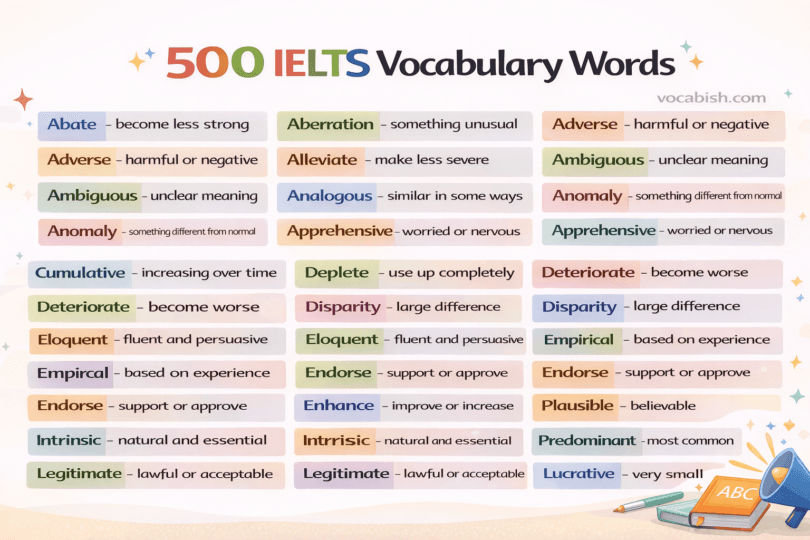
- Abate: become less strong
- Aberration: something unusual
- Adverse: harmful or negative
- Alleviate: make less severe
- Ambiguous: unclear meaning
- Analogous: similar in some ways
- Anomaly: something different from normal
- Apprehensive: worried or nervous
- Arbitrary: random or without reason
- Assumption: belief without proof
- Catalyst: something that causes change
- Coherent: clear and logical
- Constrain: limit or restrict
- Contentious: causing disagreement
- Conventional: traditional
- Corroborate: confirm with evidence
- Cumulative: increasing over time
- Deplete: use up completely
- Deteriorate: become worse
- Disparity: large difference
- Eloquent: fluent and persuasive
- Empirical: based on experience
- Endorse: support or approve
- Enhance: improve or increase
- Erosion: gradual destruction
- Exacerbate: make a problem worse
- Feasible: possible to do
- Fluctuate: change often
- Formidable: very difficult
- Futile: useless or pointless
- Hypothesis: proposed explanation
- Impartial: fair and neutral
- Inevitable: cannot be avoided
- Infer: reach a conclusion
- Inhibit: prevent or slow down
- Intrinsic: natural and essential
- Justification: reason or explanation
- Legitimate: lawful or acceptable
- Lucrative: very profitable
- Marginal: very small
- Mitigate: reduce the impact
- Notion: idea or belief
- Obsolete: no longer used
- Paradigm: model or example
- Plausible: believable
- Predominant: most common
- Prevalent: widespread
- Proponent: supporter of an idea
- Prudent: careful and wise
- Radical: extreme or major
- Resilient: able to recover
- Scrutinise: examine closely
- Significant: important
- Sustainable: able to continue long-term
- Tentative: not certain
- Transient: temporary
- Unprecedented: never happened before
- Viable: workable or practical
- Vulnerable: easily harmed
- Widespread: found in many places

PDF of IELTS Vocabulary Words
Tips to Learn IELTS Vocabulary Faster
- Learn 5–10 words daily
- Use words in simple sentences
- Group words by topic
- Revise weekly
- Practice speaking and writing
Learning IELTS vocabulary does not need to be difficult. With simple meanings, clear categories, and regular practice, you can improve your reading, writing, listening, and speaking skills.
This 500+ IELTS vocabulary list gives you a strong base to understand questions, share ideas clearly, and feel confident in the IELTS exam.
Frequently Asked Questions
How can I improve my IELTS vocabulary?
You can improve your IELTS vocabulary by learning new words daily, reading IELTS-level texts, and using words in simple sentences. Focus on common academic words, synonyms, and topic-based vocabulary. Regular revision and practice in speaking and writing help you remember words better.
What vocabulary do I need for IELTS?
For IELTS, you need general English words and academic vocabulary. This includes words related to education, health, environment, technology, society, and daily life. Learning a list of 500+ IELTS vocabulary words with meanings gives you enough range to understand questions and answer clearly.
How can I get 7.5 in IELTS speaking?
To get 7.5 in IELTS speaking, use accurate vocabulary, speak clearly, and avoid repeating basic words. Use topic-related words, simple collocations, and correct grammar. Practice answering questions fully and explain ideas using natural and clear language.
What are 20 tricky IELTS words with meaning?
Here are 20 tricky but useful IELTS words with easy meanings:
- Ambiguous – unclear
- Alleviate – make less severe
- Deteriorate – become worse
- Resilient – able to recover
- Scarce – limited
- Subtle – not obvious
- Coherent – clear and logical
- Plausible – believable
- Arbitrary – random
- Inevitable – cannot be avoided
- Fluctuate – change often
- Redundant – unnecessary
- Significant – important
- Marginal – small
- Exceed – go beyond
- Adequate – enough
- Sustainable – long-lasting
- Controversial – causing debate
- Reluctant – unwilling
- Notion – idea
Is learning 500+ IELTS vocabulary words enough for a high band score?
Yes, learning 500+ IELTS vocabulary words with meanings is enough if you know how to use them correctly. Quality matters more than quantity. Use words in context, not memorisation only, to score well in writing and speaking.
How should I practise IELTS vocabulary for long-term memory?
Practise IELTS vocabulary by grouping words by topic, writing short paragraphs, and speaking aloud. Revise weekly and use words in real examples. This method helps words stay in your memory and improves overall language confidence.
Read More