
Have you ever heard words that sound like the noises they describe? Words like buzz, bang, or sizzle immediately make a sound in your mind. These words are called onomatopoeia. They are a fun and powerful way to make writing more vivid and expressive. In this article, we will explore what onomatopoeia is, its types, examples, rules, common mistakes, and tips to use it effectively. By the end, you will be able to recognise and use these words confidently in your English writing and speaking.
Onomatopoeia Definition and Examples
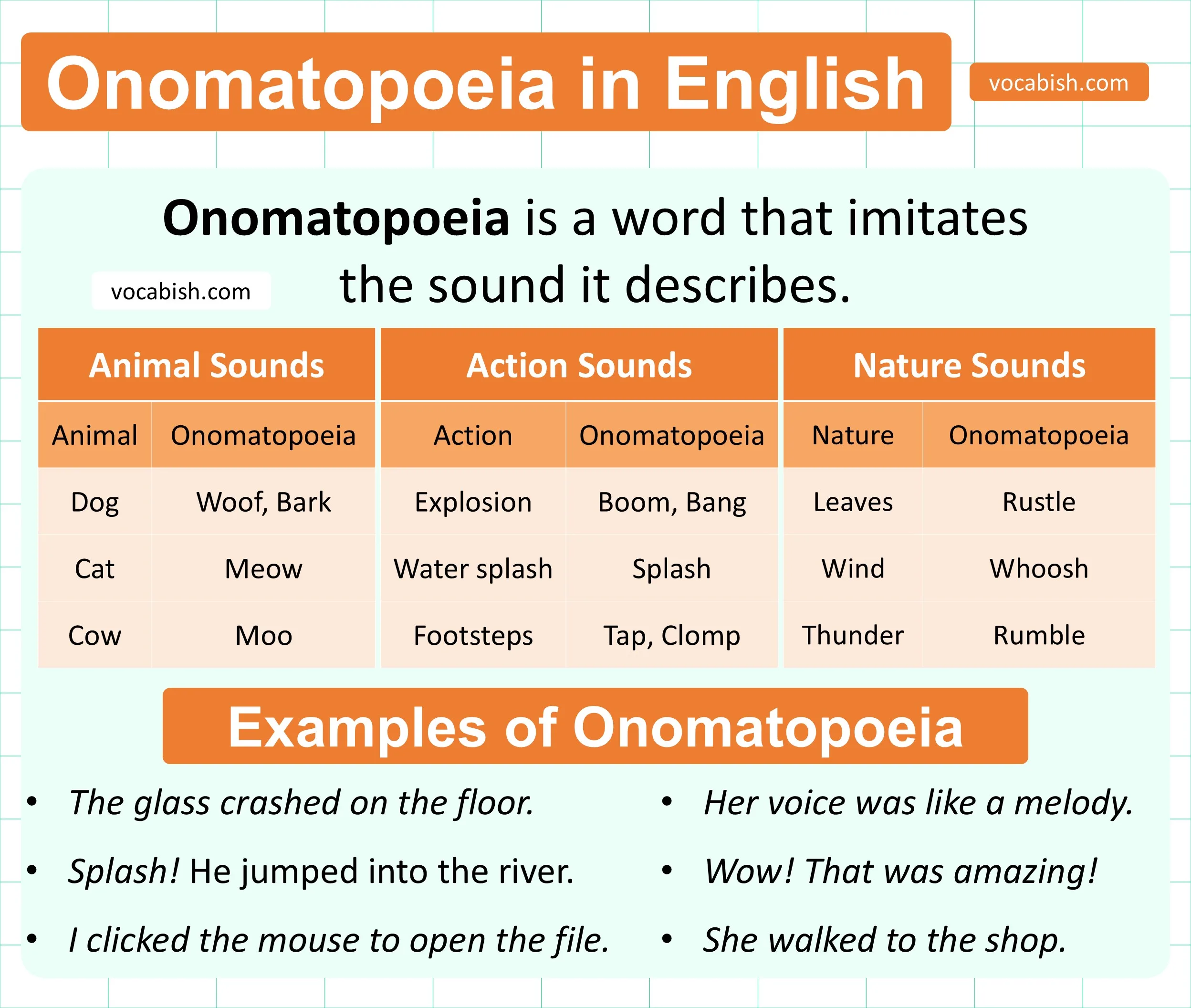
Onomatopoeia is a word that imitates the sound it describes. In simple words, it is when a word sounds like the action or thing it represents. For example:
- The bees buzzed around the flowers. – “Buzzed” sounds like the noise bees make.
- The glass shattered with a loud crash. – “Crash” mimics the sound of breaking glass.
Using onomatopoeia makes reading and listening more engaging. Writers often use it in stories, poems, comics, or even advertisements to create a realistic sound effect in the reader’s mind.
Types of Onomatopoeia
Onomatopoeic words can be divided into different types based on the sound they imitate. Understanding the types helps learners use them more accurately.
Animal Sounds
These words mimic the sounds animals make. They are often one of the first types children learn.
| Animal | Onomatopoeia | Example Sentence |
|---|---|---|
| Dog | Woof, Bark | The dog barked loudly at the stranger. |
| Cat | Meow | The kitten meowed for food. |
| Cow | Moo | The cow mooed in the field. |
| Bird | Chirp | The birds chirped early in the morning. |
| Lion | Roar | The lion roared and startled the tourists. |
Tip: In European English, “meow” and “moo” are common, but in other languages, animal sounds can be slightly different.
Action Sounds
These imitate the sounds of objects, movements, or actions. They are widely used in storytelling and comic books.
| Action / Object | Onomatopoeia | Example Sentence |
|---|---|---|
| Explosion | Boom, Bang | The fireworks went bang in the sky. |
| Water splash | Splash | He jumped into the pool with a splash. |
| Footsteps | Tap, Clomp | I heard someone’s footsteps clomp on the stairs. |
| Knocking door | Knock, Tap | She knocked on the door with a soft tap. |
| Crash / Smash | Crash | The vase fell and crashed on the floor. |
Nature Sounds
These words describe sounds from nature or the environment.
| Nature Element | Onomatopoeia | Example Sentence |
|---|---|---|
| Rain | Drip, Pitter-patter | Rain dripped from the roof. |
| Wind | Whoosh | The wind whooshed through the trees. |
| Thunder | Rumble | Thunder rumbled across the sky. |
| Leaves | Rustle | The leaves rustled under our feet. |
| Fire | Crackle | The fire crackled in the fireplace. |
Human Sounds
These mimic human-made noises or reactions.
| Sound | Onomatopoeia | Example Sentence |
|---|---|---|
| Laugh | Ha-ha, He-he | She laughed, ha-ha, at the joke. |
| Cry / Sob | Boo-hoo | The baby cried, boo-hoo, all night. |
| Yawn | Yawn | He yawned loudly during the lecture. |
| Sneeze | Achoo | She sneezed, achoo, and grabbed a tissue. |
| Hiccup | Hic | He hiccupped, hic, after drinking the soda. |
Mechanical or Technology Sounds
These imitate modern machines or electronic sounds.
| Device or Object | Onomatopoeia | Example Sentence |
|---|---|---|
| Phone | Ring | The phone rang loudly in the office. |
| Alarm | Beep | The alarm clock went beep, beep at 6 a.m. |
| Computer | Click | I clicked the mouse to open the file. |
| Camera | Click | She took a photo and the camera clicked. |
| Engine | Vroom | The car’s engine went vroom as it started. |
Usage of Onomatopoeia
Learning onomatopoeia is mostly about recognising sounds and using words correctly in sentences. Here are some useful rules and hints:
Keep the word simple – Use the standard onomatopoeic form.
- Correct: buzz, clang, sizzle
- Incorrect: buzzz, claaang
Match the tense – Onomatopoeia can change to past tense or continuous tense like any verb.
- Present: The bell rings.
- Past: The bell rang yesterday.
- Continuous: The bell is ringing.
Use in descriptive writing – Onomatopoeia is most effective when describing actions, events, or sounds.
Avoid overuse – Too many sound words in a paragraph can make it hard to read. Use them selectively.
Pay attention to punctuation – Some onomatopoeic words are followed by exclamation marks to show strong sound:
- Bang! The window shattered.
- Splash! He jumped into the river.
Onomatopoeia VS Other Common Grammar or Vocabulary Points
1. Onomatopoeia vs Adjectives
Onomatopoeia: A word that imitates a sound.
- Example: The glass crashed on the floor.
Adjective: A word that describes a noun or pronoun, but does not imitate sound.
- Example: The glass was heavy and fragile.
Key difference: Onomatopoeia creates the sound effect; adjectives describe qualities.
2. Onomatopoeia vs Verbs
Onomatopoeia: Can act as a verb or noun but primarily mimics sound.
- Example: The bees buzzed around the flowers.
Regular verb: Expresses action without mimicking sound.
- Example: She walked to the shop.
Tip for learners: Onomatopoeic verbs add vividness by connecting action to real sounds.
3. Onomatopoeia vs Interjections
Onomatopoeia: Words imitate natural or mechanical sounds.
- Example: The fireworks went boom!
Interjection: Words or phrases express emotions or reactions.
- Example: Wow! That was amazing!
Difference: Interjections express feelings; onomatopoeia imitates actual noises.
4. Onomatopoeia vs Figurative Language
Onomatopoeia: Literal sound imitation.
- Example: The fire crackled in the fireplace.
Simile/Metaphor: Compares things indirectly.
- Example: Her voice was like a melody.
Key point: Onomatopoeia makes the reader “hear” the sound; figurative language makes them imagine or compare.
5. Onomatopoeia vs Phonetics
Onomatopoeia: Specific words that imitate sounds.
Phonetics: The study of all speech sounds and how they are produced.
Tip: Phonetics is a broader field; onomatopoeia is a small, practical category used in writing and speaking.
Examples of Onomatopoeia
Here’s the list of onomatopoeia examples in sentences:
- The dog went woof woof when the mailman arrived.
- The cat meowed softly for its dinner.
- The cow in the field mooed loudly all morning.
- The little ducklings quacked as they followed their mother.
- The lion roared and scared all the visitors in the zoo.
- The vase crashed to the floor when it slipped from the shelf.
- The fireworks went bang! across the night sky.
- He jumped into the pool with a splash.
- The car engine vroomed as it sped down the road.
- The door creaked as it slowly opened.
- Rain dripped from the roof into the bucket.
- The wind whooshed through the trees during the storm.
- Thunder rumbled loudly in the distance.
- The leaves rustled under our feet in the autumn park.
- The fire crackled warmly in the fireplace.
- She giggled when she saw the funny cartoon.
- The baby cooed softly in the cradle.
- He hiccupped after drinking the fizzy soda.
- I yawned during the long lecture.
- She sneezed loudly, saying “Achoo!”
FAQs
What is onomatopoeia in English?
Onomatopoeia is a word that imitates the sound it describes. Words like buzz, bang, or sizzle are onomatopoeic because they mimic real-life sounds. Learning onomatopoeia helps English learners make writing and speaking more vivid, engaging, and expressive.
What are examples of onomatopoeia words?
Common onomatopoeia words include buzz for bees, bang for explosions, sizzle for frying food, meow for cats, and drip for water. These words imitate real sounds and are often used in storytelling, comics, and descriptive writing.
How do you use onomatopoeia in a sentence?
To use onomatopoeia, include the sound word in a sentence that describes an action or event. For example: “The glass crashed to the floor” or “The birds chirped in the morning.” Match the word with the correct context and tense.
What are the common types of onomatopoeia?
Onomatopoeia can be classified into animal sounds, action sounds, human sounds, nature sounds, and mechanical sounds. Examples include woof for dogs, bang for objects, giggle for humans, rustle for leaves, and vroom for engines.
Is onomatopoeia the same in all English dialects?
Most onomatopoeia words are similar across English dialects, but some sounds may differ slightly. For example, a dog’s bark is usually woof, but spelling and pronunciation can vary in informal speech or literature. Understanding context is more important than exact spelling.
Read More