
Homophones are among the most commonly used words in English, yet they often cause confusion for learners. These words sound exactly the same when spoken but have different meanings and spellings. For example, right and write share the same pronunciation, but one refers to being correct while the other means putting words on paper. Because homophones appear frequently in conversations, books, school assignments, and everyday communication, understanding them can improve both speaking and writing skills. Learning common examples of homophones helps you recognize the correct word from context and avoid mistakes that can change the meaning of a sentence.
Let’s break it down shortly:
Homophones
Homophones are words that have the same pronunciation but different meanings and usually different spellings. They may sound identical when spoken, but their meanings change completely depending on the context.
For example:
Word | Meaning |
|---|---|
Sea | Large body of salt water |
See | To look at something |
Although they sound the same, they are used differently in sentences.
For more confusing words in English, you can visit our Confusing Words Category.
What Are Homophones?
The meaning of homophones is easy to understand. They are words that sound alike but have different meanings, spellings, or both.
Quick Definition:
- Same sound + Different meaning = Homophone
Examples:
Homophone Pair | Meaning |
|---|---|
Right | Correct |
Write | Put words on paper |
Sun | Star in the sky |
Son | Male child |
Example Sentences:
- Please write your name here.
- You got the answer right.
Why Are Homophones Important?
Homophones appear frequently in everyday English. Understanding them helps learners avoid confusion in speaking and writing.
Benefits of learning homophones:
- Improve spelling accuracy
- Understand spoken English better
- Avoid common writing mistakes
- Build stronger vocabulary
- Increase confidence in communication
For example, knowing the difference between their, there, and they’re can make your writing much clearer.
List of Homophones in English
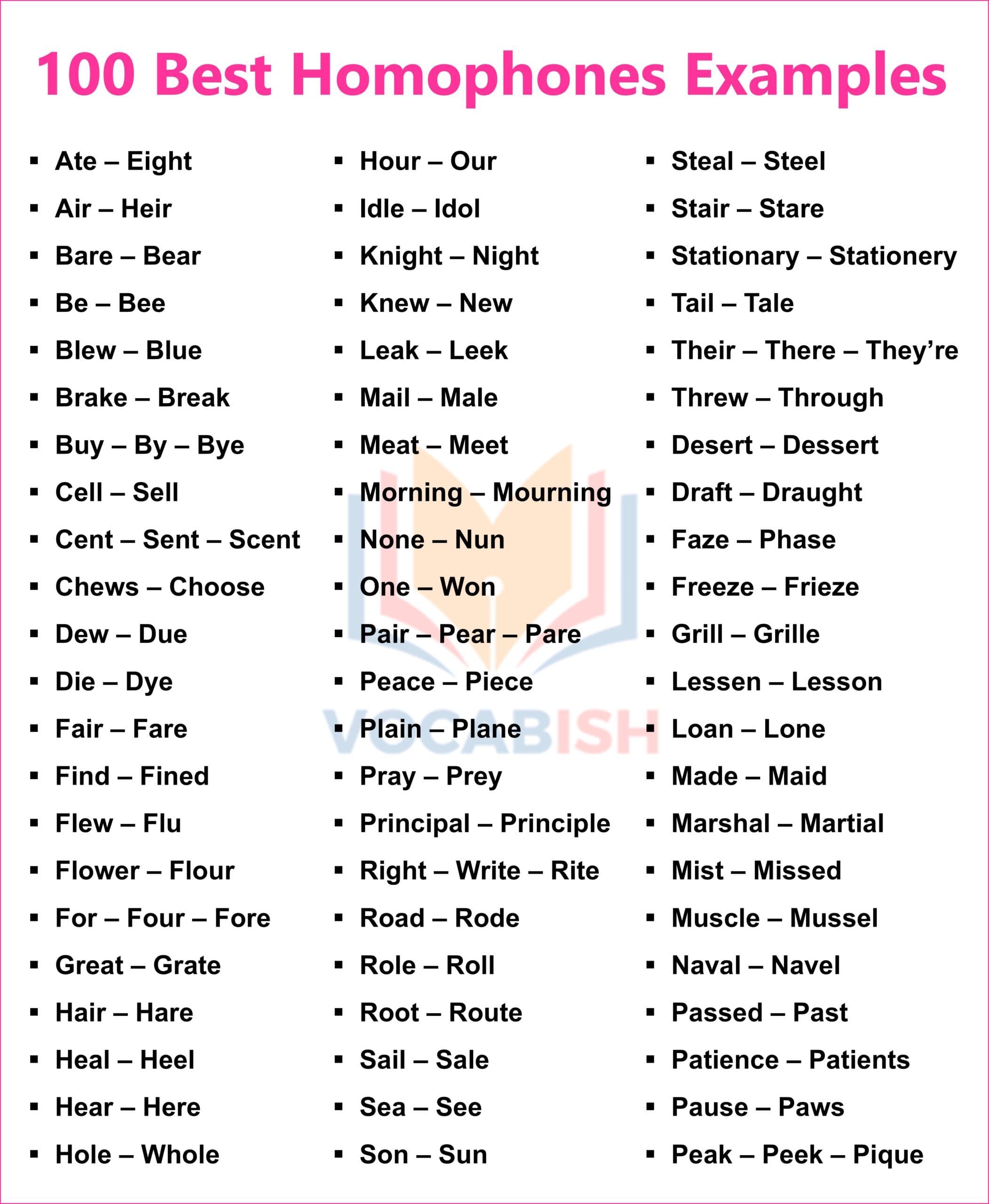
Learning homophones becomes easier when you see them organized in a clear list. Here’s the simple list of homophone pairs in English:
- Ate – Eight
- Air – Heir
- Bare – Bear
- Be – Bee
- Blew – Blue
- Brake – Break
- Buy – By – Bye
- Cell – Sell
- Cent – Sent – Scent
- Chews – Choose
- Dew – Due
- Die – Dye
- Fair – Fare
- Find – Fined
- Flew – Flu
- Flower – Flour
- For – Four – Fore
- Great – Grate
- Hair – Hare
- Heal – Heel
- Hear – Here
- Hole – Whole
- Hour – Our
- Idle – Idol
- Knight – Night
- Knew – New
- Leak – Leek
- Mail – Male
- Meat – Meet
- Morning – Mourning
- None – Nun
- One – Won
- Pair – Pear – Pare
- Peace – Piece
- Plain – Plane
- Pray – Prey
- Principal – Principle
- Right – Write – Rite
- Road – Rode
- Role – Roll
- Root – Route
- Sail – Sale
- Sea – See
- Son – Sun
- Steal – Steel
- Stair – Stare
- Stationary – Stationery
- Tail – Tale
- Their – There – They’re
- Threw – Through
- Toe – Tow
- Vain – Vein – Vane
- Wait – Weight
- Waist – Waste
- Weak – Week
- Wear – Where
- Weather – Whether
- Which – Witch
- Wood – Would
- Write – Right
Homophones and Meaning in English
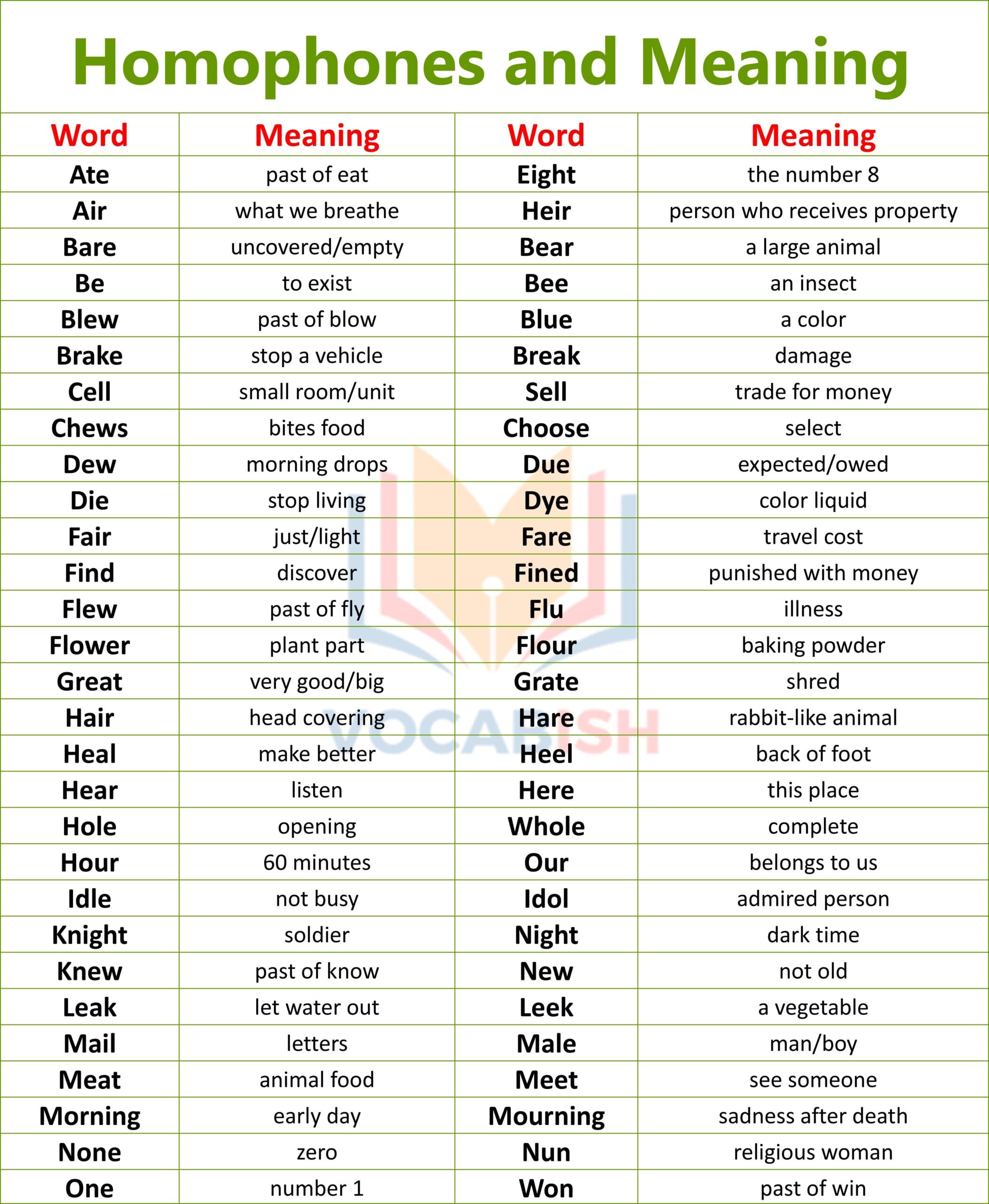
Here’s the list of 100 best homophones in English with meanings:
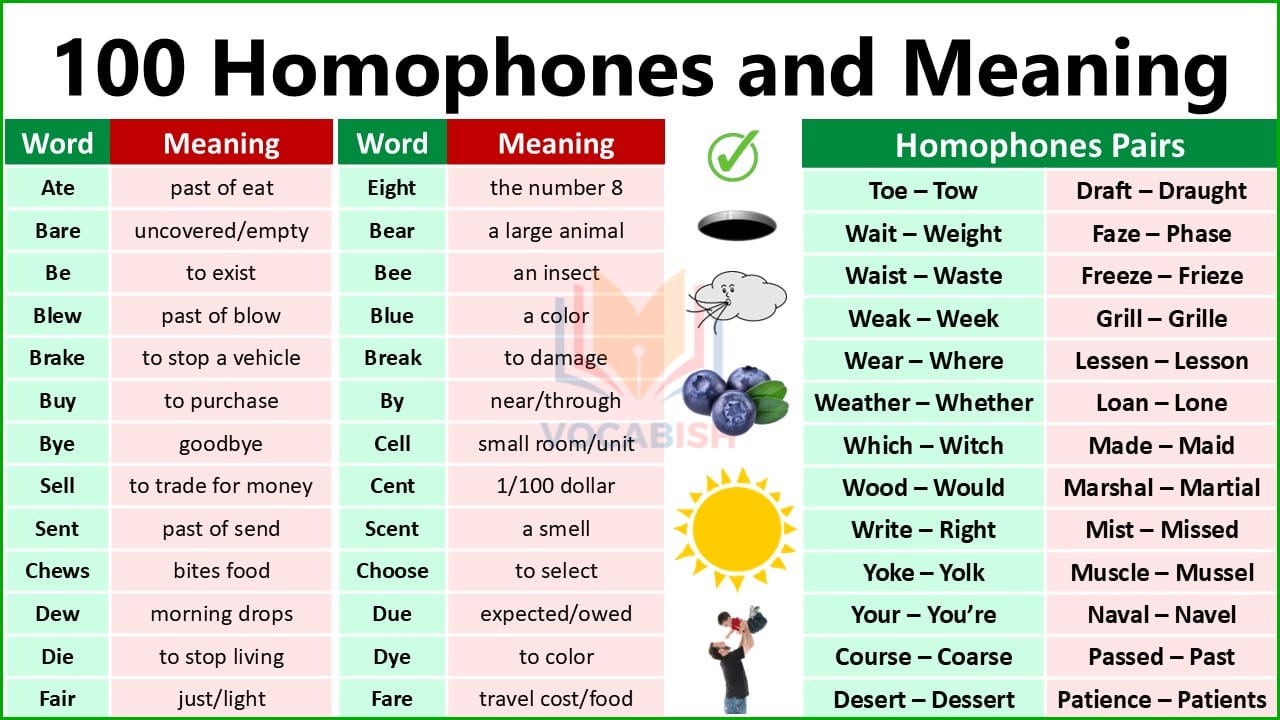
Word | Meaning | Word | Meaning |
|---|---|---|---|
ate | past of eat | eight | the number 8 |
air | what we breathe | heir | person who receives property |
bare | uncovered/empty | bear | a large animal |
be | to exist | bee | an insect |
blew | past of blow | blue | a color |
brake | stop a vehicle | break | damage |
cell | small room/unit | sell | trade for money |
chews | bites food | choose | select |
dew | morning drops | due | expected/owed |
die | stop living | dye | color liquid |
fair | just/light | fare | travel cost |
find | discover | fined | punished with money |
flew | past of fly | flu | illness |
flower | plant part | flour | baking powder |
great | very good/big | grate | shred |
hair | head covering | hare | rabbit-like animal |
heal | make better | heel | back of foot |
hear | listen | here | this place |
hole | opening | whole | complete |
hour | 60 minutes | our | belongs to us |
idle | not busy | idol | admired person |
knight | soldier | night | dark time |
knew | past of know | new | not old |
leak | let water out | leek | a vegetable |
mail | letters | male | man/boy |
meat | animal food | meet | see someone |
morning | early day | mourning | sadness after death |
none | zero | nun | religious woman |
one | number 1 | won | past of win |
peace | calm | piece | part |
plain | simple/field | plane | aircraft |
pray | talk to God | prey | hunted animal |
principal | school head | principle | rule/idea |
road | street | rode | past of ride |
role | part in life/play | roll | turn over |
root | plant base | route | path |
sail | boat cloth | sale | selling |
sea | ocean | see | look |
son | male child | sun | star |
steal | take secretly | steel | metal |
stair | step | stare | look hard |
stationary | not moving | stationery | paper & pens |
tail | animal back part | tale | story |
threw | past of throw | through | from one side to another |
toe | foot part | tow | pull a vehicle |
wait | stay | weight | heaviness |
waist | body middle | waste | throw away |
weak | not strong | week | seven days |
wear | put on | where | place |
weather | climate | whether | choice/if |
which | what one | witch | magic woman |
wood | tree material | would | past of will |
write | use words | right | correct |
yoke | wooden bar | yolk | egg center |
your | belongs to you | you’re | you are |
course | class/path | coarse | rough |
Examples of Homophones in Sentences
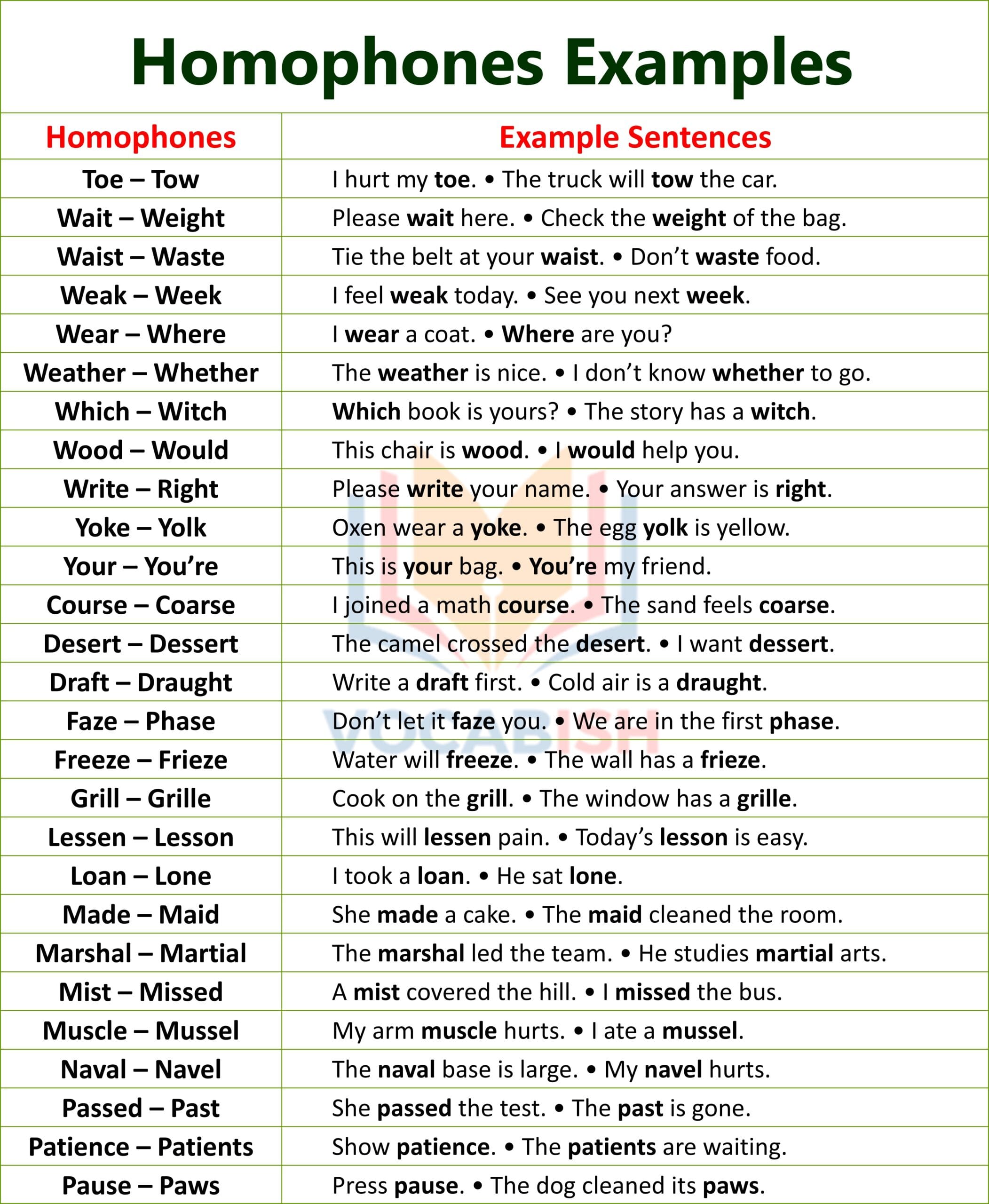
Seeing homophones in complete sentences makes it easier to understand how each word is used. Here are 20 common homophone pairs with practical examples.
Homophones | Example Sentences |
|---|---|
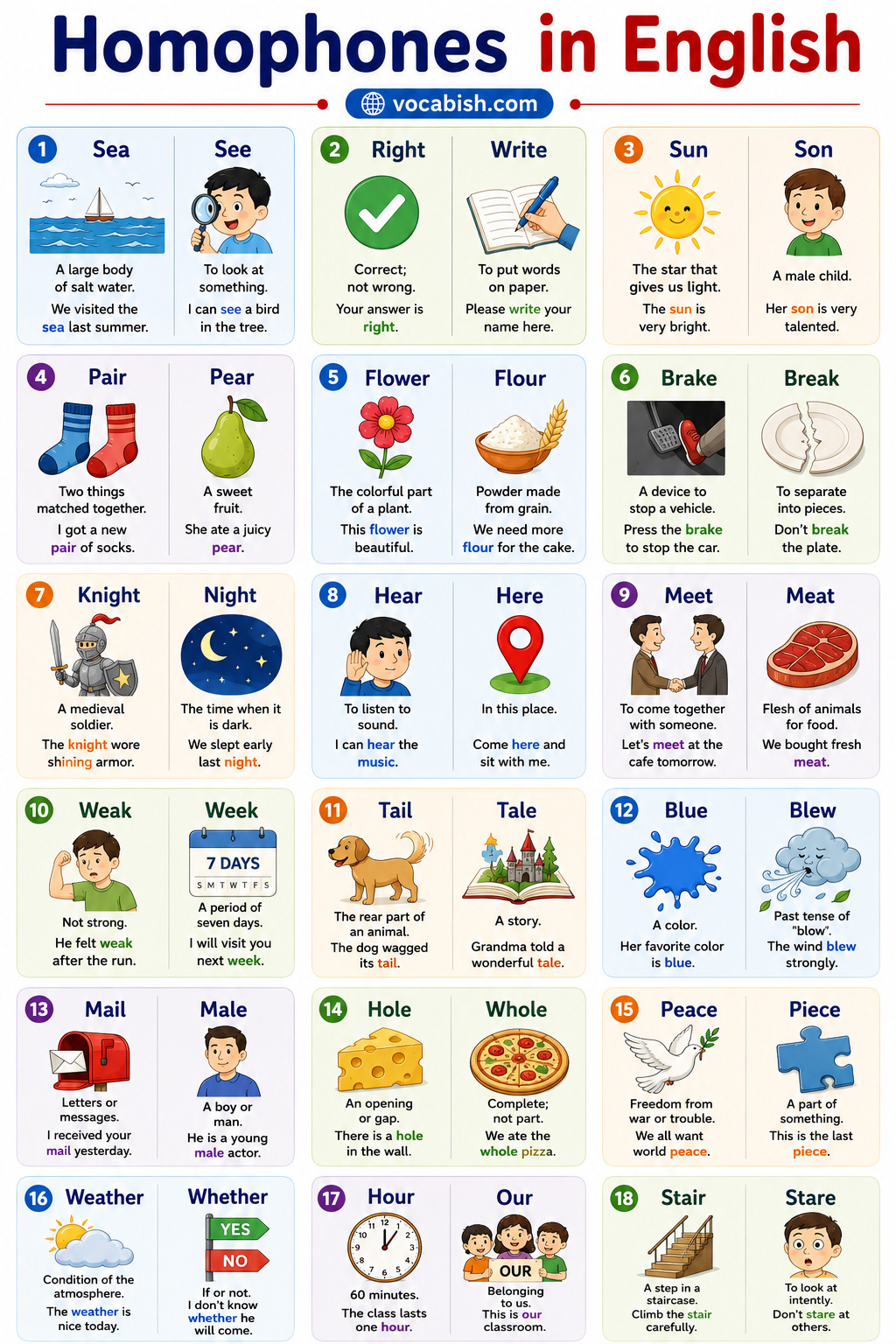
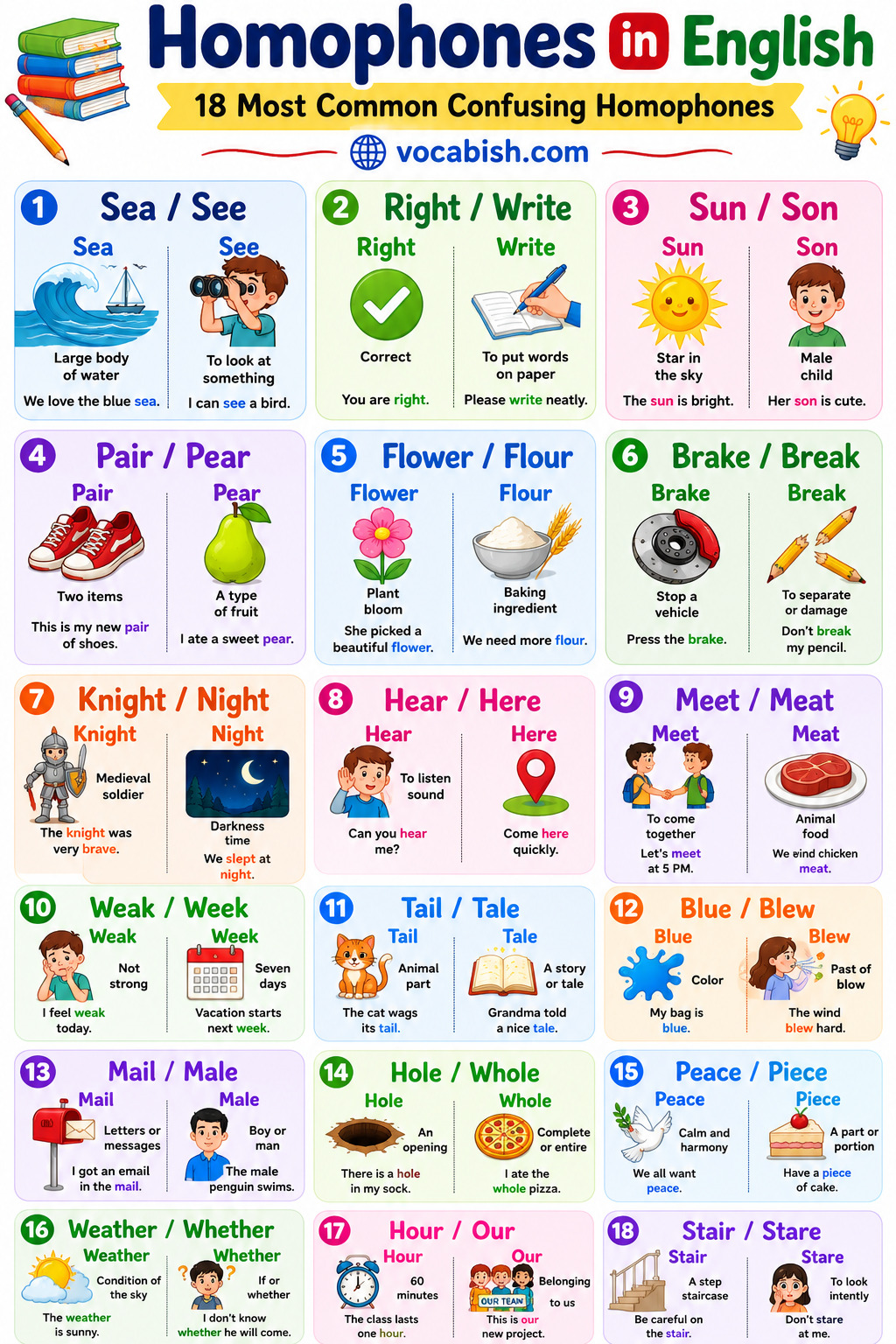
Sea / See | We spent our vacation by the sea. / I can see the mountains from here. |
Right / Write | Your answer is right. / Please write your name on the form. |
Sun / Son | The sun is shining brightly. / Their son starts school next week. |
Pair / Pear | I bought a new pair of shoes. / She ate a ripe pear after lunch. |
Flower / Flour | This flower smells wonderful. / We need more flour to bake the cake. |
Brake / Break | Press the brake carefully. / Be careful not to break the glass. |
Knight / Night | The brave knight protected the kingdom. / We watched a movie last night. |
Hear / Here | Can you hear the music? / Please come here for a moment. |
Meet / Meat | Let’s meet after class. / We bought fresh meat from the market. |
Weak / Week | I felt weak after the long run. / I’ll visit you next week. |
Tail / Tale | The dog wagged its tail happily. / Grandpa told us a funny tale. |
Blue / Blew | Her dress is blue. / The wind blew the leaves away. |
Mail / Male | I received an important mail today. / The male lion guarded the group. |
Hole / Whole | There is a hole in the wall. / I ate the whole pizza. |
Peace / Piece | Everyone hopes for world peace. / Would you like a piece of cake? |
Weather / Whether | The weather looks pleasant today. / I don’t know whether he will come. |
Hour / Our | The meeting lasted an hour. / This is our classroom. |
Stair / Stare | Be careful on the last stair. / Don’t stare at people. |
Sale / Sail | The store is having a big sale. / We watched boats sail across the lake. |
Board / Bored | She wrote the answer on the board. / I felt bored during the long wait. |
Tips for Learning Homophones
Many students find homophones confusing at first. These techniques can help.
1. Use Context: Look at the surrounding words to identify the correct meaning.
2. Learn in Pairs
Study homophones together:
- Sea / See
- Right / Write
- Sun / Son
3. Create Example Sentences: Writing your own sentences helps reinforce usage.
4. Read More English: Books, articles, and stories expose you to homophones naturally.
5. Practice Dictation: Listen to English audio and write what you hear.
You May Also Like:
- 100 Homonyms Examples in English
- Common Homographs Meaning and Examples
- 1000 A to Z Opposite Words with PDF
Common Mistakes To Avoid
Certain homophones cause confusion more often than others.
Their, There, They’re
Word | Meaning |
|---|---|
Their | Belonging to them |
There | Place |
They’re | They are |
Examples:
- Their house is large.
- The book is over there.
- They’re coming tomorrow.
Your and You’re
Word | Meaning |
|---|---|
Your | Belonging to you |
You’re | You are |
Examples:
- Is this your bag?
- You’re very kind.
Its and It’s
Word | Meaning |
|---|---|
Its | Belonging to it |
It’s | It is |
Examples:
- The cat cleaned its paws.
- It’s raining outside.
FAQs about Homophones
A homophone is a word that sounds the same as another word but has a different meaning and often a different spelling.
Common examples include sea and see, right and write, sun and son, flower and flour, and pair and pear.
Homophones sound identical in speech, so learners often choose the wrong spelling when writing or interpreting spoken English.
No. Homophones share pronunciation, while homonyms usually share both pronunciation and spelling but have different meanings.
Homophones sound the same but may have different spellings. Homographs share the same spelling but can have different meanings and pronunciations.
Learners often confuse their, there, they’re, your, you’re, its, it’s, to, too, and two.
Conclusion
Homophones are an important part of English because they teach us that words can sound the same while carrying completely different meanings. From common pairs like sea and see to frequently confused words such as their, there, and they’re, understanding homophones helps you read more accurately, write with confidence, and communicate more clearly.
The best way to remember homophones is to learn them in context rather than as isolated word lists. Pay attention to how they are used in sentences, practice them regularly, and notice them when reading books, articles, and everyday conversations. Over time, you’ll recognize the correct word naturally and avoid many of the mistakes that challenge English learners.