

Have you ever read a sentence and realized that a familiar word means something completely different from what you first thought? That’s what makes homographs interesting. These are words that have the same spelling but different meanings, and in some cases, different pronunciations as well. For example, the word “lead” can mean to guide someone, or it can refer to a type of metal. The correct meaning becomes clear only when you look at the surrounding words and context.
Homographs appear regularly in books, conversations, news articles, and everyday writing. Learning them helps you understand English more accurately, improve your reading skills, and avoid common misunderstandings. As you come across more examples of homographs, you’ll start noticing how context changes the meaning of a word, making it easier to read, write, and communicate with confidence.
Homograph
A homograph is a word that has the same spelling as another word but a different meaning. Some homographs also have different pronunciations.
For example:
Word | Meaning 1 | Meaning 2 |
|---|---|---|
Bat | A flying animal | A piece of sports equipment |
Tear | A drop from the eye | To rip something |
Lead | To guide | A type of metal |
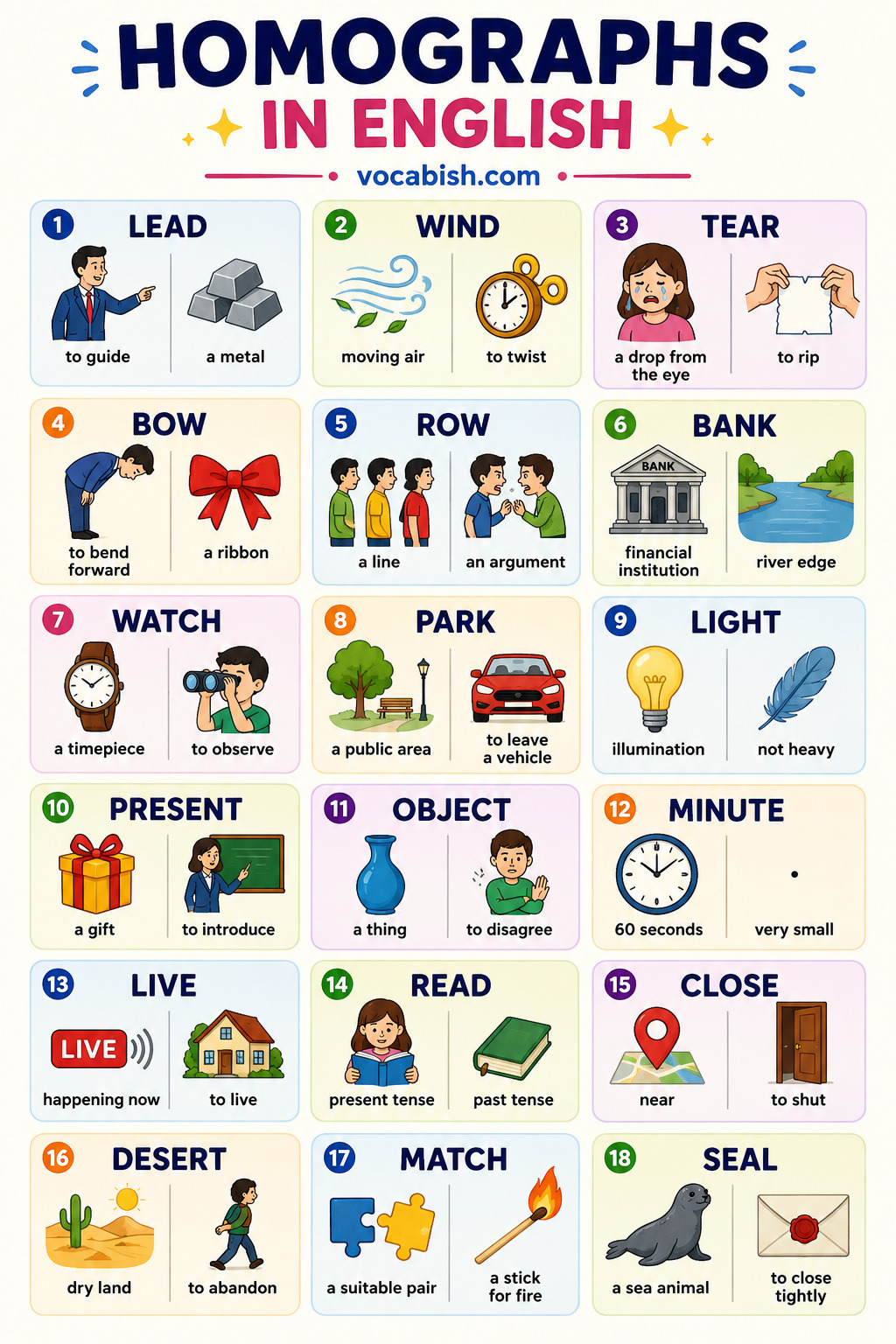
Understanding homographs helps you identify meaning from context rather than relying only on spelling.
What Is A Homograph?
The homograph meaning is straightforward: words that look the same in writing but have different meanings. Some are pronounced differently, while others sound the same.
Examples:
Homograph | Meaning | Example Sentence |
|---|---|---|
Bark | Sound made by a dog | The dog’s bark was loud. |
Bark | Outer covering of a tree | The tree bark felt rough. |
Well | Healthy | I am well today. |
Well | Water source | The village uses a well. |
Quick Formula:
- Same spelling + Different meanings = Homograph
Commonly Confused Homographs
Many English learners struggle with homographs because the meaning changes depending on the sentence.
Word | Meaning 1 | Meaning 2 |
|---|---|---|
Bow | To bend forward | Decorative ribbon |
Row | Line of things | Argument |
Wind | Moving air | To twist |
Object | Thing | To disagree |
Minute | 60 seconds | Very small |
Present | Gift | To introduce |
Close | Near | To shut |
Refuse | Waste | To decline |
Content | Happy | Information |
Desert | Dry land | To abandon |
Example:
- Please close the door.
- The school is close to my house.
The spelling stays the same, but the meaning changes.
Linguistic Characteristics of Homographs
Homographs are interesting because they show how English spelling and meaning do not always match perfectly.
They can differ in pronunciation, grammar, and usage while keeping identical written forms.
Phonetic Variation
Some homographs have different pronunciations depending on their meaning.
Homograph | Pronunciation | Meaning |
|---|---|---|
Lead | LEED | To guide |
Lead | LED | Metal |
Wind | WIND | Air movement |
Wind | WYND | Twist |
Tear | TEER | Water from the eye |
Tear | TAIR | Rip |
Row | ROH | Line |
Row | ROW | Argument |
Bow | BOH | Bend |
Bow | BOW | Ribbon |
Why It Matters:
Correct pronunciation often depends on understanding the sentence context.
Example:
- The strong wind damaged the fence.
- Please wind the clock.
Orthographic Patterns
Homographs share identical spelling patterns but may belong to different word classes.
Word | Part of Speech 1 | Part of Speech 2 |
|---|---|---|
Record | Noun | Verb |
Present | Noun | Verb |
Object | Noun | Verb |
Permit | Noun | Verb |
Conduct | Noun | Verb |
Examples:
- I bought a new record.
- Please record the meeting.
Role in Language Learning
Homographs play an important role in reading, vocabulary growth, and communication.
Students learn to use context clues rather than depending only on spelling.
Homographs in Vocabulary Acquisition
Learning homographs expands vocabulary because one spelling can represent multiple meanings.
Consider the word match:
Meaning | Example |
|---|---|
Sports competition | The football match starts soon. |
Small stick for lighting fire | Strike a match carefully. |
Suitable pair | Those shoes match your shirt. |
One word can add several useful meanings to your vocabulary.
Challenges for Language Learners
Homographs can create confusion when reading and speaking.
Common difficulties include:
- Choosing the correct pronunciation
- Understanding meaning from context
- Confusing homographs with homophones
- Misinterpreting sentences
Example:
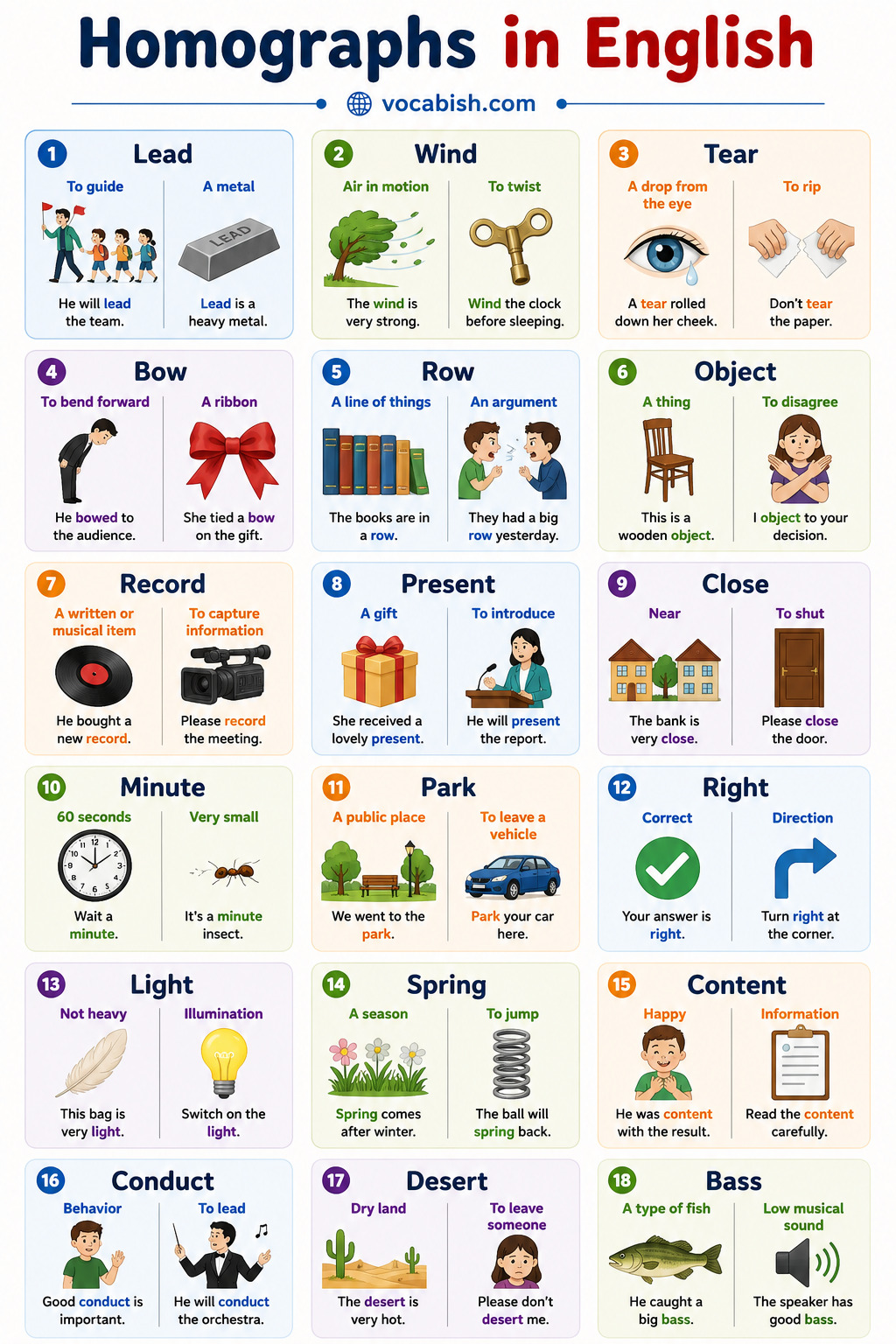
- She shed a tear.
- Be careful not to tear the paper.
Context reveals the intended meaning.
Use of Homographs in Literature
Writers often use homographs to create interest, humor, and wordplay.
Readers must think about context to understand the intended meaning.
Literary Devices
Homographs often appear in:
- Puns
- Poetry
- Advertisements
- Headlines
- Creative writing
Example:
“The fisherman couldn’t bear the cold, but he saw a bear near the river.”
The repeated spelling creates a playful effect.
Effect on Reading and Comprehension
Homographs encourage readers to process meaning carefully.
Benefits include:
- Better vocabulary awareness
- Stronger reading skills
- Improved context analysis
- Greater language flexibility
Students who encounter homographs regularly become more confident readers.
100+ Common Homograph Examples
Here’s the list of homograph words in English with their meanings:
# | Homograph | Meaning 1 | Meaning 2 |
|---|---|---|---|
1 | lead | a type of metal | to guide or be in charge |
2 | wind | moving air | to twist or turn |
3 | bow | front of a ship | to bend forward |
4 | tear | rip something | liquid from the eye |
5 | row | a line or series | to quarrel |
6 | bass | type of fish | low sound |
7 | close | near | to shut something |
8 | object | a thing | to oppose |
9 | desert | dry land | to abandon |
10 | present | gift | to show or give a presentation |
11 | minute | very small | 60 seconds |
12 | compact | small and dense | agreement |
13 | content | satisfied | material or subject |
14 | entrance | entryway | to captivate |
15 | polish | from Poland | to make shiny |
16 | wound | injury | past tense of wind |
17 | contract | agreement | to shrink |
18 | console | comfort | control panel or video game device |
19 | digest | summary | to process food |
20 | conduct | behavior | to lead or manage |
21 | reject | refuse | discarded item |
22 | record | to store information | something written or documented |
23 | refuse | garbage | to decline |
24 | subject | topic | to force under authority |
25 | alternate | take turns | other option |
26 | contest | competition | to dispute |
27 | live | exist | broadcast in real time |
28 | permit | allow | a legal document |
29 | sewer | underground pipe | someone who sews |
30 | fine | good quality | a penalty |
31 | address | location | speak to |
32 | bowstring | part of a bow | cord of a musical bow |
33 | entranceway | passage | act of enchanting |
34 | tearful | full of tears | something torn |
35 | sow | plant seeds | female pig |

Homographs Examples in Sentences
# | Homograph | Sentence 1 | Sentence 2 |
|---|---|---|---|
1 | lead | The pipes are made of lead. | She will lead the team to victory. |
2 | wind | The wind blew the leaves away. | Please wind the string around the spool. |
3 | bow | The bow of the ship is painted red. | He took a bow after the performance. |
4 | tear | Don’t tear the paper. | A tear rolled down her cheek. |
5 | row | We planted a row of flowers. | They had a loud row last night. |
6 | bass | He caught a huge bass in the lake. | I love the deep bass in this song. |
7 | close | Sit close to the window. | Please close the door quietly. |
8 | object | That object on the table is heavy. | I object to this unfair rule. |
9 | desert | Camels live in the desert. | He decided to desert his old habits. |
10 | present | I gave her a birthday present. | He will present his project tomorrow. |

Homograph vs Homonym
Many learners confuse these terms.
Term | Same Spelling | Same Sound | Different Meanings |
|---|---|---|---|
Homograph | Yes | Sometimes | Yes |
Homophone | No or Sometimes | Yes | Yes |
Homonym | Usually same spelling and pronunciation | Yes | Yes |
Tips to Learn and Remember Homographs
- Use context clues: Read the sentence carefully to understand meaning.
- Practice reading aloud: Notice pronunciation differences.
- Create sentences: Make your own examples for each meaning.
- Group words by topic: Daily life, school, emotions, and nature.
- Use flashcards: Helps memorize multiple meanings quickly.
You May Also Like:
- 100 Homonyms Meanings and Examples
- 100 Best Homophones and Meanings
- Opposite Words in English with PDF
FAQs about Homographs
A homograph is a word that shares the same spelling as another word but has a different meaning and sometimes a different pronunciation.
Common examples include lead, wind, tear, bow, and row. Each word has multiple meanings depending on context and usage.
For kids, a homograph is a word that looks the same as another word but can mean something different in a sentence.
No. Some homographs have different pronunciations, while others share the same pronunciation and differ only in meaning.
A homograph has the same spelling but different meanings. A homophone sounds the same as another word but may have different spelling.
Look at the surrounding words. Context usually reveals which meaning of the homograph is being used in that sentence.
Conclusion
Homographs are a fascinating part of English vocabulary. They show how one spelling can carry multiple meanings, making context an important reading skill. By studying these examples of homographs, learners can build stronger vocabulary, improve comprehension, and become more confident when reading and speaking English.
The more homograph examples you encounter, the easier it becomes to recognize meaning instantly from context.