
A sword is a long-bladed weapon that has been used throughout history for fighting, protection, training, and ceremonial purposes. In this blog post, you will learn the parts of a sword with their names, functions, and diagram to understand how each part of a sword is designed and used. From the blade and hilt to the guard and pommel, every part has a specific role in balance, grip, control, and protection during use. Learning the names of sword parts helps you understand English vocabulary related to historical weapons, martial arts, metalwork, and military equipment commonly used in books, history lessons, and educational studies.
What Are the Parts of a Sword?
A sword is a long weapon with a sharp metal blade. People used swords in wars, training, sports, and ceremonies for many years. Every section of a sword has a special name and purpose.
Some parts help with cutting. Others help with holding, balance, and safety.
Why Learn Sword Vocabulary in English?
Sword vocabulary appears in the following:
- History books
- Adventure stories
- Video games
- Fantasy movies
- Museums
- Martial arts lessons
These words also help learners describe objects clearly in English.
For example:
- “The knight held the sword by the grip.”
- “The blade was very sharp.”
- “The guard protected his hand.”
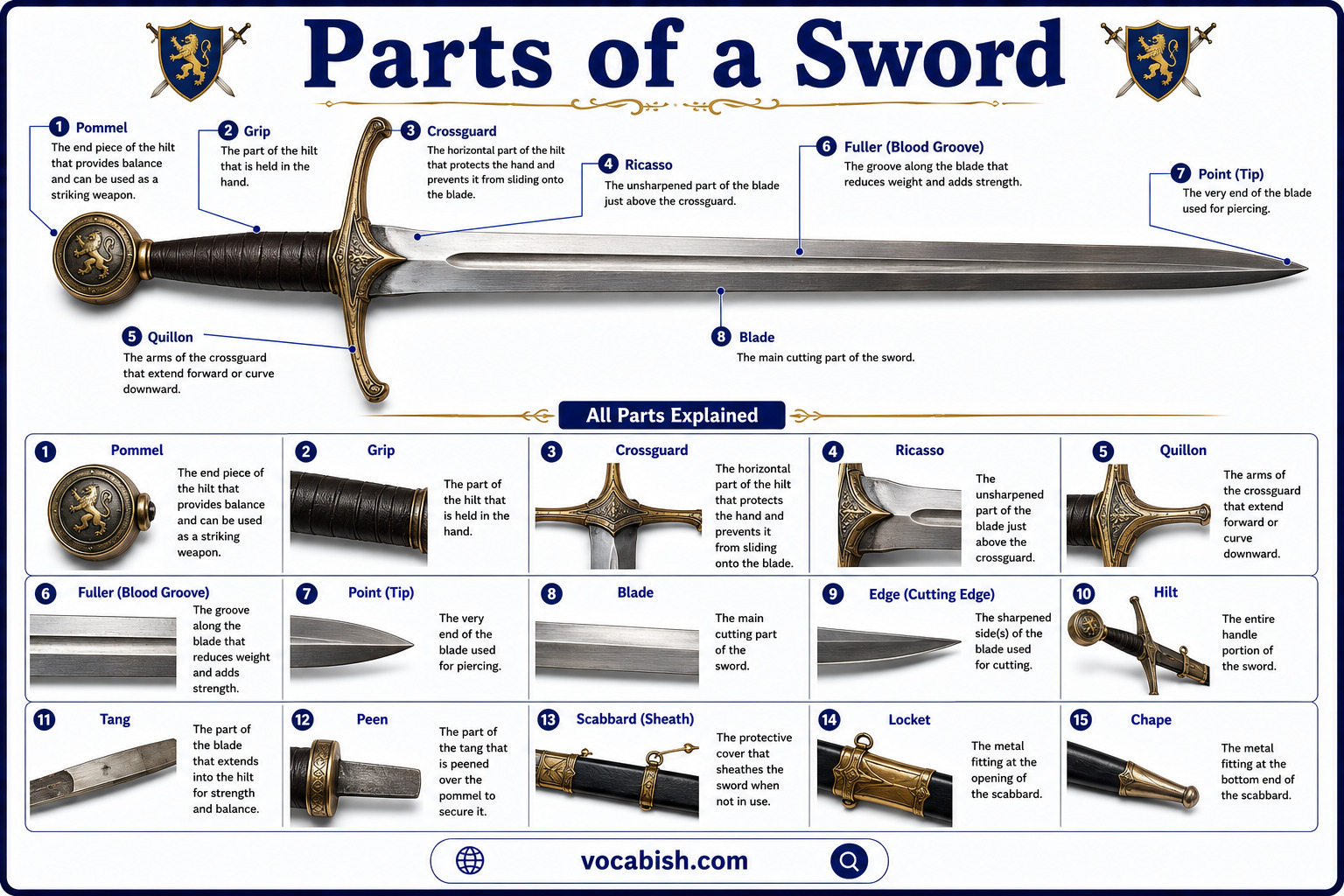
Sword Parts Labeled Diagram
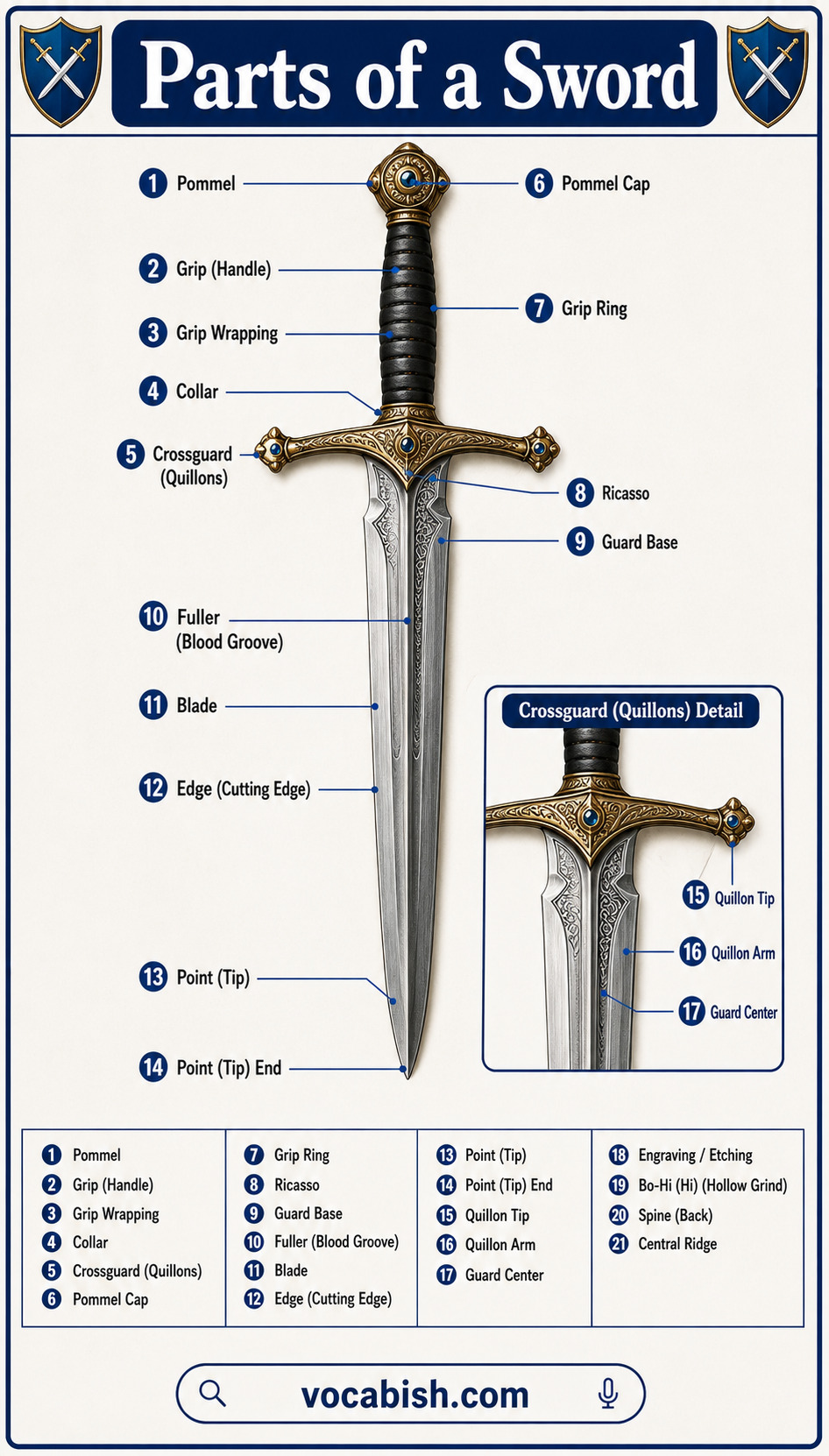
Main Parts of a Sword in English
Blade
The blade is the long metal part of the sword. It is the main cutting section.
- Function: Cuts or strikes
- Example: “The blade looked shiny and sharp.”
Edge
The edge is the sharp side of the blade.
- Function: Used for cutting
- Example: “Be careful with the sharp edge.”
Tip
The tip is the very end of the sword.
- Function: Helps with piercing
- Example: “The tip touched the target first.”
Point
The point is the sharp front area near the tip.
- Function: Used for stabbing
- Example: “The sword’s point was narrow.”
Spine
The spine is the thick back side of the blade.
- Function: Gives strength and support
- Example: “The spine keeps the blade strong.”
Fuller
The fuller is a long groove in the blade.
- Function: Makes the sword lighter
- Example: “The fuller runs through the center.”
Hilt
The hilt is the handle area of the sword.
- Function: Helps a person hold the sword
- Example: “He grabbed the hilt tightly.”
Guard
The guard is the metal part between the blade and grip.
- Function: Protects the hand
- Example: “The guard stopped the attack.”
Crossguard
The crossguard is a straight guard that crosses the sword.
- Function: Protects fingers and hands
- Example: “The crossguard was made of steel.”
Grip
The grip is the part held by the hand.
- Function: Gives comfort and control
- Example: “The leather grip felt soft.”
Pommel
The pommel is the round or heavy end of the sword handle.
- Function: Balances the sword
- Example: “The pommel improved balance.”
Tang
The tang is the hidden metal part inside the handle.
- Function: Connects the blade and handle
- Example: “A strong tang makes the sword safer.”
Ricasso
The ricasso is the dull section above the guard.
- Function: Gives better control
- Example: “His finger rested near the ricasso.”
Scabbard
The scabbard is the cover for the sword.
- Function: Protects the blade
- Example: “The sword stayed inside the scabbard.”
Locket
The locket is the metal top part of the scabbard.
- Function: Strengthens the scabbard opening
- Example: “The locket was decorated with gold.”
Chape
The chape is the metal piece at the bottom of the scabbard.
- Function: Protects the end of the cover
- Example: “The chape touched the ground.”
Common Sword Vocabulary List
Here are important sword-related words with their meanings:
- Blade — the main metal cutting part
- Edge — the sharp side
- Tip — the end point
- Point — sharp front area
- Spine — strong back side
- Fuller — groove in the blade
- Hilt — handle section
- Guard — hand protection piece
- Crossguard — straight protective bar
- Grip — holding area
- Pommel — bottom end of handle
- Tang — hidden connecting metal
- Ricasso — unsharpened blade section
- Scabbard — sword cover
- Locket — top metal part of scabbard
- Chape — bottom metal part
- Steel — strong metal material
- Sheath — another word for cover
- Handle — part used for holding
- Sharp — able to cut easily
Daily English Sentences with Sword Words
These simple examples show natural English usage:
- “The warrior cleaned his blade carefully.”
- “The grip felt comfortable in her hand.”
- “The guard protected his fingers.”
- “The sword stayed inside the scabbard.”
- “The edge was extremely sharp.”
- “The pommel helped balance the weapon.”
- “The tip pointed toward the ground.”
- “The blade had a long fuller.”
Tips to Remember Sword Parts Easily
- Learn one part at a time.
- Look at real sword pictures online.
- Repeat the words aloud.
- Match each word with its function.
- Practice with simple sentences.
- Compare the sword to tools you already know.
For example:
- The grip is like a bike handle.
- The guard is like hand protection.
- The scabbard is like a protective case.
These connections make vocabulary easier to remember.
Learning the parts of a sword in English helps you understand history, games, stories, and everyday vocabulary better. These words are useful, interesting, and easy to practice.
FAQs about Parts of a Sword
The main parts of a sword are the blade, edge, tip, guard, grip, pommel, tang, and scabbard. Each part helps with cutting, balance, control, or protection.
The blade is the long metal part of a sword. It is used for cutting, slashing, or piercing during combat or training.
The guard protects the user’s hand from enemy attacks. It sits between the blade and the grip of the sword.
The grip is the handle section that a person holds. It helps the user control the sword comfortably and safely.
The pommel balances the sword and improves control. It is the heavy part at the bottom end of the handle.
A scabbard is a protective cover for a sword. It keeps the blade safe when the sword is not in use.
The sharp cutting side of a sword is called the edge. It is designed to cut objects or targets easily.
The tip of a sword is used for piercing or stabbing. It is the pointed end at the front of the blade.
Related Articles: