
A saddle is an important piece of riding equipment placed on the back of a horse to provide comfort, balance, and support for the rider. In this blog post, you will learn the parts of a saddle with their names, functions, and diagram to understand how each part works during horse riding. From the seat and stirrups to the pommel and girth, every part has a specific role in safety, control, and riding support. Learning the names of saddle parts helps you understand English vocabulary related to horse riding, equestrian equipment, animal care, and riding activities commonly used in sports, training, and educational learning.
What Is a Saddle?
A saddle is a seat that riders place on a horse’s back. It helps the rider stay balanced and comfortable while riding. Saddles also protect the horse’s back from pressure.
Different saddles exist for racing, farming, sports, and leisure riding. However, many saddle parts have the same names in English.
Why Learning Saddle Parts Is Useful
Learning saddle vocabulary helps English learners.
- Understand horse riding equipment
- Improve everyday English vocabulary
- Read books and articles about horses
- Watch riding videos with better understanding
- Speak clearly about riding tools and gear
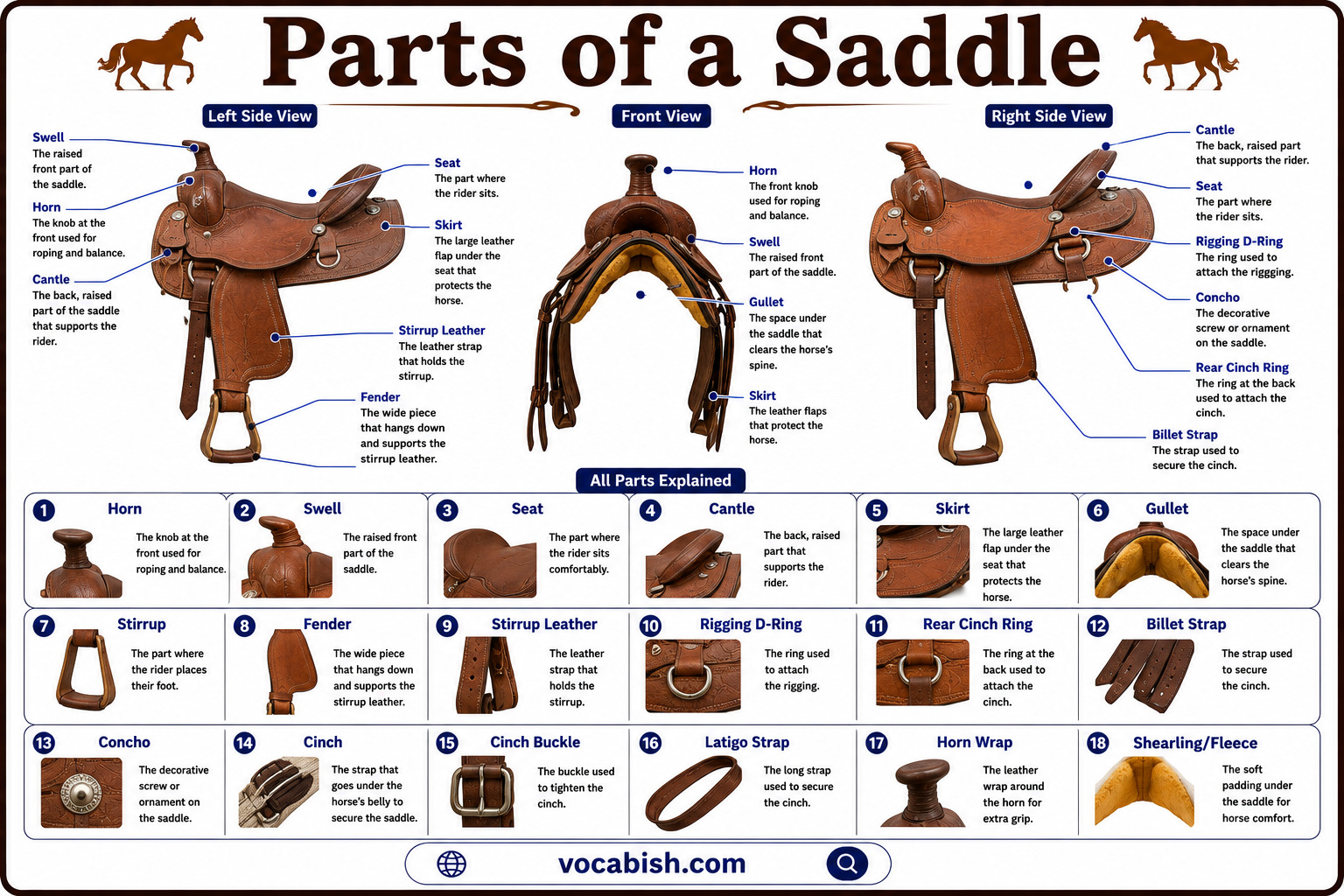
Saddle Parts Diagram
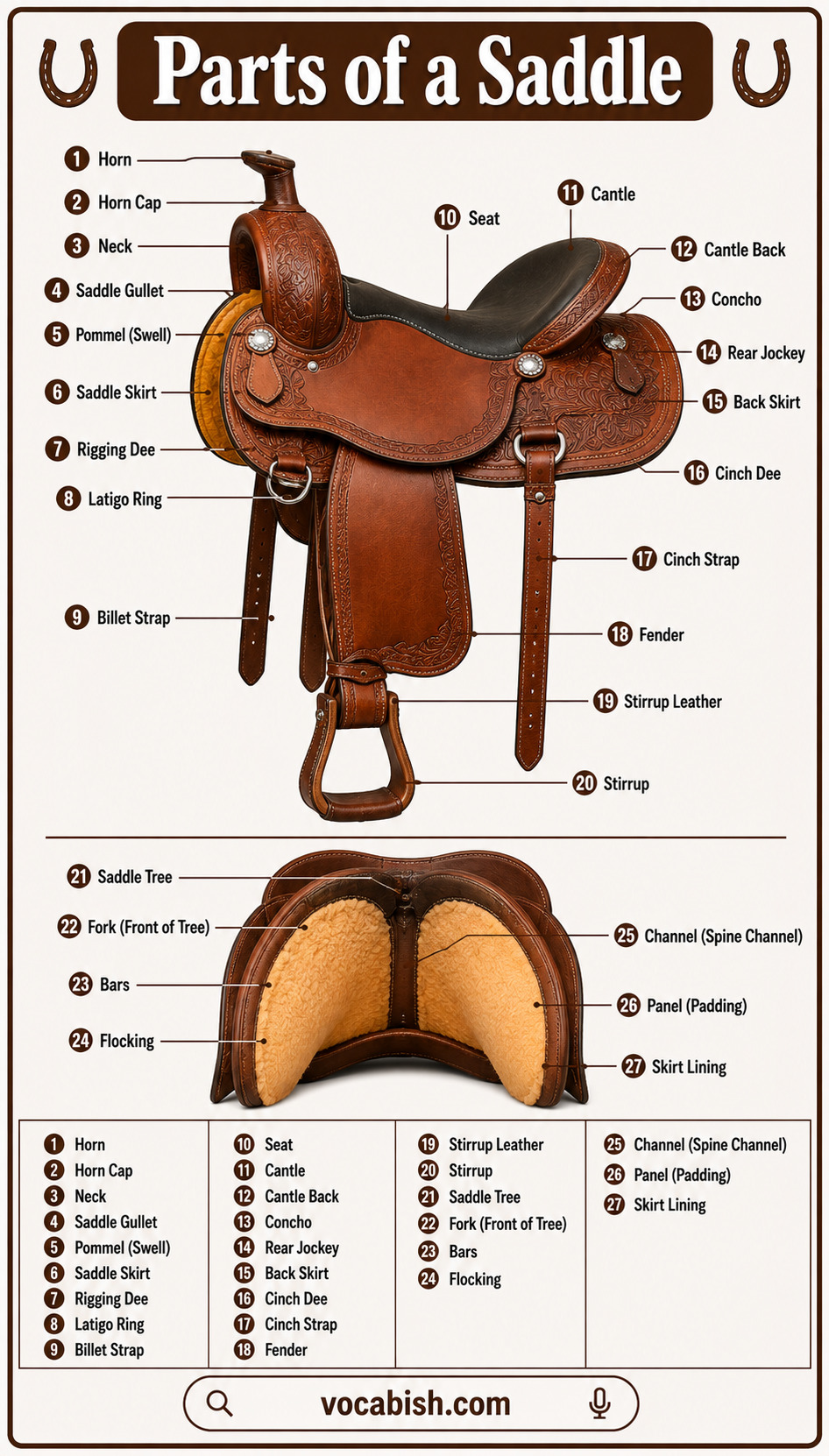
Main Parts of a Saddle in English
Seat
The seat is the middle part where the rider sits. It gives comfort and balance during riding.
- Keeps the rider stable
- Helps maintain posture
- Usually padded for comfort
Pommel
The pommel is the raised front part of the saddle.
- Provides support at the front
- Helps the rider stay secure
- Found on most riding saddles
Cantle
The cantle is the raised back part of the saddle.
- Supports the rider’s lower back
- Prevents sliding backward
- Adds comfort and safety
Stirrup
The stirrup is the loop where the rider places their feet.
- Helps with balance
- Supports the rider while mounting
- Makes riding easier
Stirrup Iron
The stirrup iron is the hard metal frame of the stirrup.
- Holds the rider’s foot
- Adds strength and support
- Usually made of metal
Stirrup Leather
The stirrup leather is the strap that connects the stirrup to the saddle.
- Holds the stirrup in place
- Adjustable for rider height
- Made from strong leather
Flap
The flap hangs down on the side of the saddle.
- Protects the rider’s legs
- Covers straps and buckles
- Gives extra comfort
Girth
The girth is the strap under the horse’s belly.
- Keeps the saddle secure
- Prevents slipping
- Must fit tightly but comfortably
Billet Straps
Billet straps connect the girth to the saddle.
- Hold the girth safely
- Keep the saddle stable
- Usually made of leather
Tree
The tree is the inner frame of the saddle.
- Gives the saddle shape
- Supports rider weight
- Helps protect the horse’s back
Panels
Panels are the soft padded parts under the saddle.
- Reduce pressure on the horse
- Improve comfort
- Help the saddle fit correctly
Skirt
The skirt is the leather piece under the saddle seat.
- Protects the horse from hardware
- Adds style and support
- Common on Western saddles
Horn
The horn is the rounded handle on Western saddles.
- Gives the rider something to hold
- Often used in ranch work
- Found only on some saddle types
Knee Roll
The knee roll is a padded section near the front flap.
- Supports the rider’s knees
- Improves leg position
- Adds safety during movement
D-Ring
The D-ring is a metal ring attached to the saddle.
- Holds equipment and bags
- Used for attaching tools
- Helpful during long rides
Saddle Pad
The saddle pad sits between the saddle and the horse.
- Protects the horse’s back
- Absorbs sweat and pressure
- Adds comfort
Buckle
The buckle joins straps together.
- Helps tighten equipment
- Keeps straps secure
- Easy to adjust
Fender
The fender is a wide leather piece on Western saddles.
- Protects the rider’s legs
- Connects to the stirrup
- Adds comfort while riding
List of All Parts of Saddle Names in English
Seat | Pommel | Cantle |
Twist | Tree | Bars |
Gullet | Horn | |
Swell | Skirt | Flap |
Fender | Panel | Knee Roll |
Thigh Block | Stirrup | Stirrup Iron |
Stirrup Leather | Stirrup Bar | Tread |
Girth | Cinch | Billet Straps |
Latigo Strap | Off Billet | Buckle |
D-Ring | Rigging | Rigging Ring |
Concho | Saddle Strings | Breast Collar |
Crupper | Back Cinch | Keeper |
Sweat Flap | Jockey | Ground Seat |
Padding | Seat Jockey | Cantle Binding |
Pommel Arch | Saddle Pad | Sheepskin Lining |
Webbing | Nail Head | Handhold |
Air Panel | Channel | Seat Bone Area |
Flap Keeper | Surcingle | Toe Cage |
Tapadero | Hooded Stirrup | Balance Strap |
Point Strap | Rear Billet | Elastic Insert |
Seat Saver | Cantle Bag | Saddle Cover |
Common Saddle Vocabulary List
- Seat — place where the rider sits
- Pommel — front raised part
- Cantle — back raised part
- Stirrup — foot support loop
- Stirrup iron — metal foot frame
- Stirrup leather — strap holding stirrup
- Flap — side leather cover
- Girth — strap under horse
- Billet straps — straps connecting girth
- Tree — saddle frame
- Panels — soft underside padding
- Skirt — leather piece below seat
- Horn — front handle on Western saddle
- Knee roll — knee support padding
- D-ring — metal attachment ring
- Saddle pad — protective cloth pad
- Buckle — fastening piece
- Fender — wide leather leg cover
Daily English Sentences About Saddles
- The rider cleaned the saddle after the lesson.
- My foot slipped out of the stirrup.
- The girth feels too loose today.
- She adjusted the stirrup leather carefully.
- The horse looked comfortable under the saddle pad.
- He held the horn while riding fast.
- The buckle needs tightening.
- This saddle has soft panels.
- The flap protects the rider’s legs.
- The cantle gives back support.
Tips to Remember Saddle Parts
- Learn a few saddle words every day.
- Look at real saddle pictures while studying.
- Practice speaking the words aloud.
- Use simple sentences for better memory.
- Match each saddle part with its function.
Learning the parts of a saddle in English helps learners improve both vocabulary and real-world understanding. These words are useful for horse riding, sports, farming, and outdoor activities. Since each saddle part has a special job, remembering the function makes learning easier and faster.
FAQs about Saddle Parts
The main parts of a saddle include the seat, pommel, cantle, stirrup, flap, girth, panels, and tree. Each part helps the rider stay safe and balanced.
A saddle helps the rider sit comfortably on the horse. It also spreads weight evenly and protects the horse’s back during riding.
The seat is the center part of the saddle where the rider sits. It provides comfort, balance, and support while riding a horse.
The stirrup supports the rider’s feet during riding. It helps with balance, mounting the horse, and controlling body movement safely.
The pommel is the raised front part of the saddle. It gives support and helps the rider stay secure while riding.
The girth keeps the saddle tightly attached under the horse’s belly. It prevents the saddle from slipping during movement.
Saddle panels reduce pressure on the horse’s back. They add comfort and help the saddle fit properly on the horse.
The pommel is the front raised part of the saddle, while the cantle is the raised back part that supports the rider’s lower back.
Related Articles: