
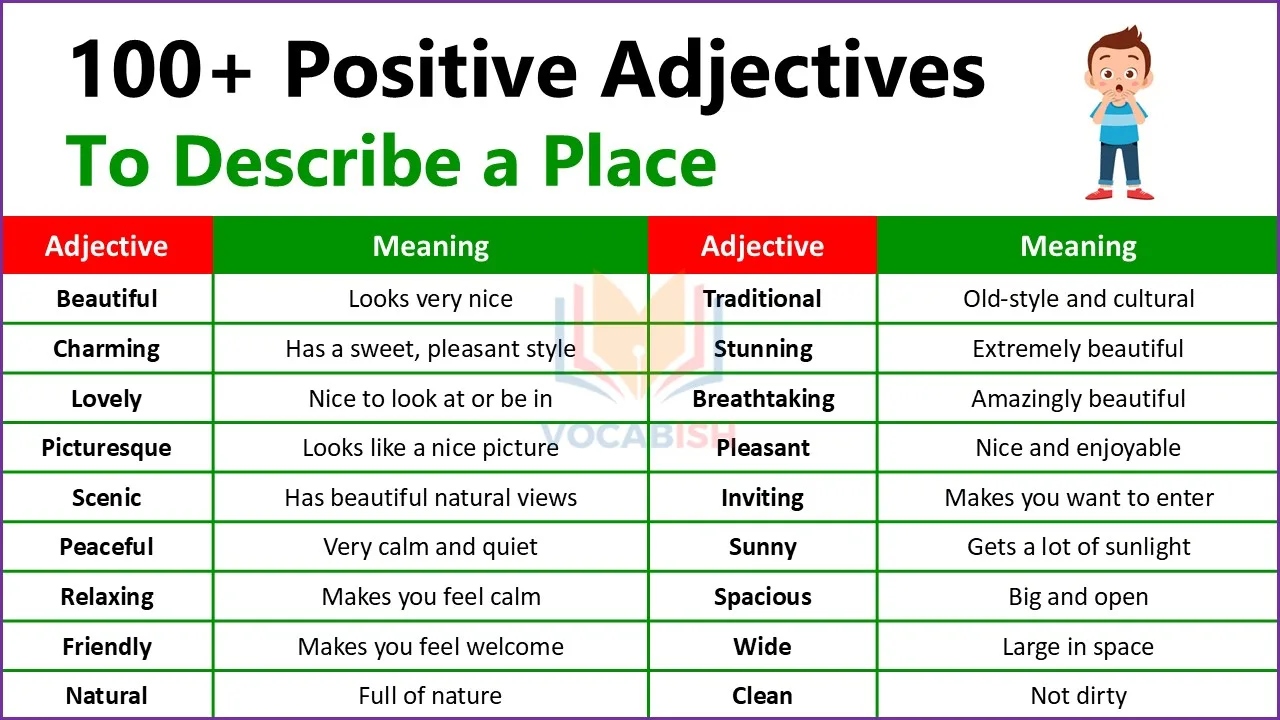
In this blog post, you will learn 100+ positive adjectives to describe a place in English. These words help you understand how to express the qualities of cities, towns, homes, and natural surroundings clearly. A strong vocabulary of place adjectives improves speaking, reading, writing, and listening skills. When you know the right words, you can describe locations with confidence and detail. Our aim is to help you master useful adjectives for places step by step. Keep reading and enhance your English expression today.
Positive Adjectives for Places
Positive adjectives for places are describing words used to show that a place looks nice, feels comfortable, or gives a good experience. These adjectives help readers feel the setting, making descriptions more clear and enjoyable.
Common uses:
- Writing about a city, town, village, room, beach, park, or building
- Talking about travel experiences
- Describing locations in stories or essays
Positive adjectives explain the good qualities, such as beautiful views, quiet areas, or clean spaces.
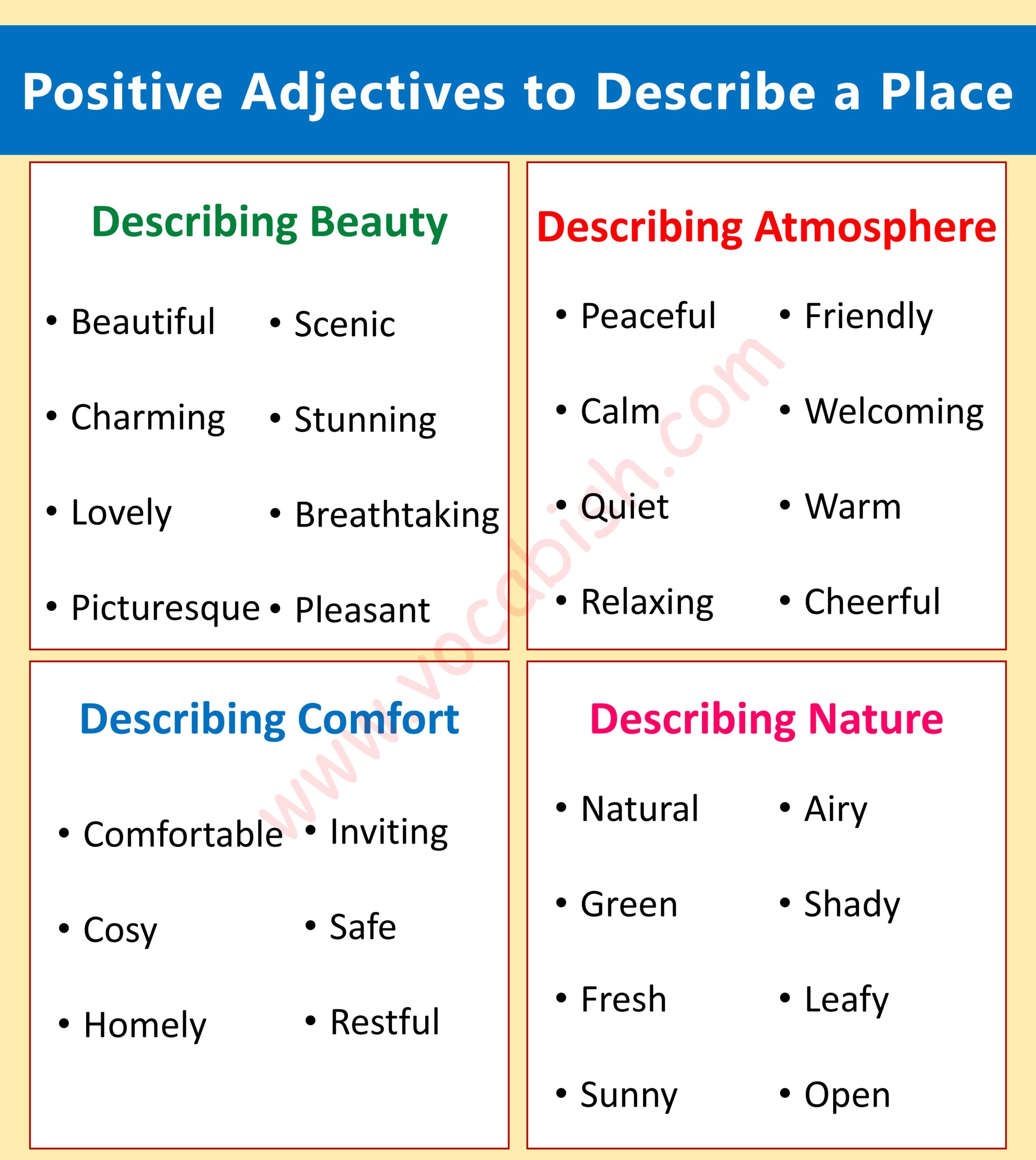
Why We Use Positive Adjectives for Places
We use these adjectives to:
- Make writing more colourful
- Give clear pictures of a location
- Share good feelings or impressions
- Help others understand why a place is enjoyable
Using positive adjectives makes your writing strong, simple, and easy to imagine.
Types of Positive Adjectives to Describe a Place
Describing Beauty
These words show how attractive a place looks.
Beautiful
Very pleasing to look at or admire.
Example: “The garden was beautiful with colourful flowers.”
Charming
Pleasant and attractive in appearance or personality.
Example: “The charming village welcomed tourists warmly.”
Lovely
Delightful, attractive, or enjoyable.
Example: “She had a lovely smile that brightened the room.”
Picturesque
Visually attractive, like a picture.
Example: “The village by the river looked picturesque at sunset.”
Scenic
Providing beautiful natural views.
Example: “We drove along a scenic mountain road.”
Stunning
Extremely impressive or beautiful.
Example: “The sunset over the lake was stunning.”
Breathtaking
So beautiful or amazing it takes your breath away.
Example: “The view from the hilltop was breathtaking.”
Pleasant
Enjoyable and nice.
Example: “We had a pleasant afternoon at the park.”
Describing Atmosphere
These show how a place feels.
Peaceful
Free from disturbance; quiet and calm.
Example: “The park was peaceful early in the morning.”
Calm
Relaxed and not worried or upset.
Example: “He stayed calm during the storm.”
Quiet
Making little or no noise.
Example: “The library was quiet and perfect for studying.”
Relaxing
Helps someone feel calm and stress-free.
Example: “Listening to music was relaxing after school.”
Friendly
Kind, pleasant, and welcoming to others.
Example: “The friendly neighbours always greeted us warmly.”
Welcoming
Inviting and warm towards guests or visitors.
Example: “The hotel staff were welcoming to all guests.”
Warm
Kind, caring, and friendly in behaviour.
Example: “She gave me a warm smile when I arrived.”
Cheerful
Happy, lively, and positive in mood.
Example: “The cheerful children played happily in the garden.”
Describing Comfort
Used for homes, rooms, hotels, cafés, and indoor places.
Comfortable
Feels relaxed and at ease physically or mentally.
Example: “She felt comfortable sitting on the soft sofa.”
Cosy
Warm, comfortable, and inviting.
Example: “We enjoyed a cosy evening by the fireplace.”
Homely
Simple, welcoming, and like home.
Example: “The café had a homely atmosphere with warm lights.”
Inviting
Appealing and welcoming to go in or join.
Example: “The garden looked inviting with colourful flowers.”
Safe
Protected from harm or danger.
Example: “The children felt safe playing in the park.”
Restful
Provides relaxation and peace.
Example: “A restful afternoon nap refreshed her for the evening.”
Pleasant
Enjoyable, nice, or agreeable.
Example: “We had a pleasant walk along the beach.”
Describing Nature
Useful for parks, countryside, beaches, mountains, and outdoor spaces.
Natural
Exists in nature; not artificial.
Example: “The garden had natural beauty with flowers and trees.”
Green
Full of plants or vegetation; fresh and healthy.
Example: “The green park was perfect for a picnic.”
Fresh
Clean, new, and lively.
Example: “We enjoyed the fresh air by the river.”
Sunny
Full of sunlight or bright.
Example: “It was a sunny morning for a walk.”
Airy
Open, light, and well-ventilated.
Example: “The room felt airy with large windows.”
Shady
Provides shade and protection from sun.
Example: “We sat under a shady tree to rest.”
Leafy
Covered with leaves or full of trees.
Example: “The leafy street looked beautiful in autumn.”
Open
Spacious and not enclosed.
Example: “The open field was perfect for playing football.”
Describing Space and Size
These words describe how large, open, or well-arranged a place is.
Spacious
Large and has plenty of room.
Example: “The living room was spacious enough for a big party.”
Wide
Extends a large distance from side to side.
Example: “The wide street allowed cars to pass easily.”
Open
Not closed or blocked; has freedom of space.
Example: “The open field was perfect for flying kites.”
Roomy
Has lots of space inside.
Example: “The new car was roomy and comfortable for all passengers.”
Broad
Wide from side to side; extensive.
Example: “He walked along the broad avenue in the city.”
Well-planned
Carefully thought out and organised.
Example: “The well-planned garden had paths and flower beds neatly arranged.”
Well-organised
Arranged neatly and efficiently.
Example: “Her desk was well-organised with all stationery in place.”
Describing Cleanliness
Helpful for public areas, hotels, and indoor places.
Clean
Free from dirt, dust, or stains.
Example: “She kept her room clean every day.”
Neat
Well-arranged and tidy in appearance.
Example: “His neat desk made it easy to find his books.”
Tidy
Organised and orderly.
Example: “The tidy kitchen looked inviting and pleasant.”
Well-kept
Maintained in good condition.
Example: “The well-kept garden had healthy plants and flowers.”
Polished
Smooth, shiny, and refined in appearance.
Example: “The polished shoes made him look smart and presentable.”
Spotless
Completely clean; no marks or stains.
Example: “Her spotless kitchen impressed everyone visiting her home.”
Describing Modern or Traditional Features
Used to show design or style.
Modern
Related to the present time; up-to-date and contemporary.
Example: “The modern house had large windows and smart furniture.”
Stylish
Having a fashionable and attractive appearance.
Example: “She wore a stylish outfit to the party.”
Elegant
Classy, graceful, and pleasing in appearance.
Example: “The elegant chandelier lit up the dining room beautifully.”
Classic
Timeless and traditionally admired.
Example: “He preferred a classic car with simple, clean lines.”
Traditional
Following customs or long-established styles.
Example: “The wedding was held in a traditional ceremony with cultural music.”
Updated
Made modern or improved recently.
Example: “The updated app now has new features for users.”
Fresh-looking
Appears clean, new, and lively.
Example: “The fresh-looking room had bright paint and neat furniture.”
List of Positive Adjectives for Places
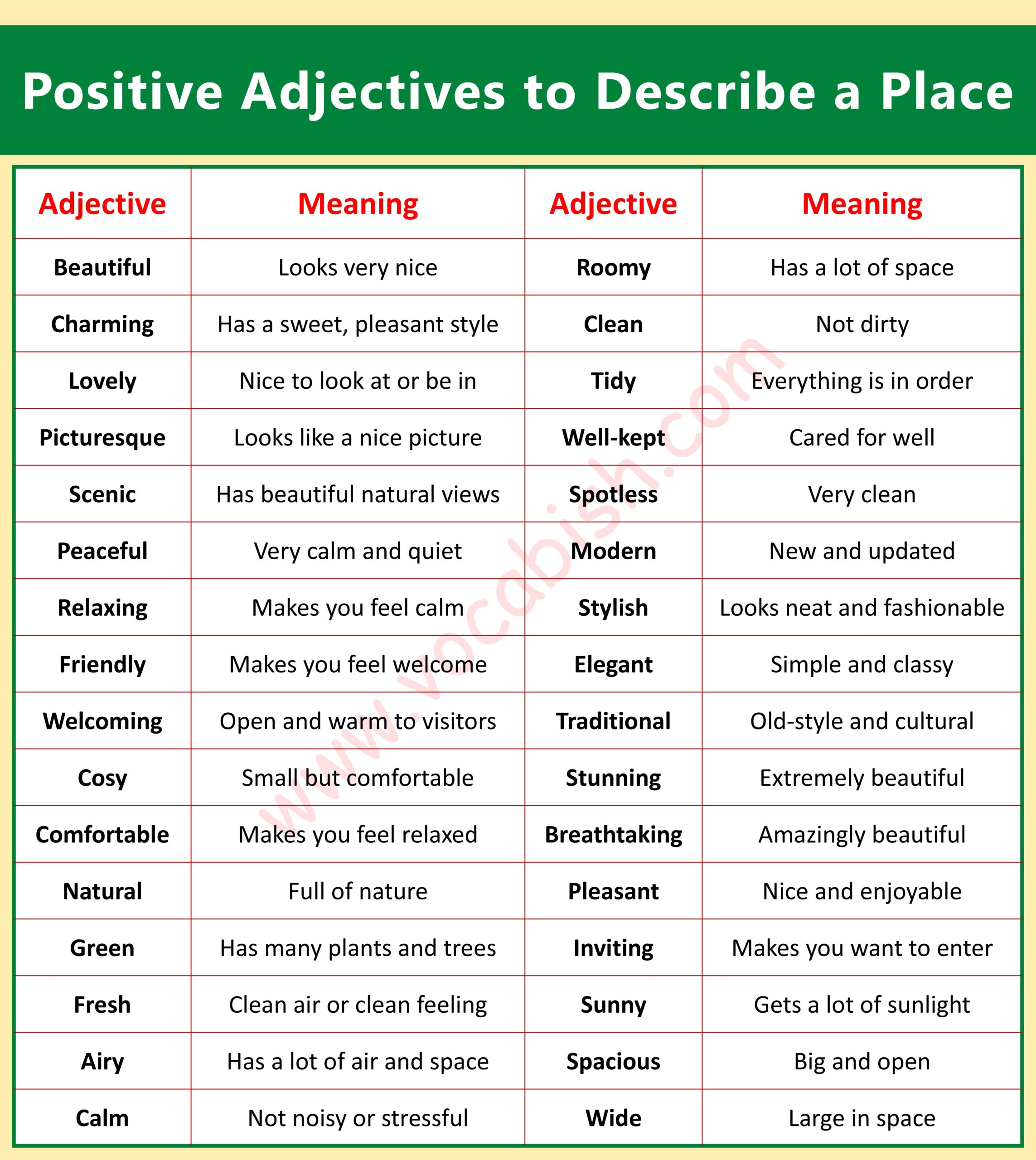
| Adjective | Meaning |
|---|---|
| Beautiful | Looks very nice |
| Charming | Has a sweet, pleasant style |
| Lovely | Nice to look at or be in |
| Picturesque | Looks like a nice picture |
| Scenic | Has beautiful natural views |
| Peaceful | Very calm and quiet |
| Relaxing | Makes you feel calm |
| Friendly | Makes you feel welcome |
| Welcoming | Open and warm to visitors |
| Cosy | Small but comfortable |
| Comfortable | Makes you feel relaxed |
| Natural | Full of nature |
| Green | Has many plants and trees |
| Fresh | Clean air or clean feeling |
| Airy | Has a lot of air and space |
| Sunny | Gets a lot of sunlight |
| Spacious | Big and open |
| Roomy | Has a lot of space |
| Clean | Not dirty |
| Tidy | Everything is in order |
| Well-kept | Cared for well |
| Spotless | Very clean |
| Modern | New and updated |
| Stylish | Looks neat and fashionable |
| Elegant | Simple and classy |
| Traditional | Old-style and cultural |
| Stunning | Extremely beautiful |
| Breathtaking | Amazingly beautiful |
| Pleasant | Nice and enjoyable |
| Inviting | Makes you want to enter |
| Homely | Warm and comfortable like home |
| Calm | Not noisy or stressful |
| Wide | Large in space |
| Open | Free space, not crowded |
| Leafy | Filled with trees |
| Shady | Area with shade from sun |
| Well-organised | Arranged in a neat way |
Useful Positive Adjectives for Place
Beauty and Appearance
| Word | Best Use |
|---|---|
| Beautiful | Any place |
| Charming | Towns, cafés |
| Lovely | Homes, parks |
| Scenic | Mountains, lakes |
| Picturesque | Villages, countryside |
Atmosphere and Feeling
| Word | Best Use |
|---|---|
| Peaceful | Parks, homes |
| Calm | Beaches, gardens |
| Relaxing | Hotels, rooms |
| Friendly | Towns, neighbourhoods |
| Welcoming | Homes, cafés |
Space and Size
| Word | Best Use |
|---|---|
| Spacious | Rooms, halls |
| Roomy | Houses, offices |
| Open | Fields, beaches |
| Wide | Streets, walkways |
| Airy | Living rooms, balconies |
Cleanliness
| Word | Best Use |
|---|---|
| Clean | Any place |
| Tidy | Homes, shops |
| Neat | Rooms, offices |
| Spotless | Hotels, bathrooms |
| Well-kept | Gardens, parks |
Examples of Sentences
- The beach is beautiful and has clear water.
- This park feels peaceful, and it is very green.
- The living room is spacious and easy to move around.
- The café is cosy and welcoming for visitors.
- The village is picturesque with lovely houses.
- The garden is well-kept, and everything looks neat.
- Our hotel room was clean, comfortable, and easy to enjoy.
- The mountain view was breathtaking and scenic.
Positive adjectives help describe a place in a clear and simple way. Using words like beautiful, cosy, peaceful, and spacious makes your speaking and writing stronger. This list and the examples give you easy wording to describe any location with confidence.
Read More