
In this blog post, you will learn about syllables in English, the building blocks of every word. Understanding syllables helps you master correct pronunciation and spelling. It also improves your reading, writing, listening, and speaking skills. By knowing the different types of syllables and seeing practical examples, you can understand how words are formed and use English more confidently in everyday life.
What Are Syllables?
A syllable is a sound part of a word. Every word has at least one syllable. For example:
- Cat → 1 syllable
- Apple → 2 syllables (Ap-ple)
- Computer → 3 syllables (Com-pu-ter)
Breaking words into syllables makes them easier to pronounce, spell, and remember.
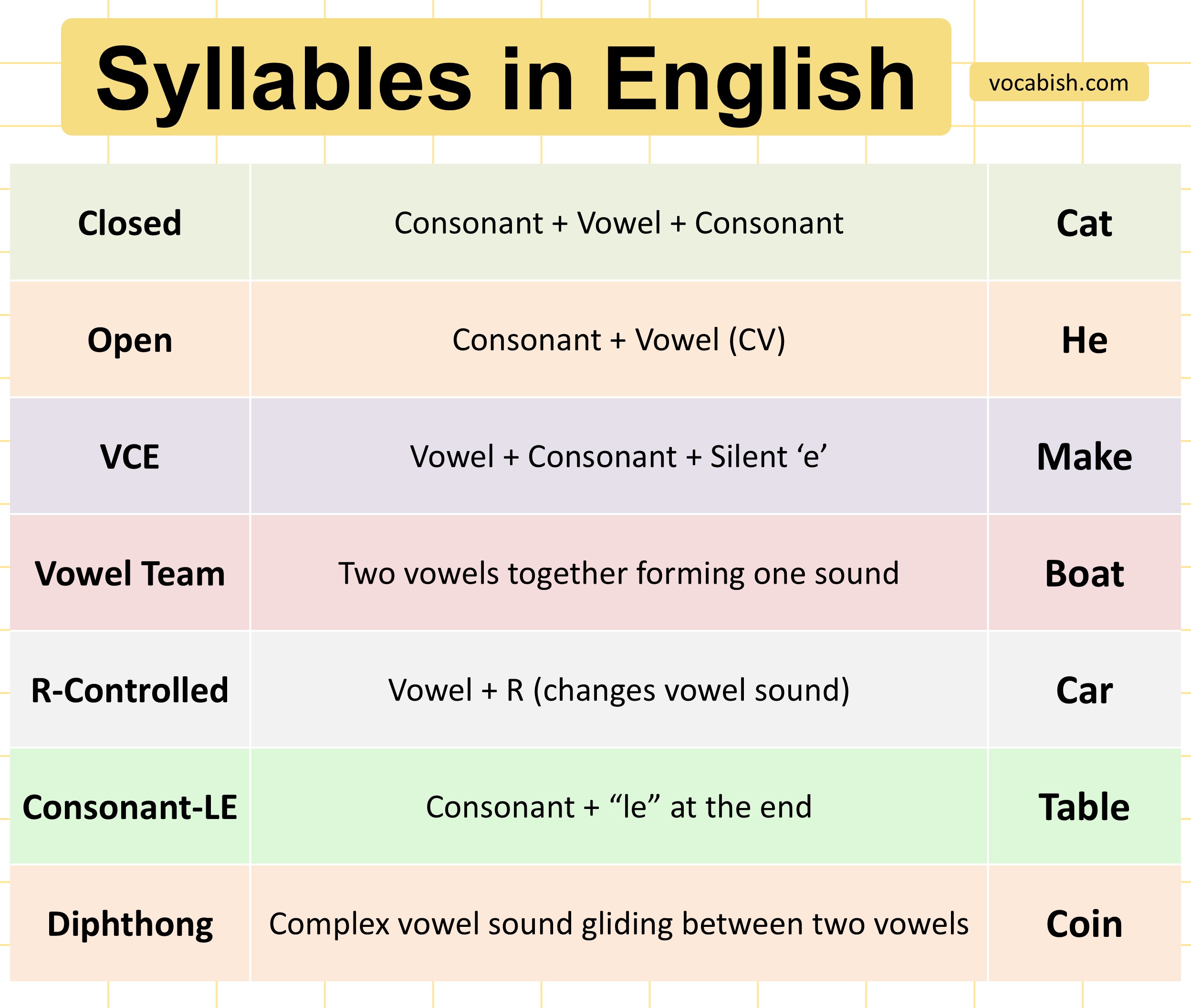
How to Form Syllable?
| Syllable Type | Structure | Example Word |
|---|---|---|
| Closed Syllable | Consonant + Vowel + Consonant (CVC) | Cat |
| Open Syllable | Consonant + Vowel (CV) | He |
| Vowel-Consonant-e (VCE) | Vowel + Consonant + Silent ‘e’ | Make |
| Vowel Team Syllable | Two vowels together forming one sound | Boat |
| R-Controlled Syllable | Vowel + R (changes vowel sound) | Car |
| Consonant-le Syllable | Consonant + “le” at the end | Table |
| Diphthong Syllable | Complex vowel sound gliding between two vowels | Coin |
The 7 Syllable Types
English syllables can be divided into 7 main types. Knowing these helps with reading, spelling, and pronunciation:
1. Closed Syllable (CVC): Ends in a consonant; vowel is short.
- Example: Cat, bed, sit
2. Open Syllable (CV): Ends in a vowel; vowel is long.
- Example: He, go, hi
3. Vowel-Consonant-e (VCE) Syllable: Silent ‘e’ makes the vowel long.
- Example: Make, time, hope
4. Vowel Team Syllable: Two vowels together make one sound.
- Example: Boat, team, rain
5. R-Controlled Syllable: Vowel followed by ‘r’ changes sound.
- Example: Car, bird, turn
6. Consonant-le Syllable: Ends with consonant + “le.”
- Example: Table, little, bubble
7. Diphthong Syllable: Complex vowel sound that glides from one vowel to another.
- Example: Coin, loud, boil
Tip for learners: Practicing these syllable types makes spelling, reading, and pronunciation much easier, especially for new or challenging words.
Examples of One-, Two-, Three-, and Four-Syllable Words
Understanding how many syllables a word has is very helpful for pronunciation, reading, and spelling. Here are clear examples:
1. One-Syllable Words (simple, short words):
- Cat, dog, sun, run, book, chair, pen, fish, tree, car
2. Two-Syllable Words (slightly longer, easy to combine):
- Apple (Ap-ple), Happy (Hap-py), Table (Ta-ble), Water (Wa-ter), River (Riv-er), Teacher (Teach-er)
3. Three-Syllable Words (more complex, often used in school or formal speech):
- Computer (Com-pu-ter), Family (Fam-i-ly), Elephant (El-e-phant), Celebrate (Cel-e-brate), Discover (Dis-cov-er)
4. Four-Syllable Words (advanced, often academic or descriptive):
- Dictionary (Dic-tion-ar-y), Important (Im-por-tant), Adventure (Ad-ven-ture), Understand (Un-der-stand), Appreciate (Ap-pre-ci-ate)
Common Syllables with Meanings
Here are useful syllables often found in everyday words:
Sun
light and heat from the sky
Example: The sun is bright today.
Water (wa-ter)
liquid for drinking
Example: Drink fresh water daily.
Food
what we eat
Example: Healthy food is important.
House
a home
Example: Our house has a garden.
Book
a set of written pages
Example: I read a book every week.
Chair
something to sit on
Example: Sit on the chair, please.
Car
a vehicle
Example: The car is fast.
Door
entrance to a room
Example: Close the door gently.
Phone
device to talk to people
Example: Call me on the phone.
Pen
writing tool
Example: I write notes with a pen.
English Syllables with Examples
Teach
to give knowledge
Example: Teachers teach students daily.
Learn
to gain knowledge
Example: I learn English every day.
Desk
a student’s table
Example: Sit at your desk.
Class
group of students
Example: We have math class now.
Paper
material to write on
Example: Take a sheet of paper.
Lesson
learning session
Example: Today’s lesson is easy.
Test
assessment
Example: I studied for the test.
School
place to learn
Example: School starts at 8 a.m.
Bag
school bag
Example: Pack your bag carefully.
Read (re-ad)
look at and understand words
Example: Read this book.
The Traits of a Syllable
A syllable has specific characteristics that make it easy to recognize:
1. Contains a vowel sound: Every syllable has at least one vowel (a, e, i, o, u).
- Example: Cat (a), Happy (Ha-ppy)
2. Has a consonant sound (optional): A syllable may start or end with consonants.
- Example: Run (R-un), Table (Ta-ble)
3. Can stand alone or combine: Some syllables are complete words; others join with more syllables.
- Example: Sun (standalone), Computer (combined)
4. Stress and rhythm: English syllables often have a stressed part, which affects pronunciation.
- Example: ComPUter (stress on second syllable)
5. Builds vocabulary patterns: Many words share syllables, helping learners guess meanings.
- Example: Tele- → television, telephone, teleport
Conclusion
Learning syllables is a simple yet powerful step to improve your English. By understanding common syllables, practicing their meanings, and using them in real-life sentences, you can speak, read, and write English more confidently. Use this list daily, and soon syllables will become a natural part of your vocabulary learning.
Frequently Asked Questions
What are syllables in English with types and examples?
Syllables in English are the sound units that make up words. Each syllable usually contains a vowel sound. Learning the types of syllables—such as closed, open, VCE, r-controlled, and consonant-le—helps learners pronounce, read, and spell words correctly, making English communication easier.
How do I identify syllables in English words?
To identify syllables, listen for vowel sounds in a word. Clap or divide the word by its sounds. For example, “computer” has three syllables: com-pu-ter.
What are the common types of syllables in English with examples?
English syllables include closed (cat), open (he), VCE—vowel-consonant-e (make), vowel team (boat), r-controlled (car), consonant-le (table), and diphthong (coin).
How many syllables are in English words?
English words can have one to many syllables. Short words like “cat” have one syllable, medium words like “happy” have two, and longer words like “computer” have three or more.
How can I count syllables in English words?
Count syllables by listening for each vowel sound in a word. Clap or tap for every distinct sound. For example, “elephant” has three syllables: el-e-phant.
What are examples of multi-syllable words in English?
Multi-syllable words have two or more syllables, like “computer” (com-pu-ter), “celebrate” (cel-e-brate), and “dictionary” (dic-tion-ar-y).
Read More