
In this blog post, you will learn regular verbs, their meanings, and example sentences with pictures. Regular verbs are action words that follow a pattern in the past tense by adding -ed. Learning these verbs is important because they are used in daily conversations, school lessons, and writing tasks. When you understand regular verbs, you can speak about past actions correctly, read stories with better understanding, write clear sentences, and listen to conversations more confidently. Keep reading to build your verb knowledge and improve your English step by step.
What Are Regular Verbs in English?
Regular verbs are verbs that form their past tense and past participle by adding -ed or -d at the end of the base verb.
Examples:
- play → played
- clean → cleaned
These verbs follow a clear pattern, which makes them easier to remember and use correctly.
Regular Verbs in English with Meanings
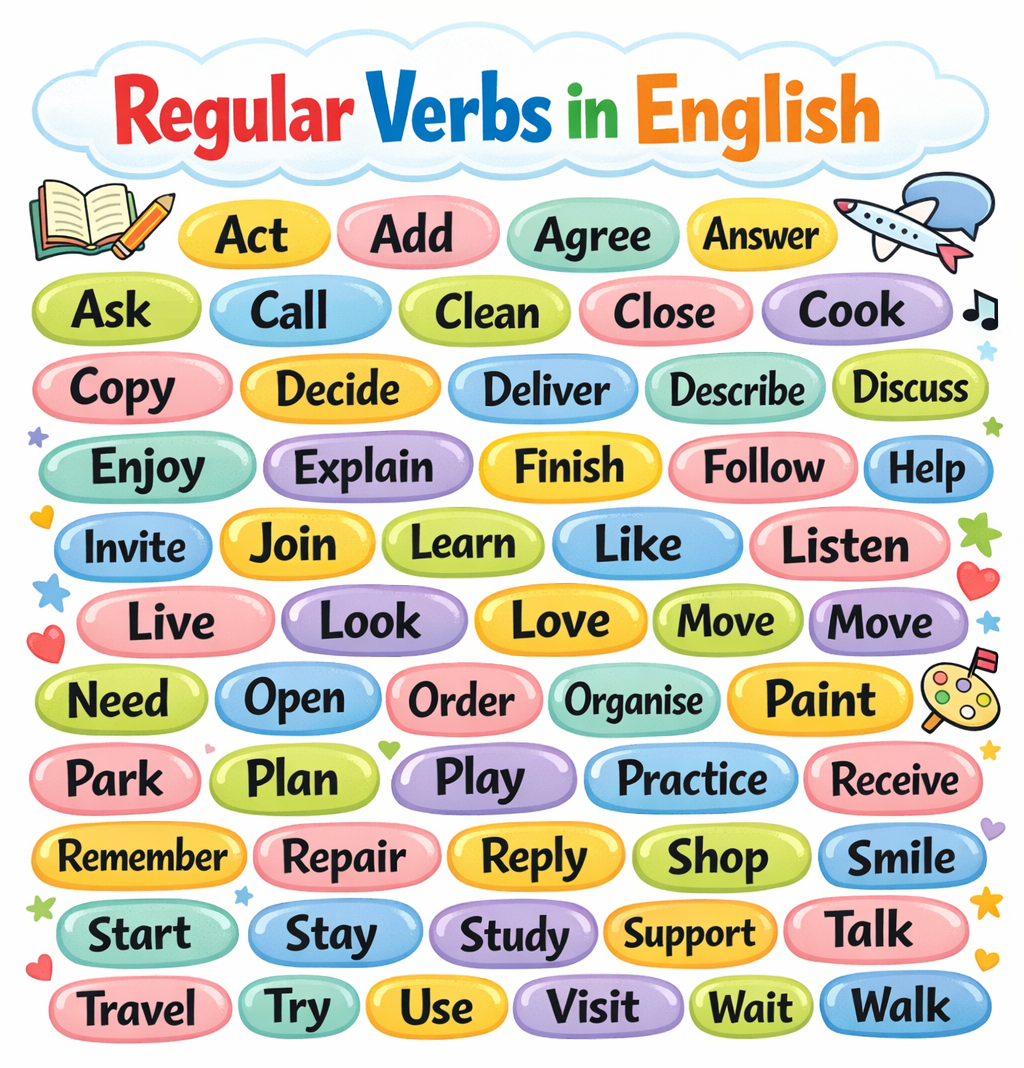
Here’s the list of the most common regular verb examples in English with their meanings:
| Regular Verb | Meaning |
|---|---|
| Act | do something |
| Add | put something more |
| Agree | say yes to an idea |
| Answer | reply to a question |
| Ask | say a question |
| Call | speak by phone |
| Clean | make something tidy |
| Close | shut something |
| Cook | prepare food |
| Copy | make the same thing |
| Dance | move to music |
| Decide | make a choice |
| Deliver | bring or send |
| Describe | say how something is |
| Discuss | talk about a topic |
| Enjoy | feel happy doing something |
| Explain | make something clear |
| Finish | complete something |
| Follow | go after someone |
| Help | give support |
| Invite | ask someone to come |
| Join | become part of something |
| Learn | get knowledge |
| Like | enjoy something |
| Listen | pay attention to sound |
| Live | stay in a place |
| Look | see something |
| Love | like very much |
| Move | change position |
| Need | require something |
| Open | make not closed |
| Order | ask for food or goods |
| Organise | arrange clearly |
| Paint | cover with colour |
| Park | stop a vehicle |
| Plan | decide before doing |
| Play | do a game or sport |
| Practice | repeat to improve |
| Receive | get something |
| Remember | keep in mind |
| Repair | fix something |
| Reply | answer someone |
| Shop | buy things |
| Smile | show happiness |
| Start | begin something |
| Stay | remain in a place |
| Study | learn a subject |
| Support | help someone |
| Talk | speak with others |
| Travel | go to places |
| Try | attempt something |
| Use | do something with |
| Visit | go to see a place |
| Wait | stay until time comes |
| Walk | move on foo |
Regular Verbs Used in Daily Actions
These verbs describe common actions people do every day.
- Walk: move on foot
- Talk: speak with someone
- Play: enjoy a game or activity
- Open: move something so it is not closed
- Close: shut something
- Clean: make something tidy
- Cook: prepare food
- Wash: clean with water
- Watch: look at something for a time
- Listen: pay attention to sound
Regular Verbs for School and Learning
These verbs are often used in classrooms and studies.
- Study: learn a subject
- Learn: gain knowledge
- Practice: repeat to improve
- Answer: reply to a question
- Ask: say a question
- Explain: make something clear
- Check: look to see if correct
- Mark: give a score or sign
- Repeat: say again
- Review: look again at work
Regular Verbs for Work and Office Life
These verbs are common in jobs and workplaces.
- Work: do a job
- Plan: decide what to do
- Help: give support
- Call: speak by phone
- Email: send a message online
- Organise: arrange things clearly
- Manage: control work or people
- Finish: complete something
- Start: begin something
- Deliver: bring or send items
Regular Verbs for Communication
These verbs help you share ideas and information.
- Speak: say words
- Explain: describe clearly
- Discuss: talk about a topic
- Share: give part to others
- Describe: say what something is like
- Agree: say yes to an idea
- Disagree: say no to an idea
- Suggest: give an idea
- Invite: ask someone to come
- Reply: answer someone
Regular Verbs for Feelings and Behaviour
These verbs describe emotions and actions.
- Like: enjoy something
- Love: feel strong liking
- Hate: strongly dislike
- Enjoy: feel happy doing something
- Smile: show happiness on face
- Laugh: make a happy sound
- Respect: show care for others
- Trust: believe someone
- Support: help someone
- Apologise: say sorry
Regular Verbs for Home and Daily Life
These verbs are used in home routines.
- Live: stay in a place
- Stay: remain somewhere
- Visit: go to see someone
- Repair: fix something
- Paint: cover with colour
- Decorate: make a place look nice
- Move: change place
- Arrange: put in order
- Shop: buy items
- Order: ask for food or goods
Regular Verbs for Travel and Movement
These verbs are useful for travel and directions.
- Travel: go to places
- Visit: go to see a place
- Stop: not move
- Return: go back
- Arrive: reach a place
- Park: stop a vehicle
- Follow: go after someone
- Cross: go from one side to another
- Explore: look around a place
- Stay: live for a short time
How Regular Verbs Are Used in English
Regular verbs are used in:
- Present tense: I work every day
- Past tense: I worked yesterday
- Future meaning (with will): I will work tomorrow
They appear in spoken English, written texts, emails, and daily conversations.
Summary on Regular Verbs
Regular verbs are easy to learn, easy to use, and very important for clear English. This list of 100 regular verbs in English gives learners a strong base for speaking, writing, and understanding everyday language. Learning these verbs will help you use English more naturally, correctly, and confidently in real-life situations.
Frequently Asked Questions
What are regular verbs and examples?
Regular verbs are verbs that form the past tense by adding -ed or -d to the base word. These verbs follow a fixed pattern and are easy to use in sentences. Common examples of regular verbs include work, play, clean, talk, and learn.
What are the 20 regular verbs?
Twenty common regular verbs used in everyday English are work, play, talk, walk, clean, help, learn, watch, call, open, close, cook, live, stay, visit, start, finish, plan, ask, and answer.
What are 100 examples of regular verbs?
One hundred examples of regular verbs include action, communication, and daily life verbs that follow the -ed rule in past tense. These verbs are widely used in speaking and writing to describe present and past actions clearly.
What is a regular and irregular verb?
A regular verb forms its past tense by adding -ed, such as work to worked. An irregular verb does not follow this rule and changes form, such as go to went or eat to ate.
How are regular verbs used in daily English?
Regular verbs are used to talk about routine actions, past events, and future plans. They appear in school work, conversations, emails, and simple writing tasks.
Read More