
Surprisingly, a large number of English verbs follow the same pattern when talking about the past. If you’ve seen words like talked, cleaned, or visited, you’ve already encountered many examples of regular verbs.
These verbs follow consistent spelling rules, making them easier to learn than many irregular verbs. Let’s look at how they work and explore 100 practical examples you can use in daily English.
If you are interested in learning all types of verbs, then visit our Verb and Its Types guide.
What Are Regular Verbs?
Regular verbs are verbs that form their past tense and past participle by adding -ed, -d, or -ied to the base form.
Because they follow consistent spelling rules, they are often among the first verbs you study.
Easy Examples:
Base Verb | Past Tense | Past Participle |
|---|---|---|
walk | walked | walked |
play | played | played |
clean | cleaned | cleaned |
dance | danced | danced |
study | studied | studied |
Example:
- I walk to school every day.
- Yesterday, I walked to school.
How Do Regular Verbs Work?
Regular verbs follow predictable rules when changing from the present tense to the past tense.
Most verbs simply add -ed.
Examples:
Present | Past |
|---|---|
work | worked |
jump | jumped |
open | opened |
visit | visited |
help | helped |
Sentence Example:
- We visit our grandparents every month.
- We visited our grandparents last weekend.
Regular Verbs vs Irregular Verbs
Many of us are confused about regular and irregular verbs. The difference is easy to keep in mind while using both verbs in sentences.
Regular Verbs | Irregular Verbs |
|---|---|
work → worked | go → went |
play → played | see → saw |
clean → cleaned | eat → ate |
talk → talked | write → wrote |
open → opened | come → came |
Regular verbs follow a rule. Irregular verbs do not follow a single pattern and must be memorized. To read more about the differences, check our guide on regular and irregular verbs in English.
Since you’re not practicing these verbs in sentences while learning them, you may not remember them for long. That’s why it’s important to use them in everyday conversations and writing.
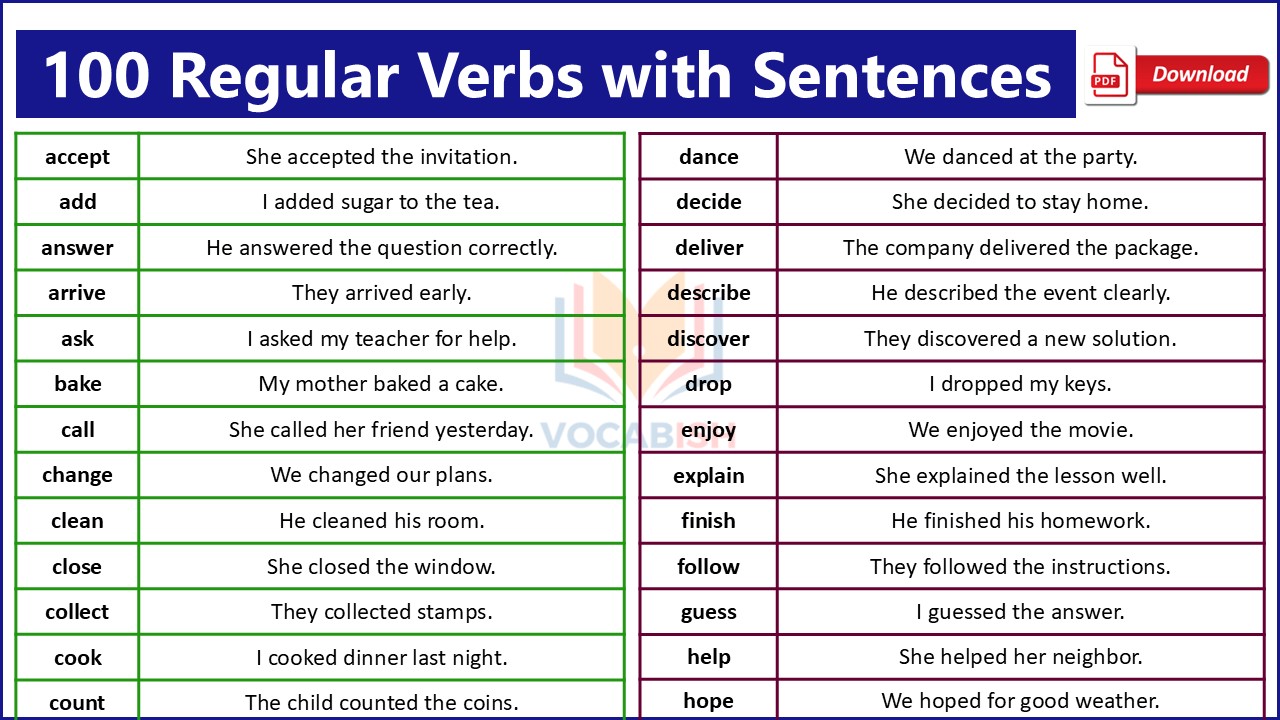
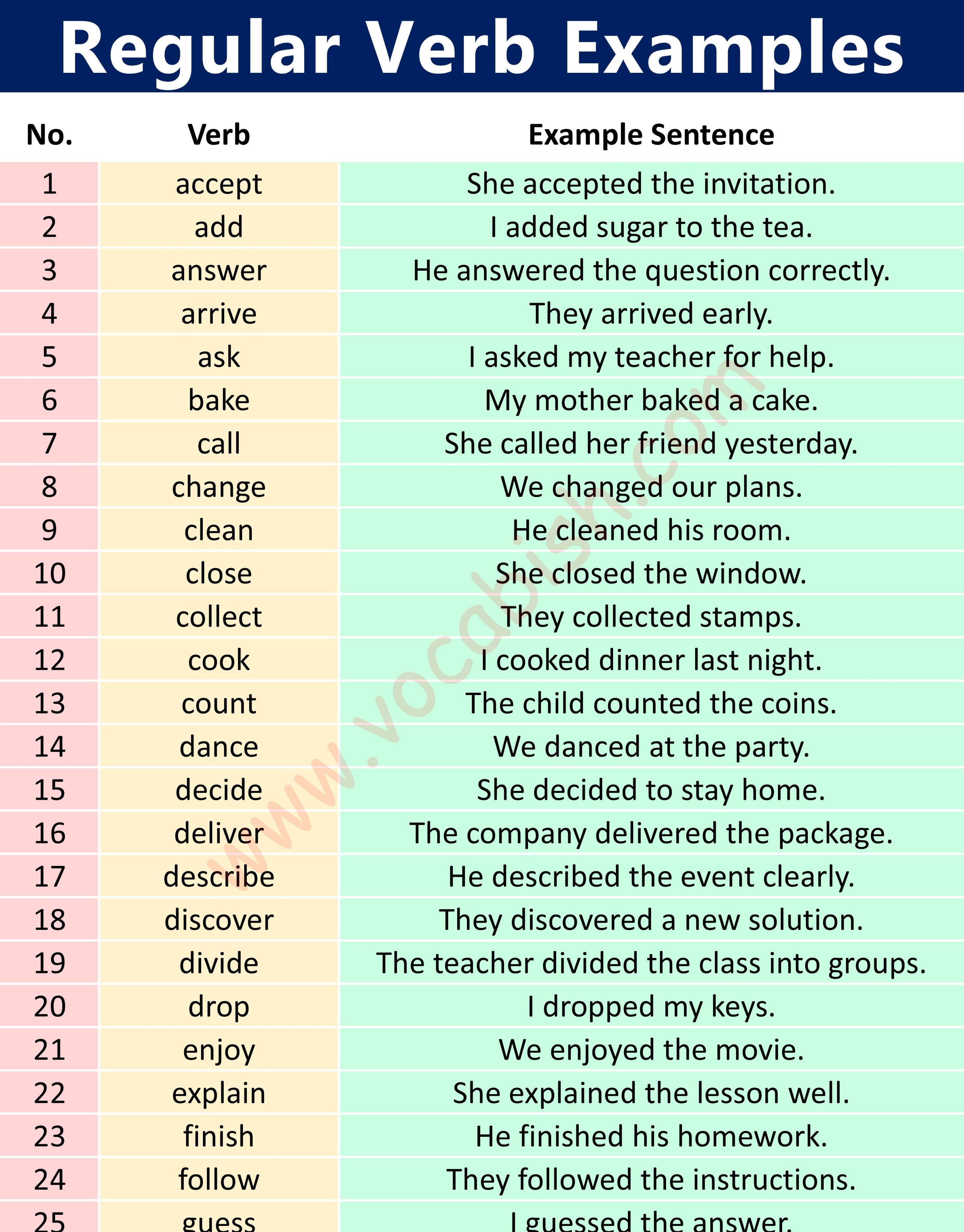
100 Examples of Regular Verbs in English
The following regular verb examples in sentences can help you understand how these verbs are used in everyday English.
No. | Verb | Example Sentence |
|---|---|---|
1 | accept | She accepted the invitation. |
2 | add | I added sugar to the tea. |
3 | answer | He answered the question correctly. |
4 | arrive | They arrived early. |
5 | ask | I asked my teacher for help. |
6 | bake | My mother baked a cake. |
7 | call | She called her friend yesterday. |
8 | change | We changed our plans. |
9 | clean | He cleaned his room. |
10 | close | She closed the window. |
11 | collect | They collected stamps. |
12 | cook | I cooked dinner last night. |
13 | count | The child counted the coins. |
14 | dance | We danced at the party. |
15 | decide | She decided to stay home. |
16 | deliver | The company delivered the package. |
17 | describe | He described the event clearly. |
18 | discover | They discovered a new solution. |
19 | divide | The teacher divided the class into groups. |
20 | drop | I dropped my keys. |
21 | enjoy | We enjoyed the movie. |
22 | explain | She explained the lesson well. |
23 | finish | He finished his homework. |
24 | follow | They followed the instructions. |
25 | guess | I guessed the answer. |
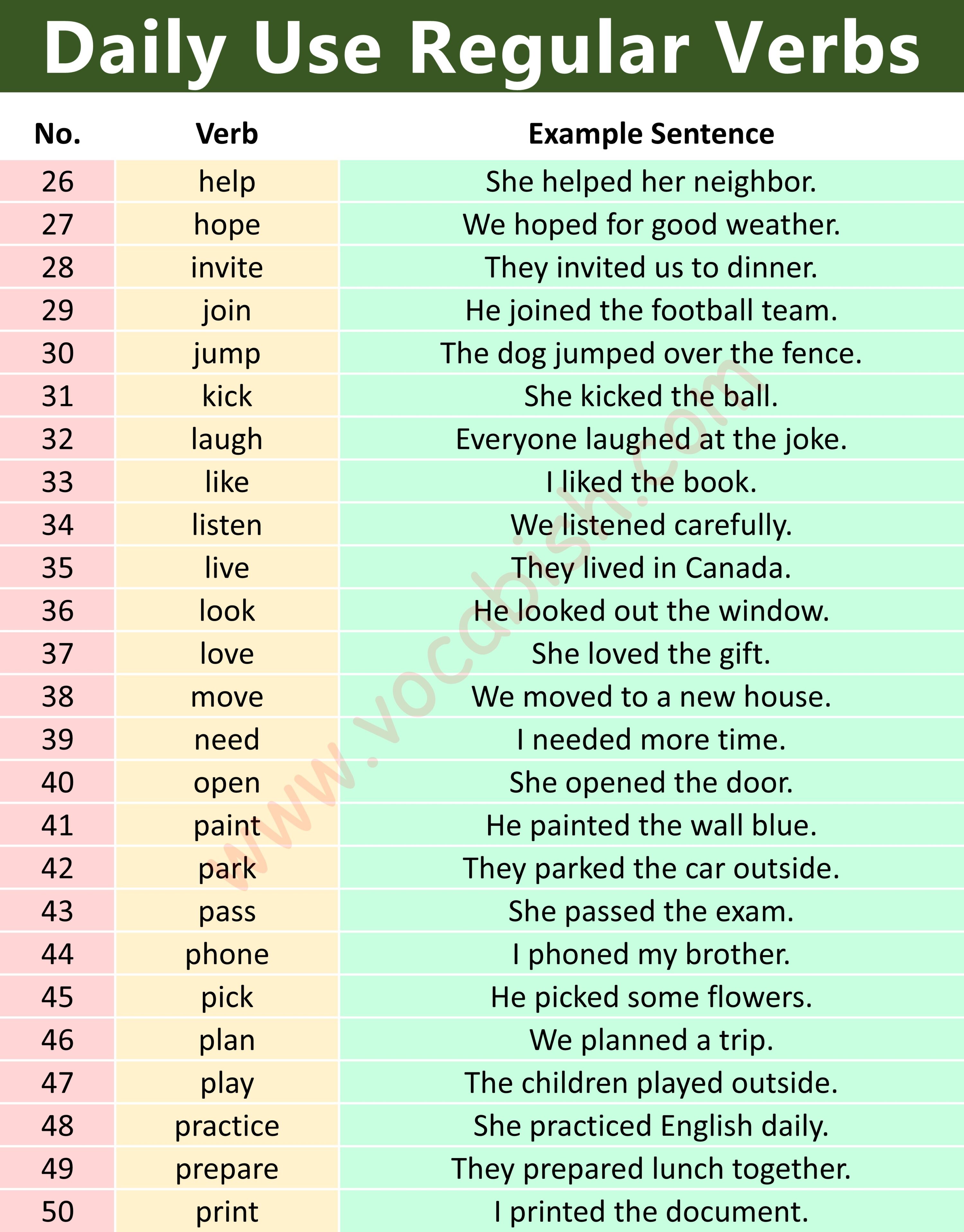
Regular Verbs Examples for Daily Use
These regular verb examples in sentences can help you talk about daily routines, hobbies, experiences, and common activities.
No. | Verb | Example Sentence |
|---|---|---|
26 | help | She helped her neighbor. |
27 | hope | We hoped for good weather. |
28 | invite | They invited us to dinner. |
29 | join | He joined the football team. |
30 | jump | The dog jumped over the fence. |
31 | kick | She kicked the ball. |
32 | laugh | Everyone laughed at the joke. |
33 | like | I liked the book. |
34 | listen | We listened carefully. |
35 | live | They lived in Canada. |
36 | look | He looked out the window. |
37 | love | She loved the gift. |
38 | move | We moved to a new house. |
39 | need | I needed more time. |
40 | open | She opened the door. |
41 | paint | He painted the wall blue. |
42 | park | They parked the car outside. |
43 | pass | She passed the exam. |
44 | phone | I phoned my brother. |
45 | pick | He picked some flowers. |
46 | plan | We planned a trip. |
47 | play | The children played outside. |
48 | practice | She practiced English daily. |
49 | prepare | They prepared lunch together. |
50 | print | I printed the document. |
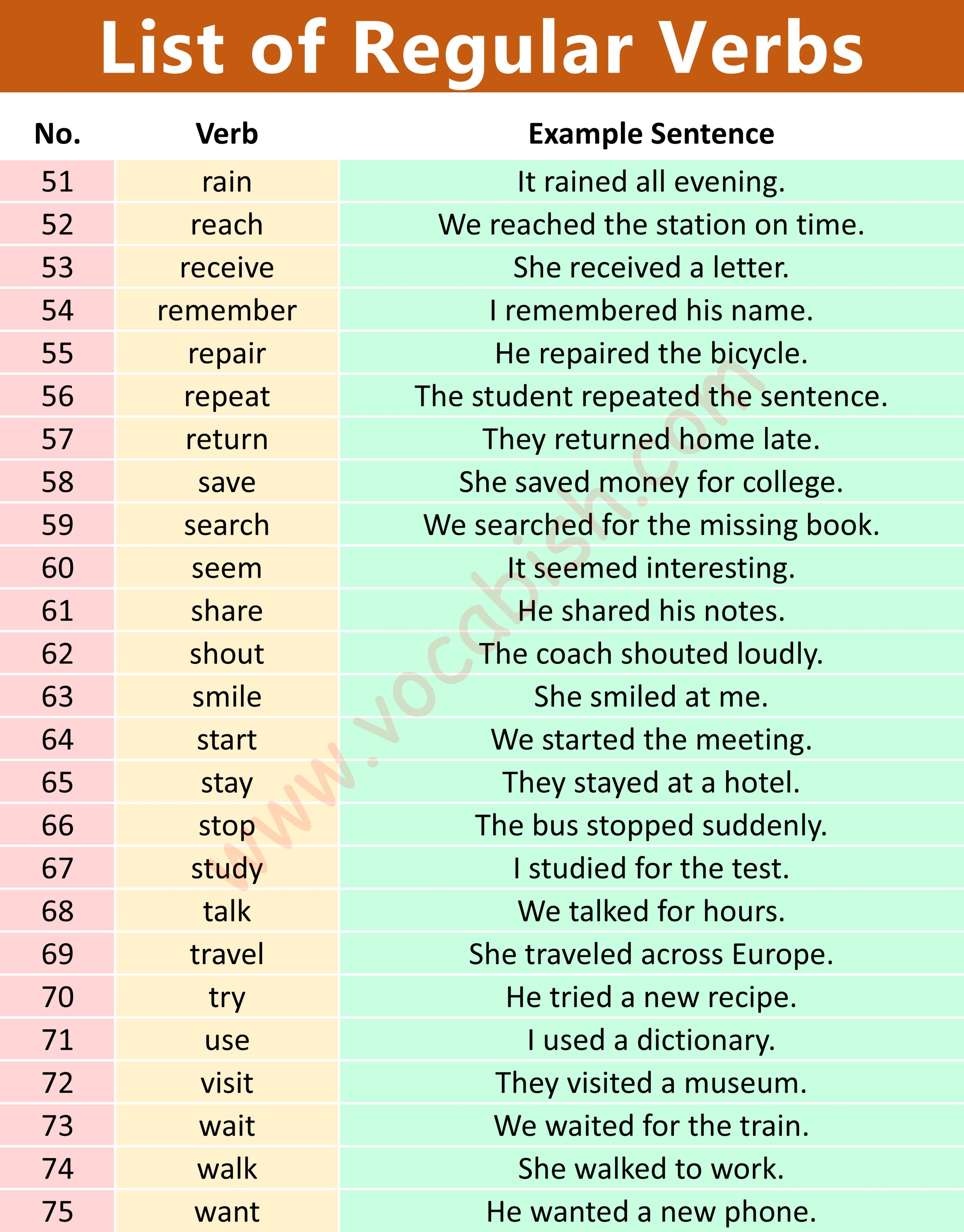
List of Regular Verbs with Example Sentences
The following list of regular verbs includes useful words that help you describe actions, events, and experiences in English.
No. | Verb | Example Sentence |
|---|---|---|
51 | rain | It rained all evening. |
52 | reach | We reached the station on time. |
53 | receive | She received a letter. |
54 | remember | I remembered his name. |
55 | repair | He repaired the bicycle. |
56 | repeat | The student repeated the sentence. |
57 | return | They returned home late. |
58 | save | She saved money for college. |
59 | search | We searched for the missing book. |
60 | seem | It seemed interesting. |
61 | share | He shared his notes. |
62 | shout | The coach shouted loudly. |
63 | smile | She smiled at me. |
64 | start | We started the meeting. |
65 | stay | They stayed at a hotel. |
66 | stop | The bus stopped suddenly. |
67 | study | I studied for the test. |
68 | talk | We talked for hours. |
69 | travel | She traveled across Europe. |
70 | try | He tried a new recipe. |
71 | use | I used a dictionary. |
72 | visit | They visited a museum. |
73 | wait | We waited for the train. |
74 | walk | She walked to work. |
75 | want | He wanted a new phone. |
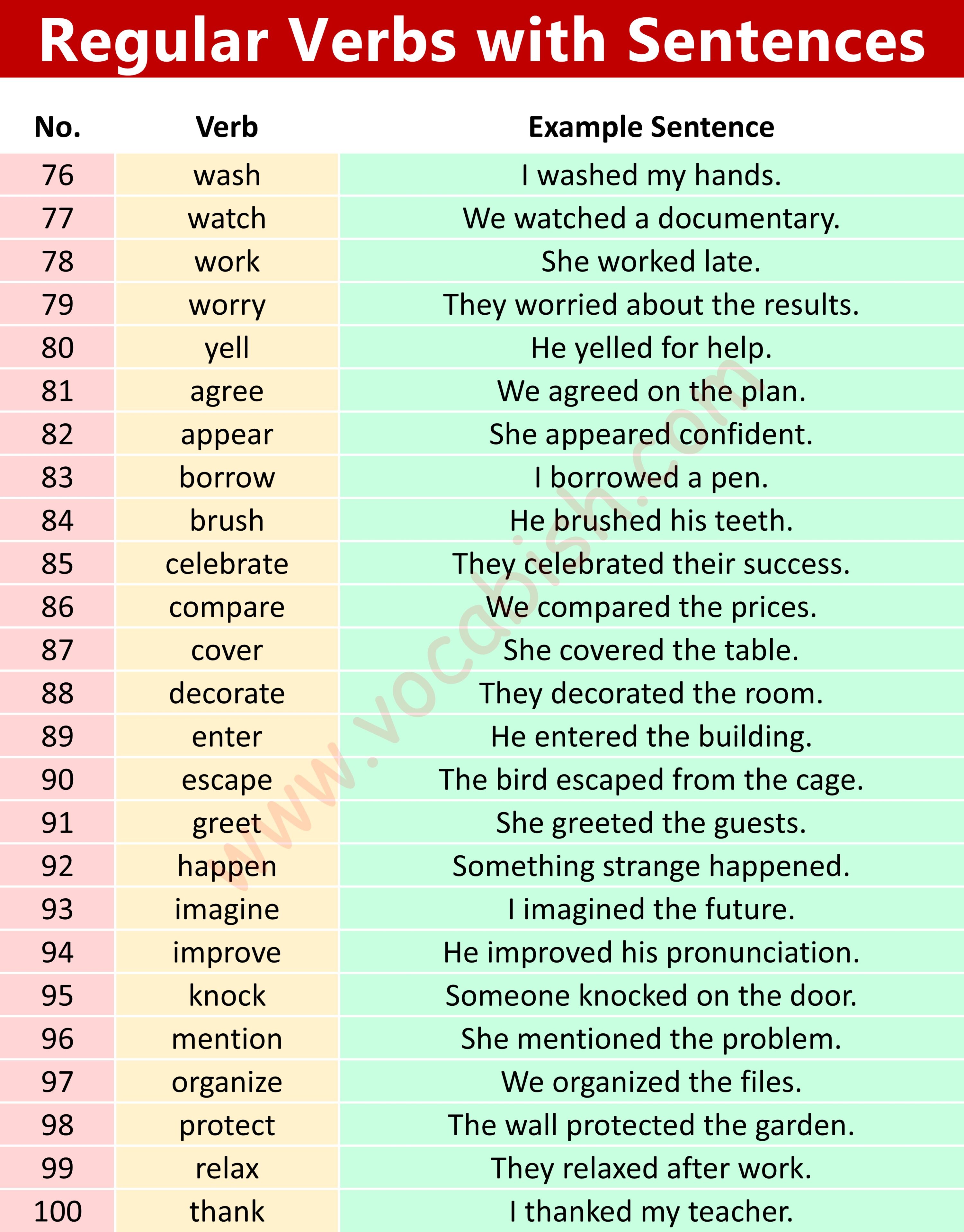
Daily Used Regular Verbs with Sentences
These regular verbs can expand your vocabulary and help you express ideas more naturally in speaking and writing.
No. | Verb | Example Sentence |
|---|---|---|
76 | wash | I washed my hands. |
77 | watch | We watched a documentary. |
78 | work | She worked late. |
79 | worry | They worried about the results. |
80 | yell | He yelled for help. |
81 | agree | We agreed on the plan. |
82 | appear | She appeared confident. |
83 | borrow | I borrowed a pen. |
84 | brush | He brushed his teeth. |
85 | celebrate | They celebrated their success. |
86 | compare | We compared the prices. |
87 | cover | She covered the table. |
88 | decorate | They decorated the room. |
89 | enter | He entered the building. |
90 | escape | The bird escaped from the cage. |
91 | greet | She greeted the guests. |
92 | happen | Something strange happened. |
93 | imagine | I imagined the future. |
94 | improve | He improved his pronunciation. |
95 | knock | Someone knocked on the door. |
96 | mention | She mentioned the problem. |
97 | organize | We organized the files. |
98 | protect | The wall protected the garden. |
99 | relax | They relaxed after work. |
100 | thank | I thanked my teacher. |
Common Patterns of Regular Verbs
Although regular verbs follow the same basic rule, spelling changes can vary slightly.
Add -ed
Most verbs follow this pattern.
Verb | Past Tense |
|---|---|
work | worked |
clean | cleaned |
jump | jumped |
help | helped |
Add -d
If a verb already ends in e, add only d.
Verb | Past Tense |
|---|---|
live | lived |
love | loved |
dance | danced |
move | moved |
Change y to i and Add -ed
When a verb ends with a consonant + y, change y to i before adding -ed.
Verb | Past Tense |
|---|---|
study | studied |
carry | carried |
worry | worried |
try | tried |
Practice Activity for Regular Verbs
Choose the correct regular verb form for each sentence.
Tips for Learning Regular Verbs
Learning a long list of regular verbs becomes easier when you use them regularly.
Try these methods:
- Read short English stories.
- Write daily journal entries.
- Practice speaking about yesterday’s activities.
- Create your own example sentences.
- Learn verbs in groups based on topics.
- Review common past tense endings.
Common Mistakes to Avoid
Many learners make small errors when using regular verbs.
Incorrect | Correct |
|---|---|
walkeded | walked |
studyed | studied |
stoped | stopped |
I walk yesterday. | I walked yesterday. |
She play yesterday. | She played yesterday. |
Remember:
- Use the correct past tense ending.
- Watch spelling changes.
- Do not add extra letters unnecessarily.
You May Also Like:
- 100 Examples of Irregular Adjectives
- 50 Irregular Verbs in English
- Irregular Subjunctive Verbs in English
FAQs about Regular Verbs
Regular verbs form their past tense and past participle by adding -ed, -d, or -ied to the base verb according to spelling rules.
There are thousands of regular verbs in English. Most newly created verbs also follow regular past tense patterns.
They follow consistent spelling rules, so you can often predict the past tense without memorizing separate forms.
Common regular verbs include work, play, clean, help, watch, walk, study, visit, talk, and open.
Their past tense forms usually end in -ed, -d, or -ied, depending on the spelling of the base verb.
Yes. They appear frequently in daily speaking and writing, especially when talking about past actions, experiences, and activities.
Conclusion
Learning examples of regular verbs helps you build confidence in English grammar and communication. Because regular verbs follow predictable patterns, they are easier to recognize, remember, and use correctly.
Start with common verbs such as walk, play, study, clean, help, and visit, then practice them in your own sentences. The more often you use regular verbs in English, the more natural they will become in everyday conversations and writing.
Here’s a comprehensive guide on irregular verb examples.