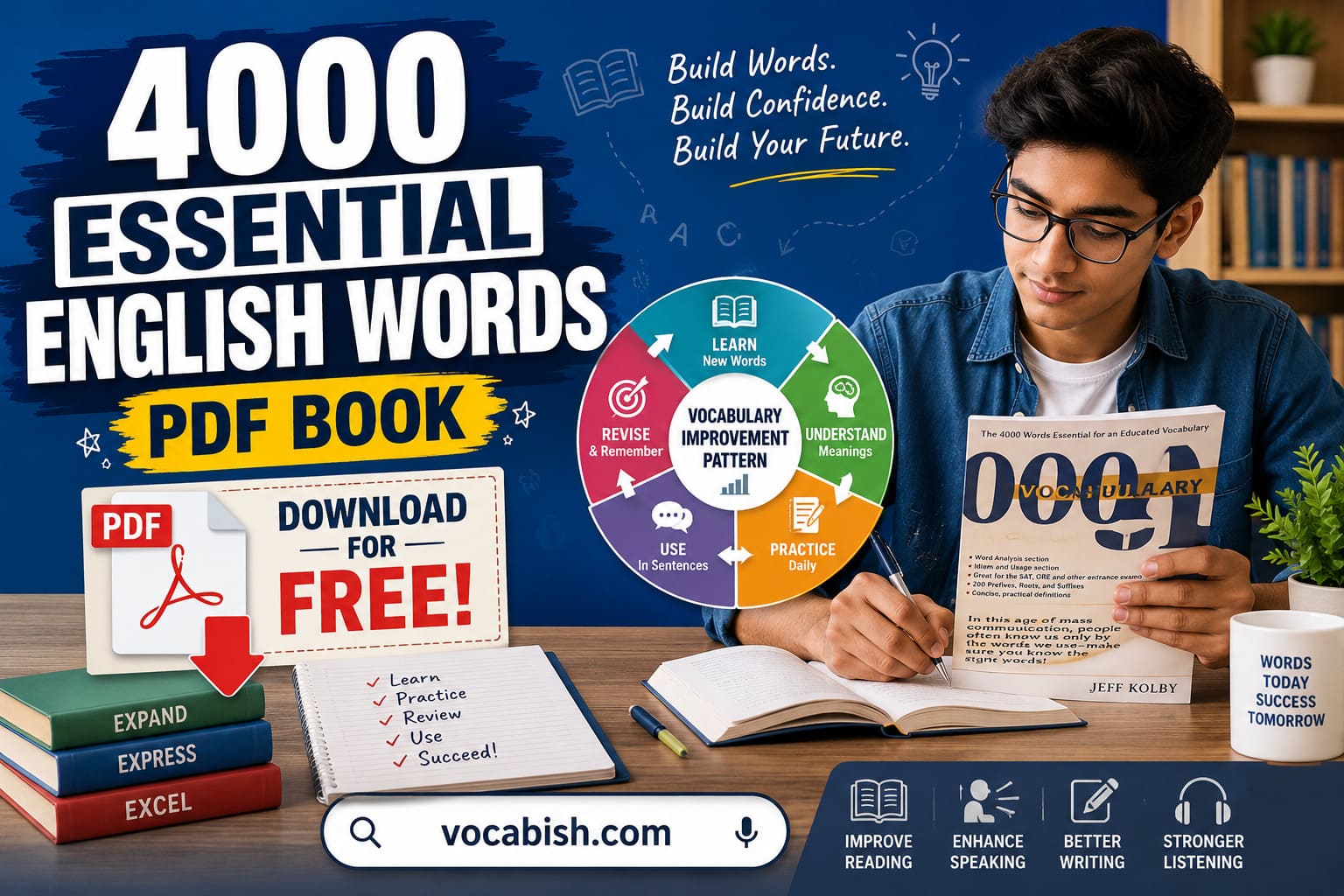
The 4000 Essential English Words Book is a useful vocabulary resource for English learners who want to speak, read, write, and understand English more confidently. This book contains thousands of important English words with short meanings, making it easier for learners to build a strong vocabulary step by step. Vocabulary is one of the most important parts of language learning because words help you express ideas clearly, understand conversations, read books, write better sentences, and improve listening skills.
For non-native English learners, learning common and educated vocabulary can open many doors. It can help you in school, exams, business communication, daily conversation, and professional writing. This article will guide you through the value of the 4000 English Words PDF Book, how to use it, and how to practice the words effectively.
What Is The 4000 Essential English Words Book?
The 4000 English Words PDF Book is a vocabulary learning book designed to help learners improve their English word power. It includes a large collection of useful words, short definitions, vocabulary quizzes, word analysis, idioms, and usage sections.
The book is especially helpful for learners who want to move from basic English to more advanced English. Many words in the book are useful for academic reading, entrance exams, professional communication, and everyday educated conversation.
Disclaimer: This PDF book is shared on our website strictly for educational and learning purposes only. We do not claim ownership of the content. If you are the copyright owner of this book or have any concerns regarding this material, please contact us, and we will take the necessary action, including removing the PDF from our website if required.
Why Vocabulary Is Important for English Learners
Vocabulary is the foundation of English communication. Grammar helps you build correct sentences, but vocabulary gives you the words to express your thoughts.
A strong vocabulary helps you:
- Speak more clearly and naturally.
- Understand books, articles, and conversations.
- Write better emails, essays, and messages.
- Improve listening comprehension.
- Perform better in English exams.
- Feel more confident in real-life situations.
For example, instead of always saying “very bad,” you can use words like terrible, awful, harmful, or serious, depending on the situation.
Main Features of the PDF Book
The book contains several useful learning sections:
| Feature | Benefit for Learners |
|---|---|
| Word lists | Learn many useful English words |
| Short meanings | Understand words quickly |
| Quizzes | Test your memory |
| Antonyms | Learn opposite meanings |
| Analogies | Improve logical vocabulary skills |
| Idioms and usage | Learn natural English expressions |
| Word analysis | Understand prefixes, roots, and suffixes |
Types of Vocabulary in the Book
The vocabulary in the book can be grouped into different categories.
Academic Words
These words are common in school, exams, and formal writing.
Examples: analyze, conclude, evidence, interpret, significant
Daily Conversation Words
These words are useful in everyday speaking.
Examples: friendly, careful, improve, support, explain
Formal and Advanced Words
These words help learners understand newspapers, books, and professional writing.
Examples: abandon, accurate, beneficial, complex, sufficient
Descriptive Words
These words help learners describe people, places, feelings, and situations.
Examples: calm, serious, cheerful, harmful, peaceful
Useful Vocabulary List with Meanings and Examples
Here are some learner-friendly vocabulary words inspired by the style of the book.
| Word | Simple Meaning | Example Sentence |
|---|---|---|
| Abandon | to leave something or someone | He had to abandon the old car. |
| Abate | to become less strong | The rain began to abate after an hour. |
| Abbreviate | to make shorter | We often abbreviate “Doctor” as “Dr.” |
| Accurate | correct and exact | Your answer is accurate. |
| Accommodate | to provide space or help | The hotel can accommodate 100 guests. |
| Accumulate | to collect over time | Dust can accumulate on old books. |
| Adapt | to change for a new situation | Students must adapt to a new learning style. |
| Adept | skillful | She is adept at solving problems. |
| Adjacent | next to | The school is adjacent to the park. |
| Advocate | to support an idea | Many teachers advocate daily reading. |
Pronunciation Tips
- Abandon: uh-BAN-duhn
- Accurate: AK-yuh-rit
- Adjacent: uh-JAY-suhnt
- Advocate: AD-vuh-kayt as a verb, AD-vuh-kit as a noun
Synonyms, Antonyms, and Word Families
Learning related words helps you remember vocabulary faster.
| Word | Synonyms | Antonyms | Word Family |
|---|---|---|---|
| Accurate | correct, exact | wrong, incorrect | accuracy, accurately |
| Adapt | adjust, change | resist | adaptable, adaptation |
| Abandon | leave, desert | keep, continue | abandoned |
| Adept | skillful, expert | unskilled | adeptly |
| Advocate | support, recommend | oppose | advocacy, advocate |
Common Learner Mistakes
1: Learning only the meaning
Do not only memorize the definition. Learn how the word is used in a sentence.
Incorrect: “I adept English.”
Correct: “I am adept at English.”
2: Confusing similar words
Accept means to receive.
Except means not including.
Example:
I accept your invitation.
Everyone came except John.
3: Using advanced words too often
Advanced vocabulary is useful, but use it naturally. Do not force difficult words into every sentence.
Practical Tips to Remember New Words
Use these methods to learn vocabulary faster:
- Learn 10 words per day.
- Write one sentence for each new word.
- Say the word aloud three times.
- Review old words every week.
- Group words by topic.
- Use flashcards.
- Practice words in speaking and writing.
A good method is: Read → Understand → Write → Speak → Review.
Vocabulary Practice Exercises
Exercise 1: Fill in the Blanks
Choose the correct word: adapt, accurate, abandon, adjacent, advocate
- The shop is _______ to the bank.
- Please give me an _______ answer.
- Good learners _______ to new situations.
- We should not _______ our goals.
- Many doctors _______ healthy eating.
Answers
- adjacent
- accurate
- adapt
- abandon
- advocate
Exercise 2: Match the Words
| Word | Meaning |
|---|---|
| 1. Abate | A. skillful |
| 2. Adept | B. become less |
| 3. Accumulate | C. collect |
| 4. Abbreviate | D. make shorter |
Answers
- B
- A
- C
- D
Real-Life Usage Examples
Daily Conversation
Ali: I want to improve my English vocabulary.
Sara: You should learn a few words every day and review them often.
Ali: That sounds helpful. I will try to adapt my study routine.
Sara: Good idea. Daily practice can make a big difference.
Short Paragraph
Learning vocabulary is important for every English learner. When students accumulate new words, they can understand more books, speak more clearly, and write better sentences. A strong vocabulary also helps learners adapt to academic and professional situations.
Simple Email Example
Subject: English Study Plan
Dear Teacher,
Building a strong English vocabulary is one of my main learning goals. Currently, I use a vocabulary PDF book and study ten new words each day. To remember them more effectively, I create example sentences and practice using the words in different situations.
Thank you for your guidance.
Best regards,
A Student
Download 4000 Essential English Words Book
How to Use This PDF Book Effectively
To get the best results from the 4000 Essential English Words book, follow this simple plan:
- Study 10–15 words daily.
- Read each word, meaning, and example.
- Write your own sentence.
- Review difficult words after 24 hours.
- Take the quizzes in the book.
- Use new words in speaking and writing.
- Keep a vocabulary notebook.
Do not try to memorize all 4000 words at once. Vocabulary learning takes time. Small daily practice is better than studying too many words in one day.
Conclusion
The 4000 Essential English Words Book is a valuable resource for non-native English learners who want to build a strong and educated vocabulary. By learning these words regularly, students can improve their speaking, reading, writing, and listening skills. Vocabulary helps learners understand English more deeply and communicate with greater confidence.
Related Articles: