
Hats are worn for fashion, comfort, weather protection, work, sport, and cultural traditions. They come in many shapes, including wide-brim hats, close-fitting winter hats, structured formal hats, and casual caps with front visors.
Learning the names of different hats can help English learners describe clothing more accurately. It also makes shopping easier because you can search for the exact style instead of using the general word hat.
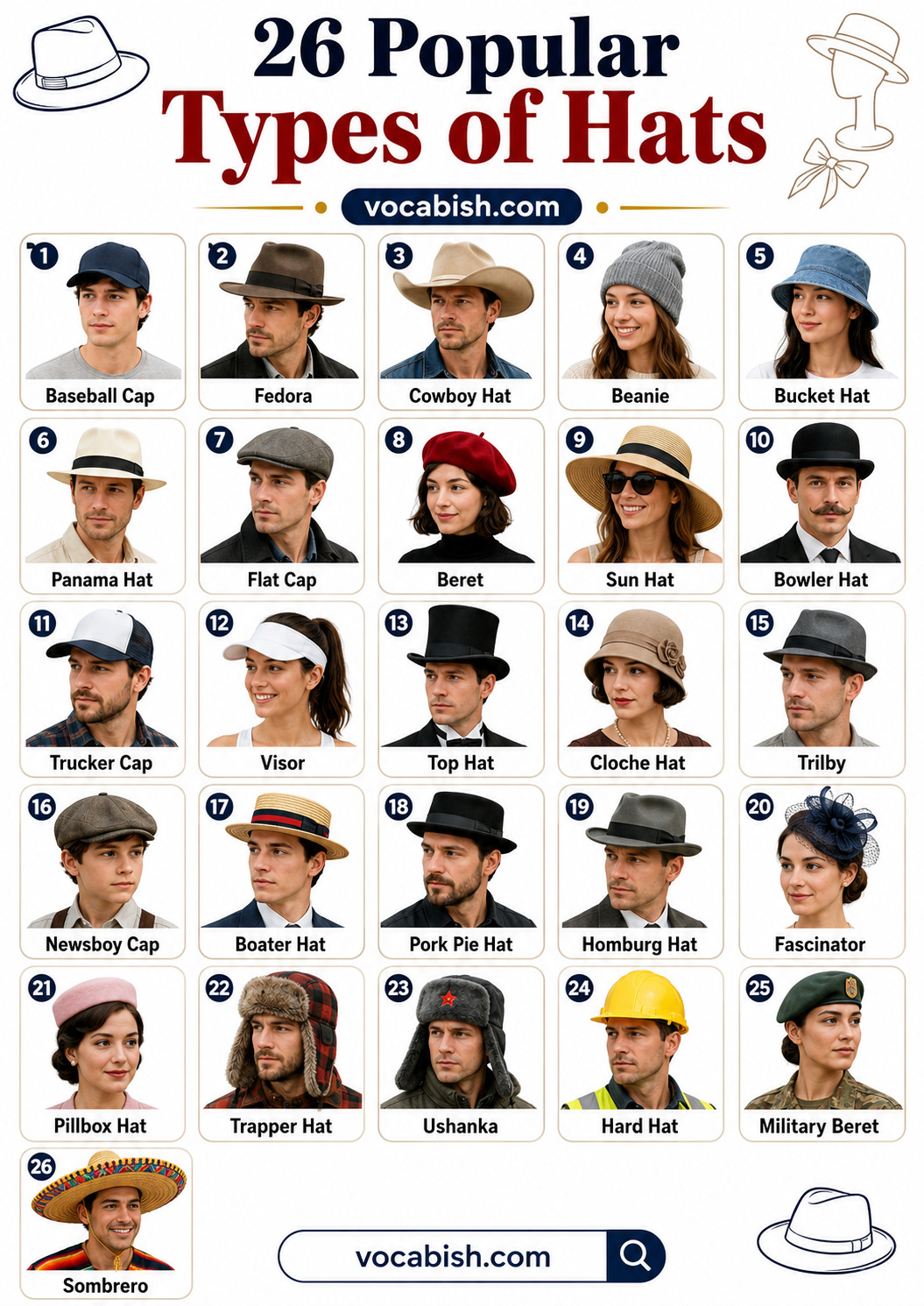
Quick List of 26 Popular Types of Hats
- Baseball Cap
- Fedora
- Cowboy Hat
- Beanie
- Bucket Hat
- Panama Hat
- Flat Cap
- Beret
- Sun Hat
- Bowler Hat
- Trucker Cap
- Visor
- Top Hat
- Cloche Hat
- Trilby
- Newsboy Cap
- Boater Hat
- Pork Pie Hat
- Homburg Hat
- Fascinator
- Pillbox Hat
- Trapper Hat
- Ushanka
- Hard Hat
- Military Beret
- Sombrero
Hat vs Cap: What Is the Difference?
A hat usually has a crown that covers the head and a brim extending around most or all of it. Examples include fedoras, cowboy hats, bucket hats, and sun hats.
A cap normally has a softer or panelled crown with a visor at the front. Baseball caps, trucker caps, flat caps, and newsboy caps are common examples.
The difference is not always strict. People often use hat as a general word for almost any type of headwear, including caps, beanies, and berets.
Top 26 Types of Hats with Names and Pictures
1. Baseball Cap
A baseball cap has a rounded panelled crown and a stiff front visor. It shades the eyes and helps keep hair away from the face. People commonly wear it for sports, casual outings, and everyday activities.
2. Fedora
A fedora has a soft crown with a centre crease, front pinches, and a full brim. It provides light shade while adding a smart and polished appearance. People wear it with formal clothing, smart-casual outfits, and vintage-inspired fashion.
3. Cowboy Hat
A cowboy hat has a high creased crown and a wide brim that often curves upward at the sides. It protects the face and neck from strong sunlight and light rain. It is commonly worn for ranch work, rodeos, country events, and Western fashion.
4. Beanie
A beanie is a soft, close-fitting hat without a brim. It keeps the head warm by covering the forehead and sometimes the ears. People commonly wear beanies during winter, outdoor activities, and casual daily routines.
5. Bucket Hat
A bucket hat has a soft crown and a short brim that slopes downward around the head. It provides light protection from sunlight and rain. It is popular for travel, fishing, festivals, streetwear, and casual summer outfits.
6. Panama Hat
A Panama hat is a lightweight woven hat with a creased crown and a medium or wide brim. It offers ventilation and shade in hot weather. People commonly wear it during summer holidays, outdoor events, and warm-weather travel.
7. Flat Cap
A flat cap has a low rounded crown that slopes forward toward a small stiff peak. It provides light warmth and protects the eyes from mild sunlight. It is commonly worn with casual, country, vintage, and smart-casual clothing.
8. Beret
A beret is a soft, round, brimless hat with a flat flexible crown. It provides light warmth while adding a distinctive and artistic appearance. People commonly wear it with military uniforms, fashionable outfits, and traditional clothing.
9. Sun Hat
A sun hat has a lightweight crown and a wide brim extending around the entire head. It shades the face, ears, and neck from direct sunlight. People commonly wear it at beaches, gardens, resorts, and outdoor summer events.
10. Bowler Hat
A bowler hat has a stiff dome-shaped crown and a narrow brim with rolled edges. It provides a structured and traditional formal appearance. It is commonly worn for heritage events, formal styling, performances, and period-inspired fashion.
11. Trucker Cap
A trucker cap has a solid front panel, a curved visor, and breathable mesh panels at the back. It provides shade while allowing air to circulate around the head. People wear it for outdoor work, travel, casual fashion, and recreational activities.
12. Visor
A visor has a front peak attached to a band but does not have a full crown. It shades the eyes while leaving the top of the head open for ventilation. It is commonly worn for tennis, golf, running, and other outdoor sports.
13. Top Hat
A top hat has a tall cylindrical crown, a flat top, and a narrow brim. It creates a highly formal and ceremonial appearance. People commonly wear it at traditional weddings, stage performances, historical events, and formal celebrations.
14. Cloche Hat
A cloche hat has a close-fitting bell-shaped crown and a small downward-curving brim. It frames the face while providing light weather protection. It is commonly worn with vintage outfits, formal daywear, and elegant autumn clothing.
15. Trilby
A trilby has a pinched crown and a narrow brim that usually turns upward at the back. It provides light shade while creating a compact and stylish appearance. People commonly wear it with casual outfits, summer clothing, and music-inspired fashion.
16. Newsboy Cap
A newsboy cap has a full rounded crown made from several fabric panels and a small front peak. It provides light warmth and shade while maintaining a relaxed shape. It is commonly worn with casual, vintage, and smart-casual outfits.
17. Boater Hat
A boater hat has a stiff flat crown, straight sides, and a flat straw brim. It provides summer shade while maintaining a neat and formal appearance. People commonly wear it at garden parties, boating events, ceremonies, and traditional summer occasions.
18. Pork Pie Hat
A pork pie hat has a low flat crown, a circular crease, and a narrow upturned brim. It provides light shade while creating a compact and distinctive silhouette. It is commonly worn with jazz-inspired, vintage, casual, and smart-casual outfits.
19. Homburg Hat
A homburg has a stiff felt crown with a centre dent and a firm brim with rolled edges. It provides light weather protection while creating a formal and dignified appearance. People commonly wear it with business clothing, suits, and ceremonial outfits.
20. Fascinator
A fascinator is a small decorative headpiece featuring feathers, flowers, bows, netting, or sculpted fabric. It complements formal clothing rather than providing weather protection. People commonly wear fascinators at weddings, horse races, parties, and elegant celebrations.
21. Pillbox Hat
A pillbox hat has a small round crown, straight sides, and no brim. It covers part of the head while creating a polished and elegant appearance. It is commonly worn at weddings, ceremonies, formal events, and vintage-themed occasions.
22. Trapper Hat
A trapper hat has an insulated crown and long earflaps that can be tied under the chin. It protects the head, cheeks, and ears from freezing temperatures and wind. People commonly wear it for hiking, hunting, winter travel, and outdoor work.
23. Ushanka
An ushanka is a fur or faux-fur hat with a rounded crown and large flexible earflaps. It provides strong insulation during extremely cold weather. It is commonly worn for winter work, snow activities, cold-climate travel, and traditional dress.
24. Hard Hat
A hard hat has a rigid protective shell with an internal suspension system and a front or full brim. It helps protect the head from workplace impacts, falling objects, and specific industrial hazards. Certified hard hats are commonly worn on construction, utility, manufacturing, and industrial sites.
25. Military Beret
A military beret is a soft round hat that usually displays an official badge above one eye. It identifies a military branch, regiment, unit, or specialised service group. It is commonly worn during military duties, parades, ceremonies, and official uniform inspections.
26. Sombrero
In English, a sombrero usually refers to a Mexican-style hat with a high crown and an extremely wide brim. It provides substantial shade from strong sunlight. It is commonly associated with regional dress, traditional celebrations, performances, and outdoor work.
Types of Hats by Purpose
Hats can be organised according to what they are designed to do. Some categories overlap because one style may provide protection while also serving as a fashion accessory.
Casual and Everyday Hats
- Baseball cap
- Beanie
- Bucket hat
- Flat cap
- Beret
- Trucker cap
- Trilby
- Newsboy cap
- Pork pie hat
- Dad cap
- Five-panel cap
- Knit cap
Formal and Occasion Hats
- Fedora
- Bowler hat
- Top hat
- Cloche hat
- Boater hat
- Homburg hat
- Fascinator
- Pillbox hat
- Cocktail hat
- Picture hat
- Formal wide-brim hat
- Wedding hat
Winter Hats
- Beanie
- Trapper hat
- Ushanka
- Watch cap
- Balaclava
- Earflap hat
- Fleece hat
- Pom-pom hat
- Thermal running hat
- Aviator hat
- Sherpa-lined hat
- Wool beret
Sun and Outdoor Hats
- Sun hat
- Panama hat
- Cowboy hat
- Bucket hat
- Sombrero
- Boater hat
- Visor
- Safari hat
- Boonie hat
- Lifeguard hat
- Hiking hat
- Legionnaire hat
Work and Safety Hats
- Hard hat
- Full-brim hard hat
- Cap-style hard hat
- Bump cap
- Welding helmet
- Firefighter helmet
- Mining helmet
- Chef’s toque
- Medical scrub cap
- Campaign hat
- Protective forestry helmet
- Safety sun hat
How to Identify Different Types of Hats
- Look at the crown: Check whether it is tall, low, round, flat, creased, pinched, or bell-shaped.
- Examine the brim: Notice whether the brim is wide, narrow, flat, curved, rolled, upturned, or downturned.
- Check for a visor: Caps commonly have a projecting peak only at the front.
- Count the panels: Baseball, trucker, and newsboy caps often use visible fabric panels.
- Observe the material: Felt, straw, wool, cotton, leather, mesh, and fur suggest different styles and purposes.
- Study the back closure: A cap may have snaps, a buckle, an elastic section, or no adjustable closure.
- Notice the crease: Fedoras, trilbies, homburgs, and cowboy hats have different crown indentations.
- Check the crown height: Top hats and cowboy hats have taller crowns than flat caps and pork pie hats.
- Look for ear coverage: Trapper hats and ushankas have earflaps for cold-weather protection.
- Observe decorations: Ribbons, feathers, badges, veils, flowers, and hatbands can help identify formal or ceremonial styles.
- Consider the purpose: Protective equipment, sports headwear, formal hats, and fashion hats have different constructions.
- Do not rely on colour: The same colour can appear across many completely different hat styles.
How to Choose the Right Hat
- Choose by purpose: Decide whether you need warmth, shade, rain protection, workplace safety, sport performance, or fashion.
- Consider the weather: Select breathable materials for summer and insulated materials for winter.
- Check the brim coverage: Wider brims provide more shade for the face, ears, and neck.
- Select the right material: Straw suits warm weather, while wool, felt, and fleece provide more warmth.
- Match the occasion: Casual caps suit everyday clothing, while structured hats work better with formal outfits.
- Measure your head: Use a soft tape around the widest part of your head before choosing a fitted size.
- Check crown depth: A crown that is too shallow may rise or fall off during movement.
- Test the comfort: The hat should feel secure without squeezing the forehead or leaving painful marks.
- Consider ventilation: Mesh panels, open weaving, and breathable fabric improve comfort in warm conditions.
- Check packability: Choose a foldable or crushable hat when travelling with limited luggage space.
- Use certified protection: Select approved safety headwear when protection from workplace or sports hazards is required.
- Choose a style you enjoy: A comfortable hat that suits your personal style is more likely to be worn regularly.
Similar Hat Styles and Their Differences
- Fedora vs Trilby
A fedora normally has a wider brim, while a trilby has a shorter brim that often turns upward at the back. - Flat Cap vs Newsboy Cap
A flat cap has a smooth low crown, while a newsboy cap has a fuller, multi-panelled crown. - Baseball Cap vs Trucker Cap
A baseball cap usually has fabric panels, while a trucker cap has breathable mesh at the back. - Panama Hat vs Straw Fedora
A Panama hat traditionally refers to an Ecuadorian toquilla-straw hat, while a straw fedora may use many woven materials. - Beanie vs Watch Cap
Beanie is a general term, while a watch cap is usually close-fitting and has a folded cuff. - Bowler Hat vs Homburg Hat
A bowler has a rounded crown, while a homburg has a centre dent and more angular shape. - Fedora vs Homburg
A fedora usually has a softer flexible brim, while a homburg has a stiff brim with rolled edges. - Cowboy Hat vs Sombrero
Both have wide brims, but cowboy hats have shaped crowns and brims, while sombreros are usually broader. - Beret vs Military Beret
A standard beret is mainly fashionable, while a military beret follows official colour, badge, and positioning rules. - Cloche Hat vs Pillbox Hat
A cloche fits deeply around the head, while a pillbox sits higher and has straight sides. - Boater Hat vs Panama Hat
A boater is stiff and flat-topped, while a Panama hat is generally softer and more flexible. - Trapper Hat vs Ushanka
Both have earflaps, but ushankas are traditionally fur-based and strongly associated with severe cold climates. - Top Hat vs Bowler Hat
A top hat has a tall cylindrical crown, while a bowler has a short rounded crown. - Visor vs Baseball Cap
A visor leaves the top of the head uncovered, while a baseball cap has a complete crown. - Pork Pie Hat vs Trilby
A pork pie hat has a flat crown, while a trilby has a creased and pinched crown.
FAQs about Types of Hats
Popular choices include baseball caps, beanies, bucket hats, fedoras, sun hats, cowboy hats, flat caps, berets, trucker caps, and Panama hats.
A hat usually has a brim around the crown, while a cap commonly has a fitted crown and a visor only at the front.
Panama hats, sun hats, bucket hats, boater hats, visors, and lightweight caps offer shade, ventilation, and comfort during warm weather.
Beanies, trapper hats, ushankas, wool caps, and fleece-lined hats provide insulation and cover the head and ears in cold weather.
Top hats, homburgs, fedoras, fascinators, pillbox hats, boaters, and elegant cloche hats can complement weddings, ceremonies, races, and formal outfits.
A hat should feel secure without squeezing, slipping, or leaving painful marks, and it should sit comfortably above the ears and eyebrows.
Final Summary
Hats are available in many shapes, materials, and designs. Some styles, such as baseball caps and beanies, are suitable for everyday wear, while top hats, fascinators, and homburgs are usually reserved for formal occasions.
The easiest way to identify a hat is to examine its crown, brim, visor, material, panels, and decorations. A wide brim may indicate a sun hat or cowboy hat, while a panelled crown with a front visor usually identifies a cap.
Pictures make these differences easier to understand. When each image has a clear label, English learners can connect the hat’s name with its shape, purpose, and common use.
You May Also Like