Triangles are among the most important shapes in geometry. We see them in buildings, road signs, bridges, artwork, tools, and many everyday objects. Learning the different types of triangles helps students understand angles, side lengths, area, perimeter, and other basic geometry concepts.
A triangle can be classified in two main ways. We can classify it by the lengths of its sides or by the measurements of its angles. This means one triangle may have two correct names. For example, a triangle can be both isosceles and right.
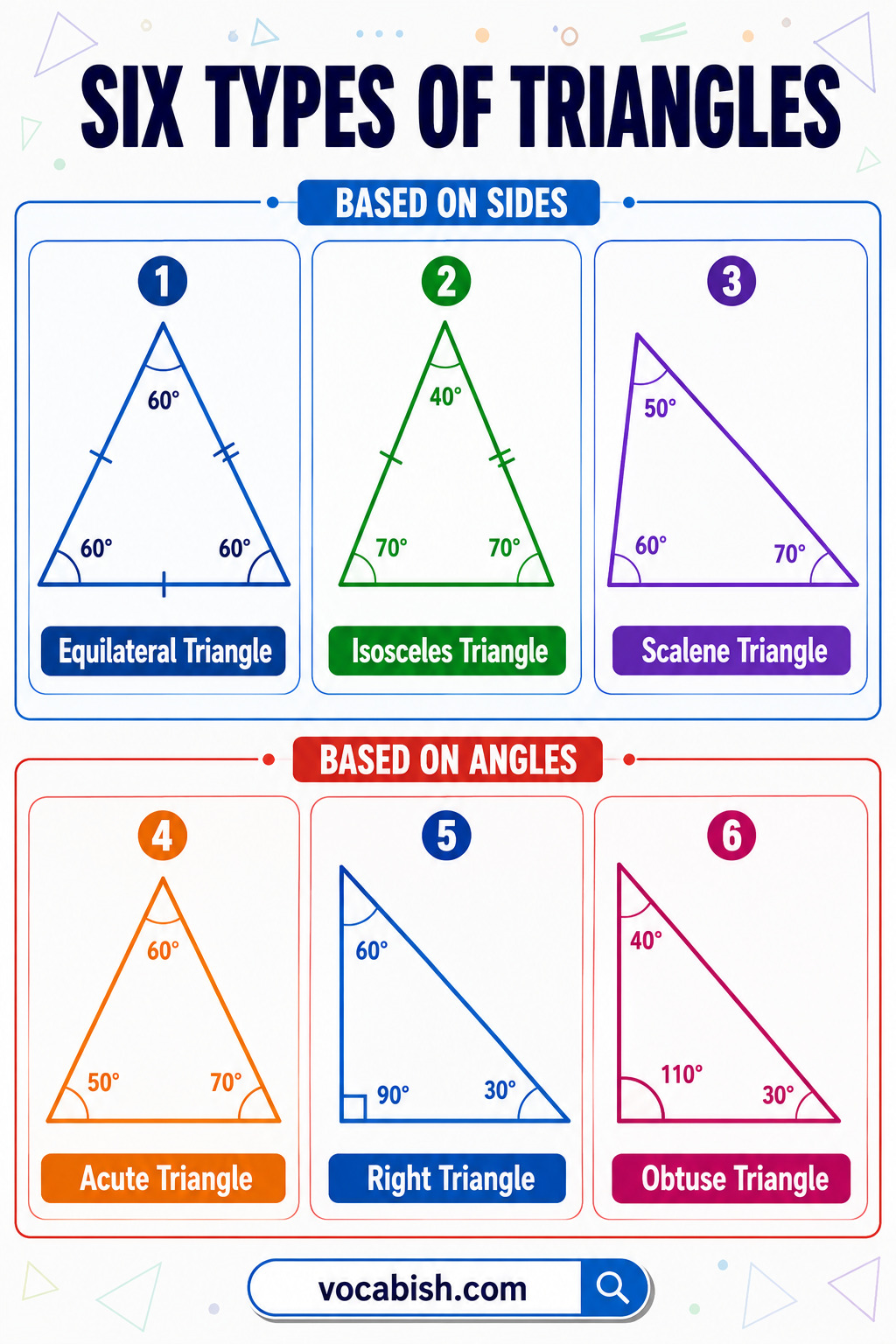
There are six basic types of triangles. Equilateral, isosceles, and scalene triangles are classified by their sides. Acute, right, and obtuse triangles are classified by their angles.
This guide explains their names, properties, formulas, and uses through simple definitions and practical examples.
What Is a Triangle?
A triangle is a closed, two-dimensional shape made from three straight sides. These sides meet at three points called vertices. A triangle also has three interior angles.
In ordinary plane geometry, the three interior angles of every triangle always add up to 180 degrees. Triangles can be small, large, narrow, wide, symmetrical, or irregular, but they must always have three sides and three angles.
Basic Parts of a Triangle
The main parts of a triangle include:
- Sides: The three straight lines forming the shape
- Vertices: The three points where the sides meet
- Angles: The spaces formed inside the triangle where two sides meet
- Base: Any side chosen as the bottom of the triangle
- Height: The perpendicular distance from the base to the opposite vertex
- Interior region: The space enclosed by the three sides
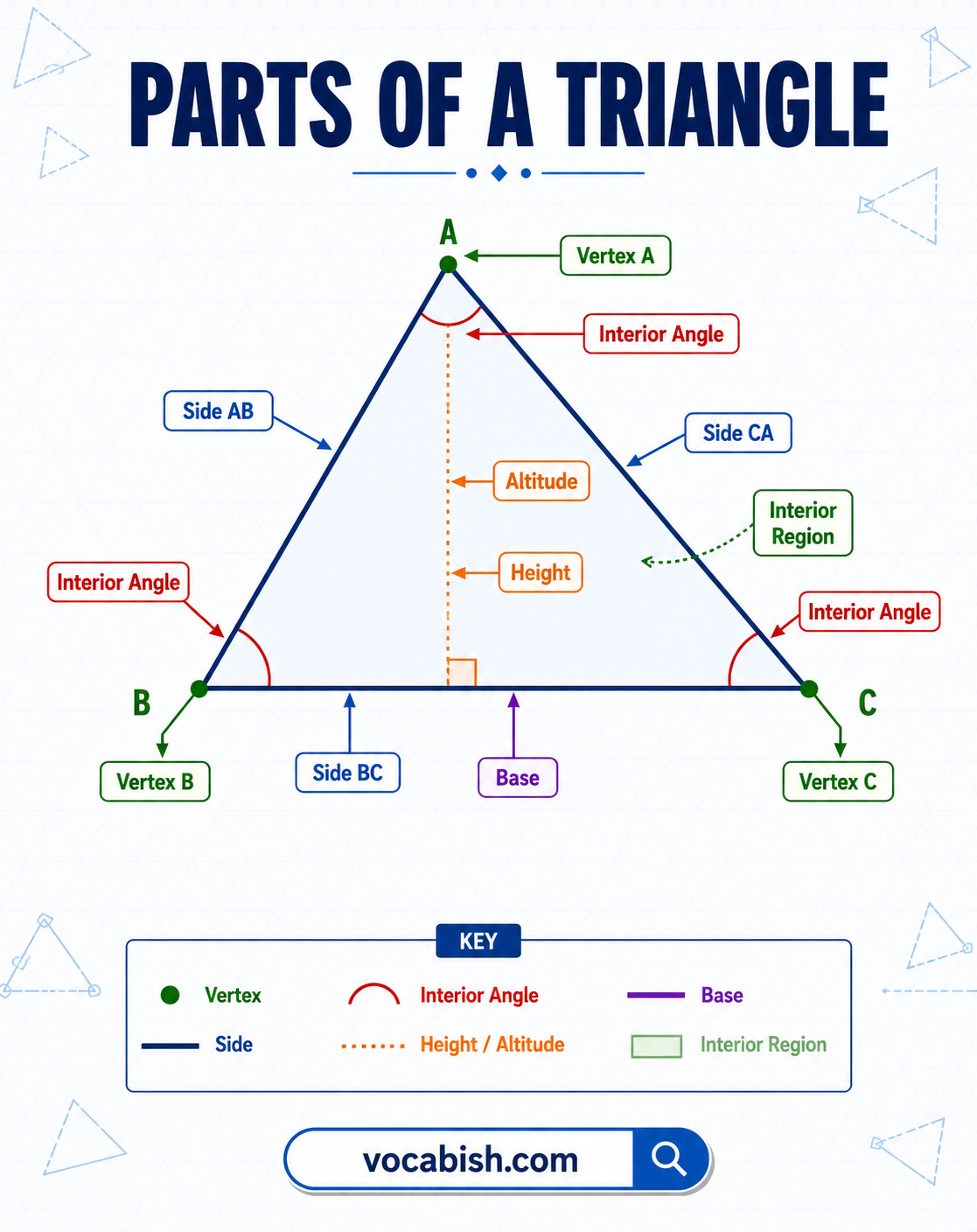
The base does not always need to appear at the bottom. Any of the three sides can serve as the base when calculating the area.
Basic Properties of Every Triangle
Every triangle has several basic properties:
- It has exactly three straight sides.
- It has three vertices and three interior angles.
- Its interior angles add up to 180 degrees.
- The sum of any two side lengths must be greater than the third side.
- Its perimeter equals the total length of its three sides.
- Its area can be calculated using its base and perpendicular height.
These properties apply to all types of triangles, regardless of their size or appearance.
How Are the Different Types of Triangles Classified?
Triangles are classified according to their side lengths and angle measurements. These two methods describe different features of the same shape.
A triangle may receive one name based on its sides and another based on its angles. For example, a triangle with two equal sides and one 90-degree angle is an isosceles right triangle.
Classification by Side Lengths
When classifying a triangle by its sides, compare the lengths of all three sides.
- Three equal sides form an equilateral triangle.
- Two equal sides form an isosceles triangle.
- Three different side lengths form a scalene triangle.
Classification by Angle Measurements
When classifying a triangle by its angles, look at the size of its largest angle.
- If all angles are below 90 degrees, it is acute.
- If one angle equals 90 degrees, it is right.
- If one angle is greater than 90 degrees, it is obtuse.
Types of Triangles Based on Their Sides
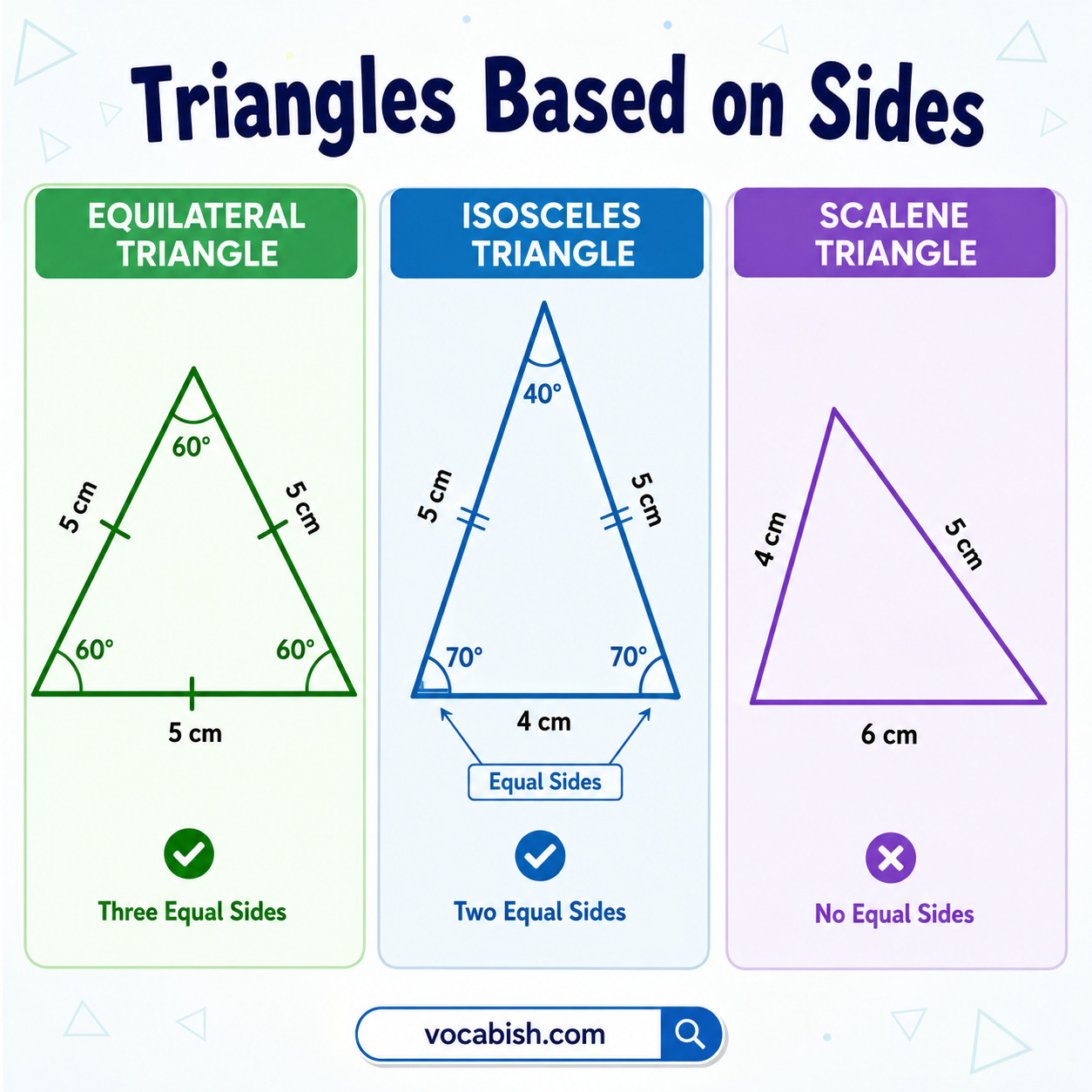
There are three main types of triangles by sides: equilateral, isosceles, and scalene. The classification depends on how many sides have equal lengths.
1. Equilateral Triangle
An equilateral triangle has three equal sides and three equal angles of 60 degrees each.
Because all its sides and angles are equal, it is highly symmetrical. It has three lines of symmetry. A line drawn from any vertex to the opposite side divides the triangle into two equal parts.
For example, a triangle with side lengths of 6 centimetres, 6 centimetres, and 6 centimetres is equilateral.
An equilateral triangle is always acute because all three angles measure 60 degrees, which is less than 90 degrees.
Equilateral triangle shapes can appear in decorative patterns, geometric artwork, structural designs, and triangular signs.
2. Isosceles Triangle
An isosceles triangle has at least two equal sides. The angles opposite those equal sides are also equal.
The two equal sides are often called the legs, while the remaining side is called the base. The angle between the two equal sides is known as the vertex angle. The other two angles are the base angles.
For example, a triangle with sides measuring 7 centimetres, 7 centimetres, and 4 centimetres is isosceles.
Most isosceles triangles have one line of symmetry running from the vertex angle to the centre of the base.
Isosceles triangles often appear in roofs, bridge supports, decorative designs, and mathematical diagrams.
In formal mathematics, an equilateral triangle may also be considered isosceles because it has at least two equal sides. However, many beginner textbooks use “isosceles” to mean a triangle with exactly two equal sides.
3. Scalene Triangle
A scalene triangle has three sides of different lengths and three angles of different measurements.
It has no equal sides and normally has no line of reflectional symmetry. Its longest angle lies opposite its longest side, while its smallest angle lies opposite its shortest side.
For example, a triangle with side lengths of 3 centimetres, 4 centimetres, and 5 centimetres is scalene.
A scalene triangle may be acute, right, or obtuse. The side lengths alone do not tell us its angle classification unless we calculate or measure the angles.
Scalene triangles appear in irregular structures, design layouts, maps, engineering diagrams, and natural patterns.
Types of Triangles Based on Their Angles
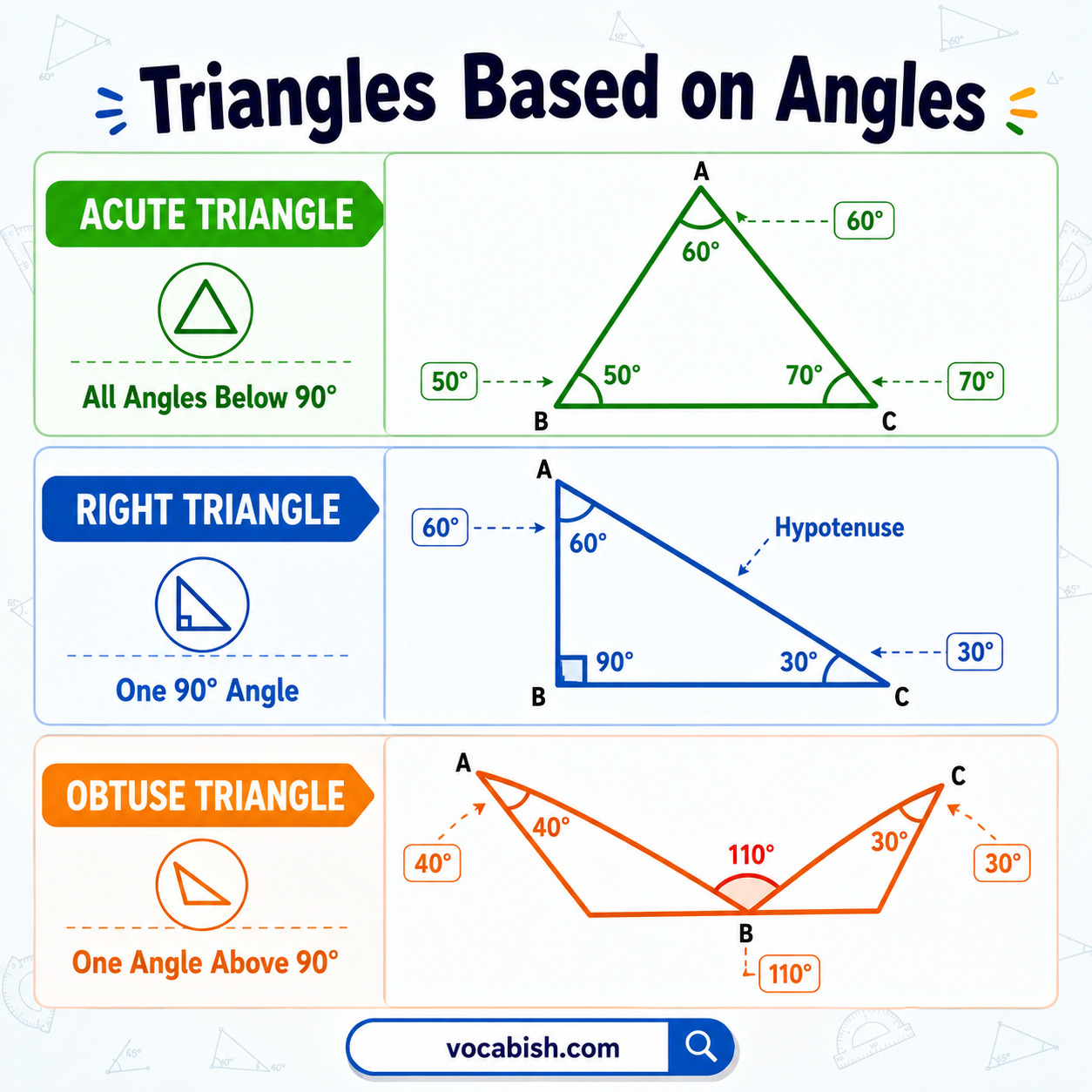
The three main types of triangles by angles are acute, right, and obtuse triangles. A triangle is classified according to the measurement of its largest interior angle.
4. Acute Triangle
An acute triangle has three angles that are each smaller than 90 degrees.
For example, a triangle with angles of 50 degrees, 60 degrees, and 70 degrees is acute. All three measurements are below 90 degrees, and their total is 180 degrees.
An acute triangle may be equilateral, isosceles, or scalene. Every equilateral triangle is acute because all its angles measure 60 degrees.
Acute triangles appear in geometric patterns, roofs, artwork, and structural frames. However, you should measure or calculate the angles rather than classify the triangle only by its appearance.
5. Right Triangle
A right triangle has one angle measuring exactly 90 degrees. The side opposite the right angle is called the hypotenuse.
The hypotenuse is always the longest side of a right triangle. The other two sides are commonly called legs. They meet to form the 90-degree angle.
A triangle with sides measuring 3, 4, and 5 units is a common example of a right triangle because:
3² + 4² = 5²
9 + 16 = 25
Right triangles are widely used in construction, architecture, surveying, engineering, navigation, and design. Builders use them to check whether corners are square.
A right triangle may be scalene or isosceles, but it cannot be equilateral.
6. Obtuse Triangle
An obtuse triangle has one angle greater than 90 degrees but smaller than 180 degrees. Its other two angles must be acute.
For example, a triangle with angles of 110 degrees, 40 degrees, and 30 degrees is obtuse. The 110-degree angle is greater than 90 degrees, while all three angles still total 180 degrees.
A triangle cannot have two obtuse angles because two angles greater than 90 degrees would already add up to more than 180 degrees.
An obtuse triangle may be isosceles or scalene. It cannot be equilateral because an equilateral triangle has three 60-degree angles.
Special Types of Triangles
Some triangle names describe special combinations of sides and angles. These are not separate from the six basic classifications. Instead, they give more specific information about the triangle.
Equiangular Triangle
An equiangular triangle has three equal interior angles.
Since the angles of every triangle add up to 180 degrees, each angle in an equiangular triangle measures 60 degrees.
In Euclidean geometry, every equiangular triangle is also equilateral. This means it has three equal sides as well as three equal angles.
Isosceles Right Triangle
An isosceles right triangle has two equal sides and one 90-degree angle.
The two remaining angles are equal. Since all three angles must add up to 180 degrees, each remaining angle measures 45 degrees.
An isosceles right triangle is therefore also known as a 45-45-90 triangle.
45-45-90 Triangle
A 45-45-90 triangle contains angles of 45 degrees, 45 degrees, and 90 degrees.
The two legs are equal in length. If each leg has a length of x, the hypotenuse has a length of:
x√2
For example, if each leg measures 5 centimetres, the hypotenuse measures 5√2 centimetres.
This special relationship allows students to find missing side lengths without using a calculator for every step.
30-60-90 Triangle
A 30-60-90 triangle contains angles of 30 degrees, 60 degrees, and 90 degrees.
Its sides follow a fixed relationship:
- The shortest side lies opposite the 30-degree angle.
- The longer leg lies opposite the 60-degree angle.
- The hypotenuse lies opposite the 90-degree angle.
If the shortest side has a length of x, the longer leg measures x√3, and the hypotenuse measures 2x.
For example, if the shortest side is 4 centimetres, the longer leg is 4√3 centimetres, and the hypotenuse is 8 centimetres.
Oblique Triangle
An oblique triangle is any triangle that does not contain a 90-degree angle.
Acute and obtuse triangles are both oblique triangles. Right triangles are not included because they contain a right angle.
The term is useful when solving triangles because different formulas may apply to right and oblique triangles.
Types of Triangles Comparison Chart
The following chart compares the six basic types of triangles by their main properties.
Triangle type | Classification | Main property | Angle property | Example |
|---|---|---|---|---|
Equilateral | By sides | Three equal sides | Three 60° angles | 5 cm, 5 cm, 5 cm |
Isosceles | By sides | At least two equal sides | At least two equal angles | 6 cm, 6 cm, 4 cm |
Scalene | By sides | No equal sides | Usually no equal angles | 3 cm, 4 cm, 5 cm |
Acute | By angles | All angles are acute | Every angle is below 90° | 50°, 60°, 70° |
Right | By angles | One right angle | One angle equals 90° | 30°, 60°, 90° |
Obtuse | By angles | One obtuse angle | One angle is above 90° | 30°, 40°, 110° |
Can a Triangle Belong to More Than One Type?
Yes. A triangle can belong to one side-based category and one angle-based category at the same time.
For instance, “isosceles” describes the side lengths, while “right” describes the angles. Combining the two names provides a more complete classification.
Equilateral and Acute Triangle
Every equilateral triangle is also acute.
An equilateral triangle has three equal angles of 60 degrees. Since all three angles are smaller than 90 degrees, the triangle meets the definition of an acute triangle.
Isosceles and Right Triangle
An isosceles right triangle has two equal sides and one 90-degree angle.
Its remaining two angles are equal and measure 45 degrees each. This creates the angle set 45°, 45°, and 90°.
Isosceles and Obtuse Triangle
An isosceles triangle can also be obtuse.
For example, a triangle with angles of 100 degrees, 40 degrees, and 40 degrees is both isosceles and obtuse. It is isosceles because two angles are equal, and it is obtuse because one angle is greater than 90 degrees.
Scalene and Right Triangle
A right triangle may also be scalene.
The 3-4-5 triangle is a common example. All three sides have different lengths, making it scalene, and the side lengths satisfy the Pythagorean theorem, making it right.
Scalene and Obtuse Triangle
A triangle with angles of 105 degrees, 45 degrees, and 30 degrees is scalene and obtuse.
It is scalene because all three angles are different, which means its opposite sides are also different. It is obtuse because one angle is greater than 90 degrees.
How to Identify Different Types of Triangles
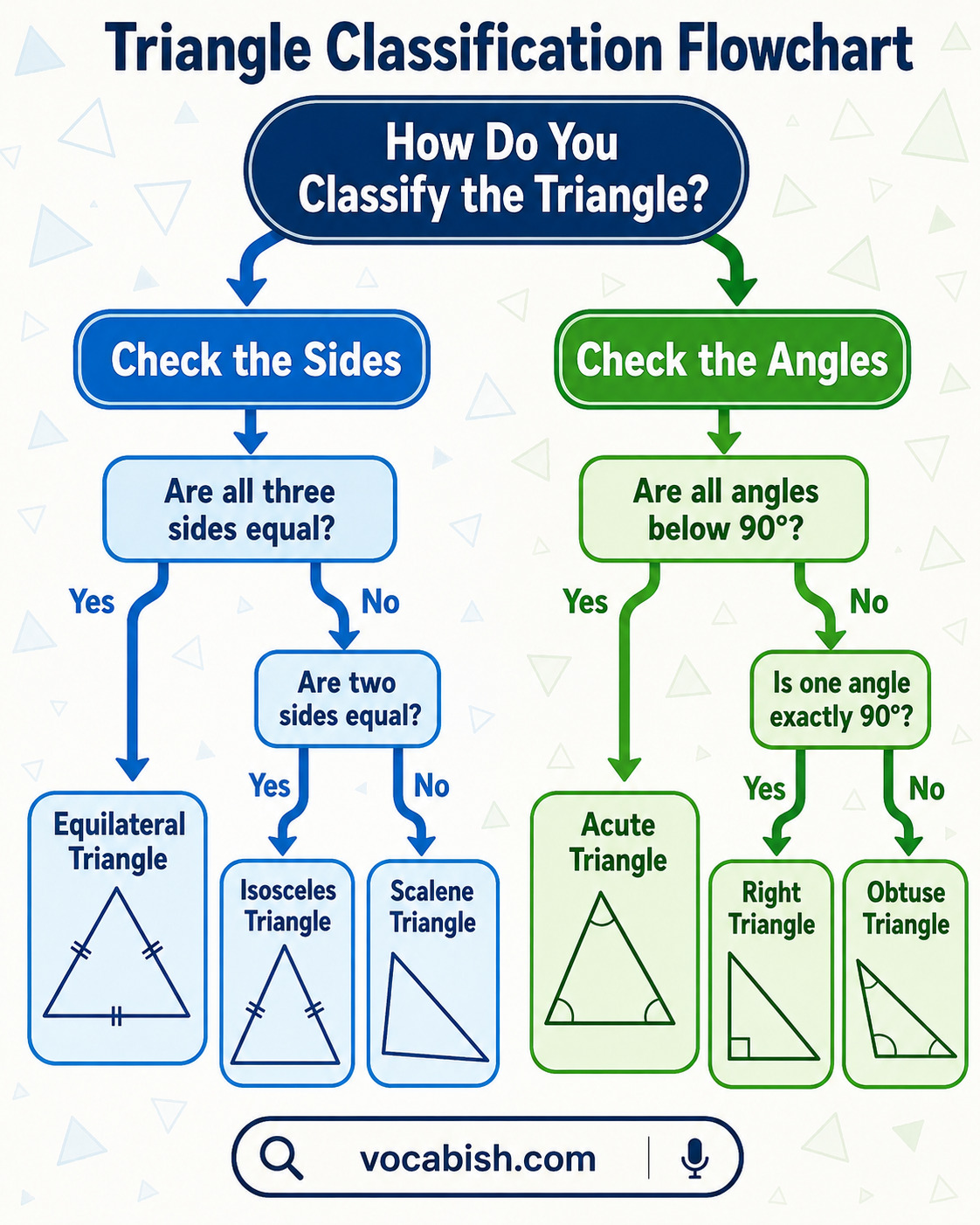
To identify a triangle correctly, examine its sides first and its angles second. You can then combine the two classifications.
Step 1: Compare the Three Side Lengths
Check whether any sides have equal lengths.
- Three equal sides: equilateral
- At least two equal sides: isosceles
- Three different sides: scalene
Do not rely only on the drawing because a diagram may not be perfectly accurate.
Step 2: Measure or Calculate the Angles
Look at the largest interior angle.
- Below 90 degrees: acute
- Exactly 90 degrees: right
- Above 90 degrees: obtuse
If two angle measurements are known, subtract their total from 180 degrees to find the missing angle.
Step 3: Give the Triangle Both Classifications
Combine the side-based and angle-based names when enough information is available.
Examples include:
- Acute equilateral triangle
- Acute isosceles triangle
- Obtuse isosceles triangle
- Right isosceles triangle
- Acute scalene triangle
- Right scalene triangle
- Obtuse scalene triangle
Identifying a Triangle Without Measuring Its Angles
If you know all three side lengths, you can identify whether the triangle is acute, right, or obtuse by comparing their squares.
Let c be the longest side.
- If a² + b² = c², the triangle is right.
- If a² + b² > c², the triangle is acute.
- If a² + b² < c², the triangle is obtuse.
For sides 3, 4, and 5:
3² + 4² = 5²
The triangle is right.
For sides 3, 4, and 6:
3² + 4² < 6²
9 + 16 < 36
The triangle is obtuse.
Triangle Properties and Formulas
Several basic formulas apply to the different types of triangles. Understanding them makes it easier to solve geometry problems.
Sum of Interior Angles
The three interior angles of a triangle add up to 180 degrees.
A + B + C = 180°
For example, if two angles measure 50 degrees and 60 degrees:
Third angle = 180° − 50° − 60°
Third angle = 70°
Perimeter of a Triangle
The perimeter is the total distance around the triangle.
Perimeter = a + b + c
Here, a, b, and c represent the three side lengths.
For a triangle with sides of 5 centimetres, 7 centimetres, and 8 centimetres:
Perimeter = 5 + 7 + 8
Perimeter = 20 centimetres
Area of a Triangle
The standard formula for the area of a triangle is:
Area = ½ × base × height
The height must meet the base at a right angle.
For a triangle with a base of 10 centimetres and a height of 6 centimetres:
Area = ½ × 10 × 6
Area = 30 square centimetres
Pythagorean Theorem for Right Triangles
The Pythagorean theorem applies only to right triangles.
a² + b² = c²
Here, a and b are the legs, while c is the hypotenuse.
For a right triangle with legs measuring 6 and 8 units:
6² + 8² = c²
36 + 64 = c²
100 = c²
c = 10
The hypotenuse measures 10 units.
Triangle Inequality Rule
The triangle inequality rule states that the sum of any two sides must be greater than the third side.
The side lengths 4, 5, and 7 can form a triangle because:
4 + 5 > 7
4 + 7 > 5
5 + 7 > 4
However, the lengths 2, 3, and 6 cannot form a triangle because:
2 + 3 is not greater than 6.
Solved Examples of Triangle Classification
The following examples show how to classify and solve common triangle problems step by step.
Example 1: Classifying a Triangle by Its Sides
A triangle has sides measuring 8 centimetres, 8 centimetres, and 5 centimetres.
Two sides have equal lengths.
Therefore, it is an isosceles triangle.
Example 2: Classifying a Triangle by Its Angles
A triangle has angles of 35 degrees, 65 degrees, and 80 degrees.
All three angles are smaller than 90 degrees.
Therefore, it is an acute triangle.
Example 3: Classifying a Triangle by Sides and Angles
A triangle has two equal sides and one angle of 90 degrees.
Two equal sides make it isosceles.
The 90-degree angle makes it right.
Therefore, it is an isosceles right triangle.
Example 4: Finding a Missing Triangle Angle
A triangle has angles of 45 degrees and 75 degrees.
Add the known angles:
45° + 75° = 120°
Subtract the result from 180 degrees:
180° − 120° = 60°
The missing angle is 60 degrees.
Example 5: Checking Whether Three Sides Form a Triangle
Suppose the proposed side lengths are 4 centimetres, 6 centimetres, and 9 centimetres.
Check the two shorter sides:
4 + 6 = 10
Since 10 is greater than 9, the first condition is satisfied. The other two combinations also satisfy the rule.
Therefore, these three lengths can form a triangle.
Types of Triangles in Real Life
Triangles are not limited to classroom diagrams. Their shapes and structural properties make them useful in many real-world settings.
Triangles in Buildings and Bridges
Builders and engineers often use triangular arrangements in roofs, towers, frames, and bridges.
A triangle keeps its shape unless the lengths of its sides change. A four-sided frame can bend more easily unless it receives extra support. Adding a diagonal support creates triangles and can make the structure more stable.
Roof trusses and bridge frameworks often contain several connected triangles.
Triangles in Road Signs
Many countries use triangular road signs to warn drivers about hazards.
The pointed shape is easy to recognise from a distance. It helps warning signs stand apart from circular regulatory signs and rectangular information signs.
However, road-sign shapes and meanings may vary between countries.
Triangles in Art and Graphic Design
Artists and designers use triangles to create direction, movement, balance, and visual focus.
An upward-pointing triangle may create a sense of stability or growth. An uneven scalene triangle may add energy and movement to a design.
Triangles also appear in logos, patterns, posters, digital interfaces, and abstract artwork.
Triangles in Everyday Objects
You can find triangular shapes in:
- Set squares
- Roof supports
- Bicycle frames
- Shelves and brackets
- Musical triangles
- Decorative patterns
- Sandwich halves
- Flags and warning markers
Some objects are perfect mathematical triangles, while others only have a roughly triangular shape.
Common Mistakes When Classifying Triangles
Students often make small classification mistakes because they focus only on appearance rather than measurements.
Assuming a Triangle Has Only One Classification
A triangle can have one name based on its sides and another based on its angles.
For example, a 3-4-5 triangle is both scalene and right. Using both names gives a complete description.
Confusing Equilateral and Isosceles Triangles
An equilateral triangle has three equal sides. An isosceles triangle has at least two equal sides.
Under the inclusive mathematical definition, an equilateral triangle is a special type of isosceles triangle. In many beginner lessons, however, “isosceles” means exactly two equal sides. Check which convention your course uses.
Calling Every Slanted Triangle Scalene
A triangle does not become scalene simply because it appears tilted or uneven.
A scalene triangle must have three different side lengths. Measure the sides or use the given values instead of judging by appearance.
Confusing the Longest Side with the Hypotenuse
Only a right triangle has a hypotenuse.
The hypotenuse lies opposite the 90-degree angle and is the longest side. In acute and obtuse triangles, the longest side is not called the hypotenuse.
Identifying an Obtuse Triangle by Appearance Alone
A drawing may make an angle appear larger or smaller than it truly is.
Use a protractor, calculate the angle, or compare the squared side lengths before deciding whether a triangle is obtuse.
FAQs About Types of Triangles
There are six basic types of triangles: equilateral, isosceles, scalene, acute, right, and obtuse. Special names also describe combinations such as isosceles right triangles and 30-60-90 triangles.
The six basic types are equilateral, isosceles, scalene, acute, right, and obtuse. The first three are classified by side lengths, while the last three are classified by angles.
The three types based on sides are equilateral, isosceles, and scalene. They have three equal sides, at least two equal sides, or three different sides respectively.
An equilateral triangle has three equal sides. Its three angles are also equal, with each measuring 60 degrees.
The three types based on angles are acute, right, and obtuse. Their largest angles are less than, equal to, or greater than 90 degrees.
An isosceles triangle has at least two equal sides. The angles opposite the equal sides are also equal.
A scalene triangle has three sides of different lengths. Its three interior angles are also usually different.
No. Two right angles would already total 180 degrees, leaving no angle measurement for the third vertex. A triangle can contain only one right angle.
An acute triangle has three angles below 90 degrees. An obtuse triangle has one angle greater than 90 degrees and two acute angles.
Summary of the Different Types of Triangles
- Equilateral, isosceles, and scalene triangles are classified by their sides.
- Acute, right, and obtuse triangles are classified by their angles.
- A triangle can receive both a side-based and an angle-based name.
- The interior angles of every plane triangle add up to 180 degrees.
- The perimeter is the sum of all three sides.
- The area equals one-half of the base multiplied by the perpendicular height.
- The Pythagorean theorem applies only to right triangles.
- The triangle inequality rule checks whether three side lengths can form a triangle.
Final Thoughts
Understanding the different types of triangles becomes easier when you use a simple method. First, compare the side lengths to identify an equilateral, isosceles, or scalene triangle. Next, examine the largest angle to decide whether the triangle is acute, right, or obtuse.
Remember that one triangle may belong to two categories at the same time. A triangle can be scalene and right, isosceles and obtuse, or equilateral and acute. Once you understand this two-part classification system, triangle names, properties, and formulas become much easier to use.
You May Also Like