
Learning comparative and superlative adjectives helps you describe and compare people, objects, and situations in English. In this blog post, you will explore how to form and use these adjectives with easy examples to show differences and extremes. Understanding comparatives and superlatives improves your speaking, reading, writing, and listening skills. By mastering these forms, you can communicate ideas clearly, make comparisons, and express yourself confidently in English.
What are Adjectives?
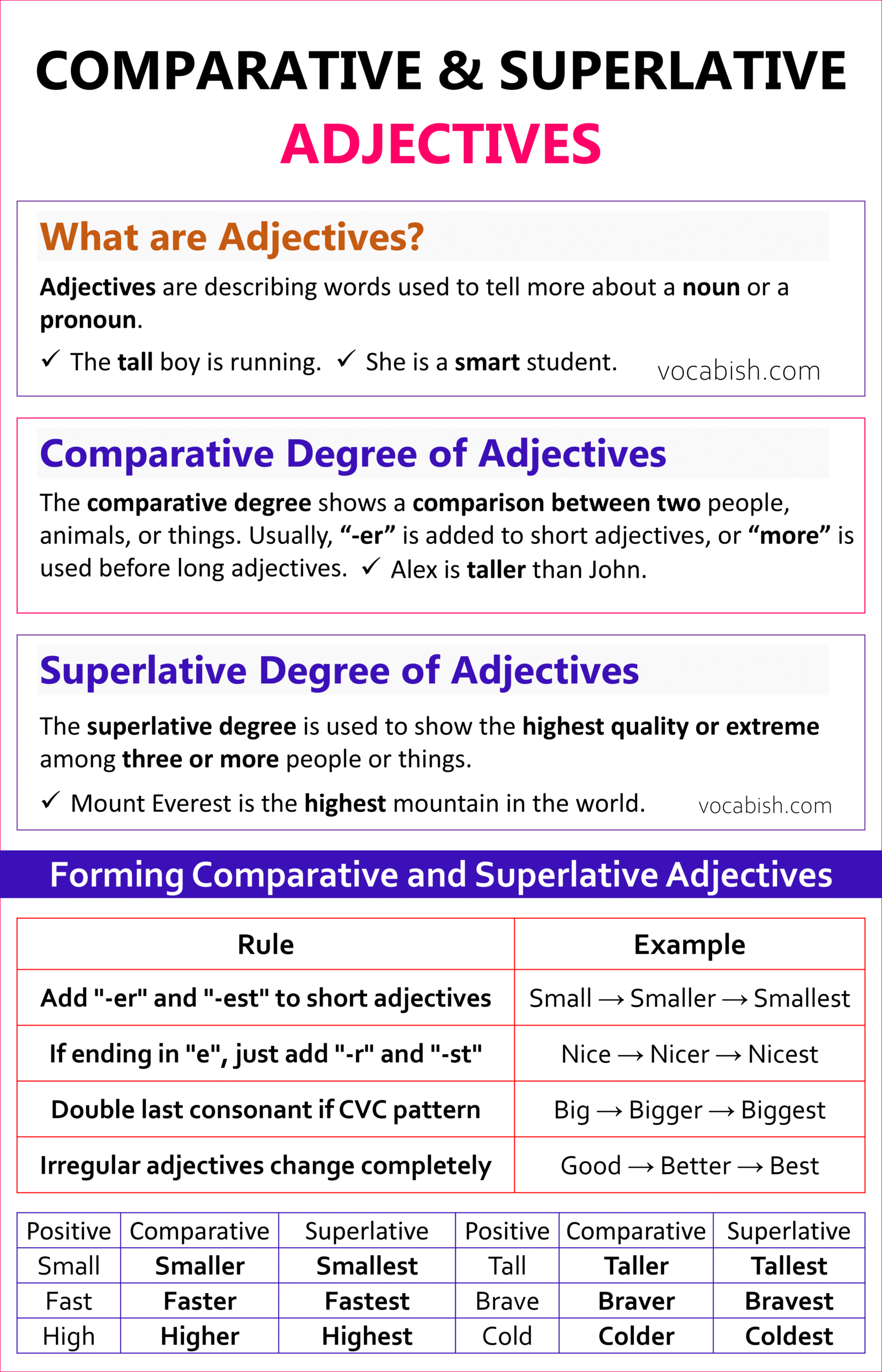
Adjectives are describing words used to tell more about a noun or a pronoun.
Examples:
➡ The tall boy is running.
➡ She is a smart student.
Here, tall and smart are adjectives because they describe the nouns boy and student.
Comparative Degree of Adjectives
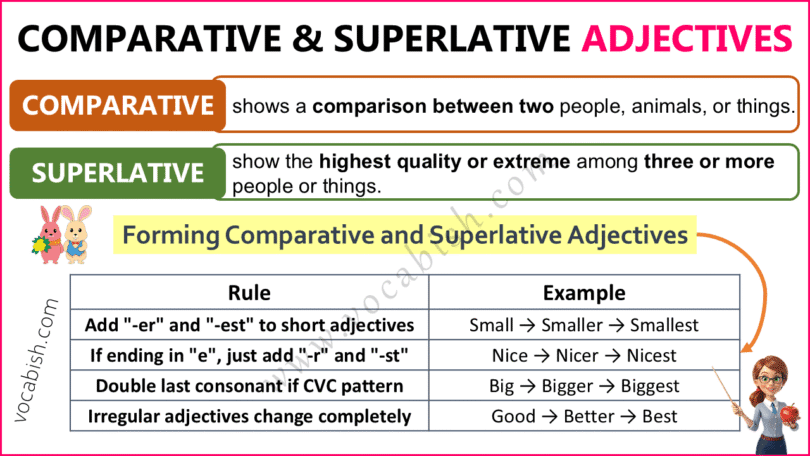
The comparative degree shows a comparison between two people, animals, or things. Usually, “-er” is added to short adjectives, or “more” is used before long adjectives.
Examples:
➡ Alex is taller than John.
➡ This book is more interesting than that one.
Key Tip: The comparative form often uses the word “than” to show the difference.
Superlative Degree of Adjectives
The superlative degree is used to show the highest quality or extreme among three or more people or things.
We usually add “-est” to short adjectives or use “most” before long adjectives.
Examples:
➡ Mount Everest is the highest mountain in the world.
➡ This is the most beautiful flower in the garden.
Key Tip: The superlative form usually uses “the” before it.
Rules for Forming Comparative and Superlative Adjectives
Type of Adjective | Comparative Form | Superlative Form | Example |
|---|---|---|---|
One-syllable words | Add -er | Add -est | tall → taller → tallest |
Ends with -e | Add -r, -st | Add -st | large → larger → largest |
Ends with one consonant + vowel + consonant | Double the last consonant | Double the last consonant + -est | big → bigger → biggest |
Two-syllable ending in -y | Change y → i and add -er / -est | Change y → i and add -est | happy → happier → happiest |
Two or more syllables | Use more / most | Use most | beautiful → more beautiful → most beautiful |
Irregular adjectives | Change completely | Change completely | good → better → best / bad → worse → worst |
Examples of Comparative and Superlative Adjectives
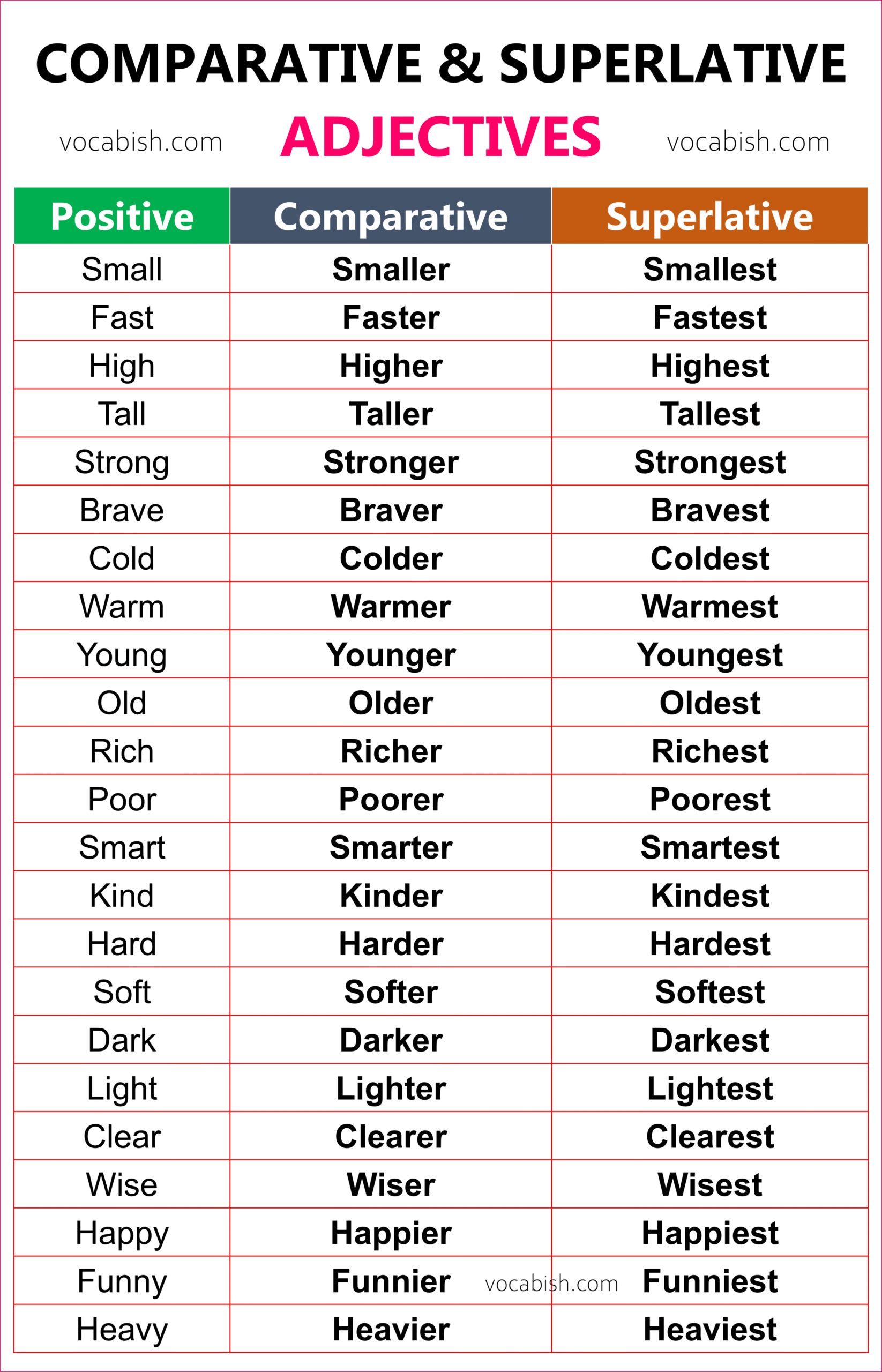
Positive | Comparative | Superlative |
|---|---|---|
big | bigger | biggest |
fast | faster | fastest |
clever | cleverer | cleverest |
old | older | oldest |
happy | happier | happiest |
large | larger | largest |
pretty | prettier | prettiest |
long | longer | longest |
high | higher | highest |
kind | kinder | kindest |
good | better | best |
bad | worse | worst |
beautiful | more beautiful | most beautiful |
difficult | more difficult | most difficult |
interesting | more interesting | most interesting |
expensive | more expensive | most expensive |
easy | easier | easiest |
young | younger | youngest |
dirty | dirtier | dirtiest |
thin | thinner | thinnest |
Summary on Degrees of Comparison
To describe or compare, you use adjectives in three degrees:
- Positive – describes one thing (She is tall.)
- Comparative – compares two things (She is taller than him.)
- Superlative – compares three or more things (She is the tallest of all.)
Learning these forms helps you speak and write more naturally in English.
Comparative and superlative adjectives make your English clear, expressive, and natural.
They help you compare things and express degrees of quality easily.
By practising daily, you can master these forms and use them confidently in both speaking and writing.
Frequently Asked Questions
Comparative adjectives compare two things, while superlative adjectives compare three or more. For example, “taller” compares two people, and “tallest” shows the highest degree among many.
For short adjectives, add “-er” for comparative and “-est” for superlative (e.g., small, smaller, smallest). For longer adjectives, use “more” and “most” before the adjective.
Use comparative adjectives when comparing exactly two things. Use superlative adjectives when comparing three or more items to show the highest or lowest degree in a group.
“This book is easier than that one” uses a comparative adjective. “This is the easiest book in the class” uses a superlative adjective to show the highest level.
Learners often use both “more” and “-er” together, like “more taller.” Another mistake is using superlatives for two items instead of comparatives, which is incorrect.
Some adjectives change completely, like “good, better, best” and “bad, worse, worst.” These forms must be memorized because they do not follow standard “-er” or “-est” rules.
No, adjectives follow different patterns based on length and spelling. Short adjectives take endings, while longer ones use “more” or “most,” and some have irregular forms.
Related Articles: