

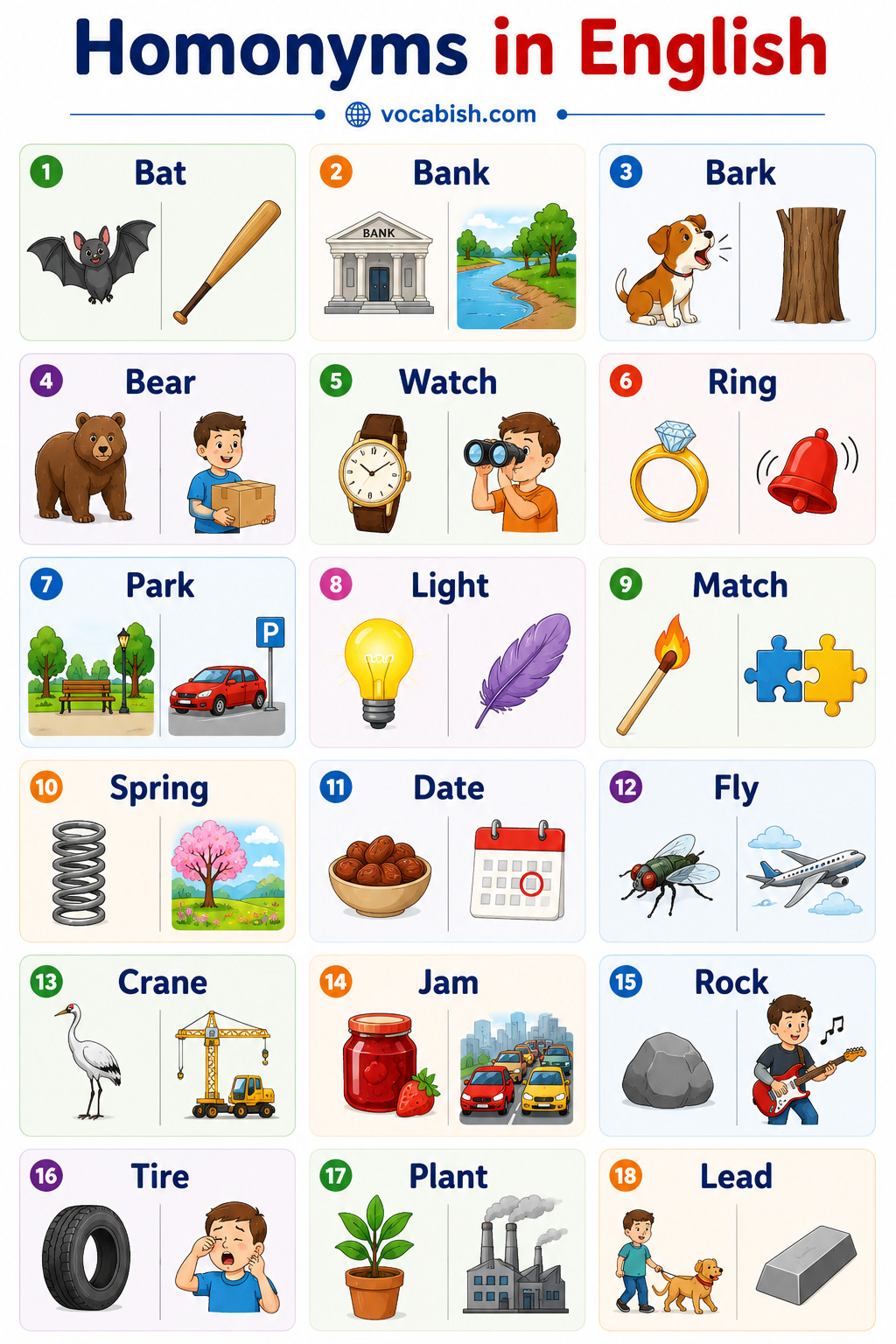
Some English words can look and sound exactly the same but have completely different meanings. These words are called Homonyms, and they appear everywhere in daily conversations, books, school lessons, and online content. For example, the word bat can refer to a flying animal or a piece of sports equipment. Without context, it can be difficult to know which meaning is intended.
Understanding homonym meanings with examples and how they work in sentences can help you improve reading comprehension, vocabulary, and communication skills. As you become familiar with these words, you’ll find it easier to understand English in different situations and avoid common misunderstandings.
Homonyms: Definition and Examples
The homonyms meaning is easy to understand. Homonyms are words that share the same spelling and pronunciation but have different meanings.
Easy Definition:
- Same spelling + Same pronunciation + Different meanings = Homonym
Examples:
Homonym | Meaning 1 | Meaning 2 |
|---|---|---|
Ring | Jewelry | Sound of a phone |
Park | Public area | Leave a vehicle |
Watch | Timepiece | Observe |
Examples in Sentences:
- I bought a gold ring.
- Did you hear the phone ring?
The meaning changes, but the word stays exactly the same.
What Are the Differences Between Homonyms, Homophones, and Homographs?
The terms homonyms, homophones, and homographs are closely related, which is why many English learners mix them up. They all describe words that share similarities in spelling, pronunciation, or both. The key difference lies in how the words look and sound.
Homonyms
Homonym is the broad term used for words that have the same spelling, the same pronunciation, or both, but different meanings. In other words, homophones and homographs fall under the larger category of homonyms.
For example:
- Bat (a flying animal)
- Bat (used in baseball or cricket)
The word looks the same, sounds the same, but has two different meanings.
Homophones
Homophones are words that sound the same when spoken but have different meanings and usually different spellings.
Examples:
- There – a place
- Their – belonging to them
- They’re – they are
More examples include:
- To / Too / Two
- Sea / See
- One / Won
- Mail / Male
- Right / Write
Although these words sound identical, their meanings and spellings are different.
Related: 100+ Confusing Words List with Explanation
Homographs
Homographs are words that share the same spelling but have different meanings. Some homographs also have different pronunciations.
For example:
- Lead (to guide) — pronounced leed
- Lead (a metal) — pronounced led
The spelling is identical, but both the meaning and pronunciation change.
Other examples include:
- Wind (moving air) / Wind (to twist)
- Tear (a drop from the eye) / Tear (to rip)
- Row (a line) / Row (an argument)
Some homographs have the same pronunciation as well:
- Bear (to carry)
- Bear (a large wild animal)
How to Use Homonyms in Writing
When using homonyms in writing, pay close attention to the sentence context so readers can understand the correct meaning. Since homonyms share the same spelling and pronunciation but have different meanings, the surrounding words help clarify which meaning you intend.
Examples:
- The children played in the park after school. (public area)
- Please park your car near the entrance. (leave a vehicle)
- She wore a beautiful ring. (jewelry)
- I heard the phone ring. (make a sound)
Quick Tip:
Always read the entire sentence to make sure the meaning is clear. Strong context helps readers understand the correct interpretation of a homonym without confusion.
Homonym Examples with Meanings
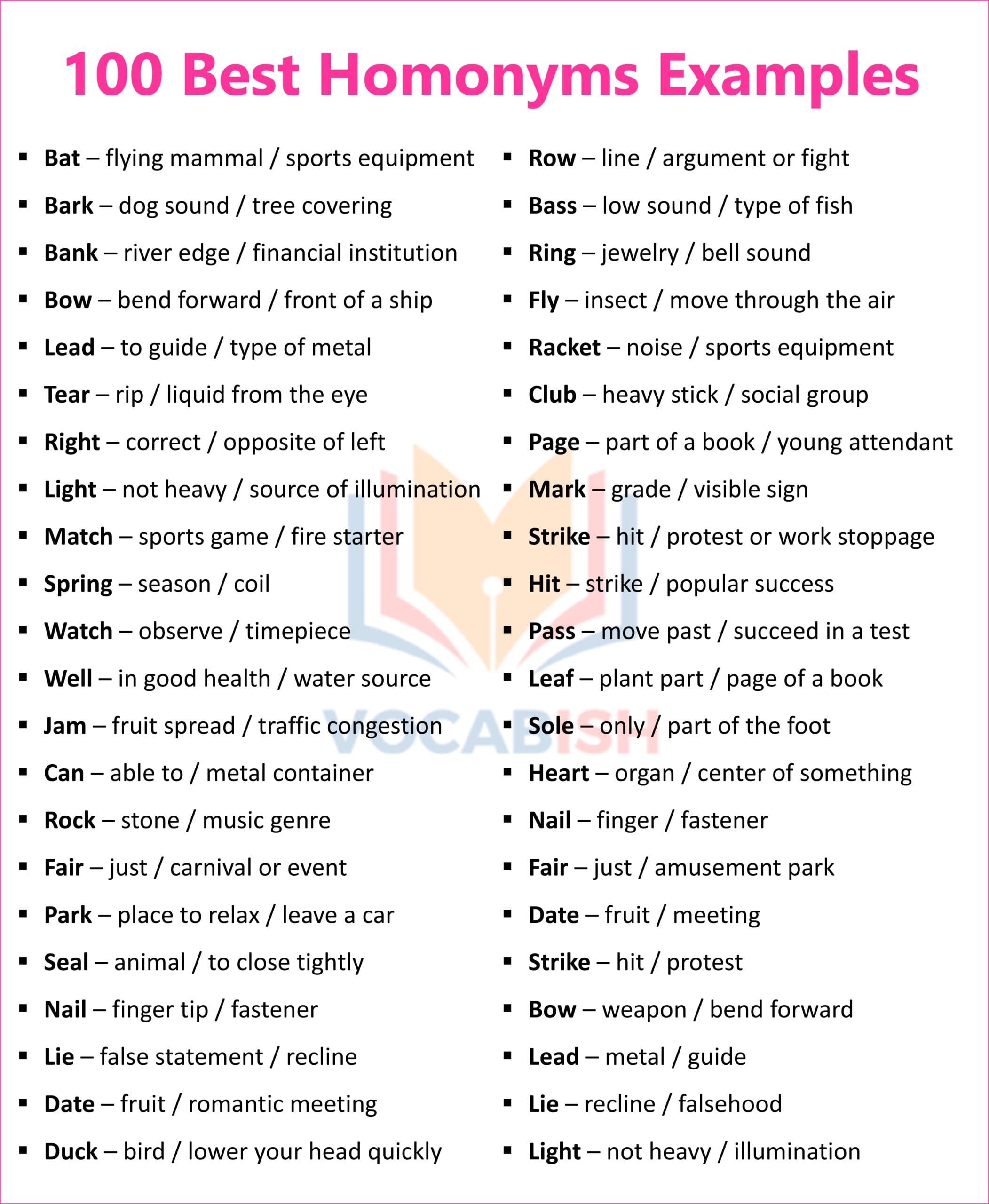
Here’s the list of 50 homonyms in English that have double meanings:
- Bat – flying mammal / sports equipment
- Bark – dog sound / tree covering
- Bank – river edge / financial institution
- Bow – bend forward / front of a ship
- Lead – to guide / type of metal
- Tear – rip / liquid from the eye
- Right – correct / opposite of left
- Light – not heavy / source of illumination
- Match – sports game / fire starter
- Spring – season / coil
- Watch – observe / timepiece
- Well – in good health / water source
- Jam – fruit spread / traffic congestion
- Can – able to / metal container
- Rock – stone / music genre
- Fair – just / carnival or event
- Park – place to relax / leave a car
- Seal – animal / to close tightly
- Nail – finger tip / fastener
- Lie – false statement / recline
- Date – fruit / romantic meeting
- Duck – bird / lower your head quickly
- Row – line / argument or fight
- Bass – low sound / type of fish
- Pen – writing tool / enclosure for animals
- Fan – cooling device / enthusiastic supporter
- Ring – jewelry / bell sound
- Fly – insect / move through the air
- Racket – noise / sports equipment
- Club – heavy stick / social group
- Page – part of a book / young attendant
- Mark – grade / visible sign
- Strike – hit / protest or work stoppage
- Hit – strike / popular success
- Pass – move past / succeed in a test
- Leaf – plant part / page of a book
- Branch – tree part / division of a company
- Pool – small water body / combined resources
- Sole – only / part of the foot
- Cheer – happiness / shout encouragement
- Heart – organ / center of something
- Wave – hand gesture / water movement
- Nail – finger / fastener
- Fair – just / amusement park
- Date – fruit / meeting
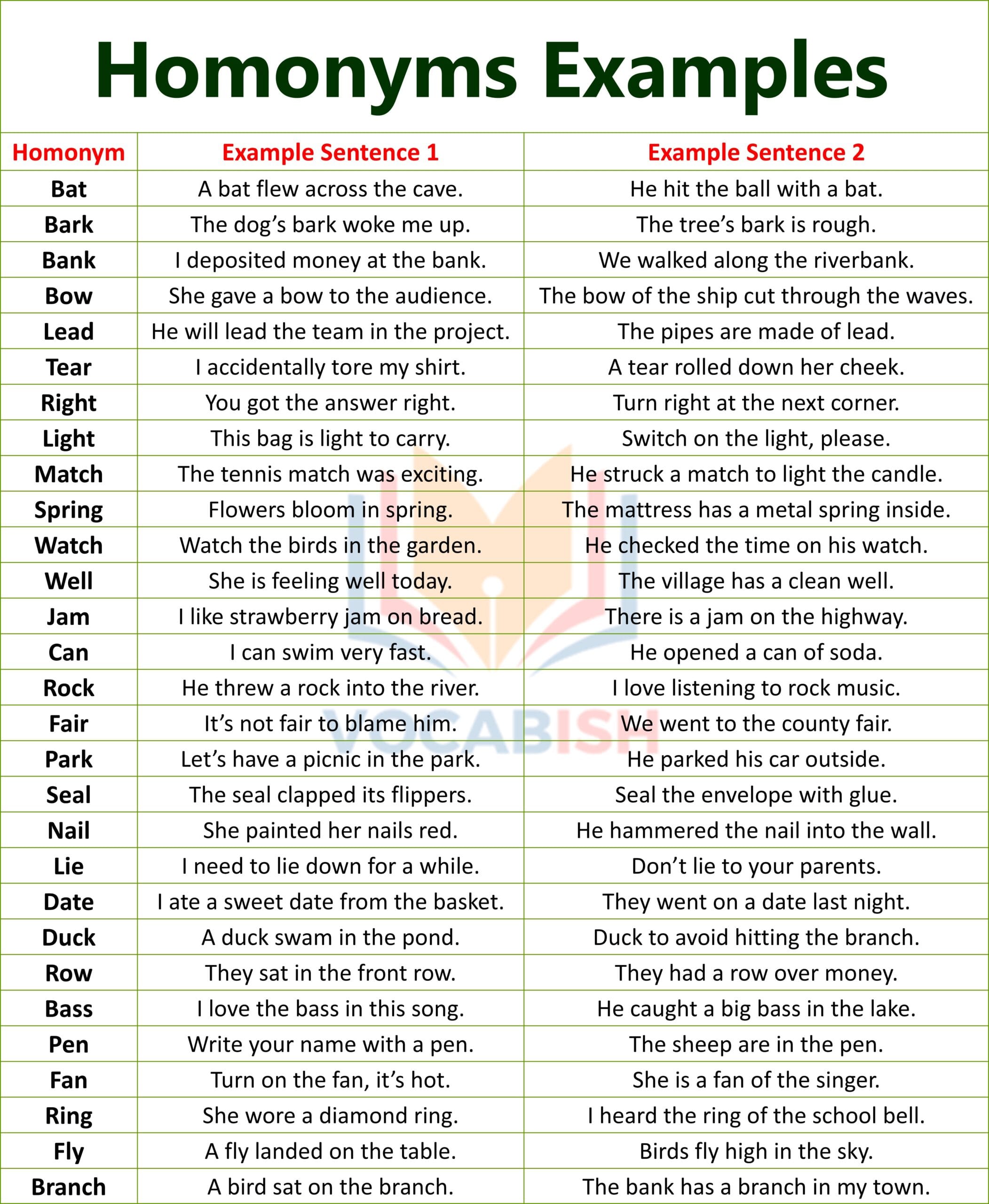
Homonym Examples in Sentences
# | Homonym | Example Sentence 1 | Example Sentence 2 |
|---|---|---|---|
1 | Bat | A bat flew across the cave. | He hit the ball with a bat. |
2 | Bark | The dog’s bark woke me up. | The tree’s bark is rough. |
3 | Bank | I deposited money at the bank. | We walked along the riverbank. |
4 | Bow | She gave a bow to the audience. | The bow of the ship cut through the waves. |
5 | Lead | He will lead the team in the project. | The pipes are made of lead. |
6 | Tear | I accidentally tore my shirt. | A tear rolled down her cheek. |
7 | Right | You got the answer right. | Turn right at the next corner. |
8 | Light | This bag is light to carry. | Switch on the light, please. |
9 | Match | The tennis match was exciting. | He struck a match to light the candle. |
10 | Spring | Flowers bloom in spring. | The mattress has a metal spring inside. |
11 | Watch | Watch the birds in the garden. | He checked the time on his watch. |
12 | Well | She is feeling well today. | The village has a clean well. |
13 | Jam | I like strawberry jam on bread. | There is a jam on the highway. |
14 | Can | I can swim very fast. | He opened a can of soda. |
15 | Rock | He threw a rock into the river. | I love listening to rock music. |
16 | Fair | It’s not fair to blame him. | We went to the county fair. |
17 | Park | Let’s have a picnic in the park. | He parked his car outside. |
18 | Seal | The seal clapped its flippers. | Seal the envelope with glue. |
19 | Nail | She painted her nails red. | He hammered the nail into the wall. |
20 | Lie | I need to lie down for a while. | Don’t lie to your parents. |
Homonyms Examples for Kids
Children often learn homonyms through familiar words and pictures.
Word | Meaning 1 | Meaning 2 |
|---|---|---|
Bat | Animal | Sports equipment |
Duck | Bird | Lower your head |
Fly | Insect | Travel through air |
Jam | Food spread | Traffic problem |
Ring | Jewelry | Phone sound |
Watch | Clock | Observe |
Bark | Dog sound | Tree covering |
Light | Lamp | Not heavy |
Rock | Stone | Gently move |
Match | Game | Pair |
Kid-Friendly Example:
- The duck swam in the pond.
- Please duck when the ball comes toward you.
You May Also Like:
- Homophones and Meanings with Examples
- Homograph Definition and Examples
- 100 Confusing Words in English with Meanings
FAQs about Homonyms
Homonyms are words that share identical written and spoken forms while representing two or more completely different meanings.
Common examples include bat, bank, ring, light, watch, park, spring, date, bark, and match.
Kids can learn homonyms through pictures, stories, example sentences, and everyday conversations that show different meanings clearly.
Homonyms usually share both spelling and pronunciation, while homographs share spelling but may have different pronunciations.
Look at the surrounding words and the overall context. The sentence usually provides enough information to determine the intended meaning.
Homonyms share spelling and pronunciation. Homophones only share pronunciation and often have different spellings.
Conclusion
Homonyms make English more interesting because a single word can carry multiple meanings. Words like bat, bank, watch, and ring may look and sound the same, but their meanings change depending on how they are used. By studying these homonyms examples, you can improve vocabulary, strengthen reading skills, and understand spoken and written English more accurately. The more exposure you have to homonyms in sentences and everyday communication, the easier it becomes to recognize the correct meaning without confusion.