

In English, loose and lose are two words that often confuse learners because they sound similar but have very different meanings. Understanding the difference is important for speaking, writing, reading, and listening accurately. In this blog post, you will learn how to use loose and lose correctly, with examples that show their meanings in real sentences. By mastering these words, you can communicate more clearly and express your ideas more confidently.
You can explore our 100 confusing words list to expand your vocabulary skills!
Meanings of Loose and Lose

Loose
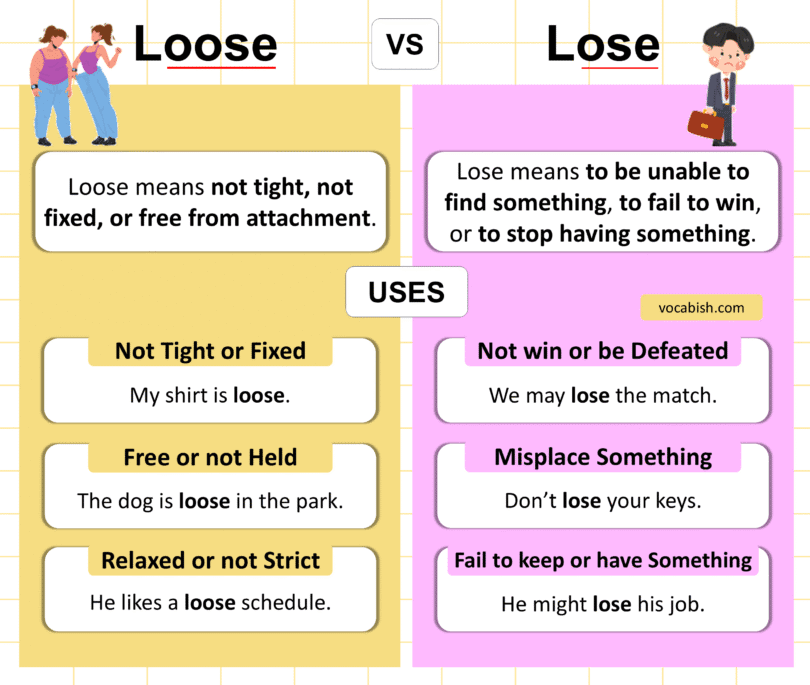
Loose means not tight, not fixed, or free from attachment. It is often used as an adjective to describe something that is not firmly held or fitting freely.
Example: My shoes are loose, so I need to tighten them.

Lose
Lose means to be unable to find something, to fail to win, or to stop having something. It is always used as a verb.
Example: Don’t lose your keys again.
Pronunciation of Loose and Lose
Word | Pronunciation | Sounds Like | Example |
|---|---|---|---|
Loose | /luːs/ | rhymes with moose | My shirt is too loose. |
Lose | /luːz/ | rhymes with choose | Try not to lose the game. |
Differences Between Loose and Lose
Point | Loose | Lose |
|---|---|---|
Part of Speech | Adjective | Verb |
Meaning | Not tight or not fixed | To misplace or not win |
Usage Example | The dog got loose from its leash. | We might lose the match. |
Common Confusion | Describes something free or untied | Describes an action or result |
Spelling Tip | Ends with “oose” | Ends with “ose” (one ‘o’) |
Usage of Loose
Loose is used when something is not firm, not tight, or moving freely. Below is an explanation in detail about when and how to use “loose” in English:
1. Not tight or fixed:
- My shirt is loose.
- The screw is loose.
2. Free or not held:
- The dog is loose in the park.
- The horse broke loose from the stable.
3. Relaxed or not strict:
- He likes a loose schedule.
- The rules are quite loose here.
Usage of Lose
Lose is used when you no longer have something, fail to win, or miss something. Below is an explanation in detail about when and how to use “lose” in English:
1. Not win or be defeated:
- We may lose the match.
- They didn’t want to lose the game.
2. Misplace something:
- Don’t lose your keys.
- I always lose my pen.
3. Fail to keep or have something:
- He might lose his job.
- She doesn’t want to lose hope.
Formal and Informal Uses of Loose and Lose
Type | Loose | Lose |
|---|---|---|
Formal | The bolt became loose after long use. | The company cannot afford to lose its clients. |
Informal | My jeans are loose now. | Don’t lose your phone again! |
Summary on Loose and Lose
- Loose → Not tight or free.
- Lose → Fail to win or misplace something.
Remember: Loose has two o’s (like “too big”).
Lose has one o (like “gone”).
FAQs on Loose vs Lose
What is the main difference between Loose and Lose?
Loose means not tight, while Lose means to misplace or not win.
Can I use Loose as a verb?
Not usually. The correct verb is Loosen (e.g., “Please loosen the rope”).
How do you pronounce Loose and Lose?
Loose is /luːs/ and Lose is /luːz/. The difference is in the ending sound.
Which word means “to misplace something”?
The correct word is Lose.
Which word means “not tight”?
The correct word is Loose.
Read More
