
The real difference between sick and ill is that “sick” is an everyday word for short-term problems like a cold, while “ill” is a formal term for serious or long-term conditions. If you are studying English, figuring out exactly when to use these two words can be frustrating. Native speakers might seem to swap them without thinking, but they are actually following unwritten rules about grammar and geography. Let’s break down the exact ill vs sick differences so you can stop second-guessing yourself and speak with confidence.
If you want to learn more confusing words, you may check our complete category: Confusing Words.
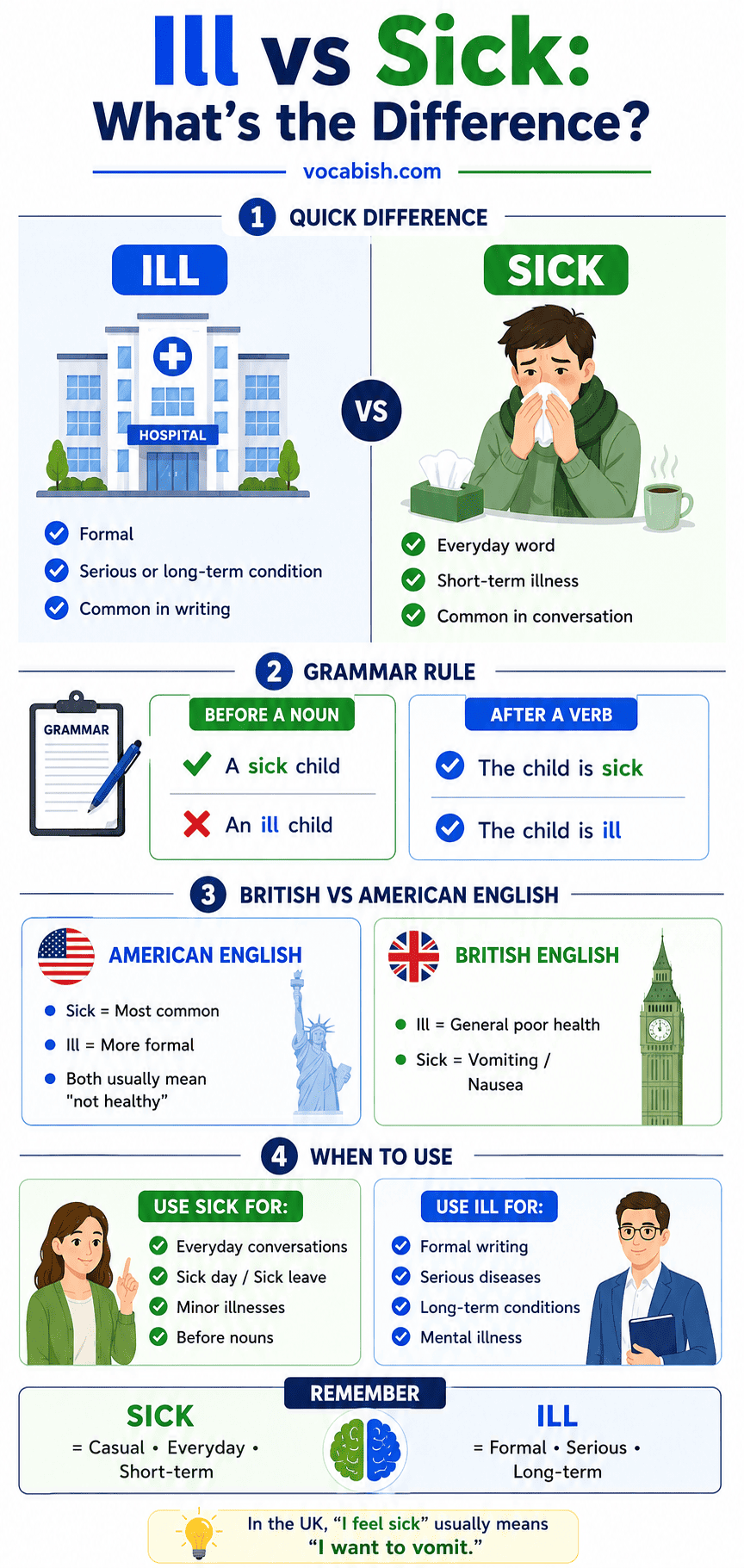
Ill vs Sick: Quick Answer
If you want to know what is the difference between ill and sick in just a few seconds, here is the basic rule:
- Sick is conversational, everyday vocabulary. We usually use it for short-term health problems (like a cold, a fever, or an upset stomach).
- Ill is more formal. We often use it for long-term, serious health conditions (like cancer or pneumonia).
However, the biggest sick and ill differences actually come down to grammar and geography (whether you are speaking British or American English).
What Does “Ill” Mean?
“Ill” is an adjective used to describe poor health. It carries a slightly formal or serious tone. When someone is ill, it often implies a condition that requires medical attention or lasts for a long time.
- Example: My uncle has been ill for several months.
- Example: She was diagnosed with a severe illness.
A quick note: “Ill” can also describe something bad, harmful, or negative. For example, “ill effects” means bad effects, and “ill-mannered” means someone has bad manners.
What Does “Sick” Mean?
“Sick” is the most common, everyday word for not feeling well. You use this when you have a headache, a cold, or just feel physically weak.
- Example: I can’t come to work today; I feel sick.
- Example: The children got sick after playing in the rain.
Native speakers also use “sick” in fixed expressions related to health and work, such as sick leave, sick day, or sick pay.
(Bonus tip: In informal slang, especially among younger people, “sick” can mean “really cool” or “amazing.” If someone says, “That car is sick,” they mean they love it!)
Ill vs Sick: Key Differences
To help you remember when to use ill and sick, here is a simple breakdown.
Feature | Sick | Ill |
Tone | Casual, everyday | Formal, serious |
Duration of health issue | Usually short-term (colds, flu) | Often long-term or severe |
Grammar placement | Can go before a noun (a sick baby) | Usually goes after a verb (the baby is ill) |
Fixed phrases | Sick day, sick leave, sick pay | Ill health, ill effects, mentally ill |
Ill vs Sick in British vs American English
If you want to know where to use ill and where to use sick, you have to look at the map. This is where most ESL learners get confused!
In American English:
Americans use “sick” and “ill” to mean the same thing. However, “sick” is far more common in daily conversation. An American will say, “I am sick” whether they have a mild cold or a serious disease. “Ill” is mostly saved for formal writing.
In British English:
This is where it gets tricky. In the UK, “ill” simply means you are not healthy. But “sick” specifically means vomiting or feeling nauseous.
- UK meaning of ill: “I feel ill.” (I have a fever/headache).
- UK meaning of sick: “I feel sick.” (I am going to throw up/vomit).
If you are in London and tell your boss “I was sick this morning,” they will assume you threw up in the bathroom!
Grammar Rules You Must Know
There is a hidden grammar rule about how to use ill and sick that many textbooks skip. It is all about where the word sits in a sentence.
1. Before a noun (Attributive Adjectives)
When you need an adjective right in front of a noun (like person, dog, child), you should almost always use sick.
- ✅ Correct: I stayed home to take care of my sick dog.
- ❌ Unnatural: I stayed home to take care of my ill dog.
2. After a verb (Predicative Adjectives)
When the adjective comes after a linking verb (like is, are, feels, seems), you can use either word.
- ✅ Correct: My dog is sick.
- ✅ Correct: My dog is ill.
When to Use Ill vs Sick (Simple Guide)
Here is a fast checklist to help you decide which word fits your sentence perfectly.
Use “Sick” when:
- You are speaking casually with friends or coworkers.
- You are calling your boss to take a “sick day.”
- You are putting the word directly in front of a noun (a sick man).
- You are in the UK and feel like you need to vomit.
Use “Ill” when:
- You are writing a formal essay or email.
- You are talking about a very serious, long-term disease.
- You are describing bad behavior or bad effects (ill-advised, ill-tempered).
Common Mistakes Learners Make
As a teacher, I hear a few common errors when students practice the difference between ill and sick.
- Mistake 1: Using “ill” before a noun.
- Wrong: He is an ill boy.
- Right: He is a sick boy. (Or: The boy is ill).
- Mistake 2: Using “sick” instead of “ill” for mental health.
- Wrong: He is mentally sick.
- Right: He is mentally ill. (This is a fixed collocation in English).
- Mistake 3: Saying “I sicked” to mean “I vomited.”
- Wrong: I sicked all night.
- Right: I was sick all night. / I threw up all night.
Ill vs Sick in Exams (IELTS, TOEFL, TEFL)
If you are taking an English proficiency test, vocabulary choice matters.
For the IELTS or TOEFL Speaking sections, using “sick” is perfectly fine when discussing daily life, a cold, or missing work.
However, in the Writing section, “ill” and “illness” will score better because they are considered higher-register (more formal) academic vocabulary.
- Speaking test: “I couldn’t go to the party because I got sick.”
- Writing test: “A high percentage of the population suffers from chronic illness due to poor air quality.”
Ill vs Sick in Spoken vs Written English
To summarize the register differences:
- Spoken English relies heavily on “sick.” It feels warmer, more human, and more relatable.
- Written English (like news reports, medical journals, and business policies) leans toward “ill” and “illness.”
Real-Life Examples (Daily Conversations)
Let’s look at how native speakers naturally use sick and ill in the real world.
1: Calling out of work
Sarah: Hi Mark, I need to use a sick day today. I woke up with a terrible fever.
Mark: Oh no! Rest up and feel better soon.
2: A formal news report
“The local hospital has reported a rise in patients falling ill with the new virus. Health officials warn that the illness targets the elderly.”
3: British English context
Tom: Are you alright? You look pale.
James: I ate some bad fish for lunch. I think I’m going to be sick. (James means he is going to vomit).
Synonyms of Ill and Sick
Want to expand your vocabulary beyond these two words? Try these natural alternatives:
- Under the weather: A very common idiom for feeling slightly sick. (“I’m feeling a bit under the weather today.”)
- Unwell: A polite, slightly formal way to say sick. (“She went home early because she was unwell.”)
- Poorly: Common in British English for someone who is sick. (“My grandfather has been quite poorly lately.”)
Quick Comparison Recap
- Sick: Everyday word, short-term issues, used before nouns, means vomiting in the UK.
- Ill: Formal word, long-term issues, used after verbs, means generally unwell in the UK.
FAQs About Sick and ill
Sick is an everyday word used for minor health issues. Ill is much more formal and describes highly serious medical conditions.
Always use “sick.” In the English-speaking working world, the standard terms are sick leave, calling in sick, and sick days. Saying “I am taking an ill day” sounds strange to native ears.
Yes, you can. Americans will completely understand you, but it might sound a little formal or dramatic compared to saying “I feel sick.”
This is a very common idiom. If you are “sick and tired” of something, it means you are completely annoyed and frustrated by it. It has nothing to do with your physical health. (Example: “I am sick and tired of this rainy weather.”)
Always use “illness” for serious medical conditions, like mental illness. Simply use “sickness” for feeling nauseous, like car or morning sickness.
Being “sick with” means you have a physical disease. Being “sick of” means you are deeply annoyed or frustrated by something.
Neither is rude. However, standard business vocabulary always uses “sick.” Tell your boss you need to take a normal sick day.
Yes, almost always. In British English, “feeling sick” points to your stomach. Say “I feel unwell” for a regular head cold.
Conclusion
Understanding the difference between ill and sick doesn’t have to be stressful. Just remember to use “sick” for everyday complaints and direct descriptions (a sick child), and reserve “ill” for formal situations, serious conditions, or when you are describing someone’s health after a verb (he is ill).
Keep practicing these rules in your daily conversations, and soon you will be using them just like a native speaker!
You May Also Like:
