
The present continuous tense is one of the most useful grammar forms in everyday English. People use it when talking about actions happening right now, temporary activities, and even future plans. Whether someone is chatting with a friend, talking on the phone, or describing what they see around them, the present progressive helps make communication clear and natural.
In this lesson, you will learn how to form the present continuous tense, when to use it, and how to create correct sentences with real-life examples. You will also practice with exercises to improve your understanding and speaking confidence.
Present Continuous Tense
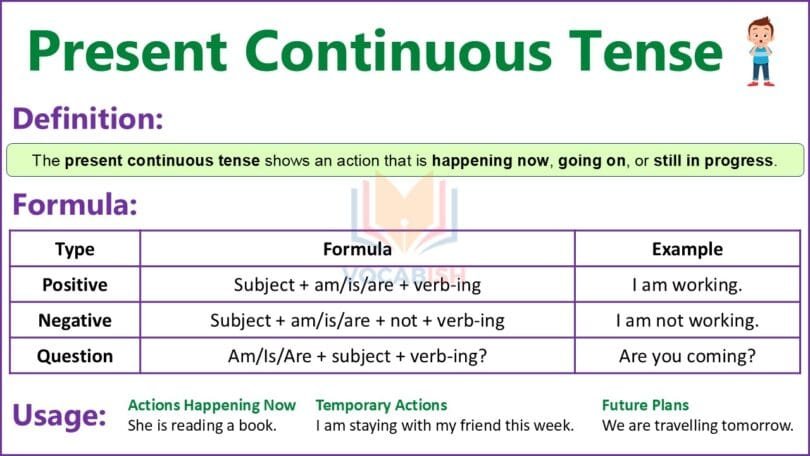
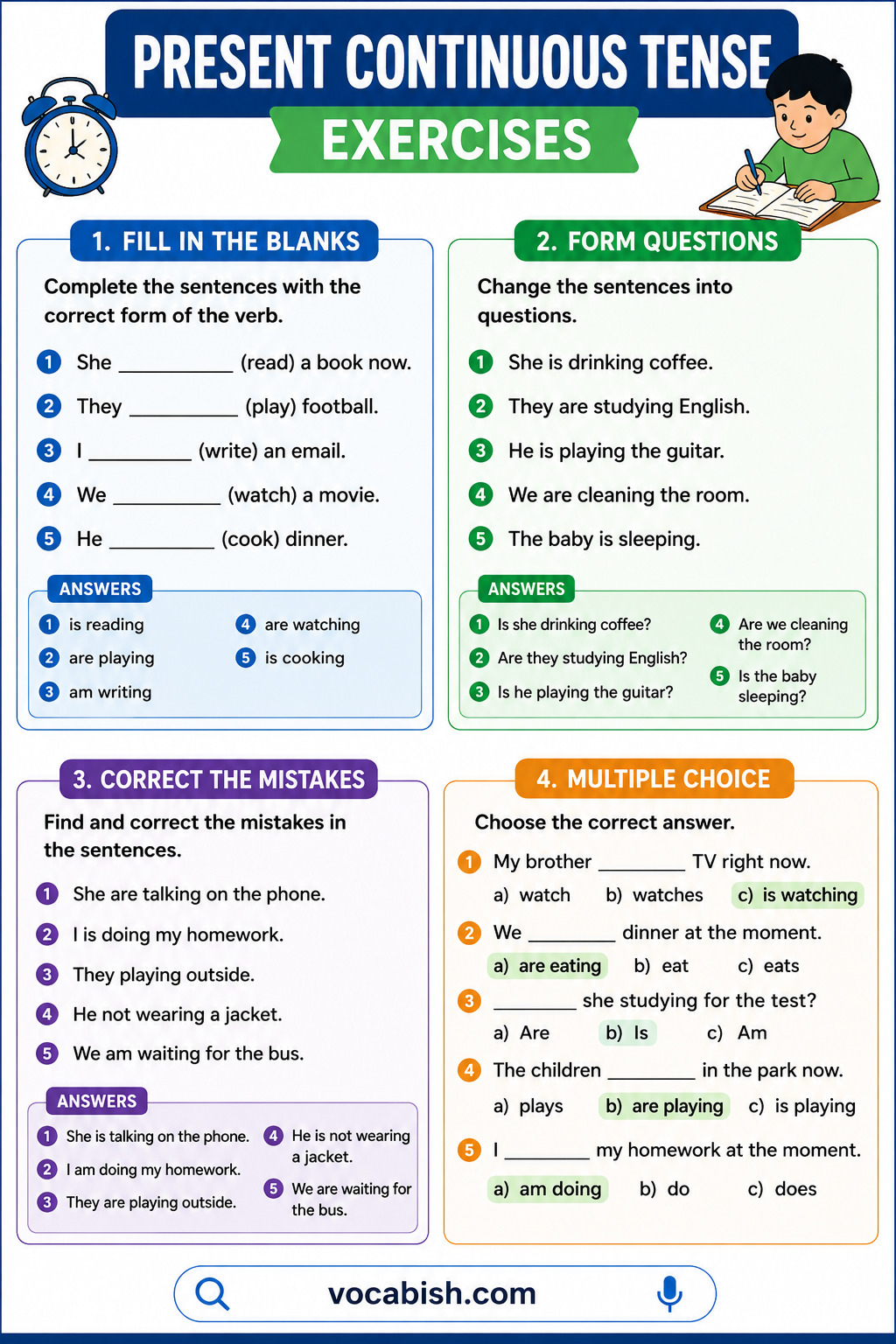
The present continuous tense is used when we talk about actions happening at the moment of speaking or around the present time. People use it often in daily conversations to describe activities, temporary situations, and future plans.
It is also called the present progressive tense because it shows an action that is continuing or in progress.
Definition and Structure
The present continuous shows that an action is happening now, is still continuing, or is temporary.
Structure:
Sentence Type | Structure | Example |
|---|---|---|
Affirmative | Subject + am/is/are + verb + ing | She is reading a book. |
Negative | Subject + am/is/are + not + verb + ing | They are not sleeping. |
Question | Am/Is/Are + subject + verb + ing? | Are you studying now? |
Formation with ‘To Be’ and Present Participle
The tense is formed with the following:
- A form of the verb “to be” (am, is, are)
- The main verb with -ing
Forms of “To Be”
Subject | Helping Verb |
|---|---|
I | am |
He / She / It | is |
You / We / They | are |
Examples:
- I am learning English.
- He is cooking dinner.
- They are traveling by bus.
Spelling Rules for Adding “-ing”
Base Verb | Present Participle |
|---|---|
read | reading |
make | making |
run | running |
Affirmative, Negative, and Interrogative Forms
Affirmative Form
These sentences state that something is happening.
Formula: Subject + am/is/are + present participle (-ing)
Examples:
- She is talking on the phone.
- I am doing my homework.
- They are waiting for the teacher.
Negative Form
Use not after the helping verb.
Formula: Subject + am/is/are + not + present participle (-ing)
Examples:
- He is not sleeping.
- We are not watching TV.
- I am not feeling well.
Interrogative Form
Move the helping verb before the subject.
Formula: Am/Is/Are + subject + present participle (-ing)
Examples:
- Are they coming today?
- Is she wearing a blue dress?
- Am I speaking too fast?
These structures help to form statements, negate them, or ask questions regarding ongoing actions.
Usage of Present Continuous Tense
The present continuous is common in real-life communication. We use it in different situations depending on what is happening.
Describing Ongoing Actions
Use the tense for actions happening right now.
Examples:
- The baby is crying.
- I am studying for my test.
- My friends are waiting outside.
Real-Life Situation:
Imagine you call your friend and ask:
“What are you doing?”
Your friend may answer:
- “I am eating lunch.”
- “I am driving to work.”
- “I am cleaning my room.”
These actions are happening at the moment of speaking.
Indicating Future Arrangements
The present continuous can also describe planned future activities.
Examples:
- We are meeting the manager tomorrow.
- She is visiting her grandmother next week.
- I am flying to Lahore on Friday.
Real-Life Situation:
People often use this form when talking about appointments, travel plans, or meetings.
- “Are you coming to the party tonight?”
- “Yes, I am coming with my cousin.”
Expressing Temporary Situations
Sometimes a situation is not permanent. This tense helps show that it is temporary.
Examples:
- He is staying with his uncle this month.
- I am working at a café during summer.
- They are living in Karachi for a short time.
Real-Life Situation:
A student may say:
“I am taking online classes this semester.”
This means the situation is temporary, not forever.
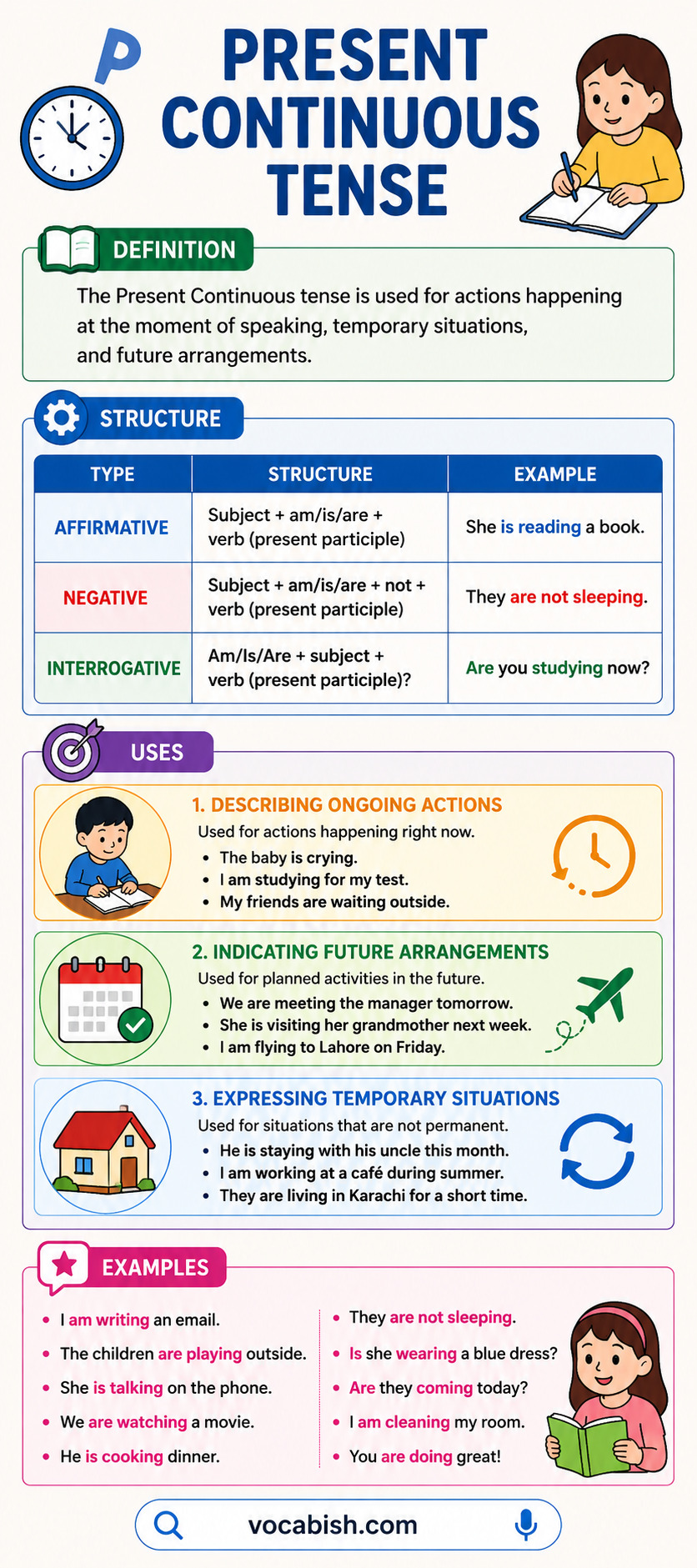
Present Continuous Tense Exercises
Exercise 1: Fill in the Blanks
Complete the sentences using the correct form of the verb in brackets.
- She __________ (read) a newspaper now.
- We __________ (wait) for the bus.
- I __________ (study) English at the moment.
- The boys __________ (play) cricket outside.
- He __________ (cook) dinner in the kitchen.
Answer Key
- is reading
- are waiting
- am studying
- are playing
- is cooking
Exercise 2: Form Questions
Change the following statements into present continuous questions.
- She is drinking coffee.
- They are watching a football match.
- He is using the computer.
- We are cleaning the classroom.
- The baby is sleeping.
Answer Key:
- Is she drinking coffee?
- Are they watching a football match?
- Is he using the computer?
- Are we cleaning the classroom?
- Is the baby sleeping?
Exercise 3: Correct the Mistakes
Find and correct the grammar mistakes in the sentences.
- I is writing a letter.
- They am going to school.
- She are talking to her friend.
- We playing football now.
- He not wearing a jacket.
Answer Key:
- I am writing a letter.
- They are going to school.
- She is talking to her friend.
- We are playing football now.
- He is not wearing a jacket.
Exercise 4: Describe the Picture
Write sentences in the present continuous tense. Use the ideas below.
- A girl / draw / a picture
- Two children / ride / bicycles
- A dog / sleep / under the table
- A man / talk / on the phone
- Birds / fly / in the sky
Answer Key:
- A girl is drawing a picture.
- Two children are riding bicycles.
- A dog is sleeping under the table.
- A man is talking on the phone.
- Birds are flying in the sky.
Exercise 5: Multiple Choice
Choose the correct answer.
1. My mother ________ dinner right now.
a) cook
b) cooks
c) is cooking
Answer: c) is cooking
2. They ________ to music at the moment.
a) are listening
b) listen
c) listens
Answer: a) are listening
3. ________ you studying for the test?
a) Is
b) Are
c) Am
Answer: b) Are
4. The children ________ in the park now.
a) plays
b) are playing
c) is playing
Answer: b) are playing
5. I ________ my homework at the moment.
a) am doing
b) do
c) does
Answer: a) am doing
FAQs About Present Continuous Tense
The present continuous tense is used for actions happening now, temporary situations, and planned future arrangements.
Examples:
She is talking to her teacher.
We are staying at a hotel this week.
I am meeting my friend tomorrow.
Yes, both names mean the same tense. Some grammar books use “present continuous,” while others use “present progressive.”
Example:
They are playing football.
This sentence is in the present continuous or present progressive tense.
Use a form of the verb to be (am, is, are) with the main verb ending in -ing.
Examples:
I am reading.
She is cooking.
They are studying.
Yes. It can describe future plans or arrangements that are already decided.
Examples:
We are visiting Lahore next weekend.
He is starting a new job next month.
Some verbs are usually not used in continuous forms because they describe feelings, thoughts, or possession.
Common examples include:
know, like, believe, understand
Correct Examples:
I know the answer.
She likes chocolate.
The present simple describes regular habits, while the present continuous describes actions happening now.
Examples:
I play cricket every Sunday. (habit)
I am playing cricket now. (happening now)
The “-ing” form shows that the action is continuing or in progress.
Examples:
run → running
write → writing
dance → dancing
You may also like: