
We Work, We Do Work — Understanding the Present Simple
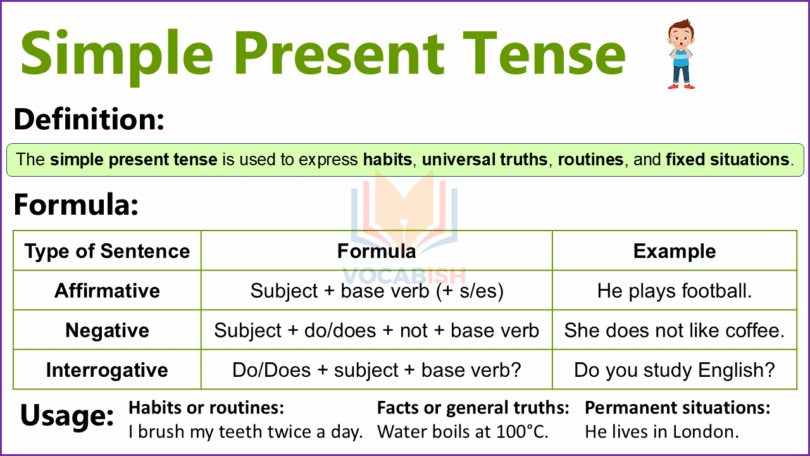
If you want to talk about your daily life in English, the simple present tense is one of the first grammar points you need. It helps you describe routines, habits, jobs, schedules, facts, and things that are generally true.
People use it all the time in real conversations:
- “I wake up at 6.”
- “She works in a bank.”
- “They play football every weekend.”
- “Water boils at 100°C.”
Even though the tense looks simple, many learners make mistakes with verbs, especially with he, she, and it. Questions and negatives can also feel confusing at first.
In this lesson, you’ll learn how the Simple Present Tense works in everyday English, how native speakers use it naturally, and how to avoid the most common errors.
What Is the Present Simple Tense?
The Simple Present Tense (also called the Present Simple) describes:
- habits
- routines
- repeated actions
- general truths
- permanent situations
- feelings and opinions
It usually talks about things that happen regularly, not actions happening right now.
Compare these:
Sentence | Meaning |
|---|---|
I study English every day. | Regular activity |
I am studying English now. | Happening at this moment |
The first sentence uses the Simple Present because it describes a routine.
Base Form of the Verb in Present Simple
Most present simple sentences use the base form of the verb.
Examples:
- work
- play
- eat
- study
- live
Subject + Base Verb:
Subject | Verb |
|---|---|
I | work |
You | work |
We | work |
They | work |
But with he, she, and it, the verb changes.
Subject | Verb |
|---|---|
He | works |
She | plays |
It | rains |
This is one of the most important rules in the tense.
How to Make Present Simple Sentences
The present simple has three basic forms:
- Positive sentences
- Negative sentences
- Questions
Let’s look at each one carefully.
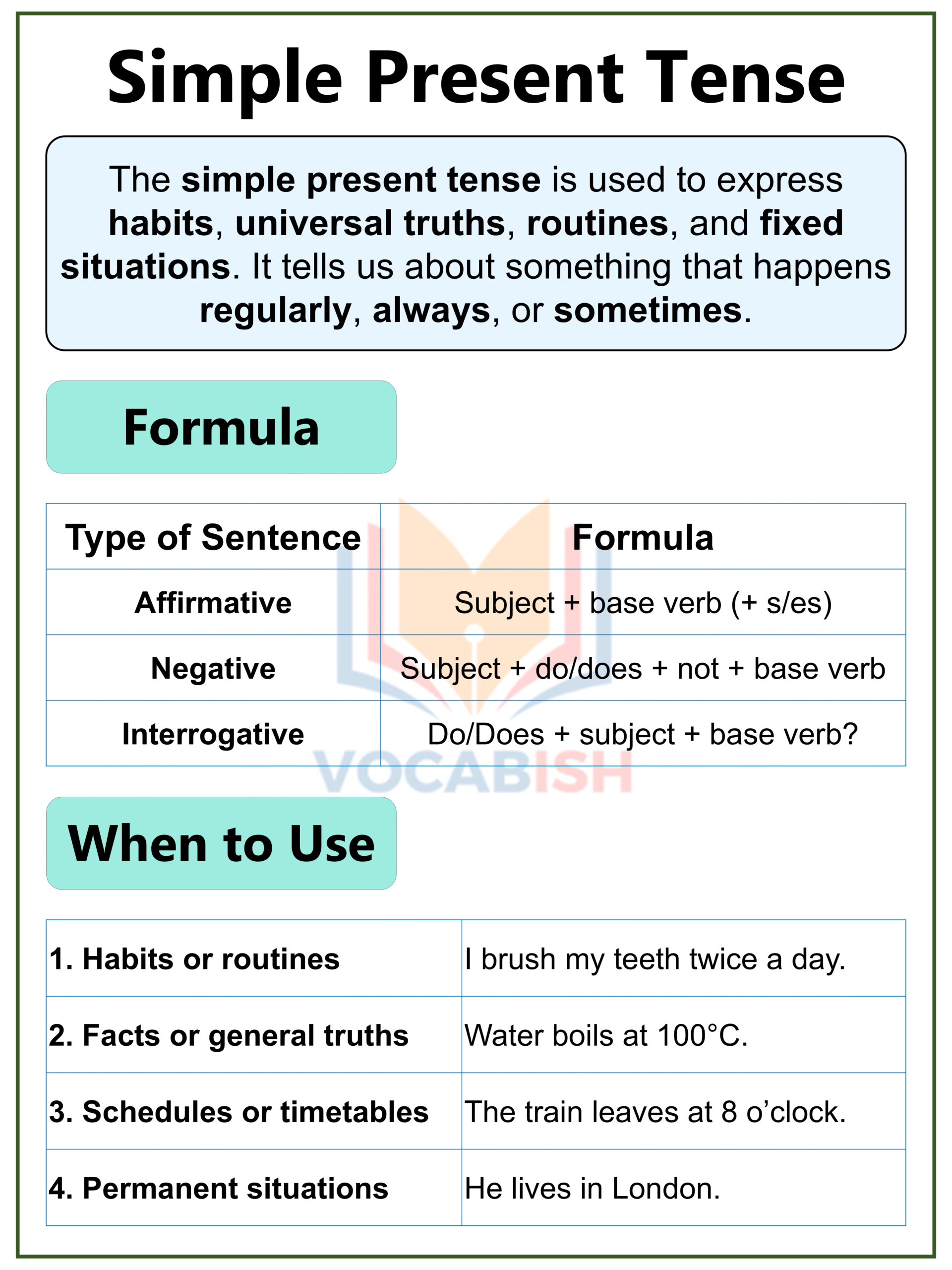
Structure of Positive Sentences
Formula:
Examples:
- I drink coffee every morning.
- They live near the station.
- She teaches math.
- He watches TV after dinner.
Notice the extra -s in the third person singular.
Structure of Negative Sentences
In negative sentences, we use do not or does not.
Formula:
Examples:
- I do not like spicy food.
- We don’t watch horror movies.
- She does not drive to work.
- He doesn’t eat meat.
Pay attention to this rule:
After doesn’t, the verb returns to the base form.
✅ He doesn’t work.
❌ He doesn’t works.
Structure of Question Sentences
Questions also use do and does.
Formula:
Examples:
- Do you play tennis?
- Does she speak Spanish?
- Do they live here?
- Does he work on weekends?
Short Answers:
Question | Short Answer |
|---|---|
Do you like tea? | Yes, I do. |
Does she study English? | No, she doesn’t. |
Rules for Third Person Singular (He, She, It)
This area causes many problems for beginners, so let’s slow down and look closely.
1. Most verbs add -s
- work → works
- play → plays
- eat → eats
2. Verbs ending in -sh, -ch, -x, -o, or -ss add -es
- watch → watches
- go → goes
- fix → fixes
3. Verbs ending in consonant + y change to -ies
- study → studies
- try → tries
But:
- play → plays
- enjoy → enjoys
because these verbs have a vowel before y.
Present Simple with Main Verb “Be”
The verb “be” is different.
Subject | Be Form |
|---|---|
I | am |
You | are |
He/She/It | is |
We/They | are |
Examples:
- I am tired.
- She is my teacher.
- They are busy today.
Negative:
- I am not ready.
- He is not at home.
- We are not late.
Questions:
- Are you hungry?
- Is she your sister?
- Am I early?
With be, we do not use do/does.
✅ Is he happy?
❌ Does he be happy?
Using Emphatic “Do” for Stress
Sometimes speakers use do to add emphasis.
Examples:
- I do understand you.
- She does like coffee.
- We do need more time.
People often use this form:
- to correct someone
- to sound stronger
- to show sincerity
Conversation Example:
A: “You don’t listen to me.”
B: “I do listen to you!”
Present Simple for Habits and Daily Routines
This is the most common use of the tense. We use it for actions that happen regularly.
Daily Routine Examples:
- I wake up at 7 every day.
- She brushes her teeth after breakfast.
- They take the bus to school.
- My father reads the newspaper every morning.
Talking About Your Day:
The Present Simple is perfect for basic speaking practice:
“I get up early, make coffee, check my phone, and go to work.”
This kind of sentence pattern is extremely common in spoken English.
Present Simple for Facts and General Truths
Some things are always true, so we use the present simple.
Examples:
- The Earth moves around the Sun.
- Water freezes at 0°C.
- Cats like warm places.
- The sun rises in the east.
These are not temporary actions. They are facts.
Present Simple for Stative Verbs
Some verbs usually do not appear in continuous tenses.
These are called stative verbs.
Common stative verbs include:
- know
- like
- love
- hate
- understand
- believe
- want
- need
Examples:
- I know the answer.
- She likes jazz music.
- They want a bigger apartment.
Native speakers normally say:
✅ I understand.
❌ I am understanding.
Signal Words Used in Present Simple
Certain time expressions often appear with the present simple.
Signal Word | Example |
|---|---|
always | She always arrives early. |
usually | We usually eat at home. |
often | I often call my mother. |
sometimes | He sometimes walks to work. |
never | They never complain. |
every day | I study every day. |
on weekends | She works on weekends. |
These words help listeners understand frequency.
Common Mistakes in Present Simple
1. Forgetting the third-person “s”
❌ She walk to school.
✅ She walks to school.
2. Using “does” with an -s verb
❌ He doesn’t works here.
✅ He doesn’t work here.
3. Wrong question structure
❌ You like pizza?
✅ Do you like pizza?
4. Mixing Present Simple and Present Continuous
❌ I am go to school every day.
✅ I go to school every day.
Present Simple vs Present Continuous
These two tenses are often confused.
Present Simple
Used for:
- routines
- repeated actions
- facts
Present Continuous
Used for:
- actions happening now
- temporary situations
Compare the Meaning:
Present Simple | Present Continuous |
|---|---|
I work in a hospital. | I am working now. |
She studies at night. | She is studying at the moment. |
They play football on Fridays. | They are playing football now. |
One describes a habit. The other describes a current action.
Real-Life Conversation Examples
At Work
Emma: What time do you start work?
Ryan: I usually start at 8:30.
Emma: Do you drive to the office?
Ryan: No, I take the train.
Talking About Hobbies
Leo: Do you play any sports?
Nina: Yes, I play badminton every weekend.
Leo: Does your brother play too?
Nina: No, he prefers chess.
In Class
Teacher: Where do you live?
Student: I live near the city center.
Teacher: Does your sister study here too?
Student: Yes, she does.
Exercises of Present Simple with Answers
Exercise 1: Fill in the blanks
Use the correct form of the verb.
- She ______ to school by bus.
- They ______ coffee every morning.
- He ______ TV after dinner.
- We ______ English on Tuesdays.
- My brother ______ in a hospital.
Answers
- goes
- drink
- watches
- study
- works
Exercise 2: Make Negative Sentences
- She likes tea.
- They play soccer.
- He drives to work.
Possible Answers
- She does not like tea.
- They do not play soccer.
- He does not drive to work.
Exercise 3: Write Questions
- you / like / music
- she / work / here
- they / study / English
Answers
- Do you like music?
- Does she work here?
- Do they study English?
You may also like:
- Uses and Examples of Past Simple Tense
- Structure and Examples of Future Simple Tense
- Present Continuous Tense Explained in English
FAQs about Present Simpe
No. The present simple talks about routines and facts, while the present continuous talks about actions happening now.
We add -s or -es with third-person singular subjects:
— he
— she
— it
Example:
— She works.
— He studies.
Sometimes, yes. It is common for schedules and timetables.
Examples:
The train leaves at 9.
School starts next Monday.
The correct form is:
He doesn’t.
Because he uses does in the present simple.
Final Thoughts
The simple present tense is one of the most useful parts of English grammar because people use it constantly in daily conversation. Once you learn how to form positive sentences, negatives, and questions, you can start talking naturally about your life, habits, routines, and opinions.
A good way to improve is to describe your everyday activities in English:
- what time you wake up
- what you eat
- where you work or study
- what you do on weekends
The more you practice real-life speaking, the more natural the present simple becomes.