
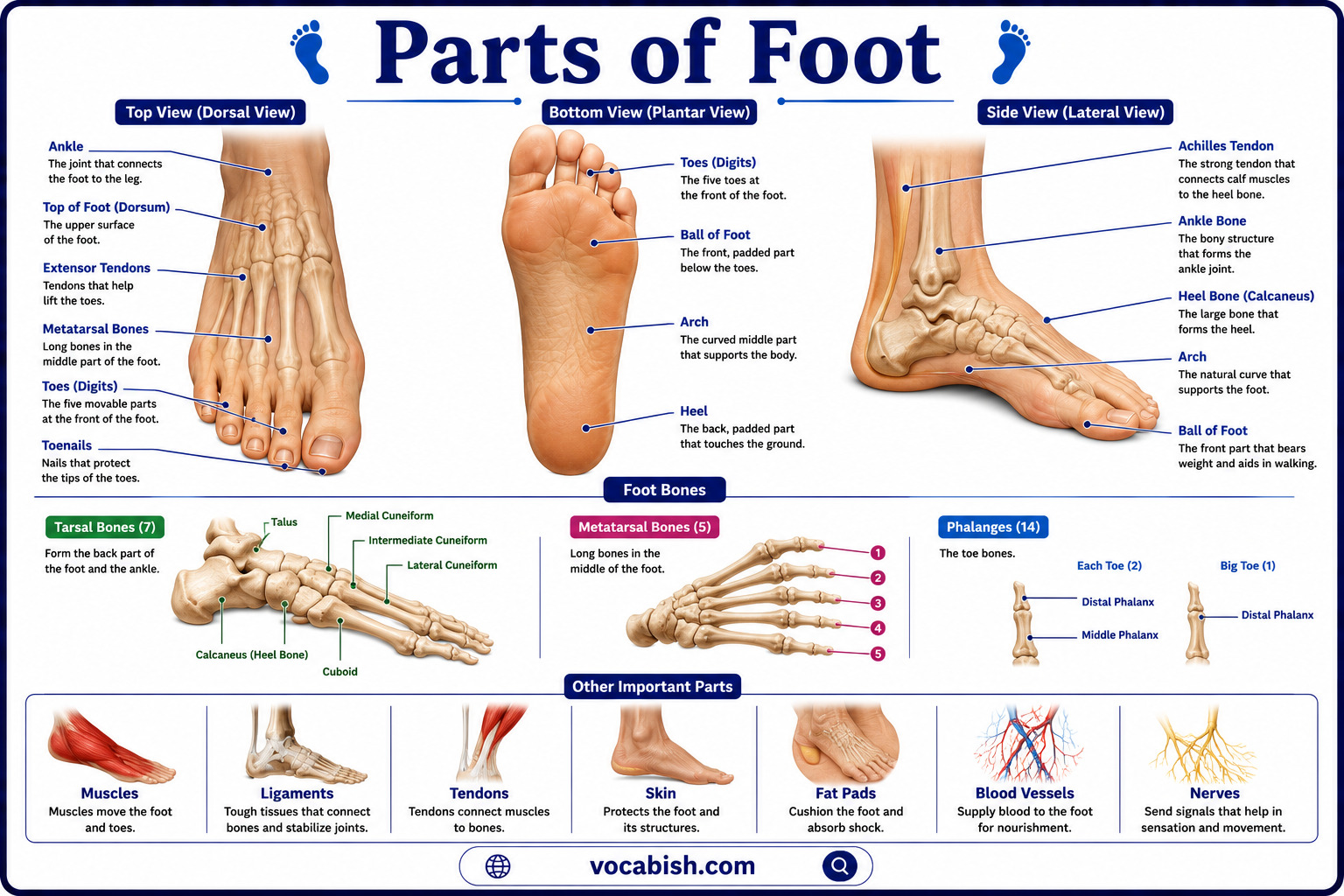

The foot is an important part of the human body that helps people stand, walk, run, jump, and maintain balance during movement. In this blog post, you will learn the parts of the foot, their functions, and a labeled diagram to understand the structure of the human foot in detail. From the toes and heel to the arch and ankle, each part of the foot has a specific role in support, movement, and body balance. Learning the names of foot parts helps you understand English vocabulary related to human anatomy, health, physical movement, and body structure commonly used in schools, books, and educational studies.
What Is the Foot?
The foot is the lower part of the leg. It connects to the ankle and helps the body move. Humans have two feet, and each foot contains bones, muscles, joints, skin, and nails.
The foot supports body weight and keeps balance while walking or standing.
Why Learning Foot Vocabulary Is Important
Learning body-part vocabulary helps you:
- Understand health and science topics
- Speak clearly about injuries or pain
- Improve reading comprehension
- Build strong everyday English vocabulary
- Describe movement and physical actions correctly
These words are useful in school, daily conversation, sports, and medical situations.
Labeled Diagram of the Foot
Here are the main labeled parts of the foot:
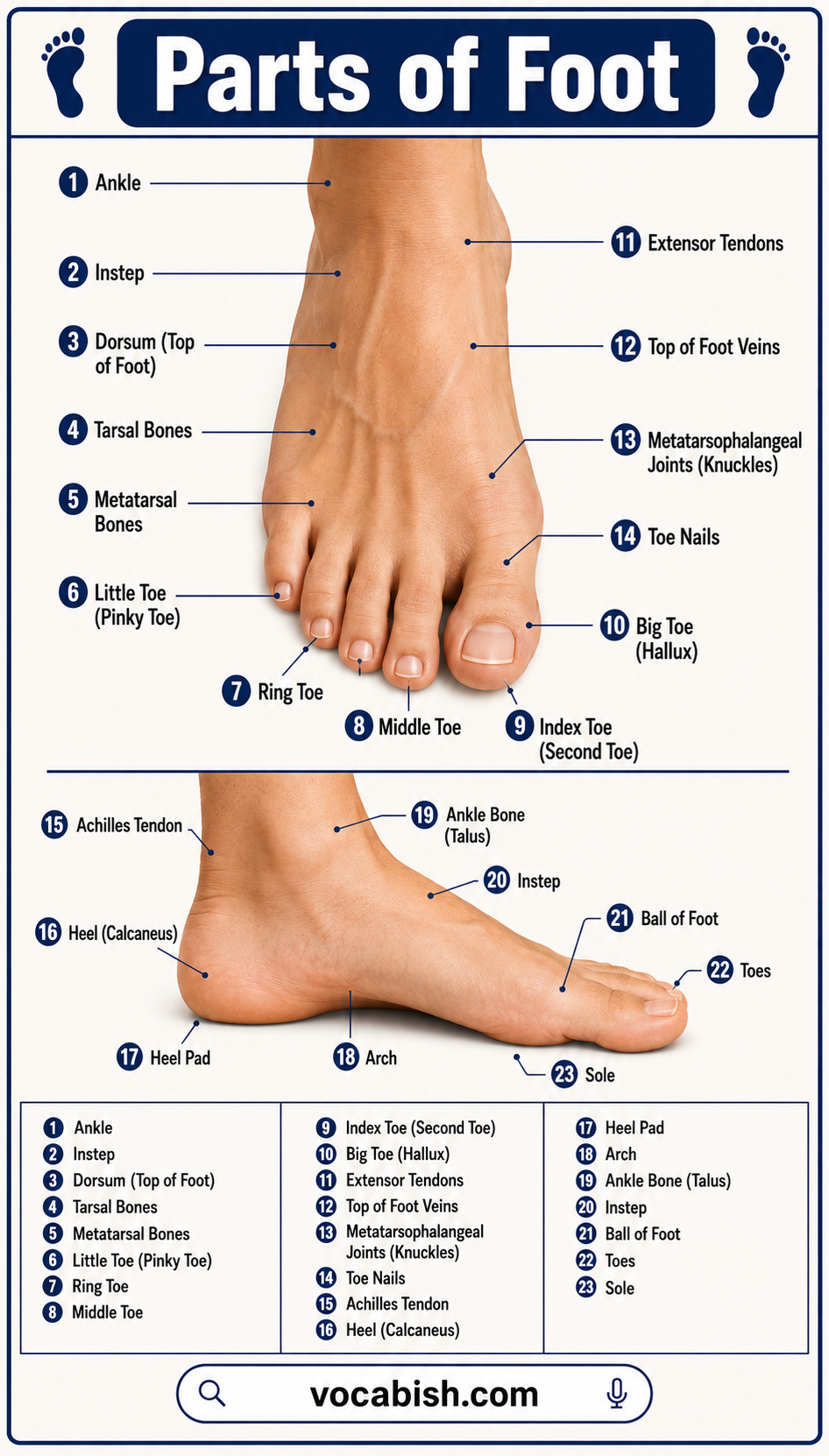
Main Parts of the Foot and Their Functions
Toes
Toes are the small front parts of the foot. Each foot usually has five toes.
Functions:
- Help balance the body
- Support walking and running
- Improve movement control
Big Toe
The big toe is the largest toe on the foot.
Functions:
- Helps push the body forward
- Supports balance while walking
- Gives strength during running
Toenail
A toenail is the hard covering on the top of each toe.
Functions:
- Protects the toe
- Supports healthy skin around the toe
Sole
The sole is the bottom surface of the foot.
Functions:
- Touches the ground while standing
- Helps absorb pressure
- Supports walking comfort
Heel
The heel is the back part of the foot below the ankle.
Functions:
- Carries body weight
- Helps maintain balance
- Supports walking and standing
Arch
The arch is the curved middle part under the foot.
Functions:
- Absorbs shock
- Helps the foot stay flexible
- Supports body movement
Ankle
The ankle connects the foot to the leg.
Functions:
- Allows foot movement
- Helps turning and bending
- Supports body stability
Ball of the Foot
This part is below the toes on the front sole.
Functions:
- Helps during walking and jumping
- Carries pressure during movement
Instep
The instep is the top curved middle area of the foot.
Functions:
- Supports foot shape
- Helps shoe fitting
Achilles Tendon
The Achilles tendon is a strong tissue behind the ankle.
Functions:
- Connects calf muscles to the heel
- Helps running, jumping, and climbing
Bones of the Foot
The human foot contains many bones that work together for movement and support.
Important foot bones include:
- Tarsals
- Metatarsals
- Phalanges
- Heel bone
- Ankle bone
Functions of foot bones:
- Support body weight
- Help movement
- Protect soft tissues
- Keep body balanced
Muscles and Soft Parts of the Foot
Soft tissues help the foot move smoothly and stay flexible.
Important soft parts include:
- Muscles
- Tendons
- Ligaments
- Skin
- Joints
These parts help:
- Bend the foot
- Move the toes
- Prevent injuries
- Support walking and running
Common Foot Vocabulary Words
Here are important foot-related English words with their meanings:
- Toe — small front part of the foot
- Heel — back part of the foot
- Sole — bottom of the foot
- Arch — curved middle part under the foot
- Ankle — joint connecting foot and leg
- Toenail — nail on the toe
- Footprint — mark left by a foot
- Sock — cloth worn on the foot
- Shoe — footwear for protection
- Sandal — open footwear
- Sneaker — sports shoe
- Barefoot — without shoes
- Footstep — sound or mark of walking
- Toe joint — joint connecting toe bones
- Instep — upper middle part of the foot
- Tendon — tissue connecting muscle and bone
- Ligament — tissue connecting bones
- Foot bone — bone inside the foot
- Calf — lower back part of the leg
- Balance — ability to stand steadily
Daily Used Foot-Related Words
These words are common in everyday English:
- Walk
- Run
- Jump
- Step
- Kick
- Climb
- Stand
- Dance
- March
- Slip
- Stumble
- Sprint
- Hop
- Crawl
- Stretch
You can read more about the daily-used action verbs list in English.
Sentences Using Foot Vocabulary
- My heel hurts after running.
- She washed her feet before bed.
- The child walked barefoot on the grass.
- His shoe protects his foot.
- The athlete injured his ankle.
- I moved my toes slowly.
- Good balance helps people stand safely.
Tips to Remember Foot Parts
- Study labeled diagrams regularly.
- Repeat the vocabulary aloud.
- Use the words in daily sentences.
- Match words with pictures.
- Practice spelling each body-part name.
- Learn a few new words every day.
The foot has many important parts that help the body move, balance, and stay active. Learning the parts of the foot improves both science knowledge and English vocabulary. Simple words like heel, sole, toe, and ankle are useful in daily communication and school learning.
FAQs about Foot Parts
The main parts of the foot are the toes, heel, sole, arch, ankle, ball of the foot, and Achilles tendon. Each part helps with movement and balance.
The foot supports body weight, helps balance, and allows walking, running, jumping, and standing. It also absorbs pressure while moving on different surfaces.
The arch helps absorb shock and supports body balance. It also makes walking and running smoother by spreading body weight evenly across the foot.
The heel carries body weight and supports balance during standing and walking. It also helps the foot stay stable while moving.
A normal human foot has five toes. The toes help maintain balance and improve movement while walking, running, or climbing.
The Achilles tendon connects the calf muscles to the heel bone. It helps the foot move during running, jumping, climbing, and walking.
The main foot bones are called tarsals, metatarsals, and phalanges. These bones support movement, balance, and body weight.
Related Articles: