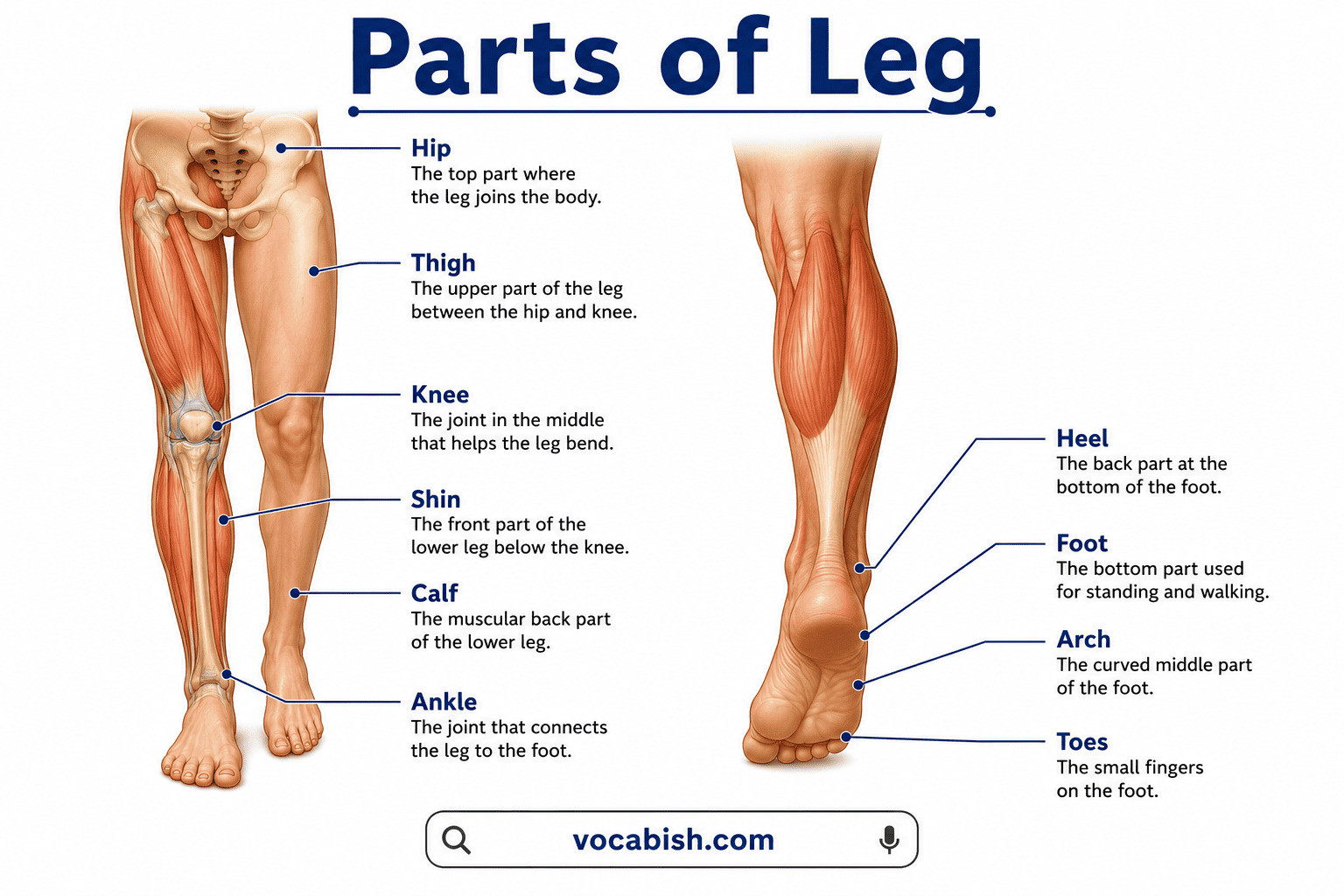

The parts of the leg work together to support body weight, maintain balance, and make movement possible. From the upper leg and lower leg to the bones, muscles, joints, nerves, blood vessels, feet, and toes, each structure has a specific function in the human body. Understanding all parts of the leg with names and functions can help students, English learners, and anatomy learners build a clear foundation in leg anatomy and how the leg performs everyday activities such as walking, running, and standing.
Overview of Leg Anatomy
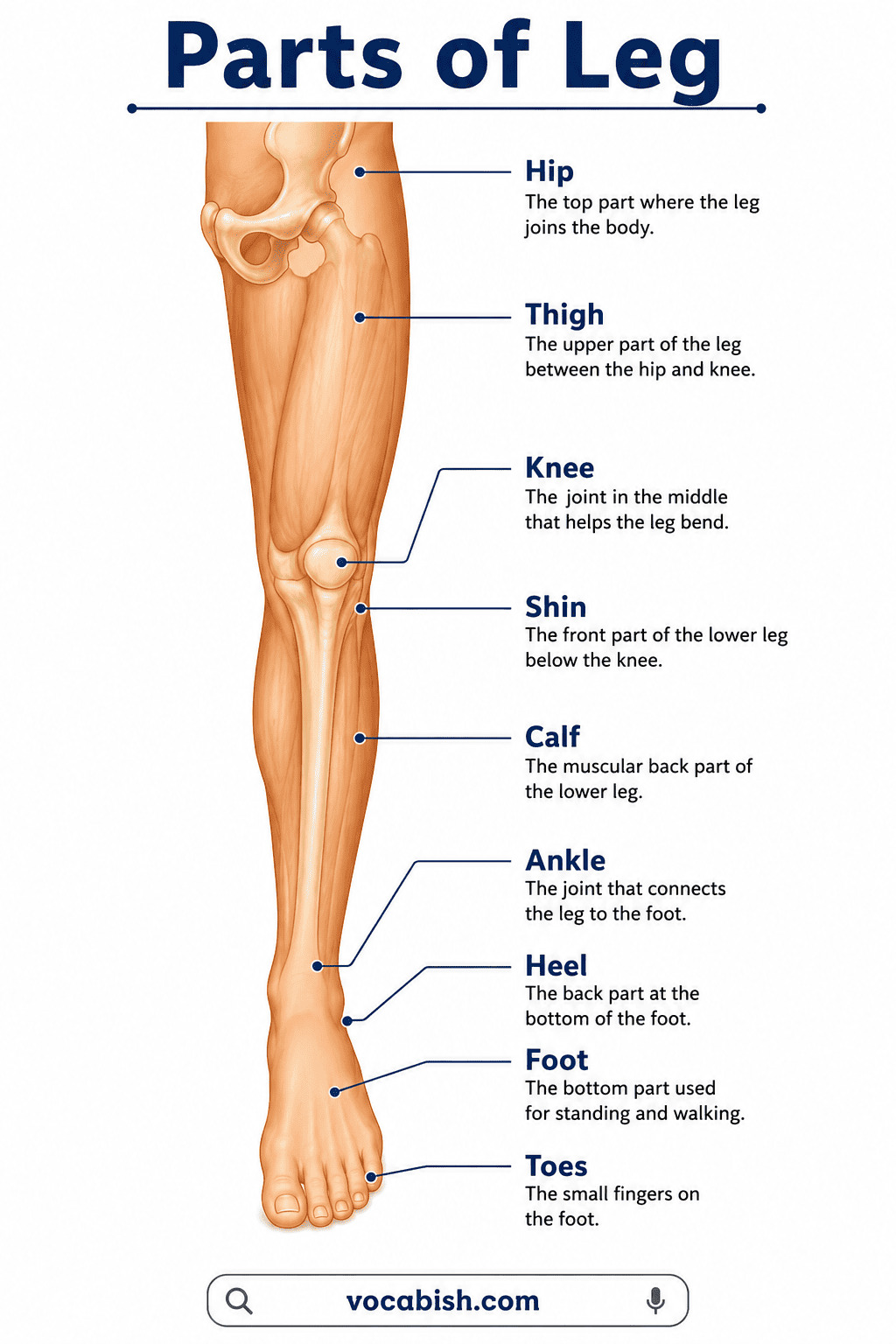
The leg is one of the strongest structures in the human body. It connects the hip to the foot and supports body weight during movement.
The leg anatomy is divided into:
- Upper leg (thigh region)
- Lower leg (shin and calf region)
- Foot (support and balance unit)
Each section includes bones, muscles, nerves, and blood vessels that work together in coordination.
Upper Leg Parts and Names
The upper leg is the area between the hip and the knee. It contains powerful structures that provide strength, support body weight, and generate the force needed for movement.
Parts of the upper leg included:
- Femur (thigh bone) – main bone of the upper leg
- Quadriceps muscles – front thigh muscles used for extending the knee
- Hamstrings – back thigh muscles used for bending the knee
- Hip joint connection – joins leg to pelvis
Lower Leg Parts and Names
The lower leg is the section between the knee and the ankle. It contains structures that support body weight, maintain balance, and help control movement during walking, running, and standing.
Main parts of the lower leg:
- Tibia (shin bone) – larger bone in front
- Fibula – thinner bone on the outer side
- Calf muscles (gastrocnemius and soleus) – help in walking and standing on toes
- Achilles tendon – connects calf muscles to heel
Bones of the Leg with Functions
The bones of the leg provide the body’s main support and create the framework needed for movement. They help bear weight, maintain posture, and work with muscles and joints to make walking, running, and other activities possible.
Scientific Name | Location | Function |
|---|---|---|
Femur | Upper leg | Supports body weight, connects hip to knee |
Tibia | Lower leg (front) | Main weight-bearing bone of lower leg |
Fibula | Lower leg (side) | Provides stability and muscle attachment |
Muscles of the Leg
The muscles of the leg generate the force needed for movement and help maintain balance and posture. They work together to control actions such as walking, running, jumping, and changing direction.
Major leg muscles:
- Quadriceps – straighten the knee
- Hamstrings – bend the knee
- Gluteal muscles – support hip movement
- Calf muscles – help in walking, running, and jumping
Joints in the Leg
Joints connect the bones of the leg and allow smooth, controlled movement. They make it possible to bend, straighten, rotate, and support the body during activities such as walking, running, and climbing stairs.
Main leg joints:
- Hip joint – connects leg to pelvis, allows rotation and movement
- Knee joint – bends and straightens the leg
- Ankle joint – supports foot movement and balance
Blood Vessels and Nerves in the Leg
Blood vessels supply oxygen and nutrients to the leg tissues, helping them stay healthy and function properly. Nerves carry signals between the brain and the leg, allowing movement, coordination, and sensation such as touch, pressure, and temperature.
Blood vessels included:
- Femoral artery – supplies blood to the thigh
- Popliteal artery – located behind the knee
- Tibial arteries – supply the lower leg and foot
Nerves included:
- Sciatic nerve – largest nerve, runs from lower back to foot
- Femoral nerve – controls front thigh muscles
- Peroneal nerve – controls movement and sensation in lower leg
Soft Parts of the Human Leg
The soft parts of the leg support movement, flexibility, and stability while protecting important structures inside the limb. They help the leg function smoothly during everyday activities and physical exercise.
Soft parts include:
- Muscles – help in movement like walking, running, and jumping
- Tendons – connect muscles to bones
- Ligaments – connect bones to other bones and stabilize joints
- Nerves – carry signals from brain to leg muscles
- Blood vessels – supply oxygen and nutrients
Foot and Toe Parts
The foot is the final part of the parts of the leg structure and plays an important role in balance, support, and movement. It connects the body to the ground and helps distribute weight during walking and running.
Main parts of the foot and toes:
- Tarsals – group of bones forming the ankle and heel area
- Metatarsals – long bones in the middle of the foot
- Phalanges – bones of the toes
- Heel (calcaneus) – strongest bone in the foot
- Arch of the foot – curved structure that absorbs shock
Toe structure:
- Big toe (hallux) – helps with balance and push-off movement
- Other toes (2nd to 5th) – assist in stability and grip
Functions of Leg Parts
Each part of the leg has a specific role in daily movement.
- Support body weight while standing
- Allow walking, running, and jumping
- Maintain balance and posture
- Absorb shock during movement
- Enable bending and stretching actions
Without coordinated work between bones, muscles, and joints, movement would not be possible.
All Parts of Leg
Category | Parts |
|---|---|
Upper Leg | Femur, Quadriceps, Hamstrings |
Lower Leg | Tibia, Fibula, Calf muscles |
Joints | Hip, Knee, Ankle |
Tendons | Achilles tendon |
Nerves | Sciatic, Femoral, Peroneal |
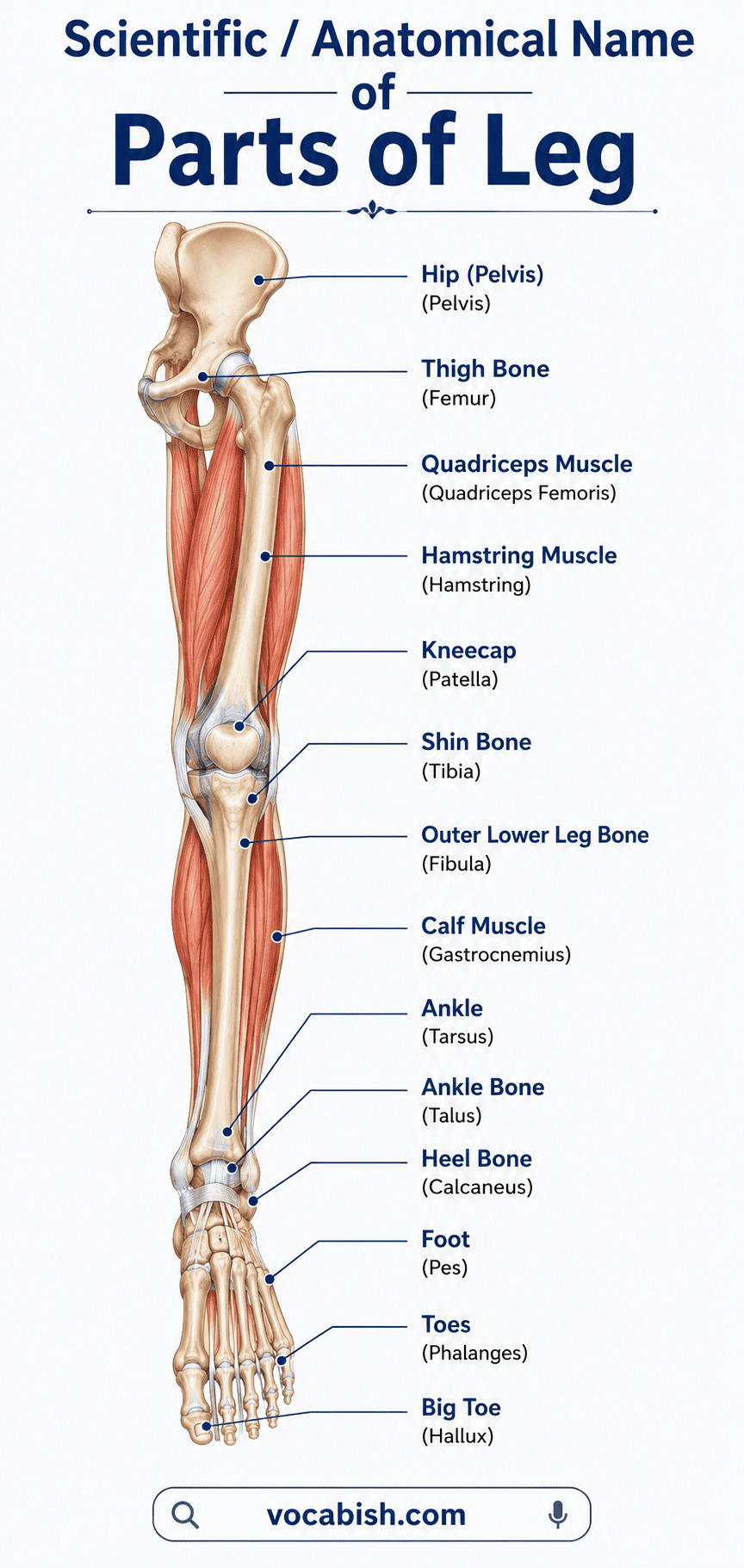
Scientific Names of the Leg Parts
Common Leg Part Name | Scientific / Anatomical Name |
|---|---|
Hip | Coxa |
Thigh | Femur Region |
Knee | Patella Region |
Shin | Tibia |
Calf | Sura |
Ankle | Tarsus |
Heel | Calcaneus |
Foot | Pes |
Toes | Phalanges |
Big Toe | Hallux |
Knee Cap | Patella |
Thigh Bone | Femur |
Shin Bone | Tibia |
Outer Lower Leg Bone | Fibula |
Calf Muscle | Gastrocnemius |
Front Thigh Muscle | Quadriceps Femoris |
Back Thigh Muscle | Hamstring |
Heel Tendon | Achilles Tendon |
Hip Bone | Pelvis |
Ankle Bone | Talus |
Leg Parts Used in a Sentence
These simple sentences help learners understand real usage.
- My knee hurts after football practice.
- She crossed her legs while sitting.
- The baby moved his toes happily.
- He injured his ankle during basketball.
- The doctor checked her calf muscle.
- I slipped and hurt my shin.
- Strong thighs help runners move faster.
- The child washed his feet before bed.
You May Also Like:
Parts of Leg-Labeled Diagram PDF
FAQs about Leg Parts
The main parts include the thigh, knee, lower leg, ankle, bones, muscles, joints, nerves, and blood vessels working together for movement.
The scientific names are femur, tibia, and fibula. These bones provide structure, strength, and support for standing and movement.
The femur supports body weight, connects the hip to the knee, and allows strong movement during walking, running, and jumping activities.
Major muscles include quadriceps, hamstrings, gluteal muscles, and calf muscles. They control bending, stretching, and balance during movement.
Tendons connect muscles to bones. The Achilles tendon is the strongest and connects calf muscles to the heel bone.
The tibia carries most body weight in the lower leg and helps maintain stability while standing, walking, and performing physical activities.
Leg joints like hip, knee, and ankle allow movement, flexibility, and coordination while supporting smooth motion during daily activities.
Nerves send signals from the brain to muscles, controlling movement, sensation, and reflex actions in different parts of the leg.
Conclusion
The parts of human leg work together in a well-coordinated system that supports every step you take. From the strong bones like the femur, tibia, and fibula to the muscles, joints, nerves, and foot structure, each part has a clear role in movement and balance.
When you understand the leg parts and their functions, it becomes easier to read biology topics, understand body movement, and connect what you learn with everyday actions like walking, running, or standing.