
Litotes is a simple way to express an idea by using a double negative to create a positive meaning. Instead of saying something directly, speakers soften the message with understatement. For example, saying “not bad” often means “good.”
English speakers use litotes in daily conversations, writing, and literature. Learning this expression helps English learners understand natural speech, recognize hidden meanings, and speak more politely and clearly.
When you understand litotes, you improve your reading, listening, and speaking skills because many real-life conversations use this style.
What Is Litotes in English?
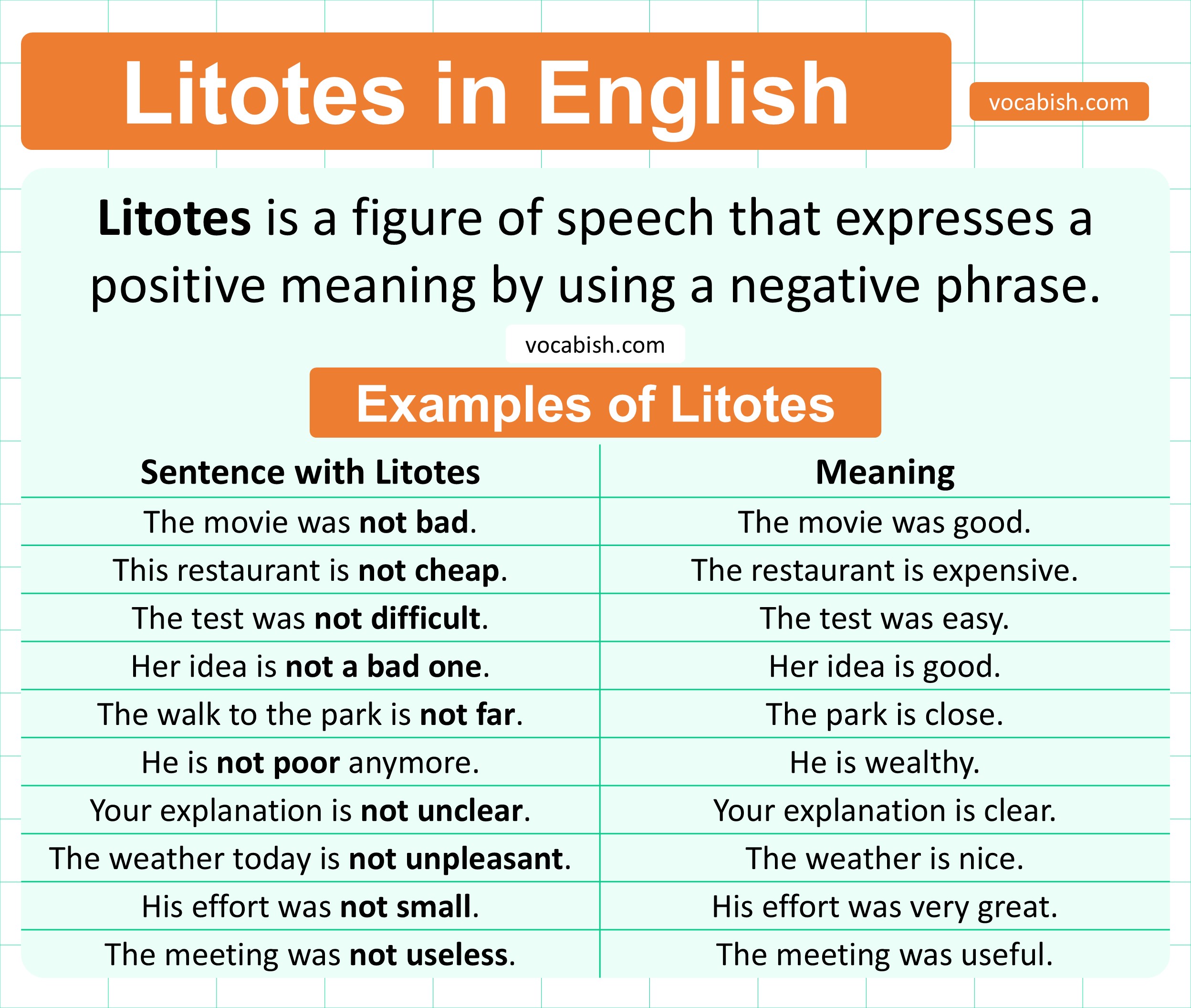
Litotes is a figure of speech that expresses a positive meaning by using a negative phrase.
Instead of saying something strongly, the speaker makes the statement softer or more polite.
Example
- The movie was not bad.
Meaning: The movie was good.
The phrase “not bad” reduces the strength of the statement, but the meaning stays positive.
Rules for Using Litotes
Litotes works best when the sentence stays clear, simple, and natural. Because this expression uses a negative form to suggest a positive meaning, careful usage helps readers understand the idea quickly.
Follow these practical rules when using litotes in English.
1. Use a negative phrase to express a positive meaning
Litotes usually appears as “not + opposite adjective.”
Example
- The task is not difficult.
Meaning: The task is easy.
2. Keep the sentence easy to understand
Avoid complicated wording. Simple expressions make litotes clearer.
Example
- The meal was not bad.
Meaning: The meal was good.
3. Use litotes for polite or modest tone
Litotes often softens strong statements.
Example
- Your work is not disappointing.
Meaning: Your work is good.
4. Avoid too many negatives
Using several negative words in one sentence can confuse readers.
Confusing:
- The result is not unlikely to be not successful.
Clear:
- The result is not unlikely.
5. Use litotes only when it adds meaning
If a direct sentence sounds better, choose simple language.
Direct:
- The movie was excellent.
Litotes:
- The movie was not bad.
Purpose of Litotes in Writing
Writers use litotes for several communication purposes. This style helps express ideas indirectly and thoughtfully.
1. To create a polite tone
Litotes softens praise or criticism.
Example
- Your suggestion is not unreasonable.
2. To show modesty
Speakers sometimes avoid strong praise.
Example
- His performance was not bad.
3. To add emphasis through understatement
A quiet statement can sometimes feel stronger than direct praise.
Example
- Her achievement was not small.
Meaning: It was very impressive.
4. To create subtle humor or irony
Writers sometimes use litotes to create a clever tone.
Example
- That was not the smartest decision.
5. To make writing sound more natural
English speakers often prefer understatement in conversation and writing.
Examples of Litotes in Everyday Speech
Litotes appears frequently in daily conversations. These expressions help people sound polite, calm, and realistic.
Here are common everyday examples.
- The exam was not difficult.
Meaning: The exam was easy. - Your cooking is not bad.
Meaning: Your cooking is good. - This place is not far from my house.
Meaning: It is close. - Her idea is not a bad one.
Meaning: It is a good idea. - The meeting was not useless.
Meaning: It was helpful. - He is not poor anymore.
Meaning: He is wealthy. - The weather today is not unpleasant.
Meaning: The weather is nice. - Your explanation was not unclear.
Meaning: It was clear.
These expressions help speakers communicate politely without sounding too strong.
Examples of Litotes in Literature and Poetry
Writers and poets often use litotes to create subtle meaning and stylistic effect. This technique adds depth and sometimes irony to a sentence.
Here are well-known literary-style examples.
1. Classic poetic understatement
- He was not unaware of the danger.
Meaning:
He clearly understood the danger.
2. Literary emphasis
- The hero’s courage was not small.
Meaning:
The hero was very brave.
3. Subtle description
- The night was not without beauty.
Meaning:
The night was beautiful.
4. Irony in storytelling
- The king was not pleased with the news.
Meaning:
The king was very angry.
5. Dramatic understatement
- The battle was no small victory.
Meaning:
It was a very important victory.
Many famous authors use litotes because understatement can make writing feel more thoughtful and powerful.
How Litotes Works in Sentences
Litotes usually follows a simple pattern.
Negative word + opposite adjective
Examples:
- not bad → good
- not difficult → easy
- not uncommon → common
- not impossible → possible
The speaker chooses understatement instead of a strong statement.
This style appears often in polite speech, academic writing, and literature.
Common Litotes Expressions
Here are common litotes expressions that English learners often hear.
- Not bad – quite good
- Not uncommon – fairly common
- Not impossible – possible
- Not wrong – correct or acceptable
- Not difficult – easy
- Not small – quite large
- Not unusual – normal
- Not unhappy – somewhat happy
- Not cheap – expensive
- Not simple – complex
- Not weak – strong
- Not far – close
- Not poor – wealthy
- Not careless – careful
- Not slow – fast
These expressions often appear in both spoken and written English.
Litotes in Daily Conversation
People frequently use litotes when they want to sound polite, modest, or careful.
Examples:
- Your idea is not bad.
- The exam was not difficult.
- Her performance was not disappointing.
- This solution is not impossible.
In conversation, this style sounds softer than direct praise or criticism.
Litotes for Describing Feelings and Emotions
Litotes also appears when people describe emotions indirectly.
Emotion-related litotes
- Not unhappy – somewhat happy
- Not disappointed – satisfied
- Not worried – calm
- Not afraid – confident
- Not upset – comfortable
Examples
- She looked not unhappy after hearing the news.
- I am not disappointed with the result.
These phrases make emotional statements sound less dramatic.
Litotes for Actions and Opinions
Speakers also use litotes when sharing opinions.
Opinion-based litotes
- Not a bad idea – a good idea
- Not unreasonable – fair
- Not incorrect – correct
- Not without reason – justified
- Not surprising – expected
Examples
- Your suggestion is not a bad idea.
- His decision was not unreasonable.
This style appears often in formal discussions and writing.
Vocabulary Related to Litotes
Below are important vocabulary words related to litotes and understatement. Each word helps learners understand how indirect language works.
- Understatement – expressing something in a weaker way than expected
- Negation – using negative words like not or never
- Double negative – two negatives used to create a positive meaning
- Irony – saying something that means the opposite
- Politeness – speaking in a respectful or gentle way
- Tone – the attitude or feeling in speech
- Implied meaning – a meaning that is suggested but not directly stated
- Indirect expression – speaking in a less direct way
- Emphasis – giving special importance to an idea
- Softening language – words that reduce strong statements
- Contrast – showing differences between ideas
- Expression – a phrase used to communicate meaning
- Context – the situation that helps explain meaning
- Interpretation – understanding the meaning of words
- Nuance – a small difference in meaning
- Statement – a sentence that expresses an idea
- Opinion – what someone thinks about something
- Meaning – what words or sentences communicate
These vocabulary words help learners understand how litotes functions in communication.
Litotes vs Understatement vs Irony
These three expressions often appear in English speaking and writing. They all reduce or change the strength of a statement, but they work in different ways. Understanding the differences helps learners interpret meaning correctly.
Feature | Litotes | Understatement | Irony |
|---|---|---|---|
Basic Meaning | A positive idea expressed using a negative phrase | Saying something less strongly than the real situation | Saying something that means the opposite of the literal words |
Language Structure | Usually uses “not + opposite adjective” | Uses weaker words than the reality | Words and situation contrast with each other |
Purpose | To soften a statement or create polite emphasis | To reduce the strength of an idea | To create humor, sarcasm, or hidden meaning |
Tone | Polite, modest, indirect | Calm, mild, or subtle | Often humorous, sarcastic, or dramatic |
Common in | Daily speech, formal writing, literature | Conversation, storytelling, descriptions | Literature, jokes, conversations, speeches |
Example Sentence | The test was not difficult. | The test was a little challenging. | After a very hard test: Well, that was easy! |
Real Meaning | The test was easy | The test was very difficult | The speaker means the opposite (the test was very hard) |
Main Technique | Double-negative style expression | Mild description of a strong situation | Contrast between words and real meaning |
Tips for Using Litotes Correctly
Follow these simple tips when using litotes in English.
- Use litotes when you want to sound polite or modest.
- Do not overuse it in every sentence.
- Make sure the context clearly shows the meaning.
- Use simple negative phrases such as not bad or not impossible.
Clear communication always matters more than complex expressions.
Common Mistakes to Avoid
Many learners make small mistakes when using litotes.
Avoid these problems:
- Using too many negatives in one sentence
- Creating confusing expressions
- Using litotes when direct language is clearer
- Misunderstanding the hidden meaning
Practice with simple examples first.
Quick Practice Examples
Try to understand the meaning of these sentences.
- The teacher’s explanation was not unclear.
- The project result was not disappointing.
- His effort was not small.
Possible meanings
- The explanation was clear.
- The result was good.
- His effort was large.
Practice helps you recognize litotes quickly.
Conclusion
Litotes is a useful expression in English that uses negative wording to create a positive meaning. Speakers use it to sound polite, thoughtful, or modest.
When English learners understand litotes, they can:
- recognize indirect meaning
- understand natural conversation
- improve reading and listening comprehension
With regular practice, you will notice litotes in everyday English and use it confidently in your own communication.
FAQs
Litotes in English is a figure of speech that expresses a positive idea by using a negative phrase. For example, “not bad” means good. Speakers use it to soften statements and sound polite.
A common example of litotes in English is “The movie was not bad.” The speaker actually means the movie was good. The negative phrase creates a softer, indirect positive meaning.
Litotes is used to make statements sound polite, modest, or subtle. It allows speakers and writers to avoid strong claims while still expressing approval, agreement, or emphasis.
Litotes uses a negative expression to show a positive meaning, such as “not difficult.” Understatement simply reduces the strength of a statement, like saying “a bit hard” for something very difficult.
Yes, litotes is very common in everyday English. People often say phrases like “not bad,” “not impossible,” or “not far” to express ideas politely or modestly.
Students can identify litotes by looking for a negative word such as “not” combined with the opposite adjective. The sentence usually suggests a positive meaning through this indirect expression.
Related Articles: