
In this blog post, you will learn how to use sentences with for conjunction in English. The word “for” connects two ideas and shows a reason or cause for something. Understanding how to use it helps English learners improve speaking, reading, writing, and listening skills. By practicing these sentences, you can explain your thoughts more clearly, make conversations natural, and understand English texts better. Step by step, you will master using “for” in everyday situations, making your English stronger and more confident.
Introduction to “For” as a Conjunction
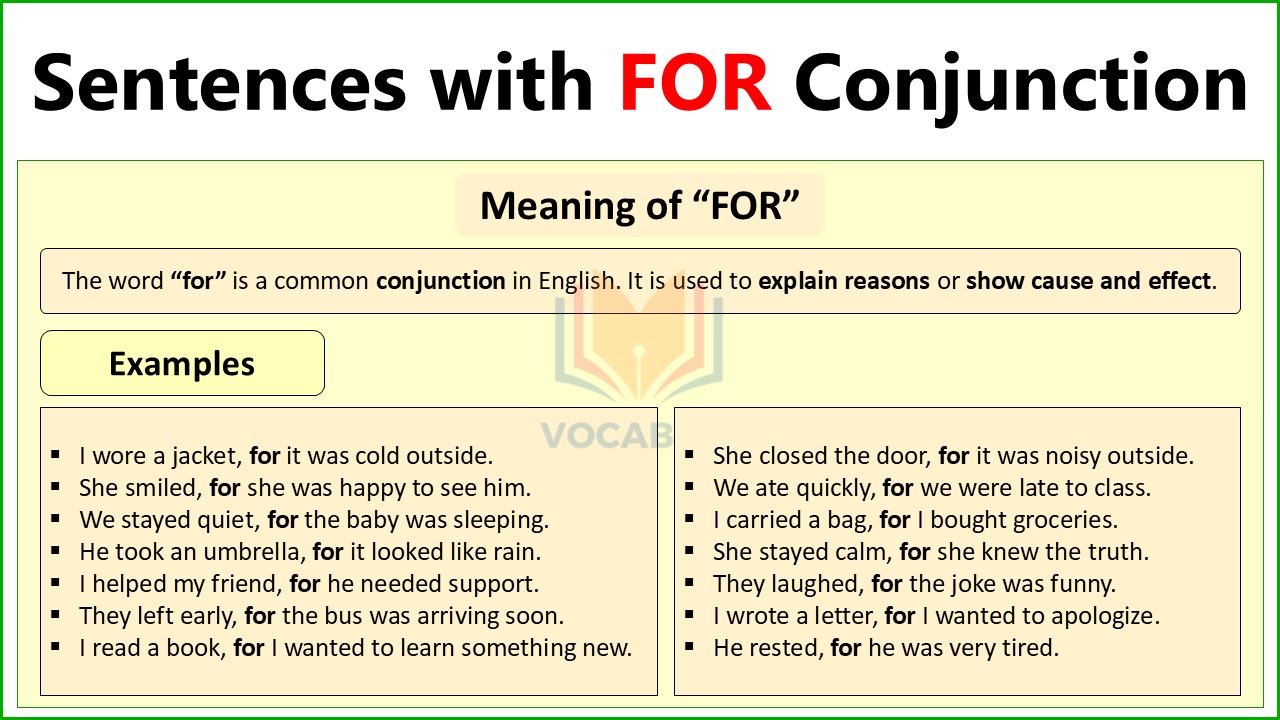
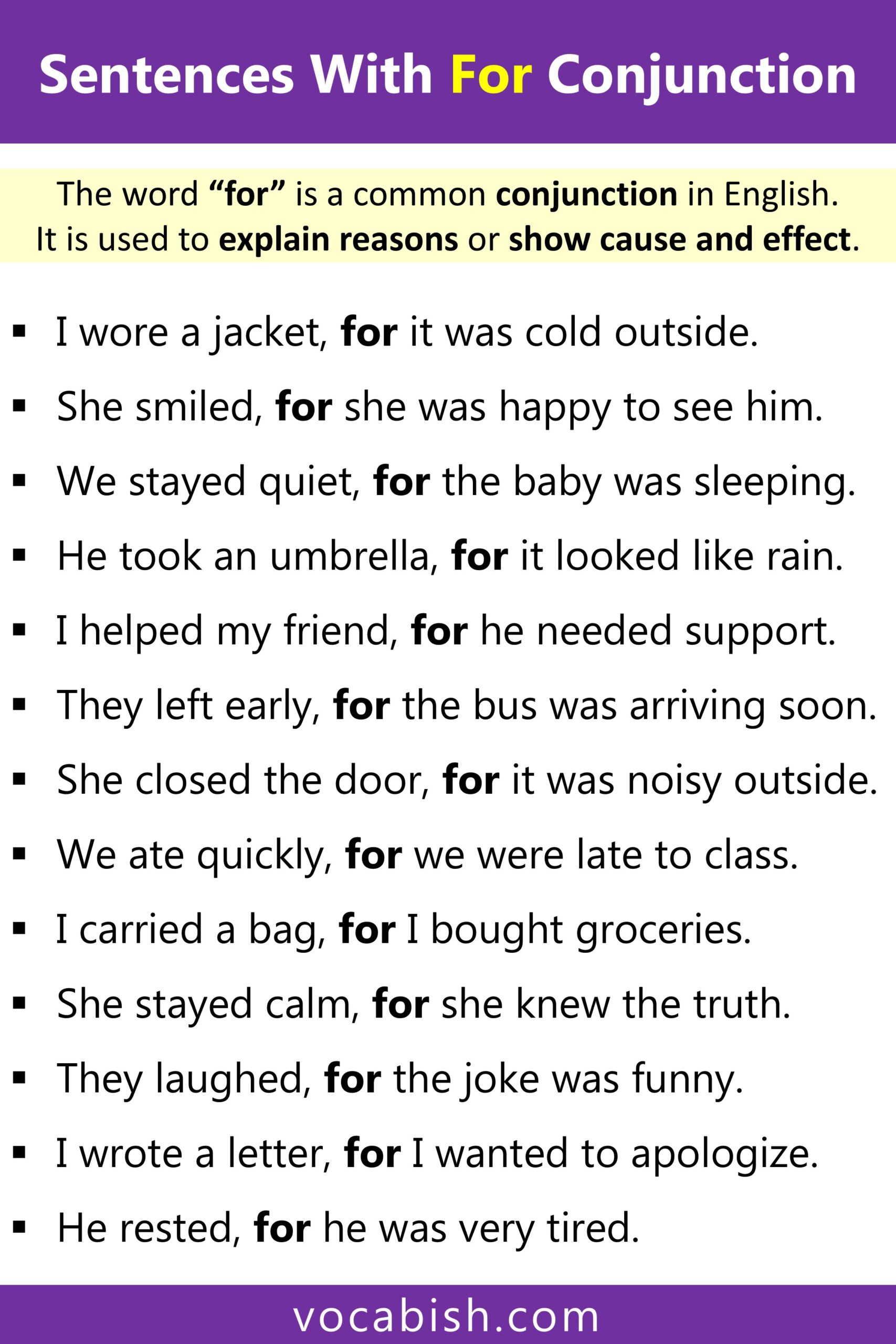
The word “for” is a common conjunction in English. It is used to explain reasons or show cause and effect. In simple words, it connects two ideas where the second idea explains the first.
Example:
- I stayed home, for it was raining.
Here, “for” tells us why I stayed home.
Why Learning “For” is Important
Learning how to use “for” correctly helps you:
- Explain reasons clearly.
- Connect ideas in speaking and writing.
- Make your sentences sound natural and professional.
Using “for” correctly also improves reading comprehension. Many English books, news articles, and daily conversations use “for” to explain causes.
Basic Rules for Using “For” in Sentences
Position: “For” usually comes between two clauses.
- Example: She was happy, for she passed the test.
Meaning: It means because or due to in most sentences.
- Example: I did not go out, for I felt sick.
Punctuation: Place a comma before “for” when it connects two complete ideas.
- Example: He studied hard, for he wanted to succeed.
Examples of Sentences With “For” Conjunction
Here are 15 simple examples using “for”:
- I wore a jacket, for it was cold outside.
- She smiled, for she was happy to see him.
- We stayed quiet, for the baby was sleeping.
- He took an umbrella, for it looked like rain.
- I helped my friend, for he needed support.
- They left early, for the bus was arriving soon.
- I read a book, for I wanted to learn something new.
- She closed the door, for it was noisy outside.
- We ate quickly, for we were late to class.
- He spoke softly, for he didn’t want to wake anyone.
- I carried a bag, for I bought groceries.
- She stayed calm, for she knew the truth.
- They laughed, for the joke was funny.
- I wrote a letter, for I wanted to apologize.
- He rested, for he was very tired.
Useful Vocabulary Words Related to “For” Sentences
Here is a list of important words that often appear in “for” sentences:
- Reason – the cause of something
- Cause – why something happens
- Effect – the result of an action
- Because – synonym for “for” in explaining
- Explain – make something clear
- Due to – another way to show cause
- Result – what happens after a cause
- Consequence – outcome of an action
- Support – help or aid
- Provide – give or offer
- Need – something required
- Decision – choice or judgment
- Purpose – reason for doing something
- Outcome – final effect of actions
- Benefit – advantage or good result
- Reasoning – thinking about causes and effects
- Motivation – reason behind an action
- Evidence – proof or support for a reason
Daily Used “For” Sentences
Here are common daily sentences that English learners can use:
- I wore sunglasses, for the sun was bright.
- She stayed home, for she felt tired.
- We were quiet, for the baby was sleeping.
- He left early, for he had a meeting.
- I brought snacks, for everyone was hungry.
- She smiled, for she got good news.
- We took a taxi, for it started raining.
- He studied hard, for the exam was tomorrow.
- I wrote notes, for I wanted to remember everything.
- They wore masks, for it was unsafe outside.
Common Mistakes to Avoid
Do not use “for” at the start of a sentence like “Because.”
- ❌ For it was raining, I stayed home. (Better: I stayed home, for it was raining.)
Do not forget the comma before “for” when joining two ideas.
- ❌ She was happy for she won the game.
- ✅ She was happy, for she won the game.
Do not confuse with “for” as a preposition.
- Preposition: I bought a gift for my friend.
- Conjunction: I gave him a gift, for it was his birthday.
Conclusion
Using “for” as a conjunction helps you connect ideas, explain reasons, and write clearly. Practicing simple sentences daily improves your confidence in speaking and writing. Remember to watch for comma placement and the difference between conjunction and preposition.
By learning vocabulary related to cause and effect, you can make your English stronger and more natural. Try making your own sentences with “for” today!
FAQs
A sentence with the “for” conjunction connects two ideas, showing a reason or cause. It often means “because” in simple English sentences.
Use “for” between two complete ideas to explain a reason. Example: “I stayed home, for it was raining.” Always place a comma before it.
Yes, “for” can replace “because” to show cause or reason, especially in formal or written English. Example: “He left early, for he was tired.”
Common examples include: “She smiled, for she passed the test,” or “We wore jackets, for it was cold outside.” They explain everyday reasons clearly.
I stayed home, for it was raining.
She smiled, for she got good news.
We left early, for the bus was arriving.
He took an umbrella, for it looked like rain.
I helped my friend, for he needed support.
They were quiet, for the baby was sleeping.
She closed the window, for it was noisy outside.
I wore a jacket, for it was cold.
He studied hard, for the exam was tomorrow.
We laughed, for the joke was funny.
I stayed inside, for it was raining outside.
This shows cause and effect, where “for” explains the reason for the first action.
As a conjunction, “for” explains a reason: “I stayed home, for it rained.” As a preposition, it shows purpose: “This gift is for you.”
Related Articles: