
The past simple tense is the most common tense we use to talk about completed actions in the past. When we want to describe what happened yesterday, last week, last year, or even many years ago, we usually use the past simple.
For beginner English learners, this tense is especially important because it helps you talk about past experiences, daily events, school activities, holidays, and stories.
In this lesson, you will learn:
- Story examples and common mistakes
- How to form the Past Simple tense
- Positive, negative, and question structures
- Regular and irregular verbs
- Special rules with the verb be
- When to use the Past Simple
What Is the Past Simple Tense?
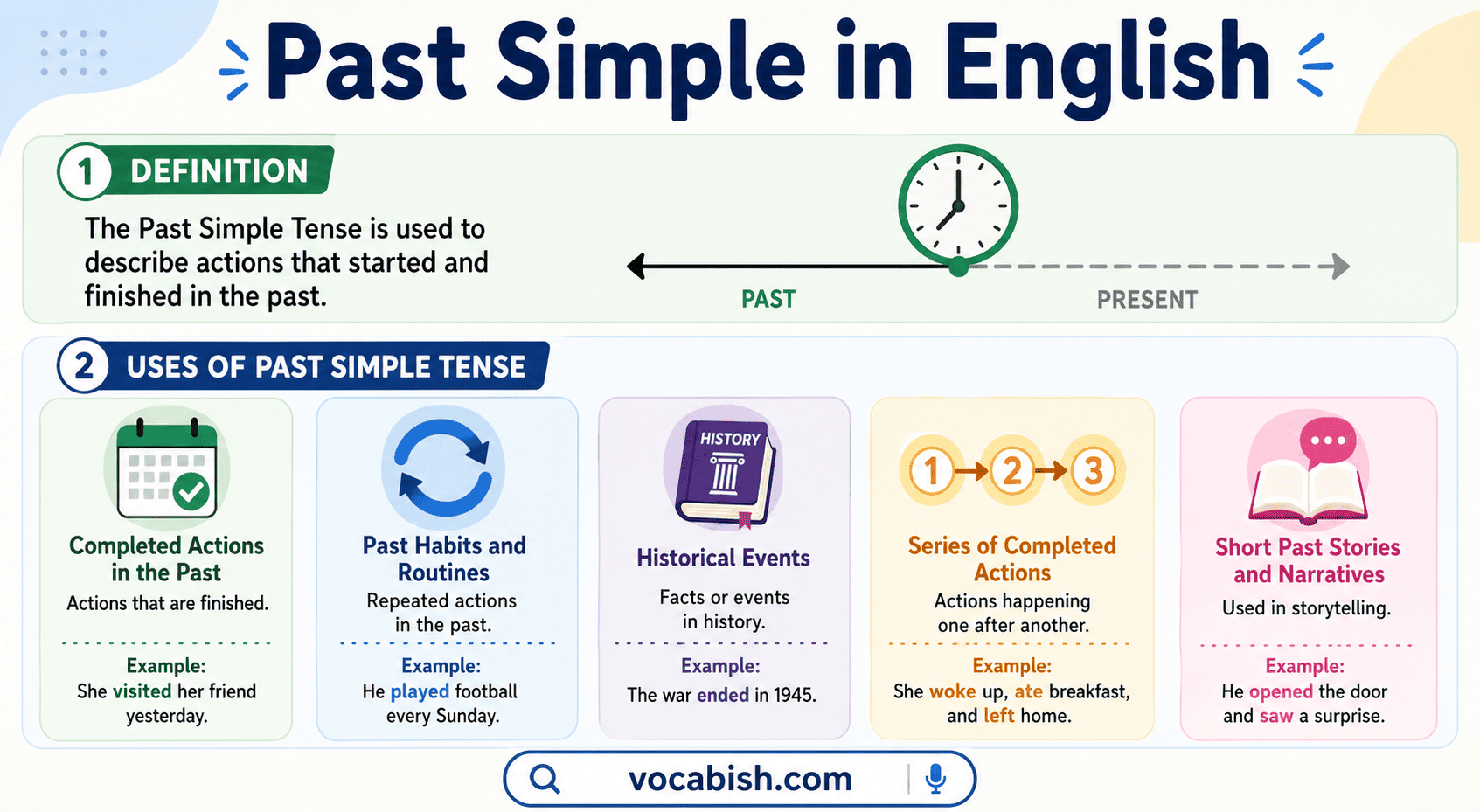
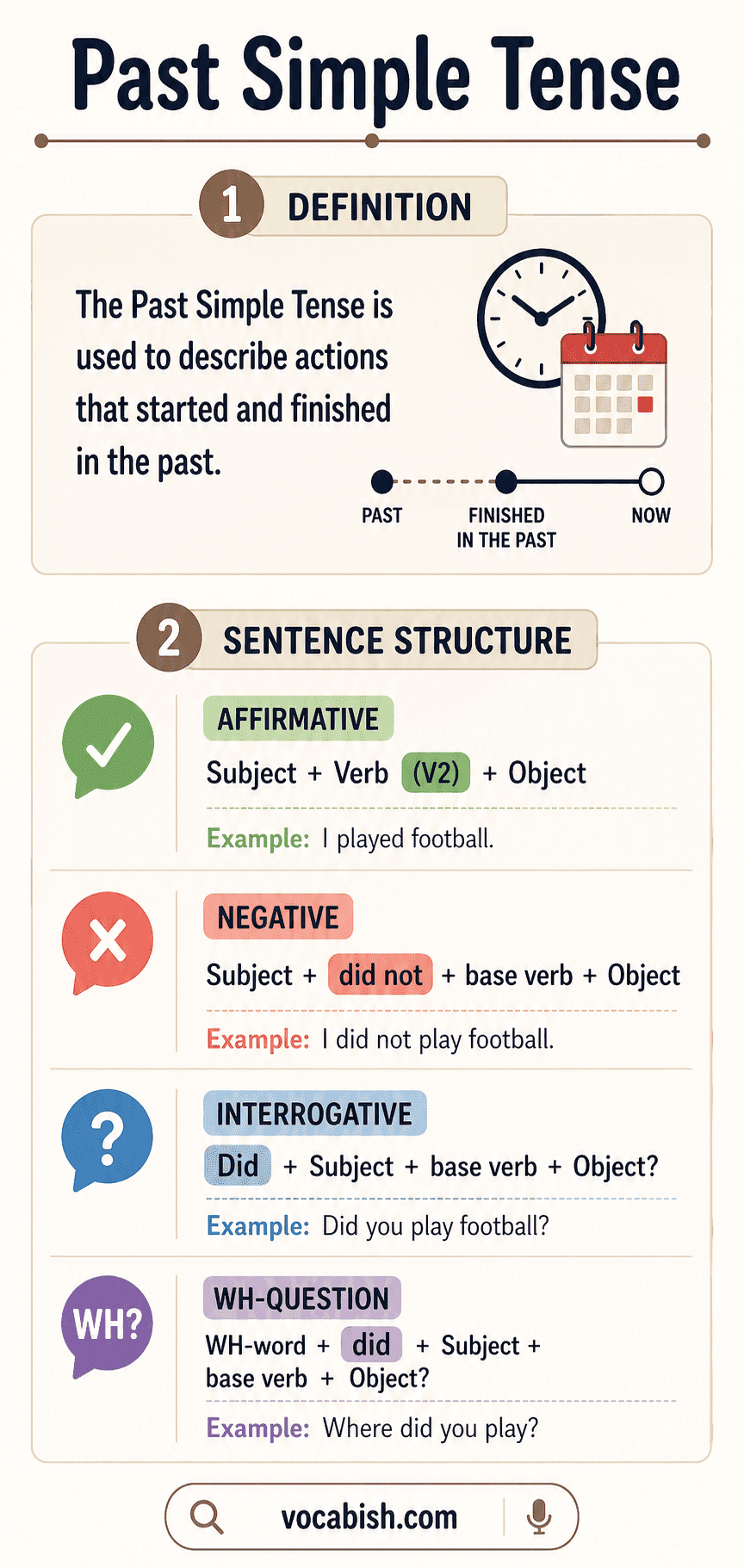
The past simple tense is used to describe actions, events, or situations that started and finished in the past.
Examples:
- I visited my uncle last weekend.
- She finished her homework yesterday.
- They watched a football match on Sunday.
- We traveled to Lahore last month.
Each action happened in the past and is already complete.
Structure of the Past Simple
The structure depends on whether the verb is regular or irregular.
Subject + Past Form of Verb + Object
Subject | Verb | Example |
|---|---|---|
I | played | I played football. |
She | visited | She visited her aunt. |
We | watched | We watched a movie. |
They | cleaned | They cleaned the room. |
Examples:
- I walked to school.
- He opened the door.
- They enjoyed the picnic.
- We studied English.
Related: 12 Tenses Structure and Charts
How Do We Make the Past Simple Tense?
There are two basic structures for the past simple tense.
1. Positive Sentences
Subject + Main Verb (Past Form)
Subject | Main Verb | Example |
|---|---|---|
I | played | I played football. |
You | worked | You worked hard. |
She | visited | She visited her aunt. |
They | watched | They watched a movie. |
2. Negative and Question Sentences
Subject + Auxiliary Verb + Main Verb
Subject | Auxiliary Verb | Main Verb |
I | did not | go |
She | did not | work |
Did | you | go |
Did | they | work |
Look at these examples with the verbs go (irregular) and work (regular).
Subject | Auxiliary Verb | Main Verb | Example | |
+ | I | — | went | I went to school. |
+ | You | — | worked | You worked very hard. |
– | She | did not | go | She did not go with me. |
– | We | did not | work | We did not work yesterday. |
? | Did | you | go | Did you go to Lahore? |
? | Did | they | work | Did they work at home? |
From the above table, notice the following points…
For Positive Sentences:
- No auxiliary verb is used.
- The main verb changes to its past form.
- Regular verbs usually add -ed.
- Irregular verbs have special forms.
Examples:
- I played cricket.
- She watched television.
- They went home.
- We ate lunch.
For Negative Sentences:
- Use did not (didn’t).
- The main verb returns to its base form.
Examples:
- I didn’t play football.
- She didn’t watch the movie.
- We didn’t go to school.
- They didn’t eat breakfast.
For Question Sentences:
- Use Did at the beginning.
- The main verb stays in the base form.
Examples:
- Did you visit your grandmother?
- Did she finish her homework?
- Did they go to the market?
- Did he play cricket?
Regular and Irregular Verbs in Past Simple
English verbs form the past simple in two different ways.
Regular Verbs
Most verbs add -ed.
Base Verb | Past Form |
work | worked |
play | played |
clean | cleaned |
visit | visited |
watch | watched |
Examples:
- We worked all day.
- She visited her cousin.
- They cleaned the classroom.
Irregular Verbs
Irregular verbs do not follow the -ed rule.
Base Verb | Past Form |
go | went |
see | saw |
come | came |
eat | ate |
write | wrote |
buy | bought |
take | took |
make | made |
Examples:
- I went to the zoo.
- She saw her teacher.
- We ate dinner together.
- They bought new books.
Past Simple with the Main Verb Be
The verb be follows a different structure.
Structure:
Subject + was/were
Subject | Verb Be |
I | was |
He | was |
She | was |
It | was |
You | were |
We | were |
They | were |
For Positive Sentences:
Subject | Verb Be | Example |
I | was | I was at home. |
He | was | He was tired. |
They | were | They were happy. |
Examples:
- I was late.
- She was in the library.
- We were excited.
- They were friendly.
Negative Sentences:
Subject | Verb Be | Not | Example |
I | was | not | I was not tired. |
They | were | not | They were not ready. |
Examples:
- He was not angry.
- We were not late.
- She wasn’t at school.
- They weren’t busy.
For Question Sentences:
Verb Be | Subject | Example |
Was | she | Was she happy? |
Were | they | Were they ready? |
Examples:
- Was he at home?
- Were you tired?
- Was the test difficult?
- Were they surprised?
Important Rule:
With be, we do not use did.
❌ Did she be happy?
✅ Was she happy?
How Do We Use the Past Simple Tense?
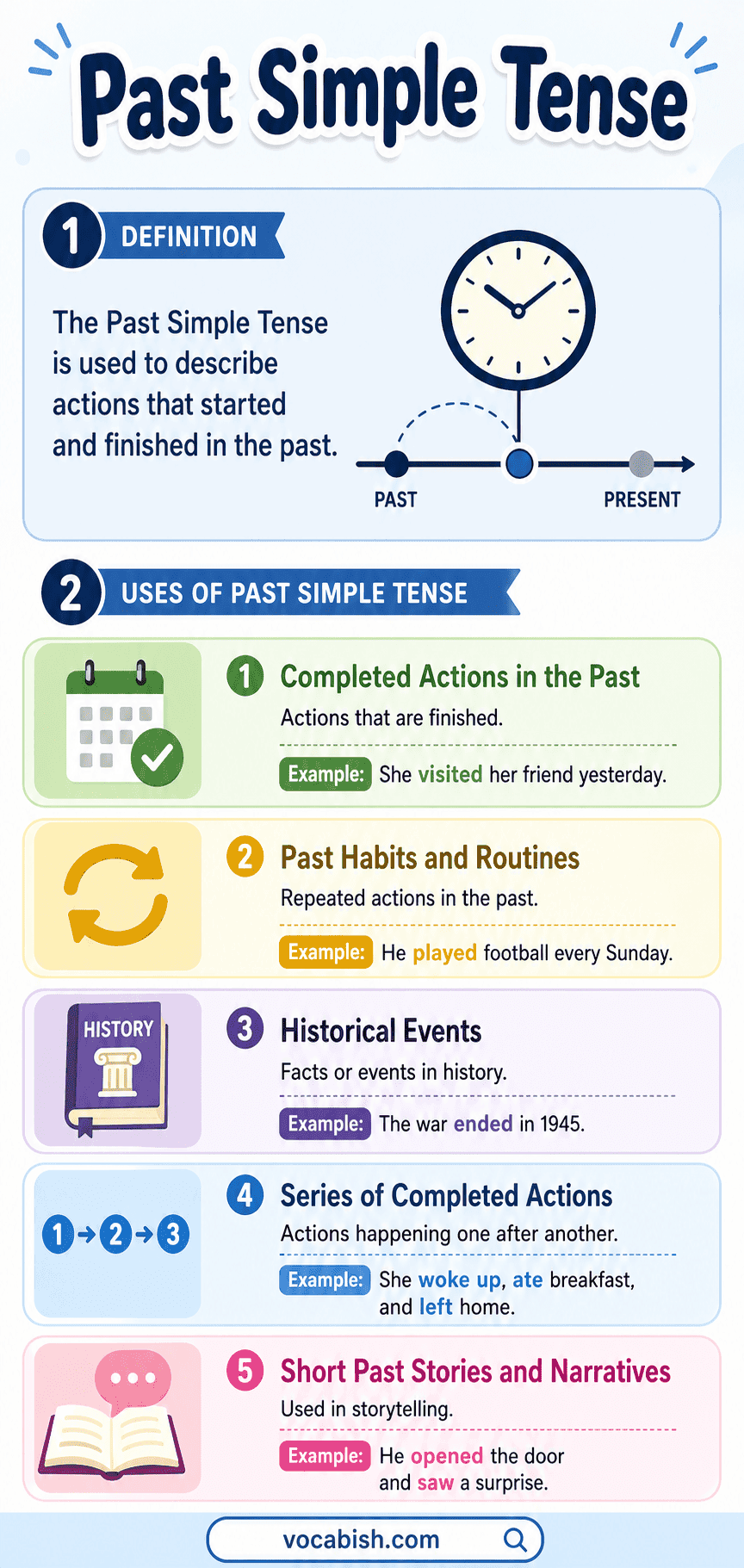
We use the Past Simple to talk about actions, situations, and events that happened and finished in the past.
The event may be very short or very long.
Short Past Events
Examples:
- The balloon burst.
- She opened the door.
- We heard a loud noise.
- He dropped his phone.
These actions happened quickly and finished immediately.
Long Past Events
Examples:
- I lived in Multan for ten years.
- They studied at that school for six years.
- She worked there for a long time.
- We stayed with our grandparents during summer vacations.
These events lasted longer, but they are still completely finished.
What Matters?
We use the past simple when:
- The action happened in the past.
- The action is finished.
- The time is known or understood.
Examples:
- I visited my uncle yesterday.
- She finished the project last week.
- We traveled to Islamabad in 2024.
- They played cricket on Sunday.
Common Time Expressions with the Past Simple
The Past Simple often appears with these time expressions:
- yesterday
- last night
- last week
- last month
- last year
- ago
- on Monday
- in 2023
Examples:
- I saw him yesterday.
- She arrived last night.
- We met two weeks ago.
- They moved here in 2022.
Using the Past Simple to Show Event Sequence
When telling stories, we often describe events in the order they happened.
Example:
- First, I arrived at school.
- Then, I attended my classes.
- After that, I played basketball.
- Finally, I went home.
The Past Simple clearly shows the sequence of completed events.
A Simple Story Using the Past Simple
Let’s see how the past simple helps us tell a story.
Last Saturday, Ali woke up early. He ate breakfast and packed his bag. Then he met his friends at the park. They played cricket for two hours and enjoyed the sunny weather.
After the game, they went to a restaurant and had lunch together. In the evening, Ali returned home, finished his homework, and watched a movie with his family.
Every action in this story happened in the past and is finished, so the past simple is the correct tense.
Past Simple vs Present Simple
Compare these sentences:
Present Simple | Past Simple |
I play football. | I played football yesterday. |
She visits her aunt. | She visited her aunt last week. |
They watch movies. | They watched a movie last night. |
The present simple talks about habits or facts, while the past simple talks about completed actions.
Common Errors to Avoid
Error 1: Using the Present Form
❌ Yesterday I go to school.
✅ Yesterday I went to school.
Error 2: Using Past Form After “Did”
❌ Did you saw him?
✅ Did you see him?
Error 3: Using Past Form After “Didn’t”
❌ I didn’t finished my homework.
✅ I didn’t finish my homework.
Past Simple Tense Exercises
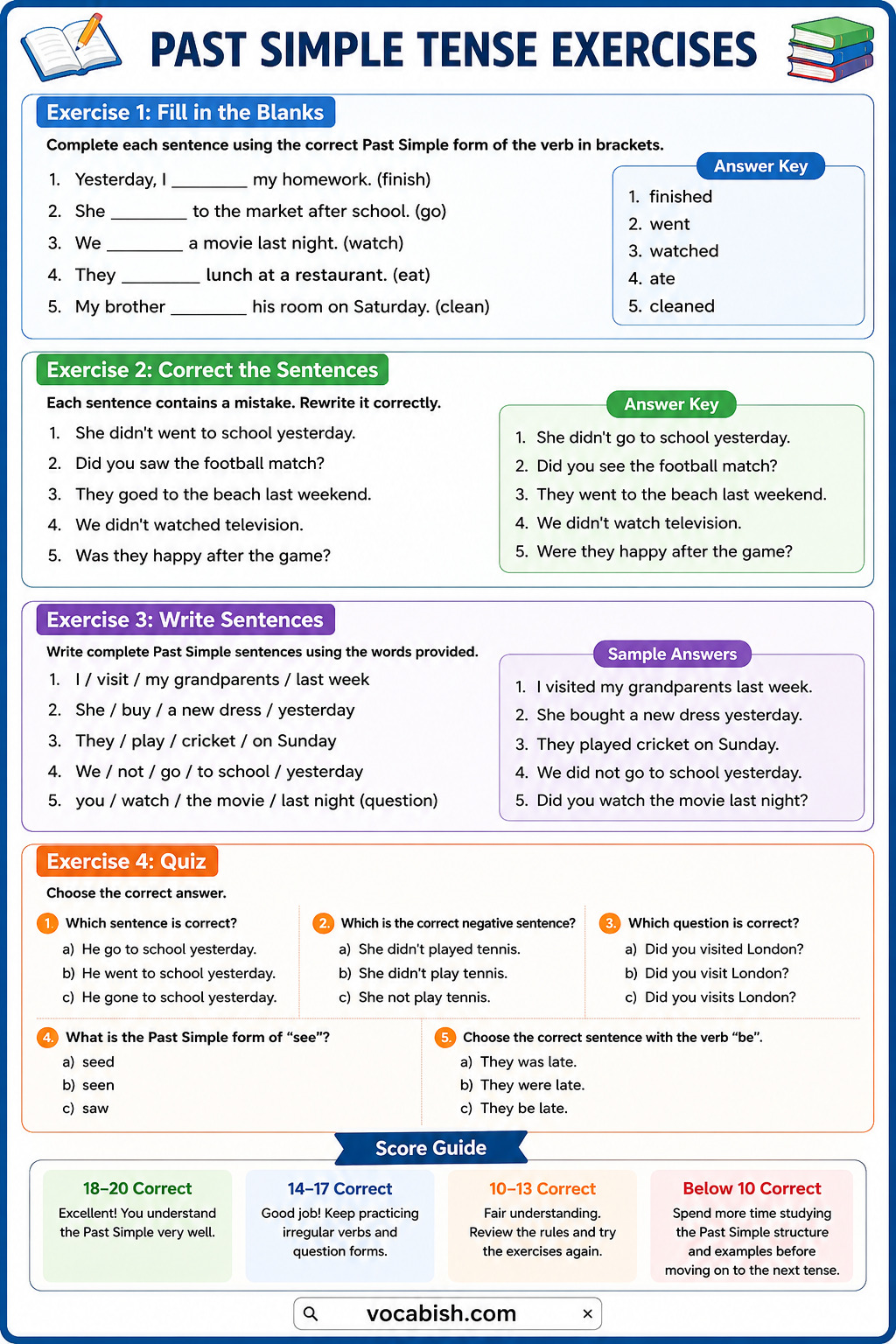
Exercise 1: Fill in the Blanks
Complete each sentence using the correct Past Simple form of the verb in brackets.
- Yesterday, I _______ my homework. (finish)
- She _______ to the market after school. (go)
- We _______ a movie last night. (watch)
- They _______ lunch at a restaurant. (eat)
- My brother _______ his room on Saturday. (clean)
Answer Key:
- finished
- went
- watched
- ate
- cleaned
Exercise 2: Correct the Sentences
Each sentence contains a mistake. Rewrite it correctly.
- She didn’t went to school yesterday.
- Did you saw the football match?
- They goed to the beach last weekend.
- We didn’t watched television.
- Was they happy after the game?
Answer Key:
- She didn’t go to school yesterday.
- Did you see the football match?
- They went to the beach last weekend.
- We didn’t watch television.
- Were they happy after the game?
Exercise 3: Write Sentences
Write complete Past Simple sentences using the words provided.
- I / visit / my grandparents / last week
- She / buy / a new dress / yesterday
- They / play / cricket / on Sunday
- We / not / go / to school / yesterday
- you / watch / the movie / last night (question)
Sample Answers:
- I visited my grandparents last week.
- She bought a new dress yesterday.
- They played cricket on Sunday.
- We did not go to school yesterday.
- Did you watch the movie last night?
Exercise 4: Quiz
Choose the correct answer.
1. Which sentence is correct?
a) He go to school yesterday.
b) He went to school yesterday.
c) He gone to school yesterday.
Answer: b) He went to school yesterday.
2. Which is the correct negative sentence?
a) She didn’t played tennis.
b) She didn’t play tennis.
c) She not play tennis.
Answer: b) She didn’t play tennis.
3. Which question is correct?
a) Did you visited London?
b) Did you visit London?
c) Did you visits London?
Answer: b) Did you visit London?
4. What is the Past Simple form of “see”?
a) seed
b) seen
c) saw
Answer: c) saw
5. Choose the correct sentence with the verb “be”.
a) They was late.
b) They were late.
c) They be late.
Answer: b) They were late.
You May Also Like:
- Present Simple Uses and Examples
- Future Simple Tense Definition and Examples
- 12 Tenses Explained with Uses and Examples
FAQs about Past Simple Tense
The past simple tense is used to describe actions, events, or situations that started and finished in the past at a specific time.
Use the Past Simple when talking about completed actions, past experiences, finished events, or stories that happened at a known time.
Form the past simple by using the past form of the main verb. Regular verbs add -ed, while irregular verbs change differently.
After did or didn’t, the main verb stays in its base form because did already shows that the action happened in the past.
Yes. The Past Simple is the most common tense for telling stories because it clearly shows a sequence of completed past actions.
Common time expressions include yesterday, last week, last year, ago, on Monday, and in 2024 to show finished past time.
Start the question with Did, followed by the subject and the base verb. For example: Did you finish your homework?
Conclusion
The past simple tense is one of the most important building blocks in English because it lets you talk about finished actions clearly and naturally. Once you understand the role of “did,” the difference between regular and irregular verbs, and the correct sentence structures, everything becomes much easier.
Keep practicing with real-life sentences, and try to describe your day in the past tense. That’s where real fluency starts to grow.