Skip to content
  • Home
  • Privacy Policy
  • About Us
  • Contact Us
Logo of vocabish.com

Vocabish

Learn English as a Second Language

  • Home
  • Vocabulary
    • Adjectives
    • A to Z Colors Name
    • Antonyms
    • Confusing Words
    • Fruits Name by Color
    • Synonyms
    • Types of Fruits
  • Kids English Learning
    • Riddles for Kids
    • Tongue Twisters for Kids
  • Emoji Meanings
  • Worksheets
  • Privacy Policy
  • Contact Us
  • Toggle search form
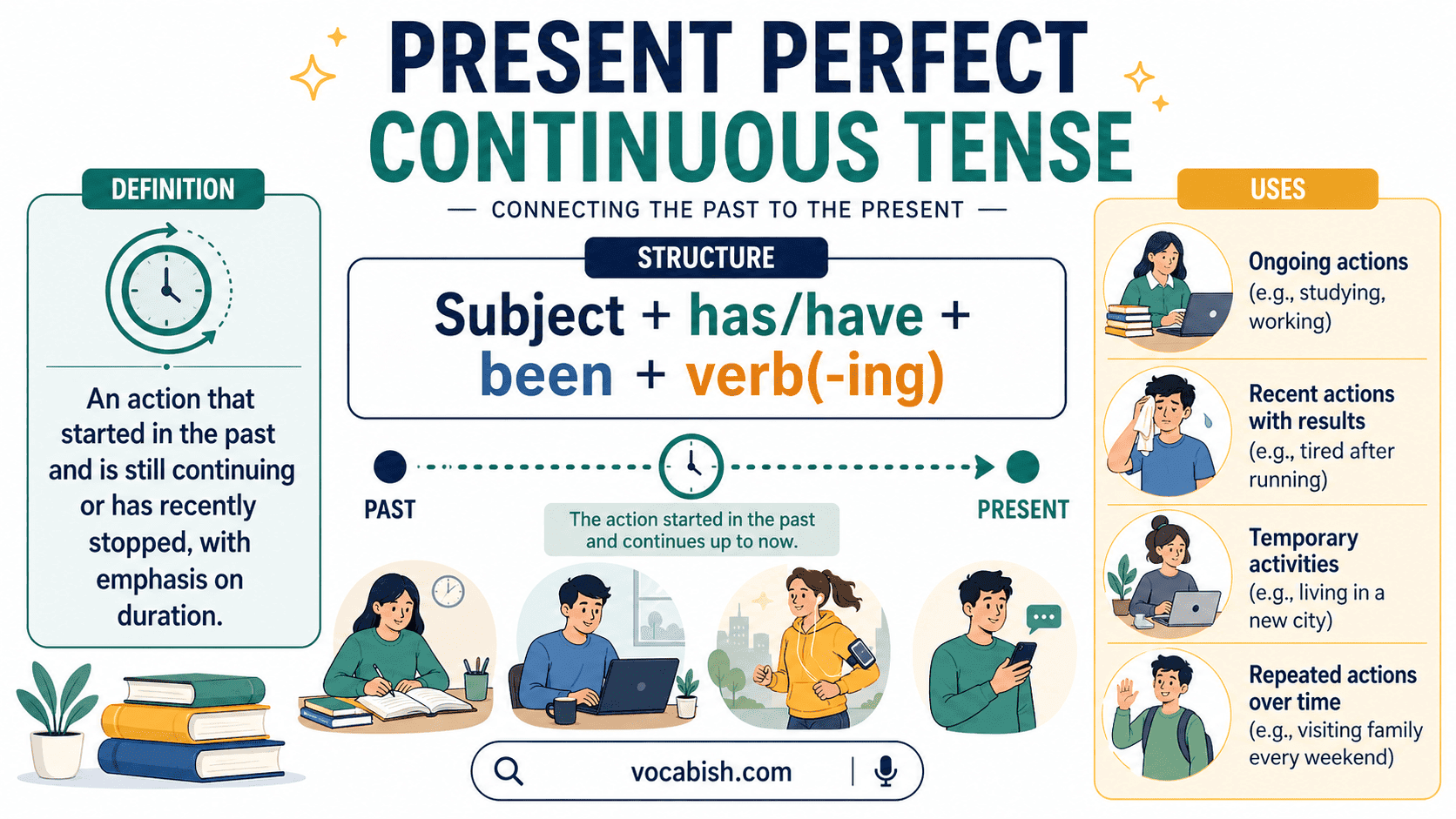
Present perfect continuous tense structure and uses explained with timeline diagram and examples of ongoing and recent actions in English

Present Perfect Continuous Tense: Structure, Uses, and Examples

Posted on April 30, 2026April 30, 2026 By Muhammad Matloob No Comments on Present Perfect Continuous Tense: Structure, Uses, and Examples

The Present Perfect Continuous tense shows actions that started in the past and are still continuing or have recently stopped. It helps you talk about how long something has been happening and connects past actions to the present moment.

In this blog post, you will learn how to form the Present Perfect Continuous, when to use it, and how it appears in real English sentences. This tense is important because it helps you express ongoing actions with time, which is very common in daily conversation. When you understand it well, you can improve your speaking by describing activities more naturally, improve your reading by recognizing sentence meaning quickly, and strengthen your writing by using correct grammar structures. It also supports listening skills because you will start noticing this tense in real conversations and media.

Table of Contents

Toggle
  • Introduction to Present Perfect Continuous Tense
  • What is the Present Perfect Continuous Tense?
  • Formula and Sentence Structure
    • 1. Affirmative Sentences
    • 2. Negative Sentences
    • 3. Interrogative Sentences
    • 4. WH-Question Sentences
  • Helping Verbs Used in Present Perfect Continuous Tense
    • 1. Use of “Has Been”
    • 2. Use of “Have Been”
    • 3. Use of Verb + Ing Form
  • Uses of Present Perfect Continuous Tense
    • 1. Actions Started in the Past and Continuing Now
    • 2. Recently Stopped Actions with Present Results
    • 3. Temporary Ongoing Activities
    • 4. Repeated Actions Over a Period of Time
  • Time Expressions Used in Present Perfect Continuous Tense
    • 1. Since
    • 2. For
    • 3. Recently
    • 4. Lately
    • 5. All Day / All Morning
  • Present Perfect Continuous Tense Examples
    • Daily Conversation Examples
    • Classroom Examples
    • Spoken English Examples
    • Question and Answer Examples
  • Rules for Using Present Perfect Continuous Tense
  • Present Perfect Continuous Tense with Since and For
  • Difference Between Present Perfect and Present Perfect Continuous
  • Difference Between Present Continuous and Present Perfect Continuous
  • Common Mistakes in Present Perfect Continuous Tense
  • Easy Tips to Learn the Tense Quickly
  • Present Perfect Continuous Tense Exercises
    • 1. Fill in the Blanks
    • 2. Make Correct Sentences
    • 3. Error Correction Practice
    • 4. Multiple Choice Questions
  • FAQs about Present Perfect Continuous
  • Conclusion

Introduction to Present Perfect Continuous Tense

The Present Perfect Continuous Tense connects the past with the present in a very direct way. It shows that an action started in the past and is still continuing or has recently stopped but still affects the present.

Think of it as a “bridge tense.” It links what happened before with what is happening now.

Examples:

  • I have been studying for two hours.
  • She has been working since morning.
  • They have been playing football all afternoon.

The focus is not just on the action, but on the duration of the action.

What is the Present Perfect Continuous Tense?

The Present Perfect Continuous Tense describes an action that began in the past and is still continuing or has recently stopped.

We use it when we care about:

  • how long something has been happening
  • the ongoing nature of an activity
  • or a recent action with visible results

Examples:

  • I have been learning English for five years.
  • He has been waiting for the bus since 8 AM.
  • We have been living here for a long time.

Most learners confuse this tense with Present Perfect, but here we focus on duration + continuity.

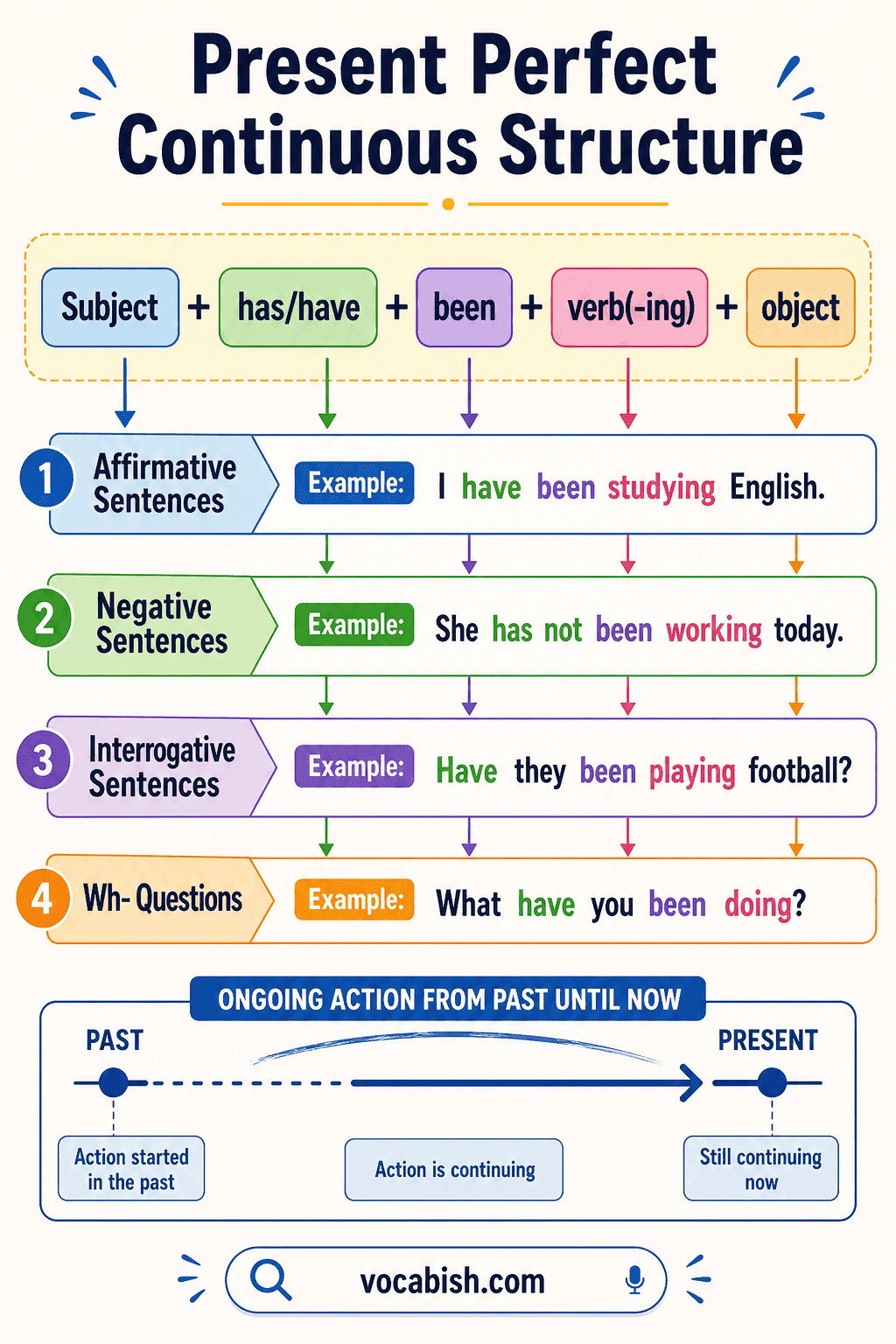
Present perfect continuous tense structure showing affirmative negative and question forms with clear English example sentences for students
Present Perfect Continuous Structure and Examples

Formula and Sentence Structure

The structure is very consistent, which makes it easier once you memorize it.

1. Affirmative Sentences

Formula: Subject + has/have + been + verb(-ing) + object

  • I have been reading this book.
  • She has been cooking since afternoon.
  • They have been playing outside.

2. Negative Sentences

Formula: Subject + has/have + not + been + verb(-ing) + object

  • I have not been sleeping well.
  • He has not been studying recently.
  • We have not been talking much.

3. Interrogative Sentences

Formula: Has/Have + subject + been + verb(-ing) + object?

  • Have you been working on this project?
  • Has she been feeling okay?
  • Have they been waiting long?

4. WH-Question Sentences

Formula: WH-word + has/have + subject + been + verb(-ing)?

  • What have you been doing?
  • Where has she been living?
  • Why have they been arguing?

Helping Verbs Used in Present Perfect Continuous Tense

1. Use of “Has Been”

Used with singular third-person subjects.

  • She has been studying hard.
  • He has been working late.
  • It has been raining all day.

2. Use of “Have Been”

Used with plural subjects and “I/you/we/they.”

  • I have been learning English.
  • They have been playing football.
  • We have been waiting for you.

3. Use of Verb + Ing Form

The -ing form shows the action is ongoing.

  • reading
  • working
  • playing
  • studying

Without “-ing,” the tense is incomplete and incorrect.

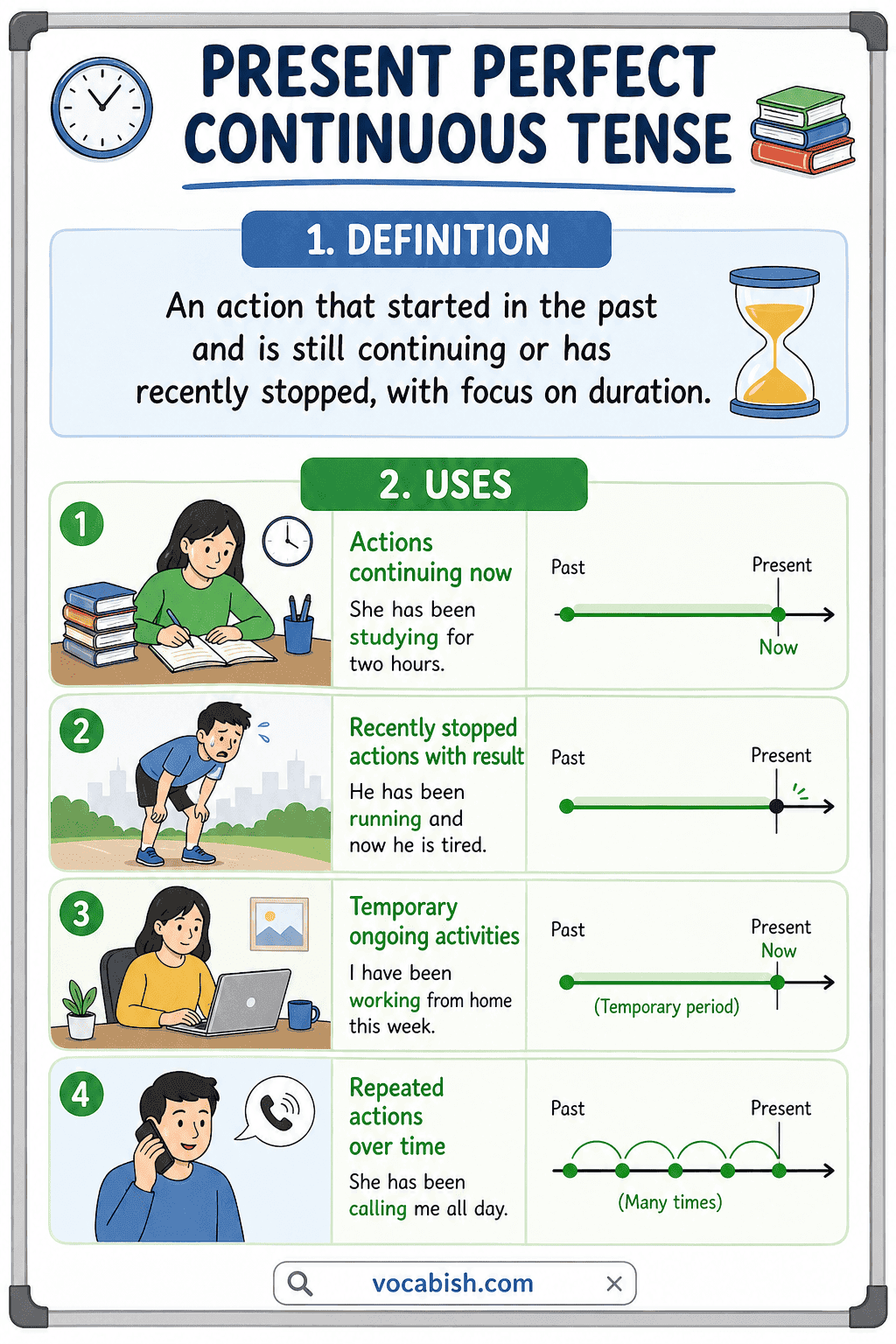
Uses of Present Perfect Continuous Tense

1. Actions Started in the Past and Continuing Now

Used when an action is still happening.

  • I have been studying for three hours.
  • She has been working here since 2020.
  • They have been living in this city for years.

2. Recently Stopped Actions with Present Results

The action may stop, but we can see its effect.

  • I have been running, so I’m tired.
  • She has been crying, her eyes are red.
  • They have been cooking, and the kitchen smells great.

3. Temporary Ongoing Activities

Used for short-term situations.

  • I have been staying at my friend’s house.
  • He has been working on a short project.
  • We have been using this room for meetings.

4. Repeated Actions Over a Period of Time

Shows repetition over time.

  • I have been calling him all morning.
  • She has been asking the same question.
  • They have been visiting us frequently.
Present perfect continuous tense uses with examples of studying working and daily activities showing actions continuing from past to present
Present Perfect Continuous Uses and Examples

Time Expressions Used in Present Perfect Continuous Tense

1. Since

  • I have been living here since 2015.

2. For

  • She has been working here for five years.

3. Recently

  • I have been feeling tired recently.

4. Lately

  • They have been arguing a lot lately.

5. All Day / All Morning

  • He has been studying all day.
  • We have been cleaning all morning.

Present Perfect Continuous Tense Examples

Daily Conversation Examples

  • I have been waiting for you for an hour.
  • She has been talking on the phone since morning.
  • We have been planning this trip for weeks.
  • He has been fixing his bike all day.
  • They have been watching TV since afternoon.
  • I have been thinking about your idea.
  • She has been shopping online recently.
  • We have been discussing the issue.
  • He has been working overtime this week.
  • They have been practicing for the match.

Classroom Examples

  • The students have been preparing for the test.
  • The class has been practicing speaking.
  • The teacher has been explaining the topic.
  • We have been learning grammar rules.
  • I have been solving exercises.
  • They have been writing essays.
  • She has been correcting mistakes.
  • We have been reading the chapter.
  • He has been asking questions.
  • I have been reviewing notes.

Spoken English Examples

  • I have been working on this for hours.
  • She has been living in London for a year.
  • They have been traveling around Europe.
  • We have been talking about you.
  • He has been feeling unwell lately.
  • I have been trying to reach you.
  • She has been practicing piano daily.
  • They have been arguing again.
  • We have been waiting outside.
  • He has been studying for exams.

Question and Answer Examples

  • Have you been studying? Yes, I have been studying all night.
  • What have you been doing? I have been working on my project.
  • Has she been exercising? Yes, she has been exercising daily.
  • Have they been traveling? Yes, they have been traveling a lot.
  • Why have you been crying? I have been watching a sad movie.
  • Have we been waiting long? Yes, we have been waiting for an hour.
  • Has he been working here? Yes, he has been working here since 2020.
  • What has she been cooking? She has been cooking dinner.
  • Have I been talking too much? Yes, you have been talking a lot.
  • Have they been practicing? Yes, they have been practicing hard.

Rules for Using Present Perfect Continuous Tense

  • Use has/have been + verb(-ing) form.
  • Focus on duration or ongoing action, not completion.
  • Always use time expressions like since, for, lately when needed.
  • Do not use stative verbs (like know, believe) in continuous form.
  • The action must connect past to present meaning.
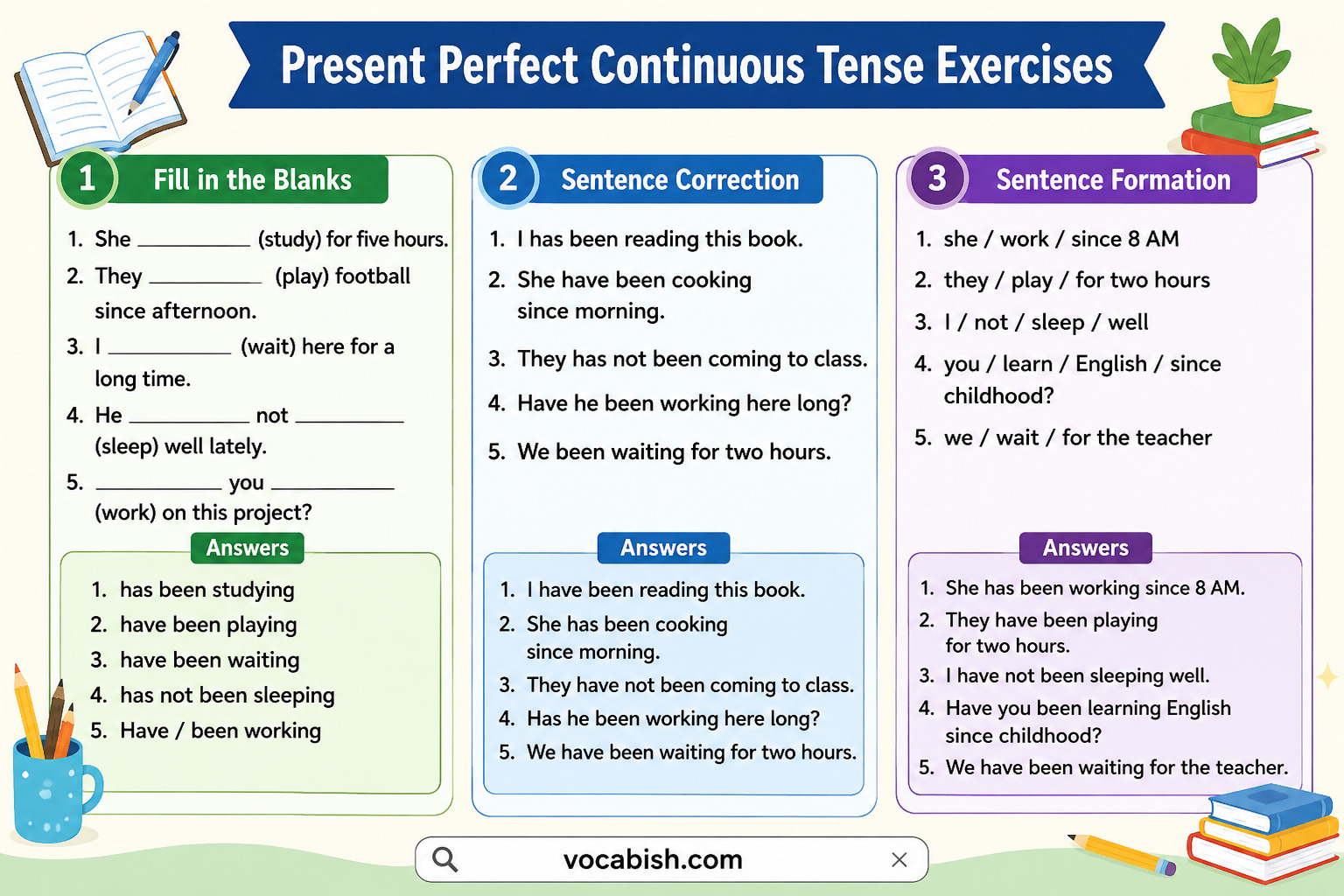
Present perfect continuous tense formula with subject has or have been verb ing structure and simple English examples for learners
Present Perfect Continuous Formula and Examples

Present Perfect Continuous Tense with Since and For

WordUsageExample
SinceSpecific point in timeI have been studying since 10 AM.
ForDuration of timeShe has been working for two hours.

Difference Between Present Perfect and Present Perfect Continuous

FeaturePresent PerfectPresent Perfect Continuous
FocusResultDuration
Structurehas/have + past participlehas/have been + -ing
ExampleI have finished my work.I have been finishing my work.

Difference Between Present Continuous and Present Perfect Continuous

FeaturePresent ContinuousPresent Perfect Continuous
TimeNowPast to present
Structuream/is/are + -inghas/have been + -ing
ExampleI am studying now.I have been studying for two hours.

Common Mistakes in Present Perfect Continuous Tense

  • Wrong: I am living here since 2010.
    Correct: I have been living here since 2010.
    Why: “Since” needs present perfect continuous, not present continuous.
  • Wrong: She has been work here.
    Correct: She has been working here.
    Why: Verb must take -ing form.
  • Wrong: They have been worked all day.
    Correct: They have been working all day.
    Why: Use “been + verb-ing,” not past participle.
  • Wrong: He has been know her for years.
    Correct: He has been knowing her for years.
    Why: Structure requires -ing form.

Easy Tips to Learn the Tense Quickly

  • Think “how long” every time you use it.
  • Remember: has/have + been + verb-ing
  • Use “since” for starting point, “for” for duration.
  • If you see an ongoing action, this tense is often the right choice.
  • Practice daily situations instead of memorizing rules only.

Present Perfect Continuous Tense Exercises

1. Fill in the Blanks

  1. I ______ (study) for two hours.
  2. She ______ (work) here since 2020.
  3. They ______ (play) football all day.
  4. He ______ (wait) for you.
  5. We ______ (learn) English recently.

Answers:

  1. have been studying
  2. has been working
  3. have been playing
  4. has been waiting
  5. have been learning

2. Make Correct Sentences

  1. I / read / book
  2. She / cook / since morning
  3. They / watch / TV
  4. He / study / all night
  5. We / talk / for hours

Answers:

  1. I have been reading a book.
  2. She has been cooking since morning.
  3. They have been watching TV.
  4. He has been studying all night.
  5. We have been talking for hours.

3. Error Correction Practice

  1. I has been working here.
  2. She have been studying hard.
  3. They has been playing football.
  4. He been working since morning.
  5. We has been talking.

Answers:

  1. I have been working here.
  2. She has been studying hard.
  3. They have been playing football.
  4. He has been working since morning.
  5. We have been talking.

4. Multiple Choice Questions

  1. I ___ been studying for hours.
    A) has
    B) have
    C) am
  2. She ___ been working here since 2020.
    A) has
    B) have
    C) is
  3. They ___ been playing football.
    A) has
    B) have
    C) are
  4. He ___ been waiting long.
    A) have
    B) has
    C) is
  5. We ___ been learning English.
    A) have
    B) has
    C) do

Answers:

  1. B
  2. A
  3. B
  4. B
  5. A

FAQs about Present Perfect Continuous

What is the Present Perfect Continuous tense?

The Present Perfect Continuous tense describes an action that started in the past and is still continuing or has recently stopped, with emphasis on duration and ongoing activity.

How do you form the Present Perfect Continuous tense?

You form it using has/have + been + verb(-ing). This structure shows an action started earlier and is still happening or has recently stopped.

When should I use the Present Perfect Continuous tense?

Use it when you want to focus on how long an action has been happening. It often describes ongoing activities or temporary situations connected to the present.

What is the difference between Present Perfect and Present Perfect Continuous?

Present Perfect focuses on result, while Present Perfect Continuous focuses on duration or ongoing activity. For example, “I have finished” vs “I have been working.”

What are common time expressions used with Present Perfect Continuous?

Common expressions include since, for, lately, recently, all day, and all morning. These words help show duration or continuity of an action.

Can we use stative verbs in Present Perfect Continuous tense?

No, stative verbs like know, believe, and like are not usually used in this tense because they do not describe actions that continue in progress.

Present Perfect Continuous tense examples for beginners?

Examples include: I have been studying for two hours, She has been working since morning, and They have been playing football all day.

How to teach Present Perfect Continuous tense?

Start by teaching meaning through real-life situations like “I have been studying for two hours.” Focus on duration first, then introduce the structure has/have been + verb(-ing), followed by guided speaking practice and comparisons with other tenses.

Conclusion

The Present Perfect Continuous Tense is all about connecting past actions to the present through duration and continuity. Once you get comfortable with the structure and time expressions, it becomes one of the most natural tenses to use in English.

Focus on real-life situations—what you’ve been doing, how long you’ve been doing it—and this tense will quickly feel automatic in your speech and writing.

12 Tenses

Post navigation

Previous Post: Present Perfect Tense: Structure, Uses, and Examples
Next Post: Past Simple Tense: Structure, Uses, and Examples

Leave a Reply Cancel reply

Your email address will not be published. Required fields are marked *

  • Facebook
  • Pinterest

Recent Comments

  • Israel BIZIMANA on 2000 Antonym Words in English with Pictures and PDF
  • Israel BIZIMANA on 2000 Antonym Words in English with Pictures and PDF
  • rachid nouacer on 100 Adverbs and Their Antonyms | Adverbs Opposite Words List
  • Adeel on How to Introduce Yourself in English for Beginners
  • OmarFaruk on 200+ Action Verbs List in English with Pictures

Recent Posts

  • Past Perfect Continuous Tense: Structure, Uses, and Examples
  • Past Perfect Tense: Structure, Uses, and Examples
  • Past Continuous Tense: Structure, Uses, and Examples
  • Past Simple Tense: Structure, Uses, and Examples
  • Present Perfect Continuous Tense: Structure, Uses, and Examples

Most Popular Articles

  • Heart Emoji Meanings : What Each Colour Heart Means (17,253)
  • Emoji Meanings: Complete List of Emojis and Their Meanings (10,268)
  • Face Emoji Meanings — The Hidden Meanings Behind Emojis (9,961)
  • Unique Irregular Verbs List in English with Examples (5,297)
  • 500 Daily Used Normal vs Advanced English Words (4,908)
  • Clothes and Fashion Vocabulary in English (3,787)
  • 50 Irregular Verbs | Present, Past, and Past Participle (3,228)
  • 50 Basic Adjectives to Describe People in English (2,750)
  • 200+ Action Verbs List in English with Pictures (2,609)

Our Topics

  • 12 Tenses (9)
  • Adjectives (44)
  • Antonyms (11)
  • Basic English Learning (5)
  • Confusing Words (35)
  • Emoji Meanings (11)
  • Examples (34)
  • Figure of Speech (8)
  • Kids English Learning (32)
    • Riddles for Kids (2)
    • Tongue Twisters for Kids (7)
  • List of Nouns (1)
  • Masculine and Feminine (7)
  • Other Ways to Say (11)
  • Parts of Speech (10)
  • Sentences (25)
  • Synonyms (37)
  • Vocabulary (187)
    • A to Z Colors Name (14)
    • Fruits Name by Color (6)
    • Types of Fruits (19)
  • Worksheets (7)
  • Writing (14)

Copyright © 2026 Vocabish.

Powered by PressBook WordPress theme