
The Past Perfect Tense helps you show which action happened first when two past actions are connected. It is used when one event in the past was already finished before another past event happened, and this makes your meaning more precise.
In this blog post, you will learn the structure, uses, and examples of the Past Perfect Tense in real situations. Many learners struggle because both actions are in the past, but this tense helps you organize events in the correct order so your message is not confusing. It also improves how you express reasons, tell stories, and explain past situations in speaking and writing.
Introduction to Past Perfect Tense
The Past Perfect Tense is used to describe an action that was completed before another action in the past. It helps you show which event happened first.
Without it, sentences can feel unclear or confusing. With it, your listener immediately understands the sequence.
Example idea:
You arrived at the station, but the train already left. Which happened first? The Past Perfect makes this clear.
What is the Past Perfect Tense?
The Past Perfect Tense describes an action that was finished before another past action or time point.
We use it because the simple past alone cannot always show sequence clearly.
Think of it as a “flashback inside the past.”
Examples:
- The action that happened first → Past Perfect
- The later action → Simple Past
This structure is especially useful in storytelling and explaining reasons for past events.
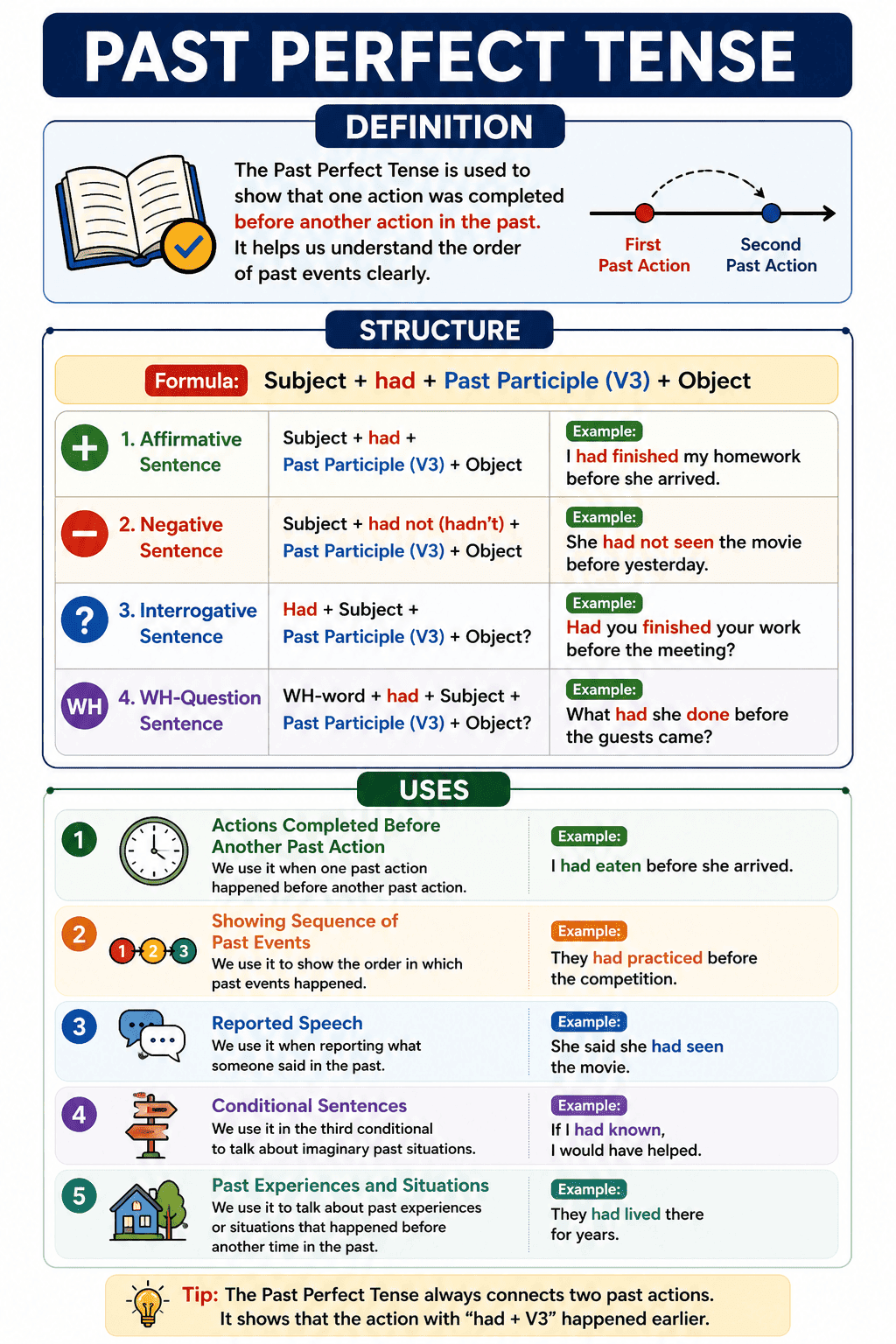
Understanding the Formula and Structure
The structure of the Past Perfect is simple, but learners often overcomplicate it.
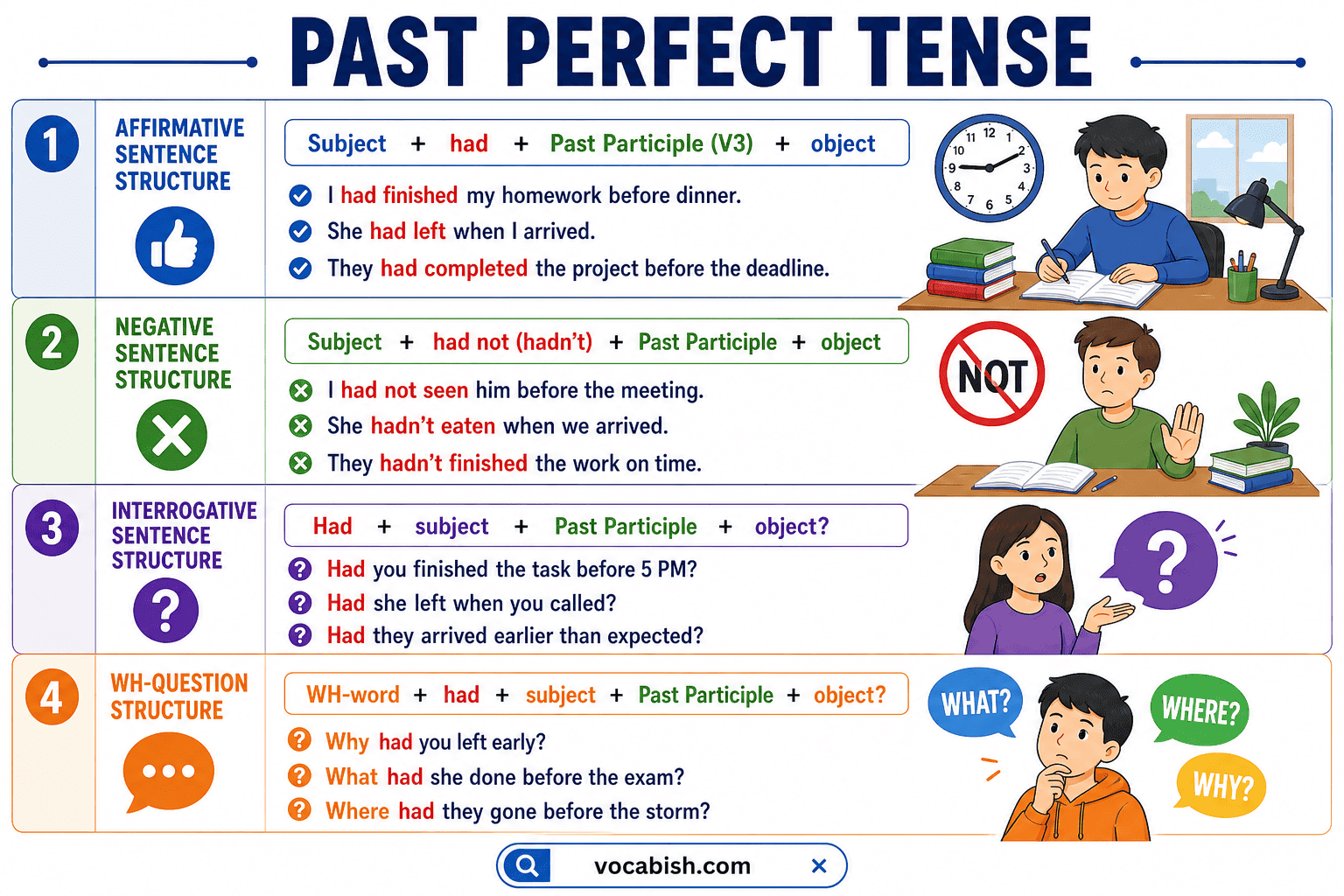
1. Affirmative Sentence Structure
Formula:
Subject + had + Past Participle (V3) + object
Examples:
- I had finished my homework before dinner.
- She had left when I arrived.
- They had completed the project before the deadline.
2. Negative Sentence Structure
Formula:
Subject + had not (hadn’t) + Past Participle + object
Examples:
- I had not seen him before the meeting.
- She hadn’t eaten when we arrived.
- They hadn’t finished the work on time.
3. Interrogative Sentence Structure
Formula:
Had + subject + Past Participle + object?
Examples:
- Had you finished the task before 5 PM?
- Had she left when you called?
- Had they arrived earlier than expected?
4. WH-Question Structure
Formula:
WH-word + had + subject + Past Participle + object?
Examples:
- Why had you left early?
- What had she done before the exam?
- Where had they gone before the storm?
Helping Verb Used in Past Perfect Tense
The Past Perfect relies on just one helping verb, but it is essential.
1. Use of “Had”
We use had for all subjects:
- I had
- You had
- He/She/It had
- We had
- They had
This makes it one of the simplest tenses structurally.
Examples:
- I had visited the place before.
- She had called me earlier.
2. Use of Past Participle (3rd Form of Verb)
The second part of the structure is the past participle (V3).
Examples:
- go → gone
- eat → eaten
- write → written
Examples:
- He had gone home.
- She had written the letter.
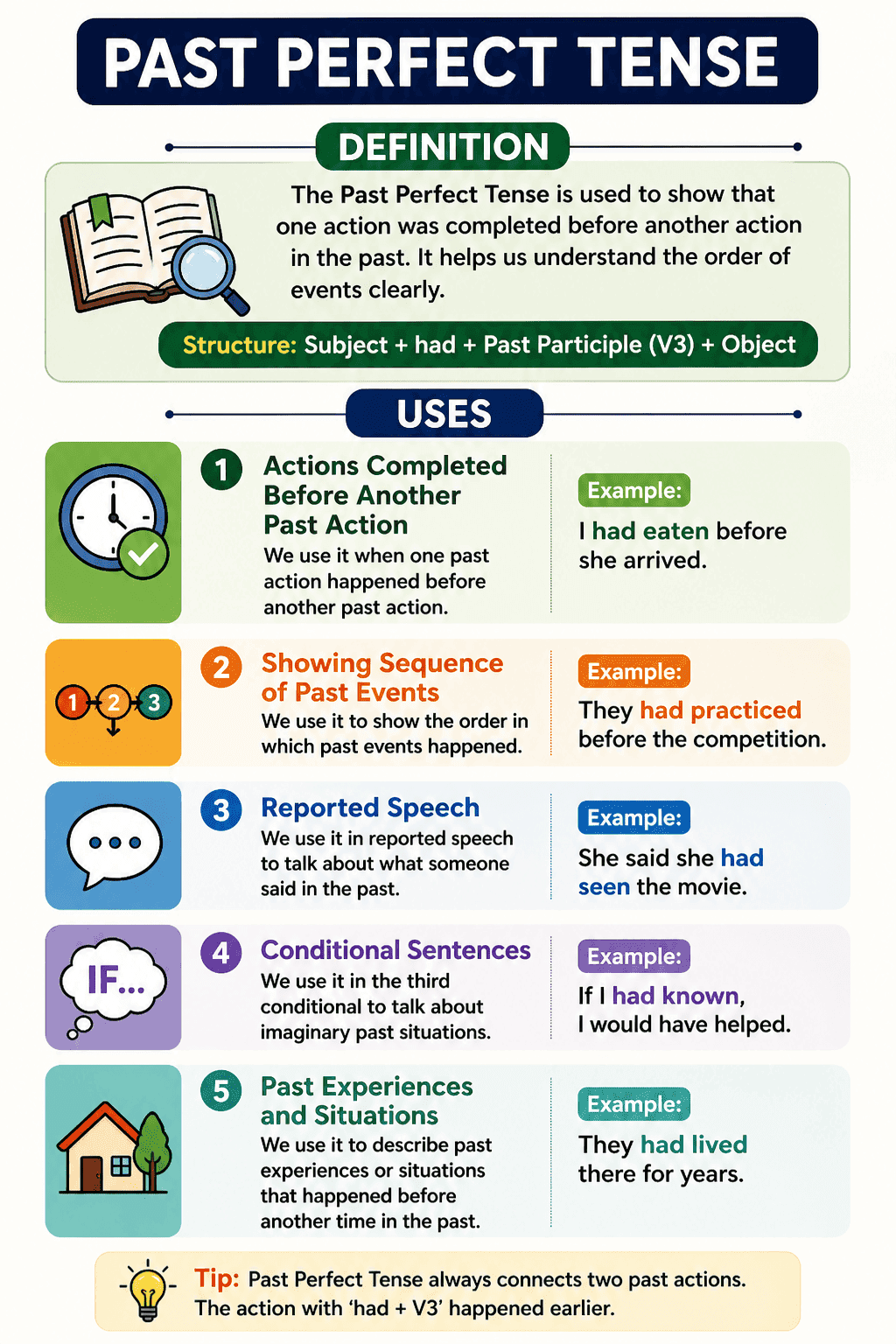
Uses of Past Perfect Tense
The Past Perfect is not just grammar—it solves communication problems.
1. Actions Completed Before Another Past Action
This is the most important use.
Examples:
- I had eaten before she arrived.
- They had left before the meeting started.
- She had finished work before 6 PM.
2. Showing Sequence of Past Events
We use it to show which event happened first.
Examples:
- He had studied hard, so he passed the exam.
- They had practiced before the competition.
- She had saved money before buying the car.
3. Reported Speech
Used when reporting something said in the past.
Examples:
- She said she had seen the movie.
- He told me he had completed the task.
- They said they had arrived early.
4. Conditional Sentences
Used in third conditional (imaginary past situations).
Examples:
- If I had known, I would have helped.
- If she had studied, she would have passed.
- If they had left earlier, they wouldn’t have missed it.
5. Past Experiences and Situations
Used to describe past background situations.
Examples:
- I had never traveled abroad before that trip.
- She had always wanted to become a doctor.
- They had lived there for years.
Signal Words Used in Past Perfect Tense
Certain words often appear with the Past Perfect.
1. Before
- I had finished before dinner.
2. After
- She left after she had spoken to him.
3. Already
- They had already arrived.
4. By the Time
- By the time I arrived, he had left.
5. Until Then
- She had never seen snow until then.
Past Perfect Tense Examples
1. Daily Life Examples
- I had woken up before the alarm rang.
- She had cooked breakfast before I got up.
- They had cleaned the house before guests arrived.
- He had left for work before 8 AM.
- We had watched the movie before dinner.
- I had finished my assignment before class.
- She had called me before leaving home.
- They had booked the tickets in advance.
- He had repaired the bike before the trip.
- We had planned everything before the event.
2. Storytelling Examples
- He had escaped before the police arrived.
- She had hidden the key before anyone noticed.
- They had built the house before the storm came.
- I had lost everything before I moved cities.
- The hero had saved the village before dawn.
- She had discovered the secret before it was too late.
- They had left the town before the war began.
- He had written the letter before disappearing.
- We had reached the cave before sunset.
- She had warned them before the accident happened.
3. Spoken English Examples
- I had already told you about it.
- She had just left when you called.
- They had finished it already.
- He had seen it before, I think.
- We had talked about it earlier.
- I had never heard that before.
- She had already eaten dinner.
- They had gone out before I arrived.
- He had called you yesterday.
- We had met before, right?
4. Question and Answer Examples
- Had you finished the work? Yes, I had completed it.
- Had she left already? Yes, she had gone home.
- Had they arrived on time? No, they had not reached yet.
- Had he studied before the exam? Yes, he had prepared well.
- What had you done before lunch? I had cleaned the room.
- Had she spoken to him? Yes, she had talked to him.
- Had they booked tickets? Yes, they had reserved them.
- Had you seen the film? Yes, I had watched it.
- Why had he left early? He had finished work.
- Had we met before? Yes, we had met earlier.
Rules for Using Past Perfect Tense
- Always use had + V3
- Both actions must be in the past
- Use Past Perfect for the earlier action
- Use Simple Past for the later action
- Do not overuse it when sequence is already clear
Difference Between Past Perfect and Simple Past
Feature | Past Perfect | Simple Past |
|---|---|---|
Action timing | Earlier past action | Completed past action |
Structure | had + V3 | V2 |
Example | I had finished before he came | I finished yesterday |
Difference Between Past Perfect and Past Continuous
Feature | Past Perfect | Past Continuous |
|---|---|---|
Focus | Completed action | Ongoing past action |
Structure | had + V3 | was/were + V-ing |
Example | I had left before he arrived | I was leaving when he arrived |
Common Mistakes in Past Perfect Tense
- Wrong: I did not had finished the work.
Correct: I had not finished the work.
Why: “did not had” is incorrect structure. - Wrong: She had went home early.
Correct: She had gone home early.
Why: Use past participle “gone,” not “went.” - Wrong: Had you went there?
Correct: Had you gone there?
Why: Question form still needs V3. - Wrong: I had finished yesterday. (when no second action exists)
Correct: I finished yesterday.
Why: Past Perfect needs a second past reference. - Wrong: He had eaten when I was arriving.
Correct: He had eaten when I arrived.
Why: Keep both actions in consistent past reference.
Easy Tips to Learn Past Perfect Tense
- Think: “What happened first?”
- Use had + V3 automatically
- Pair it with Simple Past in stories
- Practice time words like before, after, by the time
- Don’t use it when only one past action exists
Past Perfect Tense Exercises
1. Fill in the Blanks
- I ______ (finish) my work before dinner.
- She ______ (leave) when I arrived.
- They ______ (complete) the project.
- He ______ (go) home before 6 PM.
- We ______ (see) the movie already.
- She ______ (cook) before guests came.
- I ______ (never/try) that food.
- They ______ (reach) before us.
- He ______ (write) the letter.
- We ______ (plan) everything.
Answer Key:
1 had finished, 2 had left, 3 had completed, 4 had gone, 5 had seen, 6 had cooked, 7 had never tried, 8 had reached, 9 had written, 10 had planned
2. Sentence Transformation
- I finished my homework before she arrived.
- She left home before I called her.
- They completed the project before the deadline.
- He went out before dinner.
- We saw the movie before class started.
- I ate breakfast before leaving for work.
- She wrote the letter before the meeting.
- They reached the station before the train left.
- He cleaned the room before guests came.
- We planned everything before the trip.
Answers:
- I had finished my homework before she arrived.
- She had left home before I called her.
- They had completed the project before the deadline.
- He had gone out before dinner.
- We had seen the movie before class started.
- I had eaten breakfast before leaving for work.
- She had written the letter before the meeting.
- They had reached the station before the train left.
- He had cleaned the room before guests came.
- We had planned everything before the trip.
3. Error Correction Practice
- She had went to school before I arrived.
- I did not had finished my work.
- They had saw the movie before dinner.
- He had ate breakfast early.
- Had you saw the match yesterday?
- We had arrive before the bus left.
- She had writtened the letter already.
- They had leave before we reached.
- I had never saw that place before.
- He had did his homework before class.
Answers:
- She had gone to school before I arrived.
- I had not finished my work.
- They had seen the movie before dinner.
- He had eaten breakfast early.
- Had you seen the match yesterday?
- We had arrived before the bus left.
- She had written the letter already.
- They had left before we reached.
- I had never seen that place before.
- He had done his homework before class.
FAQs about Past Perfect Tense
The Past Perfect Tense shows an action that was completed before another action in the past. It is formed using had + past participle (V3) to show clear sequence of events.
You form it using subject + had + past participle (V3). For example: I had finished my work before she arrived. It stays the same for all subjects.
Use it when you want to show that one past action happened before another past action. It helps make the order of events in storytelling or explanation clear.
Past Simple shows a completed action, while Past Perfect shows the earlier action. Example: I finished after he had left. Past Perfect clarifies which happened first.
Common signal words include before, after, already, by the time, and until. These words help show the sequence of past actions and often appear with Past Perfect sentences.
No, Past Perfect is usually not used alone. It needs another past action to show comparison or order, otherwise Simple Past is more appropriate and natural.
The structure is had + past participle (V3) for all subjects. For example: She had eaten before leaving. This structure does not change with he, she, or they.
Conclusion
The Past Perfect Tense helps you organize past events clearly by showing which action happened first. Once you get comfortable with had + V3, your storytelling becomes much clearer and more natural. Focus on timing, not complexity, and this tense will start feeling effortless in real communication.