
Many English learners know the rules of the present perfect, but they still hesitate when speaking. A common question is…
“Should I use past simple or present perfect here?”
That confusion usually happens because the present perfect does not focus on when something happened. Instead, it focuses on the connection between the past and the present.
Compare these two sentences:
- I visited London in 2022.
- I have visited London.
The first sentence tells us the exact time. The second sentence talks about the experience itself.
This tense is very common in conversations, especially when people talk about life experiences, recent events, unfinished situations, or things that still matter now.
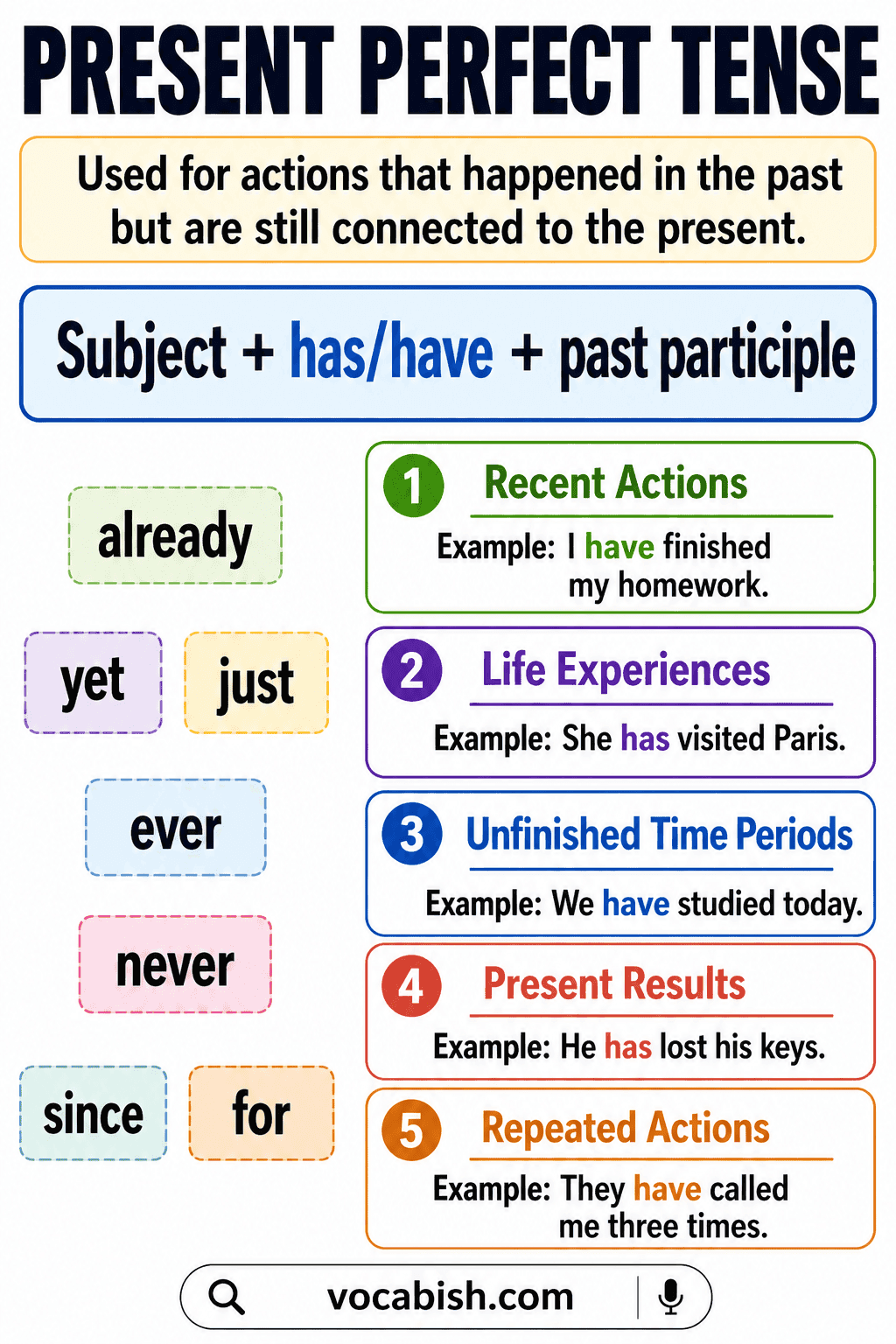
What is the Present Perfect Tense?
The present perfect tense describes actions or experiences that happened before now, but the exact time is not important.
It links the past with the present.
Look at these examples:
- She has visited Paris.
- He has grown taller.
- They have not finished their homework.
In each sentence, the past action still has some meaning in the present moment.
Why do we use it?
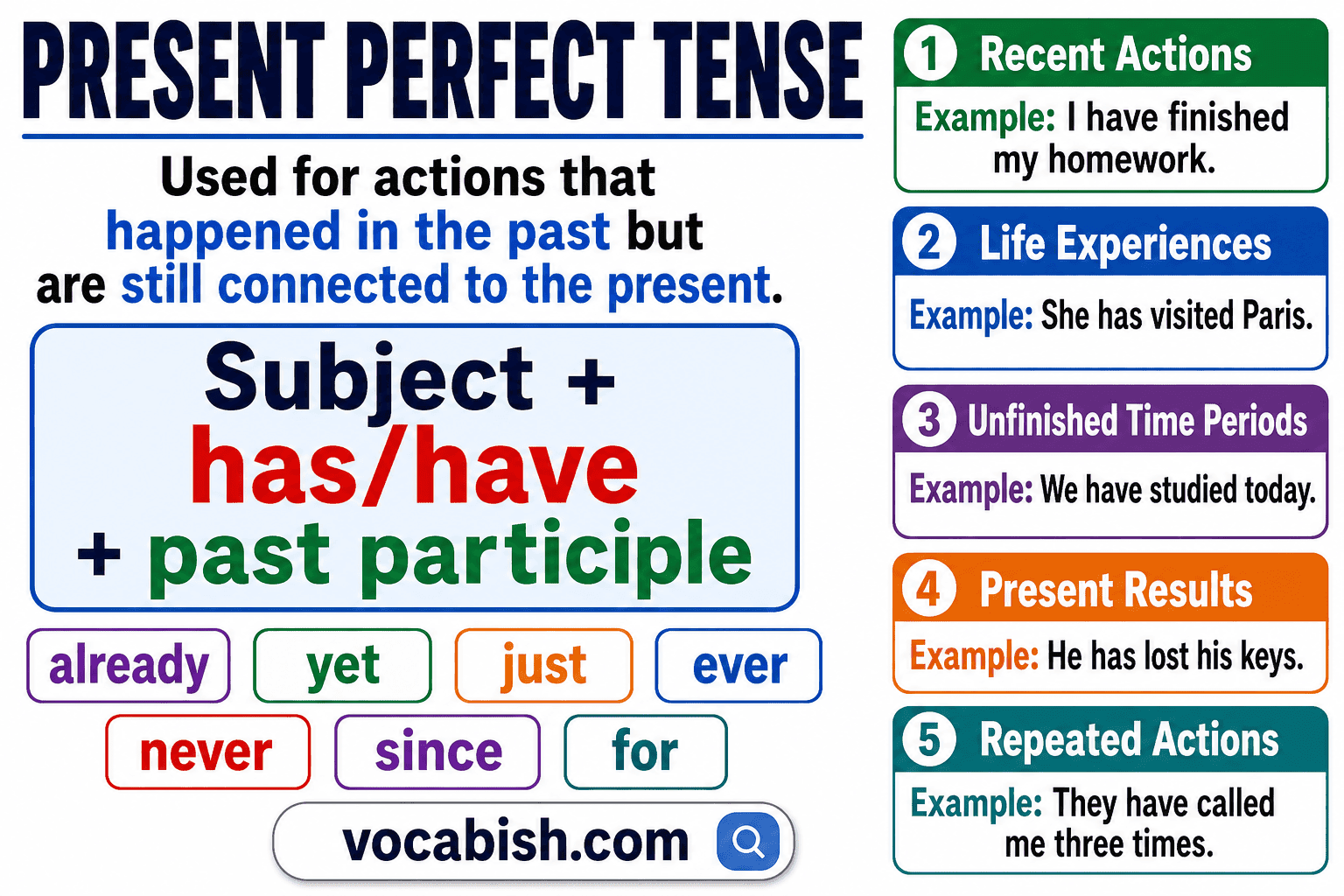
The present perfect is often used for:
1. Experiences:
We use it when talking about things someone has done in life.
- I have tried Japanese food.
- She has traveled to Turkey.
- We have seen that movie before.
The exact time is not mentioned because the experience matters more than the date.
2. Changes Over Time:
This tense also describes changes that continue until now.
- My English has improved.
- The city has become more crowded.
- He has grown a beard.
The change started in the past, but the result is visible now.
3. Incomplete or Unfinished Actions:
Sometimes an action is still not complete.
- They have not finished the project.
- I have not read the book yet.
- She has not called me.
The situation continues into the present.
Common Signal Words:
Certain words often appear with the present perfect.
Word | Example |
|---|---|
already | She has already eaten lunch. |
yet | Have you finished yet? |
just | I have just arrived. |
ever | Have you ever flown in a helicopter? |
never | He has never met my brother. |
These words help show the connection between past actions and the present moment.
Formulation of Present Perfect Tense
The present perfect uses:
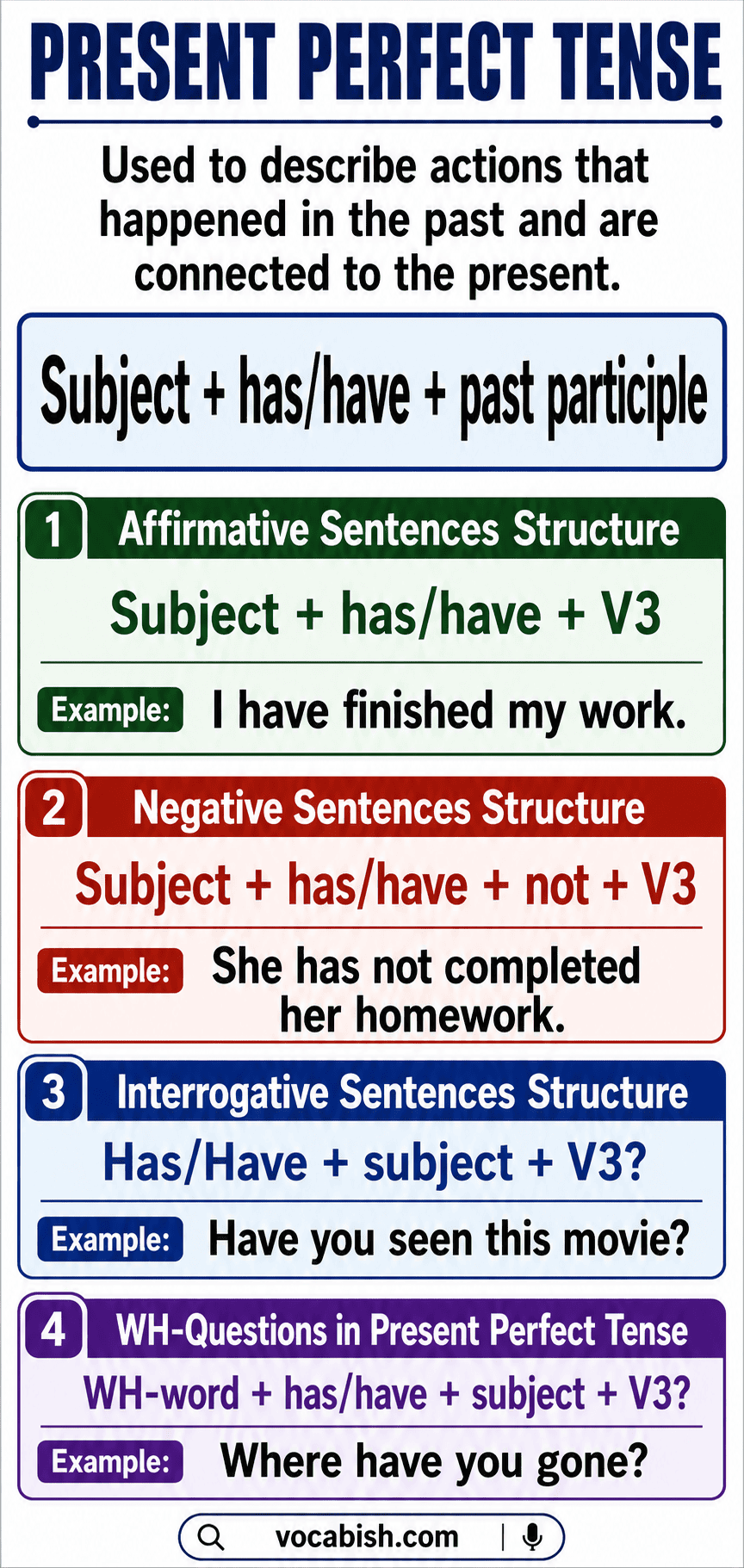
Subject + has/have + past participle
The past participle is usually the third form of the verb.
Base Verb | Past Participle |
|---|---|
go | gone |
eat | eaten |
see | seen |
finish | finished |
Affirmative Sentences
Use has with singular subjects and have with plural subjects.
Structure:
Examples:
- I have completed my assignment.
- She has lost her keys.
- They have moved to a new apartment.
- We have watched this series.
- He has started a new job.
Negative Sentences
Add not after has or have.
Structure:
Examples:
- I have not seen him today.
- She has not replied yet.
- They have not finished the work.
- He has not cleaned his room.
- We have not decided anything.
Short forms are common in speaking:
- haven’t
- hasn’t
Interrogative Sentences
Move has/have before the subject.
Structure:
Examples:
- Have you eaten breakfast?
- Has she called you?
- Have they arrived?
- Has he finished the report?
- Have we met before?
Usage of Present Perfect Tense
Understanding the uses is more important than memorizing formulas. Let’s look at the situations where English speakers naturally choose the present perfect.
Actions Completed in the Past
Sometimes the action is finished, but the result matters now.
- I have broken my glasses.
(The glasses are still broken.) - She has lost her phone.
(She still cannot find it.) - We have missed the bus.
(Now we need another way to travel.)
The action happened earlier, but its effect continues.
Actions with Present Relevance
This tense is common when recent events affect the current situation.
- He has just left the office.
- I have already submitted the form.
- They have not answered my email yet.
The speaker cares about the present result, not the exact time.
Life Experience
One of the most common uses for learners.
We use the present perfect to talk about experiences during someone’s life.
- Have you ever ridden a horse?
- I have visited many museums.
- She has never eaten sushi.
The time is unknown or unimportant.
Unspecified Time Before Now
The present perfect does not usually mention a finished time like yesterday or last year.
Correct:
- I have watched that film.
Incorrect:
- I have watched that film yesterday.
If the time is specific, English normally uses the Past Simple.
Correct:
- I watched that film yesterday.
Time Expressions in Present Perfect Tense
Certain expressions are strongly connected with the present perfect.
Recently Completed Actions
- just
- already
- yet
Examples:
- She has just arrived.
- I have already eaten.
- Have you finished yet?
Experiences in Life
- ever
- never
- before
Examples:
- Have you ever met a celebrity?
- I have never tried scuba diving.
- We have seen this place before.
Duration Until Now
The present perfect is also used with “for” and “since.”
- I have lived here for five years.
- She has studied English since 2020.
For shows duration.
Since shows the starting point.
Contrast with Past Simple Tense
This is where many learners make mistakes.
The difference is mainly about time and connection to the present.
Finished vs. Unfinished Actions
Present Perfect
The action connects to now.
- I have lived here for ten years.
(I still live here.)
Past Simple
The situation is finished.
- I lived there for ten years.
(Now I live somewhere else.)
Specific vs. General Time
Present Perfect
General experience without exact time.
- She has visited Italy.
Past Simple
Specific completed time.
- She visited Italy in 2023.
If you mention:
- yesterday
- last week
- in 2020
- two days ago
you usually need the past simple.
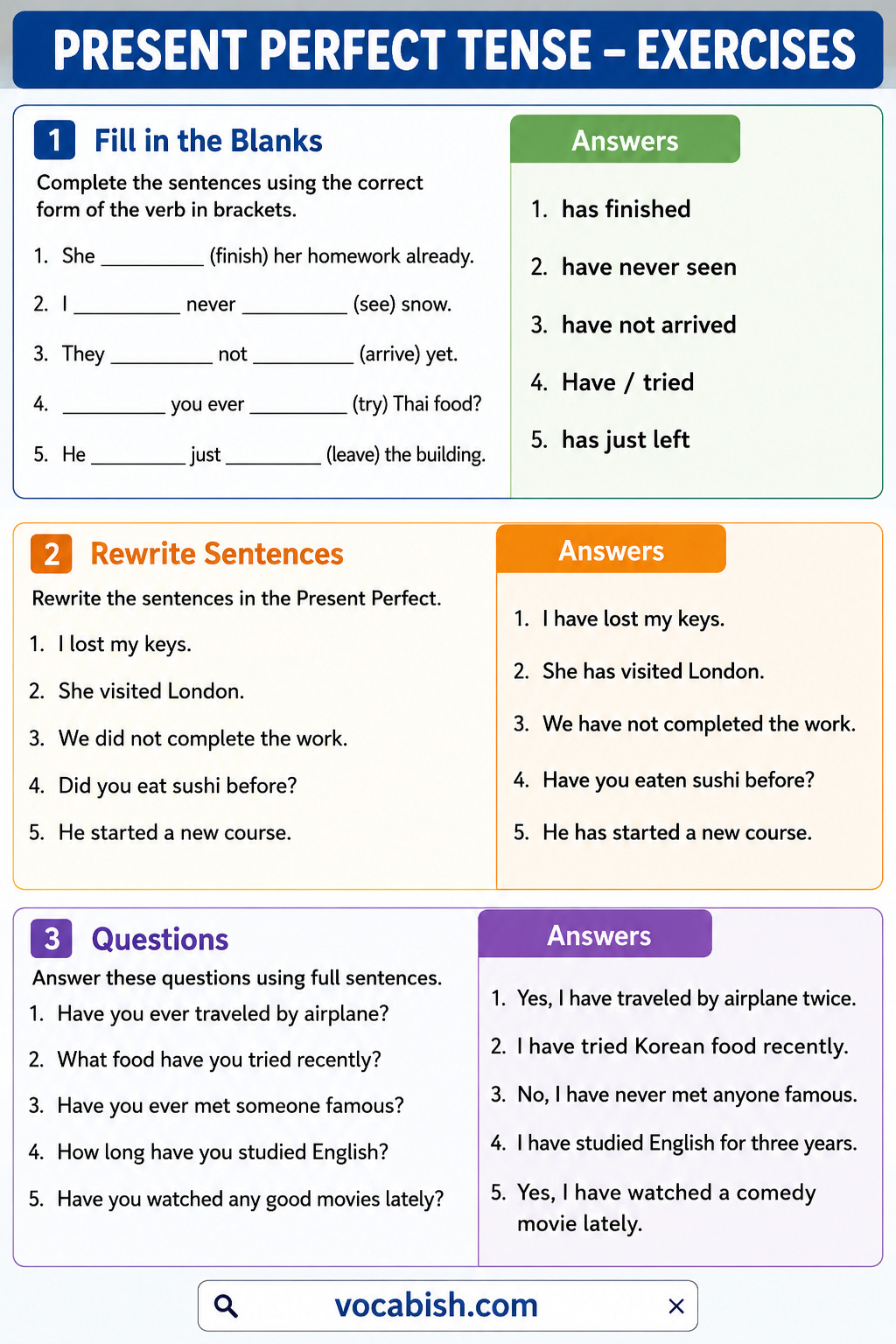
Present Perfect Tense Exercises
Practice helps learners notice the difference between finished and unfinished time.
1. Fill in the Blanks
Complete the sentences using the correct form of the verb in brackets.
- She __________ (finish) her homework already.
- I __________ never __________ (see) snow.
- They __________ not __________ (arrive) yet.
- __________ you ever __________ (try) Thai food?
- He __________ just __________ (leave) the building.
Answer Key:
- has finished
- have never seen
- have not arrived
- Have / tried
- has just left
2. Rewrite Sentences
Rewrite the sentences in the present perfect.
- I lost my keys.
- She visited London.
- We did not complete the work.
- Did you eat sushi before?
- He started a new course.
Answer Key:
- I have lost my keys.
- She has visited London.
- We have not completed the work.
- Have you eaten sushi before?
- He has started a new course.
3. Answer these Questions
Answer these questions using full sentences.
- Have you ever traveled by airplane?
- What food have you tried recently?
- Have you ever met someone famous?
- How long have you studied English?
- Have you watched any good movies lately?
Sample Answers:
- Yes, I have traveled by airplane twice.
- I have tried Korean food recently.
- No, I have never met anyone famous.
- I have studied English for three years.
- Yes, I have watched a comedy movie lately.
You may also like:
- Definition and Uses of Past Perfect Tense
- Future Perfect Tense Uses and Examples
- 12 Tenses in English Grammar with Chart
Final Thoughts
The present perfect is not only about grammar rules. It is about how English speakers connect past events to the present moment.
When learners understand this idea, the tense becomes much easier.
Remember these simple points:
- Use the present perfect for experiences and unfinished time.
- Do not mention specific finished times with it.
- Focus on the present result or connection.
- Use past simple when the exact time matters.
With enough listening and practice, choosing between the present perfect and past simple will start to feel natural.
FAQs about Present Perfect Tense
We use the present perfect for life experiences, unfinished actions, recent events, and situations that still affect the present.
Example: I have visited London twice.
The structure is:
Subject + has/have + past participle
Examples:
He has eaten breakfast.
They have completed the project.
The present perfect is used when the exact time is not important, while the past simple is used with a specific finished time.
Examples:
I have seen that movie.
I saw that movie yesterday.
No, we usually do not use specific past time expressions like yesterday, last year, or two days ago with the present perfect.
Incorrect: I have met him yesterday.
Correct: I met him yesterday.
Common signal words include:
already
yet
just
ever
never
since
for
Example: She has already left.
Many learners confuse it with the past simple because both talk about past actions. The main difference is that the present perfect focuses on present relevance or unfinished time, while the past simple describes completed past events.