
Australian slang words are informal English expressions commonly used in Australia during daily conversations, social interactions, and casual communication. In this blog post, you will learn 100+ Australian slang words and meanings with phrases to understand how these expressions are used in real-life Australian English. These slang terms are often heard in movies, travel situations, online videos, and conversations with native Australian speakers. From greetings and nicknames to everyday phrases and local expressions, each example helps you understand Australian vocabulary and recognize natural spoken English used in Australia.
If you are interested in learning more slang words and phrases, then visit our Slang Words Category.
Australian Slang
Australian slang is informal English used by people in Australia. Many words are shorter versions of normal English words. Australians also use unique phrases that sound very casual and friendly.
For example, Australians say “arvo” instead of “afternoon” and “brekkie” instead of “breakfast.”
Popular Australian Slang Words and Meanings
Here are some popular Australian slang words with meanings and real-life examples for everyday practice.
1. Mate
Mate is a friendly way to refer to a friend, acquaintance, or even a stranger. It is one of the most common Australian slang words and is used to show friendliness and respect.
Example:
- Jack: “Thanks for helping me move the furniture, mate.”
- Ben: “No worries, mate.”
2. G’day
G’day is a casual Australian greeting that means “hello” or “good day.”
Example:
- Emma: “G’day, Sarah. How was your weekend?”
- Sarah: “It was great. We went to the beach.”
3. Arvo
Arvo is the Australian slang word for afternoon.
Example:
- Liam: “Are you free this arvo?”
- Chris: “Yeah, let’s grab a coffee after work.”
4. Barbie
Barbie is short for barbecue, a popular outdoor meal where food is cooked on a grill.
Example:
- Olivia: “We’re having a barbie on Saturday. Want to come?”
- Mia: “Sure, I’d love to.”
5. Aussie
Aussie refers to an Australian person or something related to Australia.
Example:
- Tom: “Are you an Aussie?”
- Ryan: “Yeah, I was born in Sydney.”
6. Brekkie
Brekkie is the Australian slang word for breakfast.
Example:
- Sophie: “Have you had brekkie yet?”
- Luke: “Not yet. I’m making some toast now.”
7. Chewie
Chewie means chewing gum.
Example:
- Ella: “Do you have a chewie?”
- Noah: “Yeah, take one from the packet.”
8. Servo
Servo is short for service station or gas station.
Example:
- Daniel: “We need fuel before the trip.”
- Ava: “Let’s stop at the servo up ahead.”
9. Sunnies
Sunnies means sunglasses.
Example:
- Grace: “It’s really bright outside.”
- Ethan: “Don’t forget your sunnies.”
10. Mozzie
Mozzie is the Australian slang word for a mosquito.
Example:
- Chloe: “I got bitten again.”
- Jake: “There are lots of mozzies near the river tonight.”
You May Also Like: Slang Words Used by New York People
Australian Slang Words for Everyday
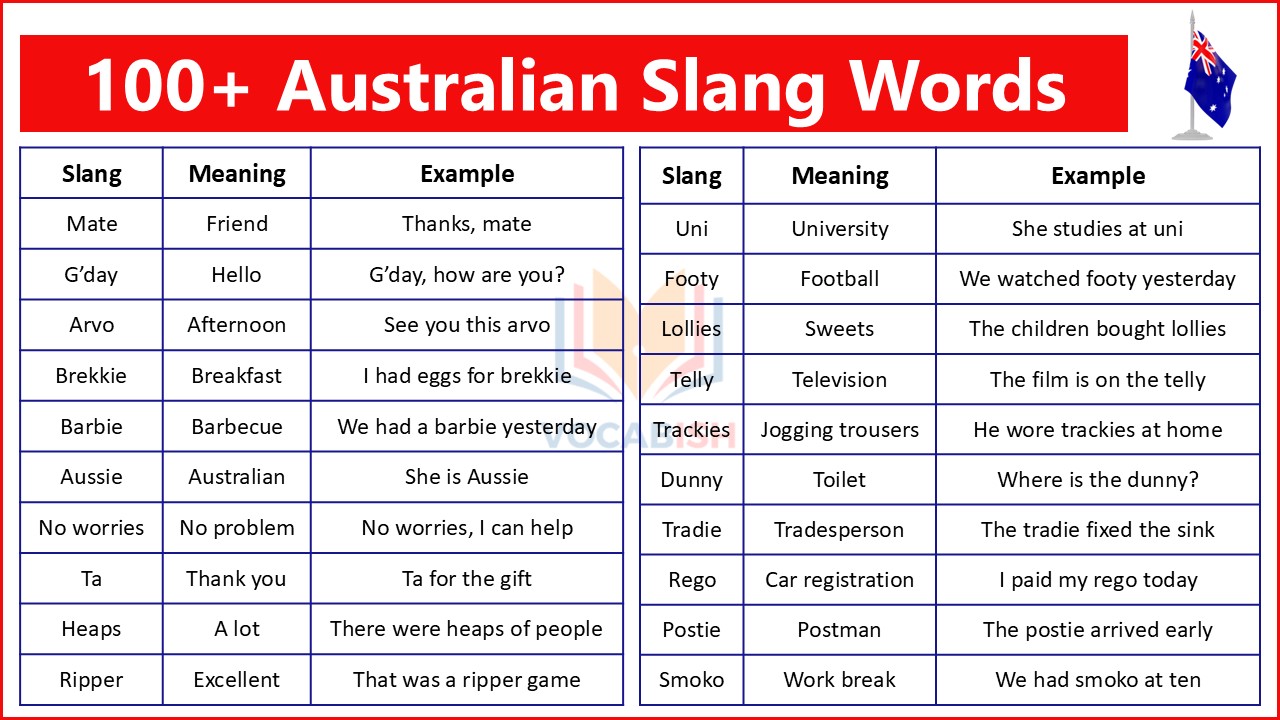
Here are some of the most common Australian slang words used every day.
Slang Word | Meaning | Example |
|---|---|---|
Mate | Friend | Thanks, mate |
G’day | Hello | G’day, how are you? |
Arvo | Afternoon | See you this arvo |
Brekkie | Breakfast | I had eggs for brekkie |
Barbie | Barbecue | We had a barbie yesterday |
Aussie | Australian | She is Aussie |
No worries | No problem | No worries, I can help |
Ta | Thank you | Ta for the gift |
Heaps | A lot | There were heaps of people |
Ripper | Excellent | That was a ripper game |
Australian Slang for People and Friends
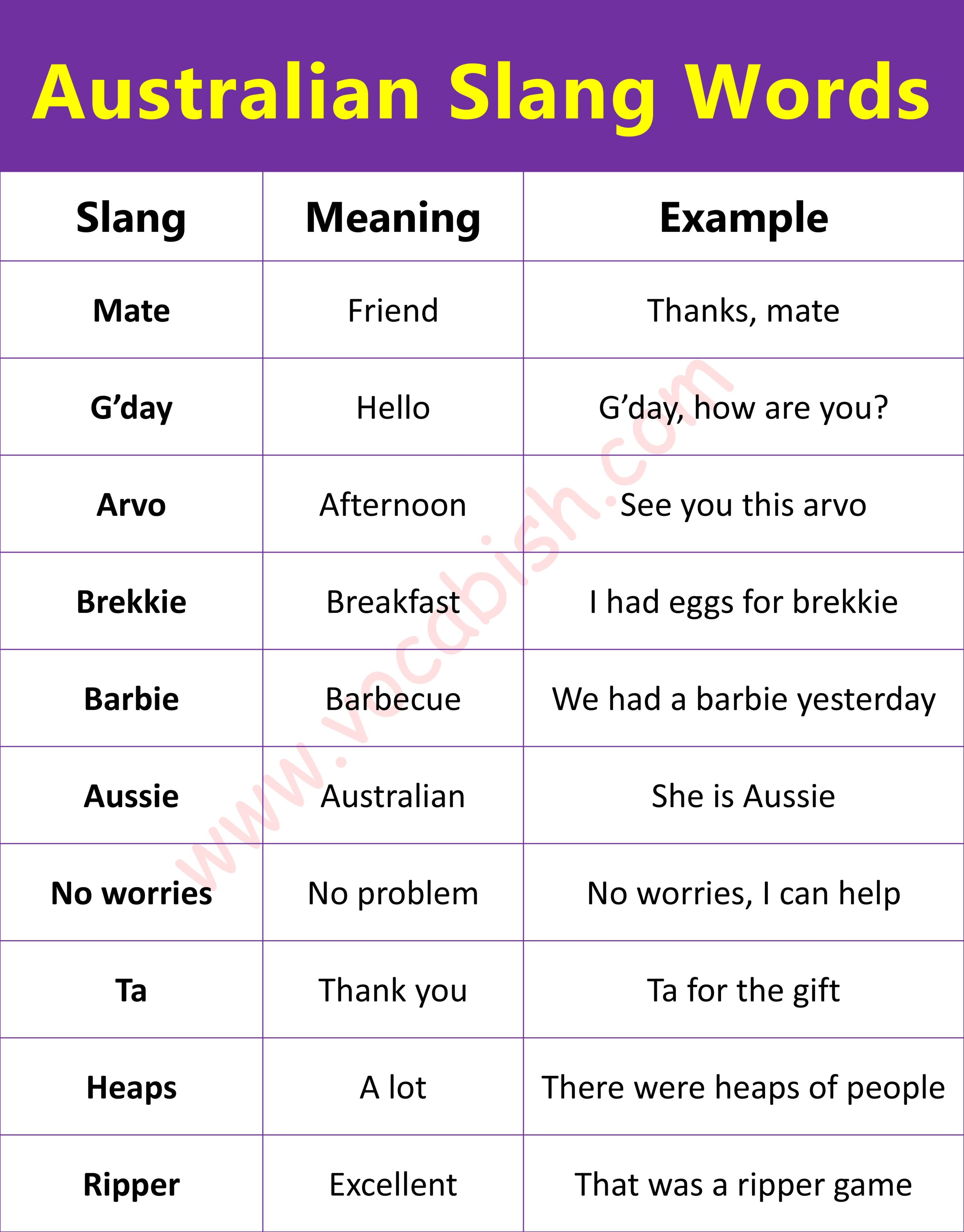
Australians use many slang words for people and relationships.
Slang | Meaning | Example |
|---|---|---|
Bloke | Man | That bloke is funny |
Sheila | Woman | The sheila works here |
Legend | Great person | You are a legend |
Cobber | Close friend | He is my cobber |
Bogan | Uncultured person | People called him a bogan |
Drongo | Silly person | Don’t be a drongo |
Dag | Funny person | He is a lovable dag |
Young fella | Young boy | The young fella is clever |
Missus | Wife or girlfriend | My missus loves music |
Hubby | Husband | Her hubby is friendly |
Food and Drink Slang Words
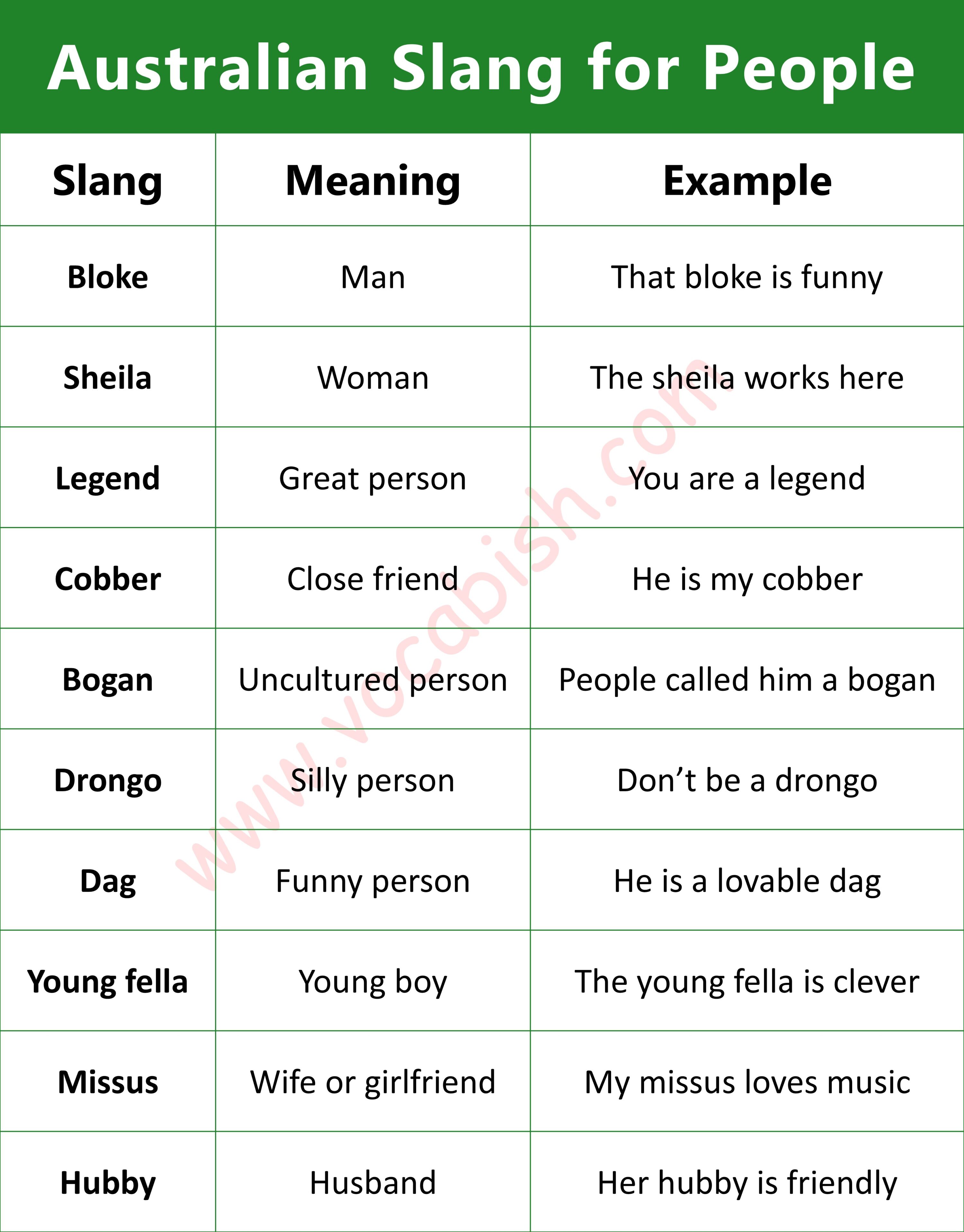
These food slangs are very common in Australia.
Slang | Meaning | Example |
|---|---|---|
Snag | Sausage | I ate two snags |
Sanga | Sandwich | I packed a sanga |
Bikkie | Biscuit | Have a bikkie |
Chook | Chicken | We cooked chook |
Cuppa | Tea or coffee | Let’s have a cuppa |
Tucker | Food | The tucker smells good |
Stubby | Beer bottle | He opened a stubby |
Esky | Cool box | Put drinks in the esky |
Cold one | Cold beer | He drank a cold one |
Macca’s | McDonald’s | We went to Macca’s |
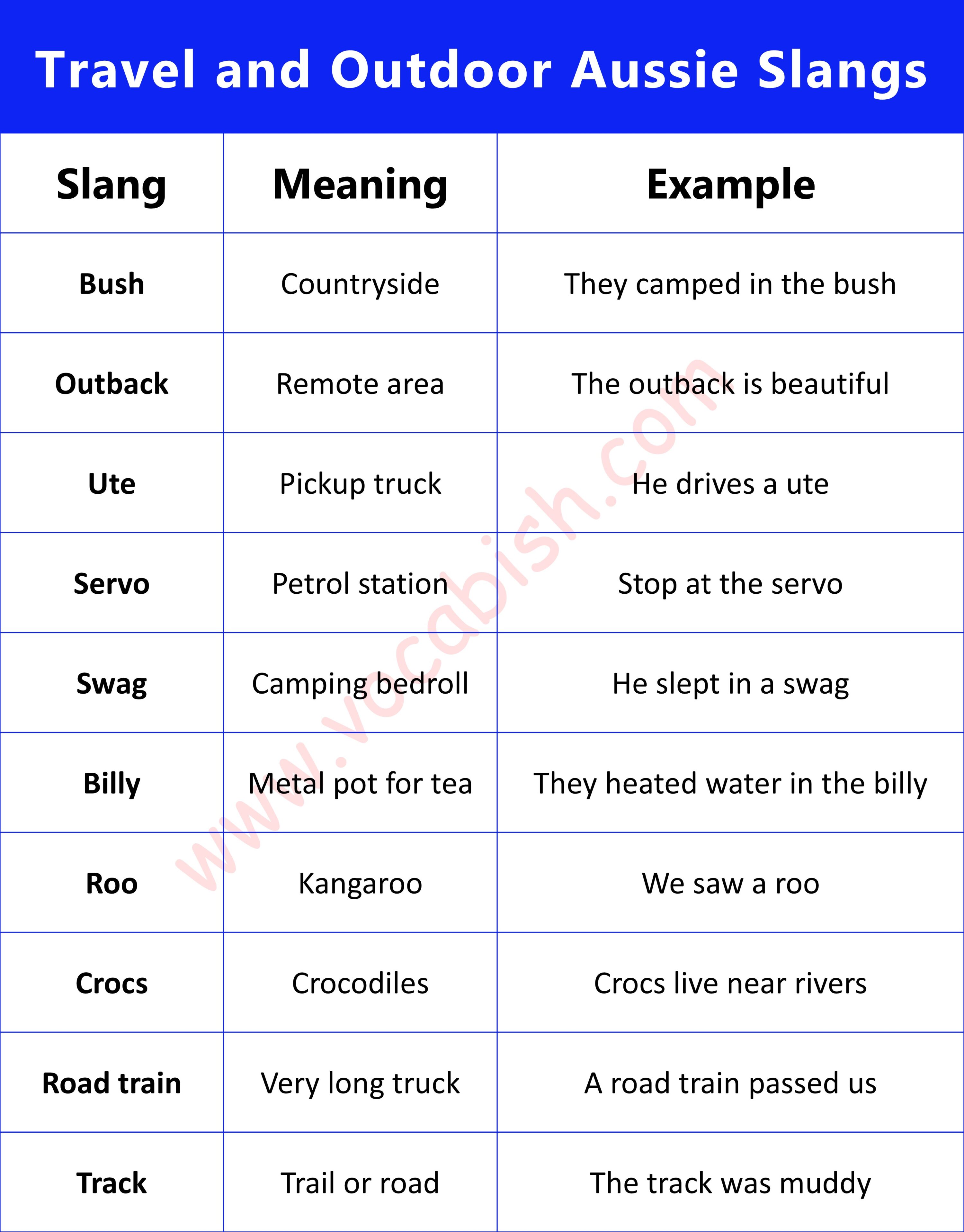
Australian Travel and Outdoor Slang
Australia has a strong outdoor culture. These slang words are useful while travelling.
Australian Slang | Meaning | Example |
|---|---|---|
Bush | Countryside | They camped in the bush |
Outback | Remote area | The outback is beautiful |
Ute | Pickup truck | He drives a ute |
Servo | Petrol station | Stop at the servo |
Swag | Camping bedroll | He slept in a swag |
Billy | Metal pot for tea | They heated water in the billy |
Roo | Kangaroo | We saw a roo |
Crocs | Crocodiles | Crocs live near rivers |
Road train | Very long truck | A road train passed us |
Track | Trail or road | The track was muddy |
Funny Australian Slang Phrases
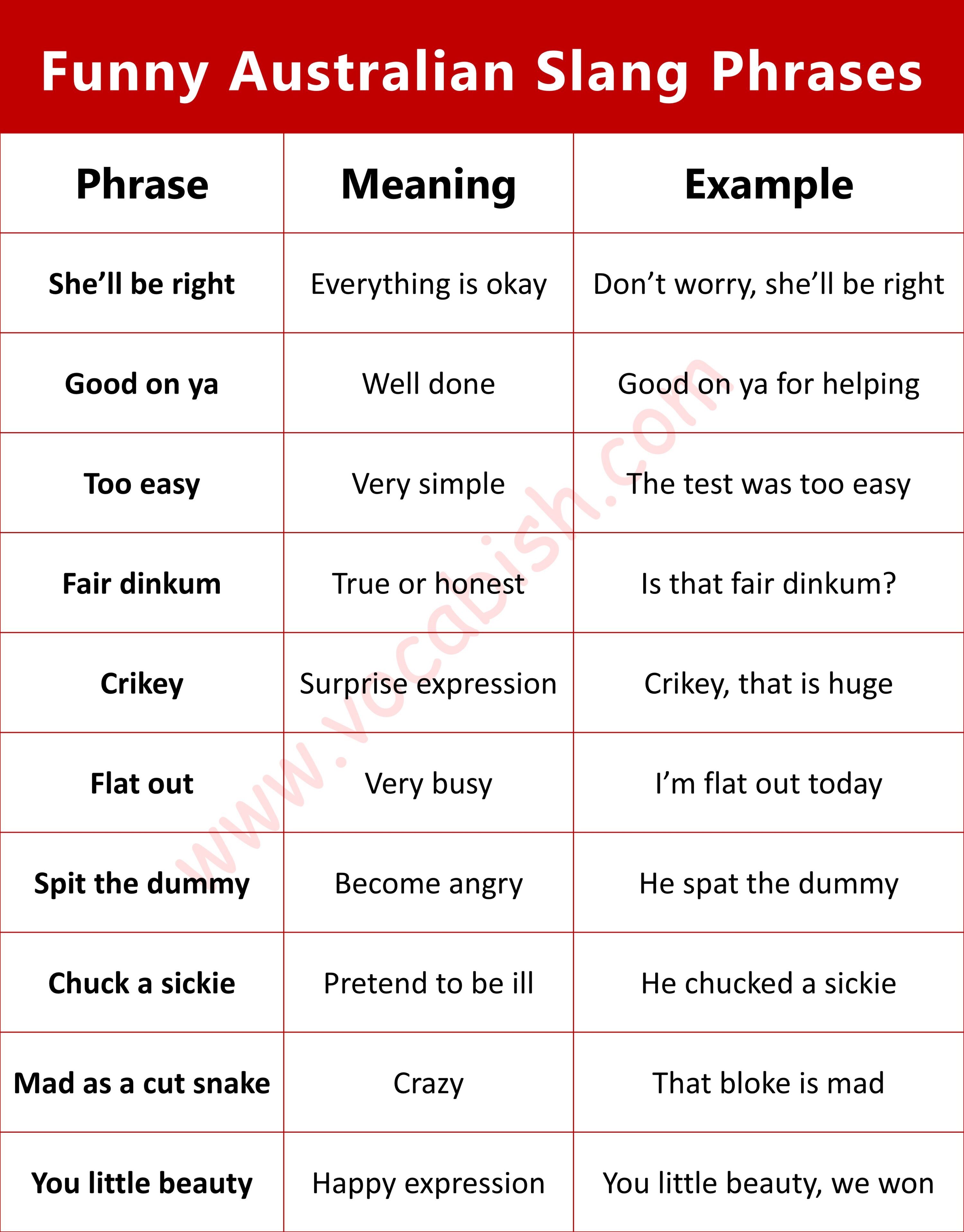
Australian English also includes funny and creative expressions.
Phrase | Meaning | Example |
|---|---|---|
She’ll be right | Everything is okay | Don’t worry, she’ll be right |
Good on ya | Well done | Good on ya for helping |
Too easy | Very simple | The test was too easy |
Fair dinkum | True or honest | Is that fair dinkum? |
Crikey | Surprise expression | Crikey, that is huge |
Flat out | Very busy | I’m flat out today |
Spit the dummy | Become angry | He spat the dummy |
Chuck a sickie | Pretend to be ill | He chucked a sickie |
Mad as a cut snake | Foolish | That bloke is mad |
You little beauty | Happy expression | You little beauty, we won |
Daily Life Aussie Slang Words and Meanings
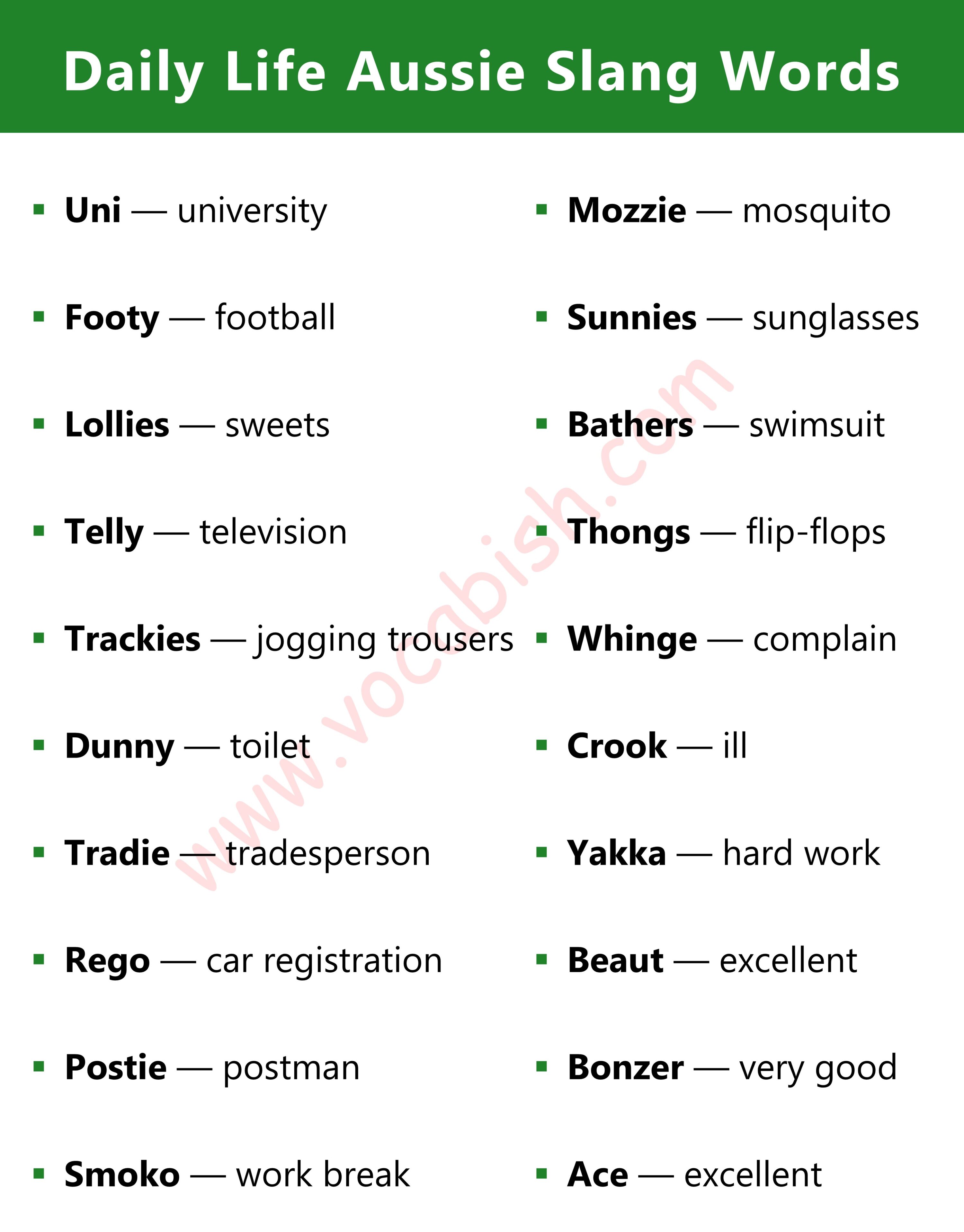
These slang words are common in daily conversations.
Australian Slang | Meaning | Example |
|---|---|---|
Uni | University | She studies at uni |
Footy | Football | We watched footy yesterday |
Lollies | Sweets | The children bought lollies |
Telly | Television | The film is on the telly |
Trackies | Jogging trousers | He wore trackies at home |
Dunny | Toilet | Where is the dunny? |
Tradie | Tradesperson | The tradie fixed the sink |
Rego | Car registration | I paid my rego today |
Postie | Postman | The postie arrived early |
Smoko | Work break | We had smoko at ten |
Mozzie | Mosquito | A mozzie bit my arm |
Sunnies | Sunglasses | Don’t forget your sunnies |
Bathers | Swimsuit | Bring your bathers to the beach |
Thongs | Flip-flops | She wore thongs outside |
Whinge | Complain | Stop having a whinge |
Crook | Ill | I feel crook today |
Yakka | Hard work | Farming is hard yakka |
Beaut | Excellent | What a beaut day |
Bonzer | Very good | That is a bonzer idea |
Ace | Excellent | You did an ace job |
Work and School Related Slangs
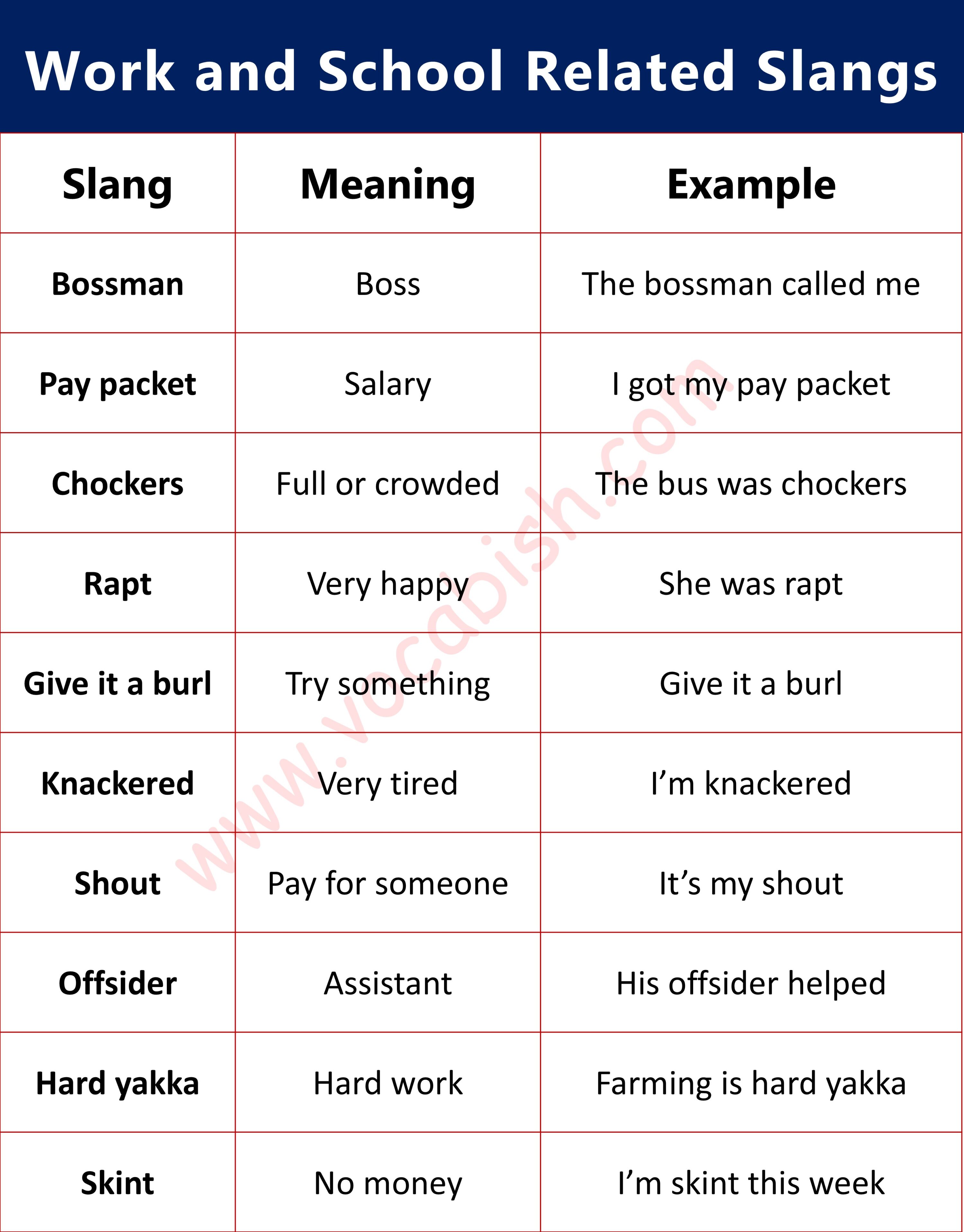
These slang words are often used at work and school.
Slang | Meaning | Example |
|---|---|---|
Bossman | Boss | The bossman called me |
Pay packet | Salary | I got my pay packet |
Chockers | Full or crowded | The bus was chockers |
Rapt | Very happy | She was rapt |
Give it a burl | Try something | Give it a burl |
Knackered | Very tired | I’m knackered |
Shout | Pay for someone | It’s my shout |
Offsider | Assistant | His offsider helped |
Hard yakka | Hard work | Farming is hard yakka |
Skint | No money | I’m skint this week |
30 Common Australian Phrases with Meanings
Australian Phrase | Meaning in English |
|---|---|
G’day | Hello |
No worries | No problem |
She’ll be right | Everything will be okay |
Good on ya | Well done |
Fair dinkum | True or honest |
How ya going? | How are you? |
Too easy | Very simple |
Mate | Friend |
Ta | Thank you |
Heaps good | Very good |
Flat out | Very busy |
Chuck a sickie | Pretend to be ill to miss work or school |
Spit the dummy | Become very angry |
Give it a burl | Try something |
Crikey | Expression of surprise |
You little beauty | Expression of happiness |
Mad as a cut snake | Foolish |
Hit the frog and toad | Leave or go away |
Buckley’s chance | No chance at all |
Hard yakka | Hard work |
Rapt | Very pleased or happy |
Chockers | Very full or crowded |
Knackered | Very tired |
Onya | Well done |
Mate’s rates | Discount for friends |
Strewth | Expression of surprise |
Hooroo | Goodbye |
Yonks ago | A very long time ago |
Beauty | Excellent or great |
Pull your head in | Behave properly or calm down |
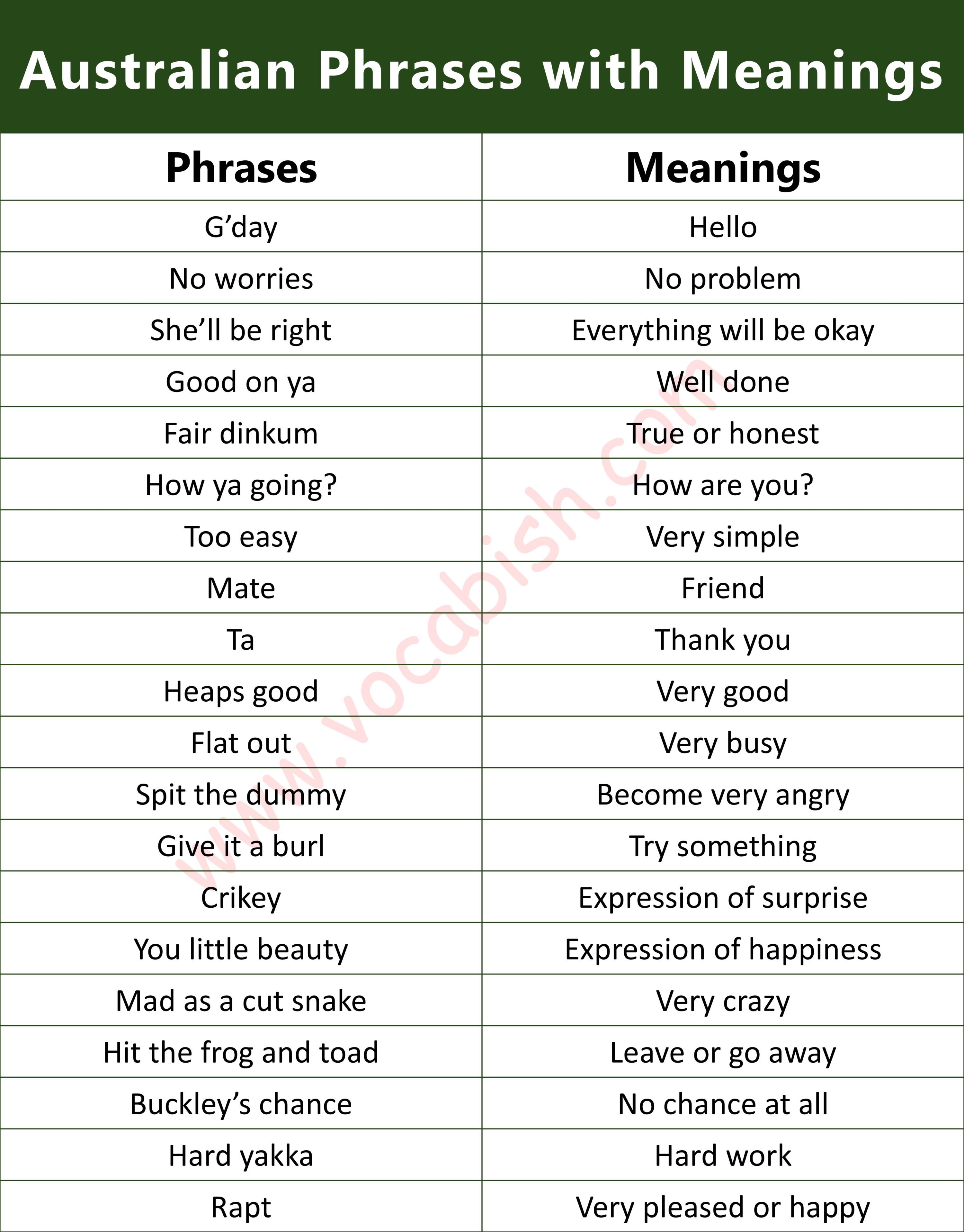
Download PDF
Tips to Learn Australian Slang Faster
Here are simple ways to remember Australian slang words:
- Watch Australian TV programmes
- Listen to native speakers
- Read simple English articles
- Practise short conversations
- Learn five words every day
- Use slang in casual speaking
- Repeat example sentences aloud
You May Also Like:
How to Speak Australian Slang
Here’s a step-by-step guide to speaking Australian slang:
- Learn easy slang words first
- Listen to Australian speakers often
- Use slang in casual conversations
- Practise short phrases daily
- Copy the Australian pronunciation
- Speak in a friendly and relaxed way
- Watch Australian films and videos
- Learn the meaning before using slang
- Start with common words like mate and no worries
- Do not use too much slang in formal situations
- Read Australian content online
- Practise speaking with confidence
Australian slang is an important part of modern English. These words make conversations sound more natural, friendly, and relaxed.
Start with easy slang words like mate, brekkie, and no worries. Then learn more phrases step by step. With practice, you will understand Australian English more clearly and speak with greater confidence.
FAQs about Australian Slang
Australian slangs are informal English words used in Australia. It includes short words, funny phrases, and casual expressions used in daily conversations by native speakers.
Mate means friend or buddy in Australian slang. Australians use this word to speak in a friendly and respectful way with other people.
Some common Australian slang words are mate, brekkie, arvo, barbie, servo, no worries, footy, sunnies, mozzie, and lollies.
A bogan is a person who behaves in a rough or uncultured way. Australians often use this slang jokingly in casual conversations.
Mozzie means mosquito in Australian slang. Australians commonly use this short word during summer and outdoor activities.
Learn common slang words, listen to native Australians, practise short phrases daily, and use slang naturally in casual conversations.
A bindi is a small sharp plant seed that can stick into your foot. Australians often use this word when talking about grass or gardens.