
Adjectives are words that describe or modify nouns. If you’ve ever said “a big house,” “a happy student,” or “three books,” you’ve already used adjectives. The tricky part is not using them—it’s using them correctly and in the right order. Many learners mix them up, especially when sentences get longer or more detailed.
In this article, you’ll understand what adjectives really are, how they work in sentences, the different types, and how to avoid the most common mistakes. By the end, adjectives will feel much more natural in your writing and speaking.
Introduction to Adjectives
Adjectives are one of the most important building blocks of English sentences. They help you give more information about people, places, things, and ideas.
Without adjectives, language feels flat and incomplete. Compare these two:
- “She bought a car.”
- “She bought a red sports car.”
The second sentence gives you a clearer picture immediately.
What is an Adjective?
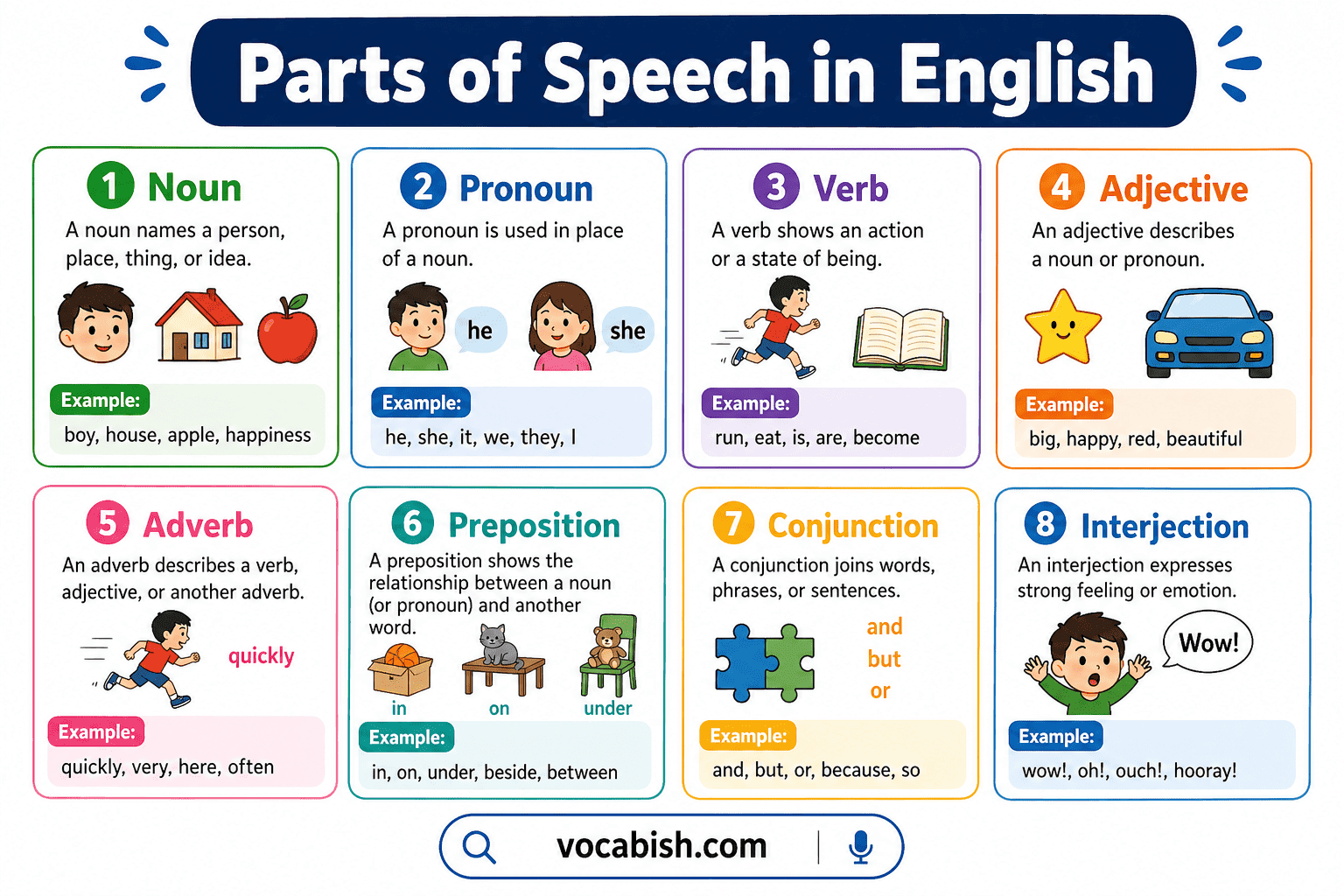
An adjective is a word that describes or gives more information about a noun or pronoun.
It tells you what kind, how many, which one, or how much.
Think of adjectives as “detail-givers.” They don’t exist alone; they always support a noun.
Examples:
- a tall man
- a cold drink
- three apples
- this book
- my phone
Most learners make the mistake of thinking adjectives are only about appearance (big, small, beautiful). In reality, they do much more than that.
Why Adjectives are Important in English
Adjectives make your communication clear, precise, and natural. Without them, you sound vague.
Why they matter:
- They help you describe things accurately
- They make writing more interesting
- They improve fluency in speaking
- They are essential in exams like IELTS and TOEFL
Example:
- “I saw a movie.” (not detailed)
- “I saw an exciting movie last night.” (clear and expressive)
Most learners underuse adjectives, especially in speaking. They stick to basic nouns and verbs, which limits expression.
Functions of Adjectives in Sentences
Adjectives can play different roles depending on where they appear in a sentence.
1. Before a noun (attributive position)
This is the most common use.
- a beautiful garden
- an interesting story
- a cold morning
2. After linking verbs (predicative position)
Here, adjectives describe the subject after verbs like is, seem, become, feel.
- She is tired.
- The soup smells delicious.
- He looks happy.
3. Modifying pronouns
Adjectives can also describe pronouns like something, someone, anything.
- Something strange happened.
- Someone new joined the class.
A common mistake is forgetting that adjectives don’t change form depending on singular or plural nouns.
Types of Adjectives with Definition and Examples
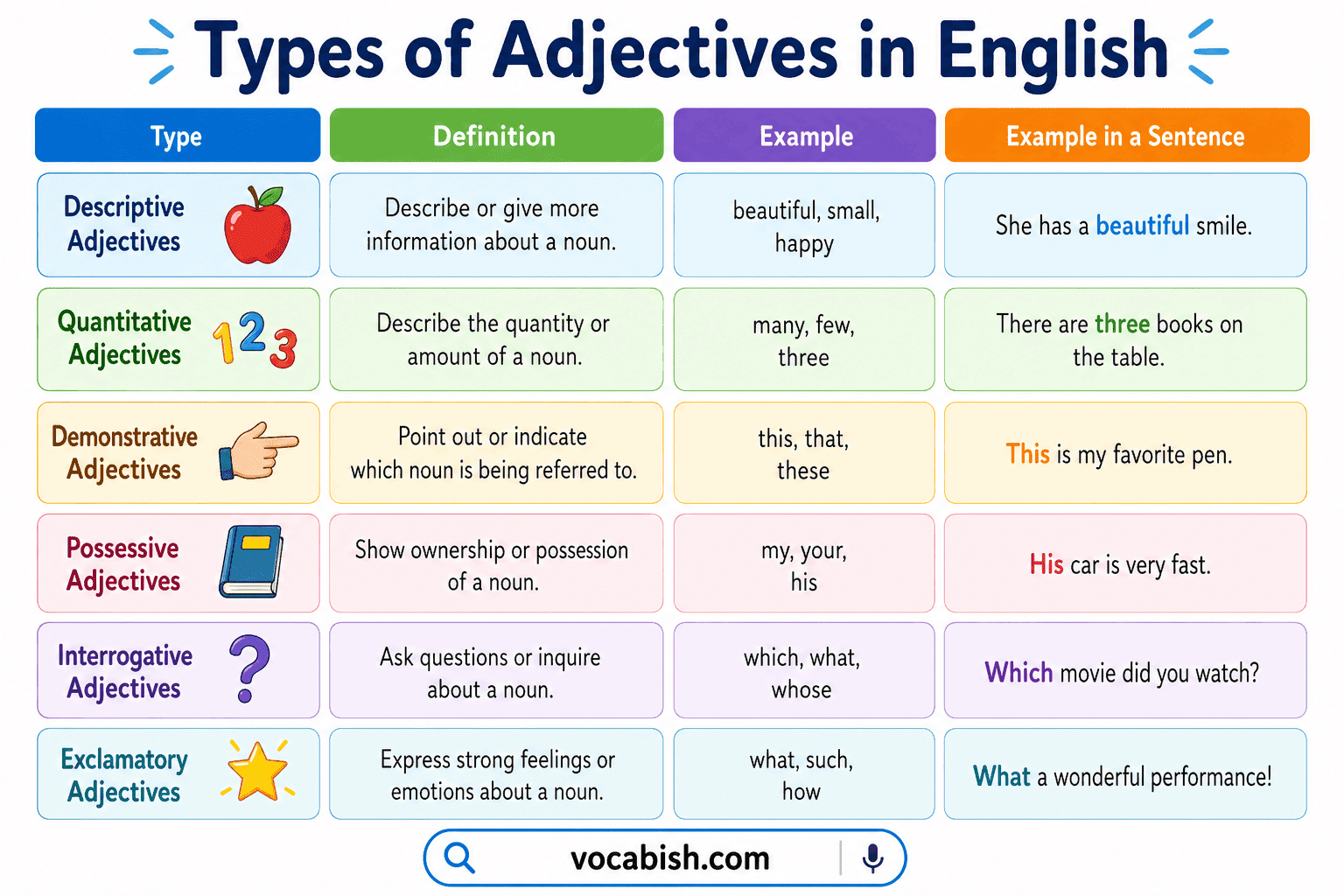
English has several types of adjectives. Each type gives different information about the noun.
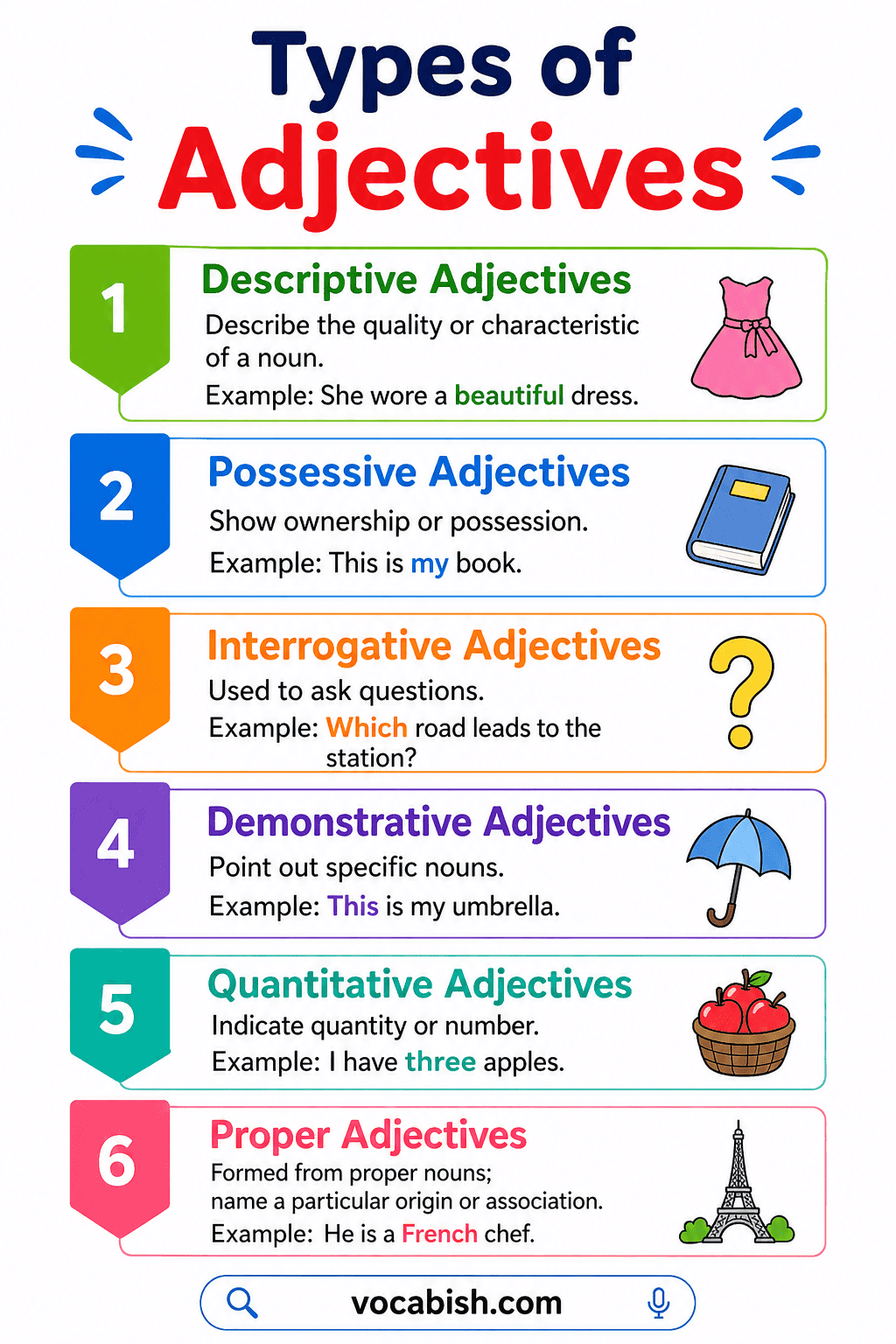
1. Descriptive Adjective
These describe qualities or characteristics.
- a smart student
- a noisy room
- a brave soldier
They answer the question: What kind?
Most learners rely heavily on these, but overusing basic ones like “good” or “nice” can make your English sound repetitive.
2. Quantitative Adjective
These show quantity (how much or how many, without exact numbers).
- some water
- much time
- few people
They are often confused with numbers, but they don’t give exact counts.
3. Numeral Adjective
These give exact numbers or order.
- three books
- first prize
- ten students
They are very precise and often used in instructions or formal writing.
4. Demonstrative Adjective
These point to specific nouns.
- this book
- that car
- these shoes
- those houses
They answer: Which one?
A common learner mistake is mixing “this/these” or “that/those.”
5. Possessive Adjective
These show ownership.
- my phone
- your bag
- her dress
- our home
Important point: these are NOT pronouns. They always come before nouns.
6. Interrogative Adjective
These are used in questions.
- which book do you want?
- what color is it?
- whose bag is this?
They are easy to confuse with interrogative pronouns, but adjectives always come with a noun.
7. Proper Adjective
These come from proper nouns (names of places, people, or cultures).
- Indian food
- Shakespearean plays
- French culture
They are always capitalized.
8. Distributive Adjective
These refer to members of a group individually.
- each student
- every child
- either option
- neither answer
They sound simple, but learners often confuse “each” and “every.”
Degrees of Adjectives
Adjectives can show comparison. This is called degrees of comparison.
1. Positive Degree
This is the basic form.
- a tall boy
- a fast car
No comparison is made here.
2. Comparative Degree
Used to compare two things.
- taller than
- faster than
Examples:
- This building is taller than that one.
- She is smarter than her brother.
3. Superlative Degree
Used to compare three or more things.
- the tallest
- the fastest
Examples:
- He is the tallest student in the class.
- This is the most interesting book I’ve read.
Comparison of Degrees of Adjectives
Degree | Form Example | Usage |
|---|---|---|
Positive | tall | No comparison |
Comparative | taller | Two things |
Superlative | tallest | Three or more |
Order of Adjectives in Sentences
When you use more than one adjective, English follows a natural order. This is where many learners struggle.
The general order is:
Opinion → Size → Age → Shape → Color → Origin → Material → Purpose
Example:
- a beautiful small old round red Italian wooden table
Yes, that looks long, but native speakers instinctively follow this order.
More natural examples:
- a lovely big new house
- a small black leather bag
- an expensive French wine bottle
A common mistake is mixing the order randomly, which makes sentences sound unnatural.
Memory tip: start with opinion and end with material.
How to Identify an Adjective in a Sentence
You can identify adjectives by asking simple questions:
- What kind?
- Which one?
- How many?
- How much?
Examples:
- The blue sky looks clear. → blue (what kind of sky?)
- She has two dogs. → two (how many?)
- This phone is expensive. → this (which phone?)
A frequent mistake is confusing adjectives with adverbs. Adjectives describe nouns, while adverbs describe verbs.
Common Mistakes with Adjectives
1. Using adjectives in the wrong position
Wrong: She is a girl beautiful.
Correct: She is a beautiful girl.
Why: Adjectives usually come before nouns.
2. Confusing “much” and “many”
Wrong: I have much friends.
Correct: I have many friends.
Why: “Many” is used with countable nouns.
3. Incorrect comparative forms
Wrong: more taller
Correct: taller
Why: Don’t double comparative forms.
4. Wrong order of adjectives
Wrong: a red big car
Correct: a big red car
Why: Size usually comes before color.
5. Using “very” with superlatives
Wrong: very the best
Correct: the best
Why: “The” already marks the superlative degree.
Adjective Exercises
1. Identify the Adjective
Find the adjective in each sentence:
- The sky is blue.
- She bought a new phone.
- They live in a big house.
- He is very tall.
Answers:
- blue
- new
- big
- tall
2. Fill in the Blanks
- She has a ___ dress. (beautiful)
- This is the ___ book in the library. (good)
- I saw ___ birds in the park. (three)
- He is ___ than his brother. (tall)
Answers:
- beautiful
- best
- three
- taller
3. Multiple Choice Questions
- Which is an adjective?
a) quickly
b) beautiful
c) run - Choose the correct sentence:
a) She is a girl intelligent.
b) She is an intelligent girl. - Which is correct?
a) more faster
b) faster
Answers:
- b
- b
- b
FAQs about Adjectives
An adjective is a word that describes or gives more information about a noun or pronoun. It tells what kind, how many, or which one, like big house or three apples.
The main types include descriptive, quantitative, numeral, demonstrative, possessive, interrogative, proper, and distributive adjectives. Each type gives different information about a noun.
Yes, “long-anticipated” is a compound adjective. It describes a noun by showing something expected for a long time, such as a long-anticipated event or a long-anticipated release.
An adjective usually answers questions like “what kind,” “which one,” or “how many.” It is placed before a noun or after linking verbs like is, seems, or feels.
Common adjectives include big, small, happy, fast, beautiful, old, and three. They describe nouns by showing size, quality, age, number, or other details in everyday sentences.
The usual order is opinion, size, age, shape, color, origin, material, and purpose. For example: a beautiful small red Italian bag follows this natural structure.
Common mistakes include wrong word order, using double comparatives like “more taller,” and confusing adjectives with adverbs. Correct usage depends on sentence position and grammar rules.
A predicate adjective comes after a linking verb and describes the subject. For example, in She is happy, “happy” is the predicate adjective describing “she.”
A descriptive adjective describes the quality or feature of a noun, such as happy student or cold weather. It answers the question “what kind of thing is it?”
Adjectives describe nouns, while adverbs describe verbs, adjectives, or other adverbs. For example, fast car uses an adjective, but runs fast uses an adverb.
Yes, “fun” can be used as an adjective in informal English. For example, a fun game or a fun trip. In formal contexts, “enjoyable” is often preferred.
Conclusion
Adjectives are essential for making your English clear, expressive, and natural. They describe nouns, show quantity, compare things, and help you build more detailed sentences.
Once you understand the types and correct order, your confidence in both speaking and writing improves quickly. The key is not memorizing rules mechanically, but noticing how adjectives work in real sentences and practicing them regularly.
You May Also Like: