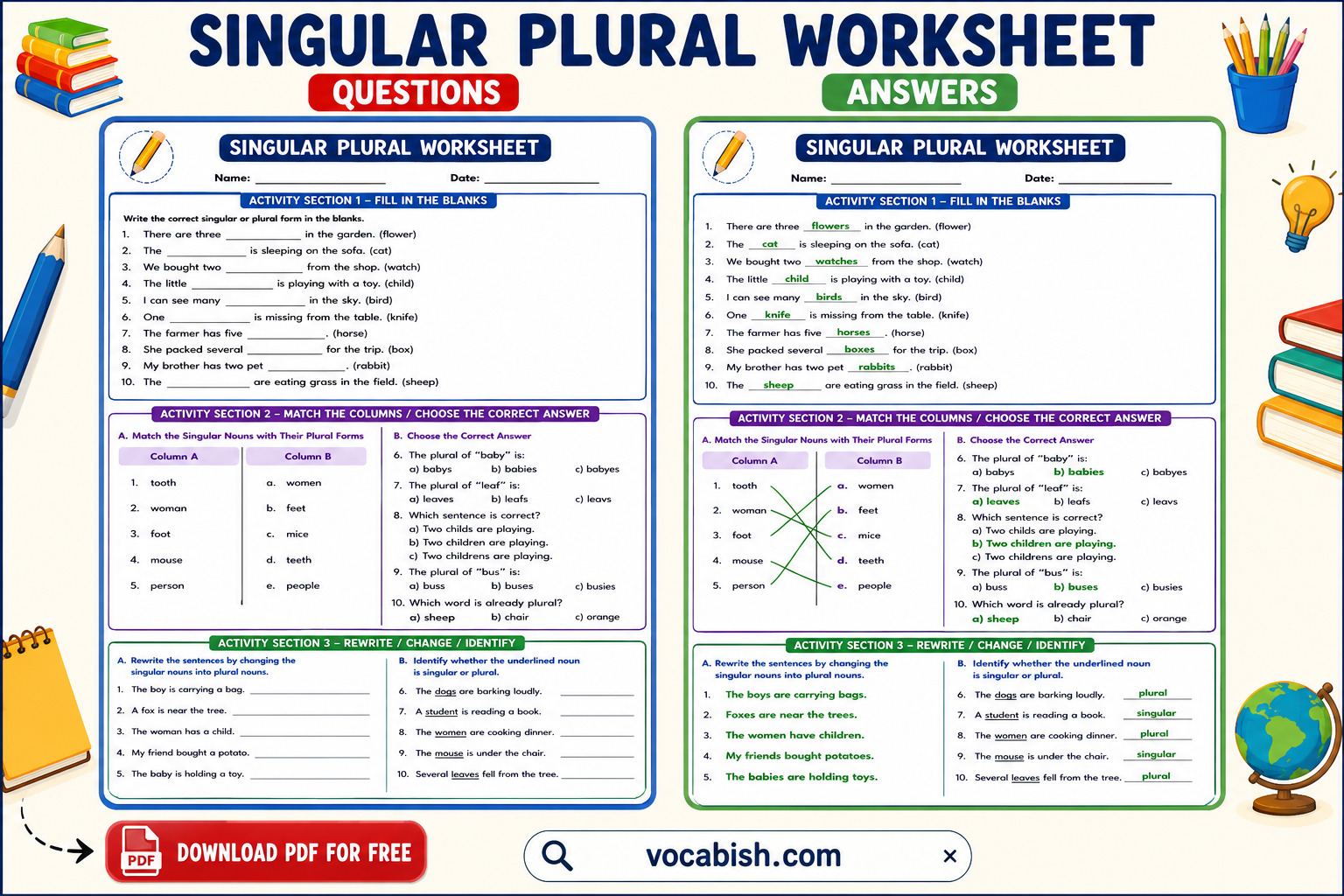

Welcome to this Singular Plural Worksheet with Answers designed for English learners and middle school students. In this worksheet, learners will practise changing singular nouns into plural nouns through simple explanations, examples, and grammar exercises. These practice sentences will help students improve their English grammar, vocabulary, and sentence-writing skills in an easy and structured way.
This worksheet includes:
- Clear rules and examples
- Fill-in-the-blanks exercises
- Matching and multiple-choice questions
- Rewrite and identify activities
- A complete answer key
What Are Singular and Plural Nouns?
A singular noun means one person, place, animal, or thing.
Examples:
- cat
- book
- child
A plural noun means more than one person, place, animal, or thing.
Examples:
- cats
- books
- children
Rules for Making Plural Nouns
Singular Noun | Plural Noun | Rule |
|---|---|---|
cat | cats | Add -s |
bus | buses | Add -es |
baby | babies | Change y to ies |
knife | knives | Change f/fe to ves |
child | children | Irregular plural |
man | men | Irregular plural |
More Examples:
- One apple → Two apples
- One box → Three boxes
- One city → Many cities
- One wolf → Several wolves
These grammar exercises will help English learners understand how singular and plural nouns work in everyday English.
Activity Section 1 – Fill in the Blanks
Write the correct singular or plural form in the blanks.
- There are three ________ in the garden. (flower)
- The ________ is sleeping on the sofa. (cat)
- We bought two ________ from the shop. (watch)
- The little ________ is playing with a toy. (child)
- I can see many ________ in the sky. (bird)
- One ________ is missing from the table. (knife)
- The farmer has five ________. (horse)
- She packed several ________ for the trip. (box)
- My brother has two pet ________. (rabbit)
- The ________ are eating grass in the field. (sheep)
Activity Section 2 – Match the Columns / Choose the Correct Answer
A. Match the Singular Nouns with Their Plural Forms
Column A | Column B |
|---|---|
1. tooth | a. women |
2. woman | b. feet |
3. foot | c. mice |
4. mouse | d. teeth |
5. person | e. people |
B. Choose the Correct Answer
- The plural of “baby” is:
- a) babys
- b) babies
- c) babyes
- The plural of “leaf” is:
- a) leaves
- b) leafs
- c) leavs
- Which sentence is correct?
- a) Two childs are playing.
- b) Two children are playing.
- c) Two childrens are playing.
- The plural of “bus” is:
- a) buss
- b) buses
- c) busies
- Which word is already plural?
- a) sheep
- b) chair
- c) orange
Activity Section 3 – Rewrite / Change / Identify
Rewrite the sentences by changing the singular nouns into plural nouns.
- The boy is carrying a bag.
- A fox is near the tree.
- The woman has a child.
- My friend bought a potato.
- The baby is holding a toy.
Identify whether the underlined noun is singular or plural.
- The dogs are barking loudly.
- A student is reading a book.
- The women are cooking dinner.
- The mouse is under the chair.
- Several leaves fell from the tree.
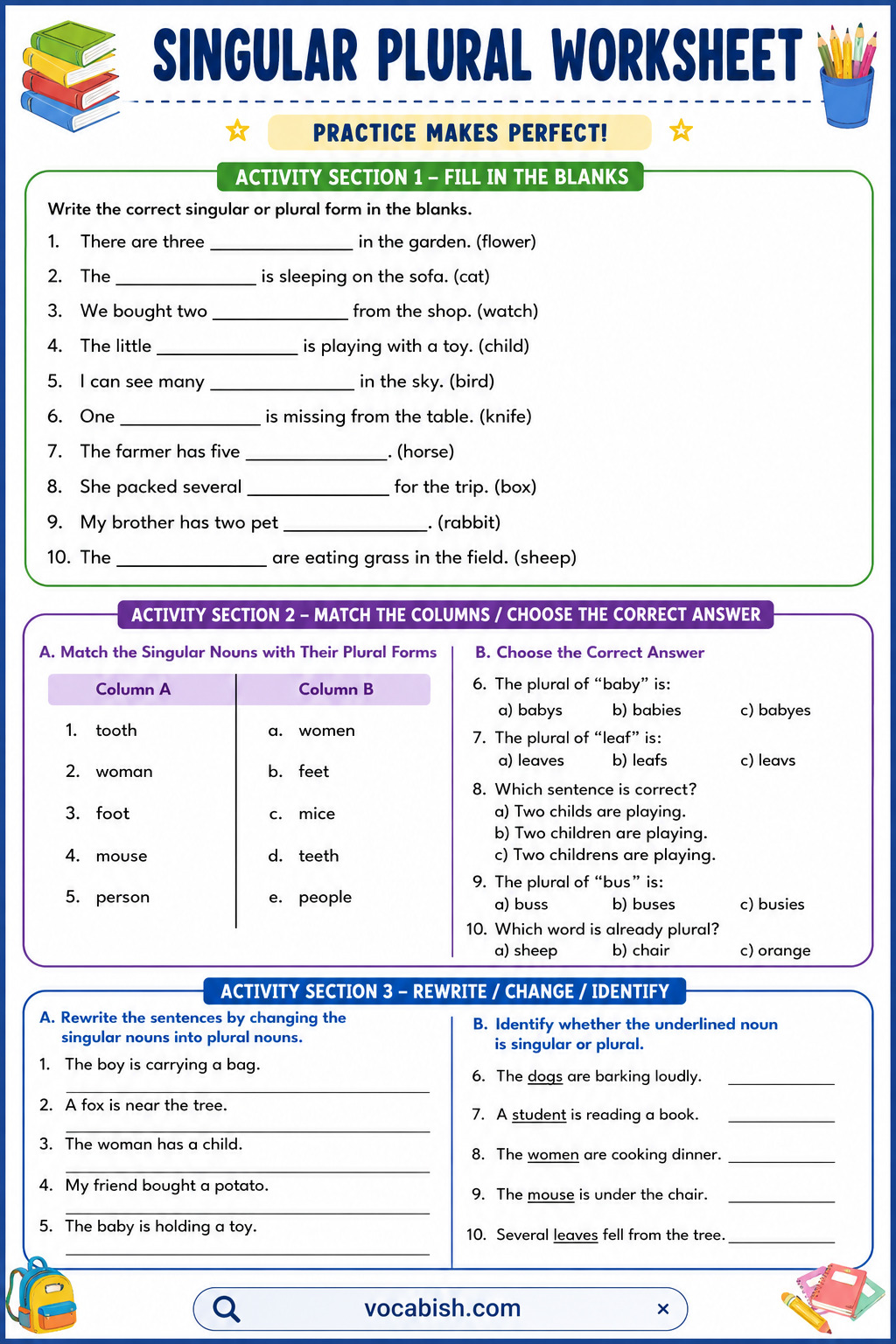
Answer Key
Activity Section 1 Answers
- flowers
- cat
- watches
- child
- birds
- knife
- horses
- boxes
- rabbits
- sheep
Activity Section 2 Answers
A. Match the Columns
1 → d
2 → a
3 → b
4 → c
5 → e
B. Multiple Choice
- b) babies
- a) leaves
- b) Two children are playing.
- b) buses
- a) sheep
Activity Section 3 Answers
- The boys are carrying bags.
- Foxes are near the trees.
- The women have children.
- My friends bought potatoes.
- The babies are holding toys.
- plural
- singular
- plural
- singular
- plural
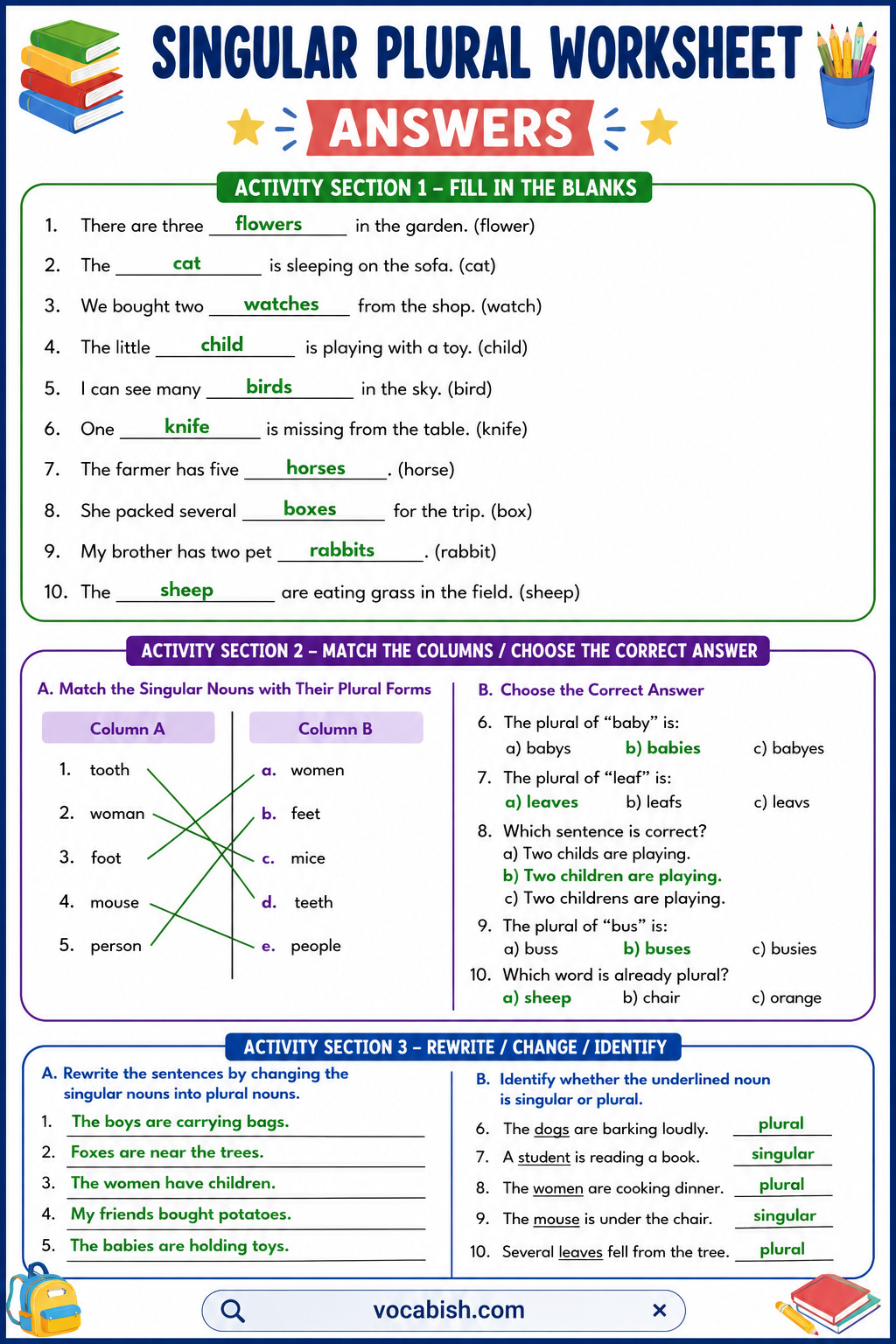
Download PDF of Worksheet
This Singular Plural Worksheet with Answers gives English learners useful grammar practice through examples, rewrite tasks, and practice sentences. Regular use of worksheets like this can improve grammar accuracy, vocabulary, and sentence-building skills. Continue practising these grammar exercises to become more confident in English writing and speaking.
Get More Worksheets PDF: