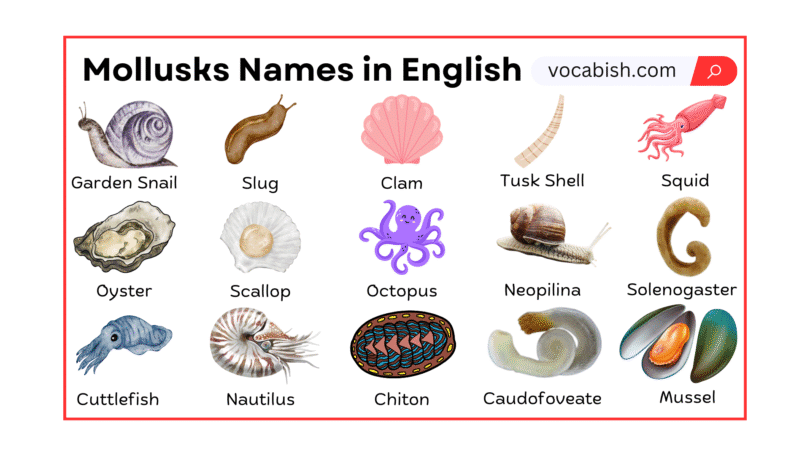

In this blog post, you will learn the names of different mollusks in English, along with pictures to help you recognize them. Knowing these animal names can improve your speaking, reading, writing, and listening skills. By exploring mollusks, such as octopuses, clams, and snails, you expand your vocabulary and gain confidence when describing animals in English. Let’s discover these fascinating creatures and master the words that describe them.
Mollusks Meaning in English
Mollusks are a large group of soft-bodied animals found in both water and on land. Most mollusks have a shell that protects their body, but some, like octopuses and squids, do not. They are one of the oldest and most diverse groups of animals on Earth.
Examples:
- A clam lives inside two shells.
- An octopus uses eight arms to catch food.
Characteristics of Mollusks
- Soft body (protected by a shell in most species).
- Bilateral symmetry (left and right body sides are equal).
- Body parts include: foot, mantle, and visceral mass.
- Most are aquatic but some (like land snails) live on land.
- Nervous system ranges from simple (clams) to advanced (octopuses).
7 Types of Mollusks with Examples
Mollusks are divided into different groups based on their body structure and features. Below are the 7 main types of mollusks with examples.
1. Gastropods
Soft-bodied mollusks, usually with one shell or no shell, move slowly.
Usually have a spiral shell (except slugs).
Examples: Garden Snail, Sea Slug, Limpet
2. Bivalves
Mollusks with two shells connected by a hinge, live mostly in water.
Mostly filter feeders that live in water.
Examples: Clam, Mussel, Oyster, Scallop
3. Cephalopods
Intelligent mollusks with tentacles, fast swimmers, no external shell in most.
Can change color and squirt ink for defense.
Examples: Octopus, Squid, Cuttlefish, Nautilus
4. Polyplacophora
Mollusks with eight shell plates on their back, live on rocky surfaces.
Example: Chiton
5. Scaphopods
Tube-shaped mollusks that live buried in sand, also called tusk shells.
Example: Tusk Shell
6. Monoplacophora
Rare deep-sea mollusks with a single cap-like shell and simple body.
Example: Neopilina
7. Aplacophora
Worm-like mollusks without shells, soft body covered with tiny spines.
Examples: Solenogaster, Caudofoveate
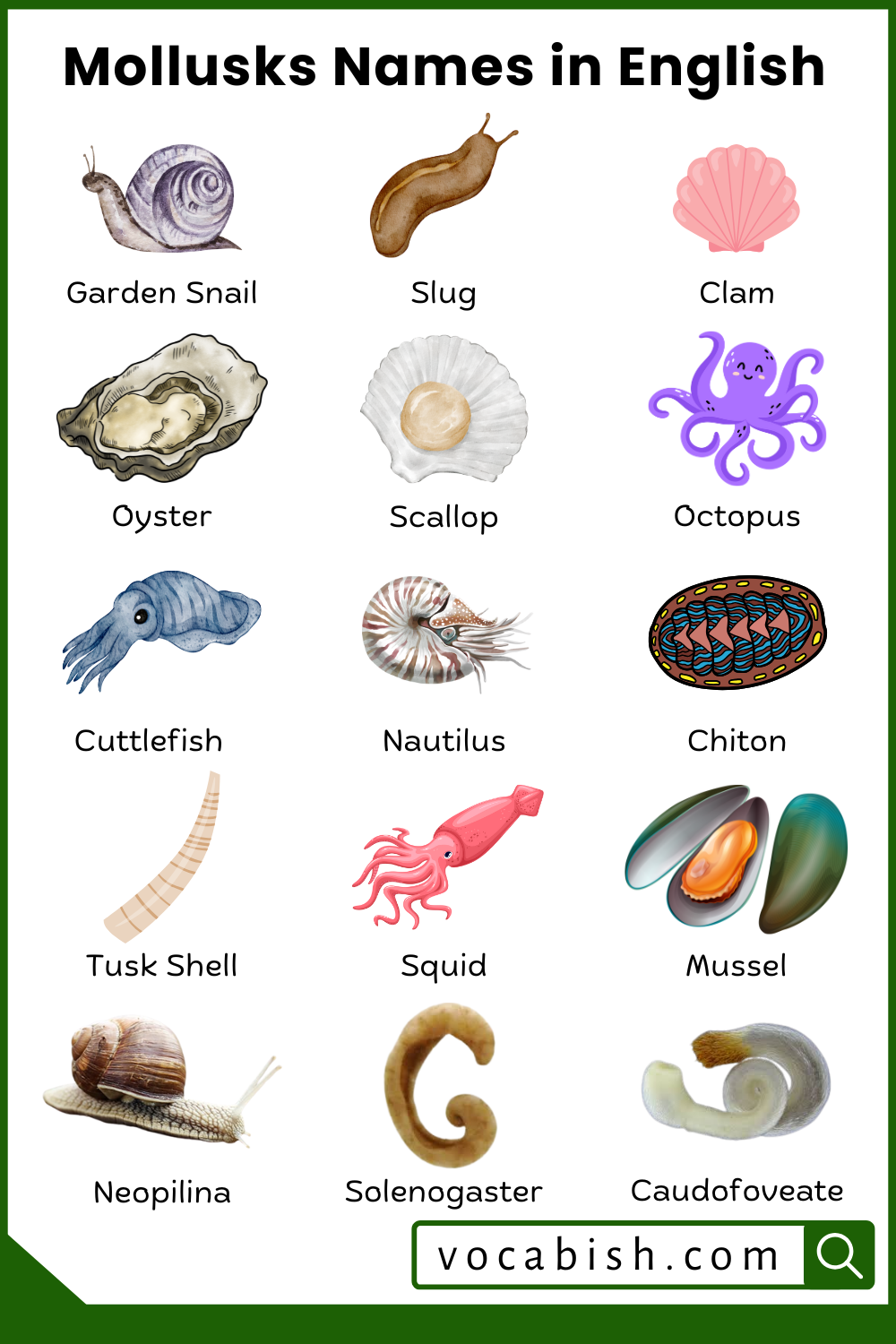
Common Mollusks Names with Pictures
Garden Snail
A land gastropod with a spiral shell, slow-moving.
Slug
A shell-less gastropod, lives in gardens and damp places.
Clam
Bivalve mollusk with two shells, found buried in sand.
Mussel
Black-shelled mollusk that attaches to rocks in water.
Oyster
Bivalve that produces pearls inside its shell.
Scallop
Bivalve with fan-shaped shells, can swim by clapping shells.
Octopus
Intelligent cephalopod with eight arms and ink defense.
Squid
Cephalopod with a long body and tentacles, fast swimmer.
Cuttlefish
Cephalopod with a unique inner shell called cuttlebone.
Nautilus
Ancient cephalopod with a spiral shell.
Chiton
Polyplacophora mollusk with eight hard plates.
Tusk Shell
Scaphopod with a long tube-like shell.
Neopilina
A simple monoplacophoran mollusk, very rare.
Solenogaster
A worm-like mollusk with no shell, lives in the sea.
Caudofoveate
Another worm-like shell-less mollusk from deep sea.
Facts about Mollusks
- The giant squid is one of the largest invertebrates in the world.
- Oysters can produce natural pearls.
- Snails are among the slowest animals.
- Cephalopods are known for their intelligence and problem-solving.
- Mollusks have existed for over 500 million years.
Scientific Name for Mollusks
Category | Scientific Name | Description |
|---|---|---|
Kingdom | Animalia | Mollusks are animals with soft bodies and no backbone. |
Phylum (Main Group) | Mollusca | The scientific name for mollusks as a complete group. |
Common Name | Mollusks | Includes snails, clams, octopuses, and similar animals. |
Gastropods | Gastropoda | Largest group including snails and slugs. |
Bivalves | Bivalvia | Mollusks with two shells like clams and oysters. |
Cephalopods | Cephalopoda | Intelligent mollusks like octopus and squid. |
Polyplacophora | Polyplacophora | Marine mollusks with eight shell plates, like chitons. |
Scaphopoda | Scaphopoda | Tusk-shaped mollusks living in sand. |
Monoplacophora | Monoplacophora | Rare deep-sea mollusks with single shell. |
Aplacophora | Aplacophora | Worm-like mollusks without shells. |
A to Z List of Mollusks
A → Abalone, Ark Clam
B → Blue Mussel, Black Limpet
C → Clam, Chiton, Cuttlefish
D → Dog Whelk, Duck Mussel
E → Eastern Oyster, Elephant Tusk Shell
F → Freshwater Mussel, Flamingo Tongue Snail
G → Garden Snail, Giant Squid
H → Hard Clam, Horse Mussel
I → Island Scallop
J → Japanese Oyster
K → Keyhole Limpet
L → Limpet, Land Snail
M → Mussel, Moon Snail
N → Nautilus, Neopilina
O → Octopus, Oyster
P → Pearl Oyster, Periwinkle Snail
Q → Queen Conch
R → Razor Clam
S → Squid, Scallop, Sea Slug, Slug
T → Tusk Shell
U → Umbrella Limpet
V → Venus Clam
W → Whelk, Windowpane Oyster
X → Xenophora (Carrier Shell)
Y → Yoldia Clam
Z → Zebra Mussel
Mollusks are soft-bodied animals with incredible diversity. From snails and clams to octopuses and squids, they play an important role in nature and human life. Learning mollusks names in English helps us understand these unique creatures better.
FAQs about Mollusks
Mollusks are soft-bodied animals, often with shells, living in water or on land. Common examples include snails, clams, and octopuses. They belong to a large animal group called Mollusca.
Yes, octopuses are mollusks. They belong to the cephalopod group and have soft bodies, eight arms, and high intelligence. They live in oceans and move quickly.
Common mollusks names in English include snail, slug, clam, oyster, mussel, squid, octopus, and scallop. These names are widely used in science, food, and daily English vocabulary.
Yes, snails are mollusks. They are part of the gastropod group and have a soft body with a spiral shell. Snails live on land and in water.
The main types of mollusks are gastropods, bivalves, cephalopods, polyplacophora, scaphopoda, monoplacophora, and aplacophora. Each group has different body structures, shells, and living environments.
Mollusks eat different foods depending on their type. Some eat plants and algae, while others eat small animals. For example, snails eat leaves, and octopuses eat fish.
Mollusks are invertebrates, meaning they do not have a backbone. Their bodies are soft, and many have shells for protection, like clams and snails.
Mollusks live in oceans, freshwater, and on land. Snails and slugs live on land, while clams, oysters, and octopuses live mostly in marine environments.
The oyster is a mollusk known for making pearls. It forms pearls inside its shell as a natural defense. Pearls are valued for jewelry and decoration.
Related Articles: