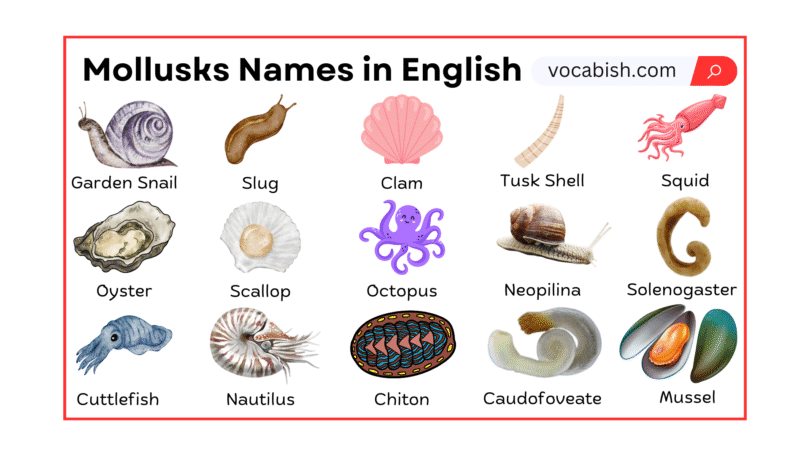

Mollusks names in English include snails, slugs, octopuses, squids, clams, oysters, mussels, and scallops. Mollusks are invertebrate animals with soft bodies, and many species have a hard shell for protection. They live in oceans, freshwater habitats, and on land, with different groups showing unique body structures, feeding habits, and ways of moving.
In this article, you will find mollusk names with pictures to help you recognize different species. We cover common types of mollusks, including gastropods, bivalves, and cephalopods, along with familiar examples from each group to expand your English vocabulary about animals and marine life.
Mollusks Meaning in English
Mollusks are a large group of soft-bodied animals found in both water and on land. Most mollusks have a shell that protects their body, but some, like octopuses and squids, do not. They are one of the oldest and most diverse groups of animals on Earth.
Examples:
- A clam lives inside two shells.
- An octopus uses eight arms to catch food.
Characteristics of Mollusks
- Soft body (protected by a shell in most species).
- Bilateral symmetry (left and right body sides are equal).
- Body parts include: foot, mantle, and visceral mass.
- Most are aquatic but some (like land snails) live on land.
- Nervous system ranges from simple (clams) to advanced (octopuses).
7 Types of Mollusks with Examples
Mollusks are divided into different groups based on their body structure and features. Below are the 7 main types of mollusks with examples.
1. Gastropods
Gastropods are the largest group of mollusks and include familiar animals such as snails, slugs, limpets, and sea hares. Many have a single shell, often spiraled, while slugs and some marine species have reduced or no external shell. They move using a muscular foot and commonly feed on plants, algae, or other small animals. Gastropods live in gardens, forests, freshwater habitats, and oceans, making their names useful for everyday animal vocabulary.
Examples:
- Garden Snail
- Land Snail
- Sea Snail
- Freshwater Snail
- Apple Snail
- Cone Snail
- Moon Snail
- Cowrie
- Whelk
- Periwinkle
- Limpet
- Abalone
- Conch
- Slug
- Sea Slug
- Nudibranch
- Sea Hare
2. Bivalves
Bivalves are mollusks whose bodies are protected by two hinged shells. Clams, mussels, oysters, and scallops belong to this group, although their shell shapes and lifestyles differ. Most bivalves filter tiny food particles from water, while many live buried in sand or mud or attached to underwater surfaces. Some species, such as freshwater mussels, live in rivers and lakes, whereas others inhabit coastal and deep marine environments.
Examples:
- Hard Clam
- Soft-Shell Clam
- Giant Clam
- Razor Clam
- Surf Clam
- Geoduck
- Manila Clam
- Quahog
- Carpet Clam
- Blue Mussel
- Green-Lipped Mussel
- Mediterranean Mussel
- Zebra Mussel
- Freshwater Pearl Mussel
- Eastern Oyster
- Pacific Oyster
- European Flat Oyster
- Olympia Oyster
- Pearl Oyster
- Sea Scallop
- Bay Scallop
- Calico Scallop
- Queen Scallop
3. Cephalopods
Cephalopods include octopuses, squids, cuttlefish, and nautiluses. Most have arms or tentacles, well-developed eyes, and active lifestyles suited to hunting in the ocean. Octopuses lack an external shell, while squids and cuttlefish have reduced internal shell structures; nautiluses retain a prominent external shell. Many cephalopods can change color, and some release ink to confuse predators while escaping.
Examples:
- Common Octopus
- Giant Pacific Octopus
- Blue-Ringed Octopus
- Mimic Octopus
- Coconut Octopus
- Dumbo Octopus
- Blanket Octopus
- Giant Squid
- Colossal Squid
- Common Squid
- Flying Squid
- Bobtail Squid
- Firefly Squid
- Common Cuttlefish
- Flamboyant Cuttlefish
- Broadclub Cuttlefish
- Giant Cuttlefish
- Chambered Nautilus
- Vampire Squid
Note: The vampire squid is a cephalopod, but it is not a true squid. Bobtail squids are also distinct from typical squids.
4. Polyplacophora
Polyplacophorans, commonly called chitons, are marine mollusks with eight overlapping shell plates along their backs. Their broad, muscular feet help them cling tightly to rocks in wave-exposed coastal habitats. Many scrape algae from rock surfaces using a specialized feeding structure called a radula. Unlike snails with a single main shell, chitons have a flexible, plated covering that makes them distinctive in photographs.
Example:
- Gumboot Chiton
- Lined Chiton
- Mossy Chiton
- West Indian Fuzzy Chiton
5. Scaphopods
Scaphopods are marine mollusks with long, curved, tubular shells that resemble tiny elephant tusks. The shell is open at both ends, allowing the animal to extend its foot into the surrounding sediment. Most live buried in sand or mud on the seafloor and feed on microscopic organisms, including foraminifera. Tusk shells are less familiar than snails or clams, but they help illustrate the variety of shell shapes found among mollusks.
Example:
- Common Tusk Shell
- Elephant Tusk Shell
- Antalis Tusk Shell
6. Monoplacophora
Monoplacophorans are a rare group of marine mollusks with a single, cap-shaped shell. They live mainly on the deep seafloor, where their bodies and habits are difficult to observe directly. Some internal structures, including certain muscles and organs, occur in repeated arrangements along the body. Genera such as Neopilina are examples of this group, making monoplacophorans an interesting addition to an article covering both familiar and unusual mollusks.
Example:
- Neopilina
- Vema
- Laevipilina
7. Aplacophora
Aplacophorans are small, worm-shaped marine mollusks that lack the conventional shells seen in snails and clams. Their soft bodies are often covered with tiny calcareous spicules, which give the surface a rough or bristly appearance. They live in marine environments, including seafloor sediments and areas around other underwater organisms. Aplacophora includes two major groups, Solenogastres and Caudofoveata, which differ in body structure and feeding habits.
Examples:
- Solenogaster
- Caudofoveate
- Neomenia
- Chaetoderma
Common Mollusks Names with Pictures
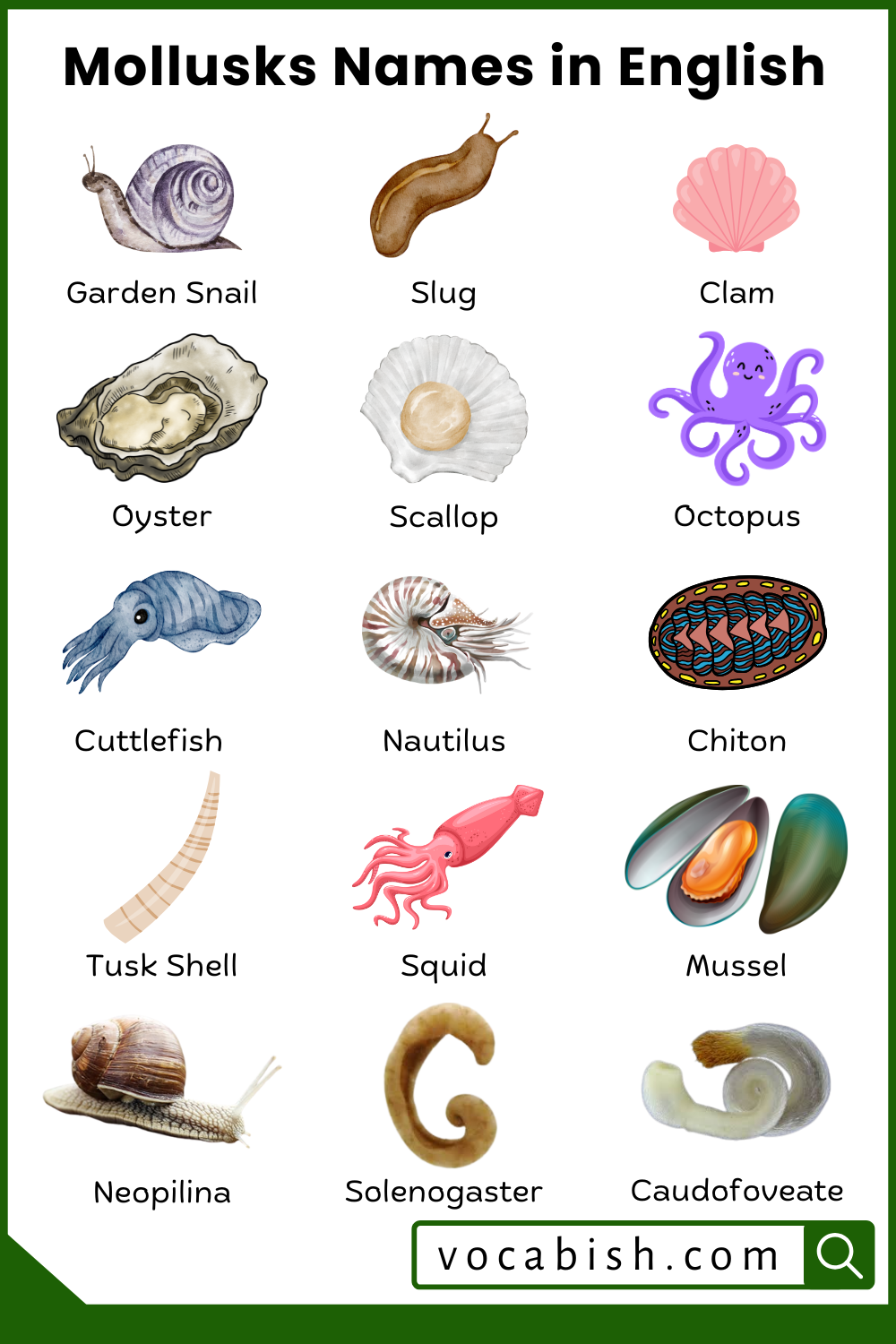
Garden Snail
A land gastropod with a spiral shell, slow-moving.
Slug
A shell-less gastropod, lives in gardens and damp places.
Clam
Bivalve mollusk with two shells, found buried in sand.
Mussel
Black-shelled mollusk that attaches to rocks in water.
Oyster
Bivalve that produces pearls inside its shell.
Scallop
Bivalve with fan-shaped shells, can swim by clapping shells.
Octopus
Intelligent cephalopod with eight arms and ink defense.
Squid
Cephalopod with a long body and tentacles, fast swimmer.
Cuttlefish
Cephalopod with a unique inner shell called cuttlebone.
Nautilus
Ancient cephalopod with a spiral shell.
Chiton
Polyplacophora mollusk with eight hard plates.
Tusk Shell
Scaphopod with a long tube-like shell.
Neopilina
A simple monoplacophoran mollusk, very rare.
Solenogaster
A worm-like mollusk with no shell, lives in the sea.
Caudofoveate
Another worm-like shell-less mollusk from deep sea.
List of All Mollusk Names
1. Snails
Snails are mollusks known for their soft bodies and coiled shells, although some species have reduced or internal shells. They live in gardens, forests, freshwater, and oceans, depending on the species. Garden snails move on a muscular foot and leave a trail of mucus as they crawl. Sea snails, such as cowries and whelks, occupy coastal habitats and play different roles in marine food webs.
Examples:
- Garden Snail
- Land Snail
- Sea Snail
- Freshwater Snail
- Apple Snail
- Cone Snail
- Moon Snail
- Cowrie
- Whelk
- Periwinkle
2. Octopuses
Octopuses are marine mollusks recognized by their eight arms, flexible bodies, and remarkable problem-solving abilities. Most have no external shell, allowing them to squeeze through narrow spaces between rocks and coral. They use suckers to grip objects, explore their surroundings, and capture prey such as crabs and shellfish. Species vary in size, color, and habitat, from shallow coastal waters to the deep ocean.
Examples:
- Common Octopus
- Giant Pacific Octopus
- Blue-Ringed Octopus
- Mimic Octopus
- Coconut Octopus
- Dumbo Octopus
- Blanket Octopus
3. Squids
Squids are fast-moving marine mollusks with elongated bodies, eight arms, and two longer tentacles used to catch prey. Unlike most shelled mollusks, they have a reduced internal structure called a pen that supports the body. Many squids use jet propulsion to move through the water and release ink to distract predators. They are important ocean predators and also serve as food for fish, seabirds, and marine mammals.
Examples:
- Giant Squid
- Colossal Squid
- Common Squid
- Flying Squid
- Bobtail Squid
- Firefly Squid
- Vampire Squid
4. Cuttlefish
Cuttlefish are marine mollusks related to squids and octopuses, but they have broad bodies and a distinctive internal shell called a cuttlebone. Their skin can rapidly change color and patterns, helping them camouflage themselves or communicate with other cuttlefish. A fin running along each side of the body helps them move through the water. They mainly feed on small fish, shrimp, and crabs.
Examples:
- Common Cuttlefish
- Flamboyant Cuttlefish
- Broadclub Cuttlefish
- Dwarf Cuttlefish
- Giant Cuttlefish
5. Clams
Clams are bivalve mollusks with two hinged shells that protect their soft bodies. Many species live buried in sand or mud, where they draw water through siphons to obtain oxygen and filter microscopic food particles. Some clams inhabit freshwater rivers and lakes, while others live in coastal and offshore marine environments. Their shells vary in shape and size, making names such as hard clam, razor clam, and giant clam useful vocabulary examples.
Examples:
- Hard Clam
- Soft-Shell Clam
- Giant Clam
- Razor Clam
- Surf Clam
- Geoduck
- Manila Clam
- Quahog
- Carpet Clam
6. Mussels
Mussels are bivalve mollusks with two shells, often elongated or wedge-shaped. Many marine species attach themselves to rocks and other hard surfaces using strong protein threads called byssal threads, while freshwater mussels have different ways of living and attaching. They feed by filtering small particles from water, contributing to aquatic ecosystems. Blue mussels and freshwater pearl mussels are familiar examples, although they belong to different ecological groups.
Examples:
- Blue Mussel
- Green-Lipped Mussel
- Mediterranean Mussel
- Zebra Mussel
- Freshwater Pearl Mussel
7. Oysters
Oysters are bivalve mollusks that usually have rough, irregular shells and live in marine or brackish water. Many attach to hard surfaces and form oyster beds or reefs that provide shelter for fish, crabs, and other aquatic animals. They feed by filtering plankton and suspended particles from the water. Pearl oysters are also mollusks, but they belong to a different group from the true oysters commonly eaten as seafood.
Examples:
- Eastern Oyster
- Pacific Oyster
- European Flat Oyster
- Olympia Oyster
- Pearl Oyster
8. Scallops
Scallops are bivalve mollusks often recognized by their fan-shaped shells with radiating ridges. Unlike many other bivalves, some scallops can swim short distances by rapidly opening and closing their shells to push water outward. They usually live on the seabed and feed by filtering tiny food particles from the water. Sea scallops, bay scallops, and queen scallops are useful examples of the different common names within this group.
Examples:
- Sea Scallop
- Bay Scallop
- Calico Scallop
- Queen Scallop
9. Chitons
Chitons are marine mollusks with eight overlapping shell plates arranged along their backs. Their broad, muscular feet help them cling tightly to rocks in coastal areas, even when waves move over them. Many graze on algae growing on rocks, using a specialized feeding structure called a radula. Unlike snails with a single shell, chitons have a distinctive plated covering that makes them easy to recognize in pictures.
Examples:
- Gumboot Chiton
- Lined Chiton
- Mossy Chiton
10. Other Mollusks
Several less familiar mollusks introduce useful vocabulary beyond the main groups. Nautiluses have external chambered shells, while tusk shells have narrow, curved shells resembling small elephant tusks. Sea hares are soft-bodied marine gastropods, and nudibranchs are colorful sea slugs known for their varied shapes and patterns. These animals demonstrate the remarkable diversity of mollusks, including species with prominent shells and others with exposed, shell-less bodies.
Examples:
- Tusk Shell
- Chambered Nautilus
- Sea Hare
- Nudibranch
- Sea Slug
Facts about Mollusks
- The giant squid is one of the largest invertebrates in the world.
- Oysters can produce natural pearls.
- Snails are among the slowest animals.
- Cephalopods are known for their intelligence and problem-solving.
- Mollusks have existed for over 500 million years.
Scientific Name for Mollusks
Category | Scientific Name | Description |
|---|---|---|
Kingdom | Animalia | Mollusks are animals with soft bodies and no backbone. |
Phylum (Main Group) | Mollusca | The scientific name for mollusks as a complete group. |
Common Name | Mollusks | Includes snails, clams, octopuses, and similar animals. |
Gastropods | Gastropoda | Largest group including snails and slugs. |
Bivalves | Bivalvia | Mollusks with two shells like clams and oysters. |
Cephalopods | Cephalopoda | Intelligent mollusks like octopus and squid. |
Polyplacophora | Polyplacophora | Marine mollusks with eight shell plates, like chitons. |
Scaphopoda | Scaphopoda | Tusk-shaped mollusks living in sand. |
Monoplacophora | Monoplacophora | Rare deep-sea mollusks with single shell. |
Aplacophora | Aplacophora | Worm-like mollusks without shells. |
A to Z List of Mollusks
A → Abalone, Ark Clam
B → Blue Mussel, Black Limpet
C → Clam, Chiton, Cuttlefish
D → Dog Whelk, Duck Mussel
E → Eastern Oyster, Elephant Tusk Shell
F → Freshwater Mussel, Flamingo Tongue Snail
G → Garden Snail, Giant Squid
H → Hard Clam, Horse Mussel
I → Island Scallop
J → Japanese Oyster
K → Keyhole Limpet
L → Limpet, Land Snail
M → Mussel, Moon Snail
N → Nautilus, Neopilina
O → Octopus, Oyster
P → Pearl Oyster, Periwinkle Snail
Q → Queen Conch
R → Razor Clam
S → Squid, Scallop, Sea Slug, Slug
T → Tusk Shell
U → Umbrella Limpet
V → Venus Clam
W → Whelk, Windowpane Oyster
X → Xenophora (Carrier Shell)
Y → Yoldia Clam
Z → Zebra Mussel
Mollusks are soft-bodied animals with incredible diversity. From snails and clams to octopuses and squids, they play an important role in nature and human life. Learning mollusks names in English helps us understand these unique creatures better.
FAQs about Mollusks
Mollusks are soft-bodied animals, often with shells, living in water or on land. Common examples include snails, clams, and octopuses. They belong to a large animal group called Mollusca.
Yes, octopuses are mollusks. They belong to the cephalopod group and have soft bodies, eight arms, and high intelligence. They live in oceans and move quickly.
Common mollusks names in English include snail, slug, clam, oyster, mussel, squid, octopus, and scallop. These names are widely used in science, food, and daily English vocabulary.
Yes, snails are mollusks. They are part of the gastropod group and have a soft body with a spiral shell. Snails live on land and in water.
The main types of mollusks are gastropods, bivalves, cephalopods, polyplacophora, scaphopoda, monoplacophora, and aplacophora. Each group has different body structures, shells, and living environments.
Mollusks eat different foods depending on their type. Some eat plants and algae, while others eat small animals. For example, snails eat leaves, and octopuses eat fish.
Mollusks are invertebrates, meaning they do not have a backbone. Their bodies are soft, and many have shells for protection, like clams and snails.
Mollusks live in oceans, freshwater, and on land. Snails and slugs live on land, while clams, oysters, and octopuses live mostly in marine environments.
The oyster is a mollusk known for making pearls. It forms pearls inside its shell as a natural defense. Pearls are valued for jewelry and decoration.
Related Articles: