
It is incredibly easy to mix up English words that look almost exactly the same. When it comes to moral and morale, that single letter “e” at the end completely changes the meaning, the pronunciation, and how the word acts in a sentence.
If you have ever stared at an email wondering if you should write about the team’s “moral” or “morale,” you are not alone. Let’s clear up this confusion directly so you can use both words with complete confidence.
Moral vs Morale: Quick Answer
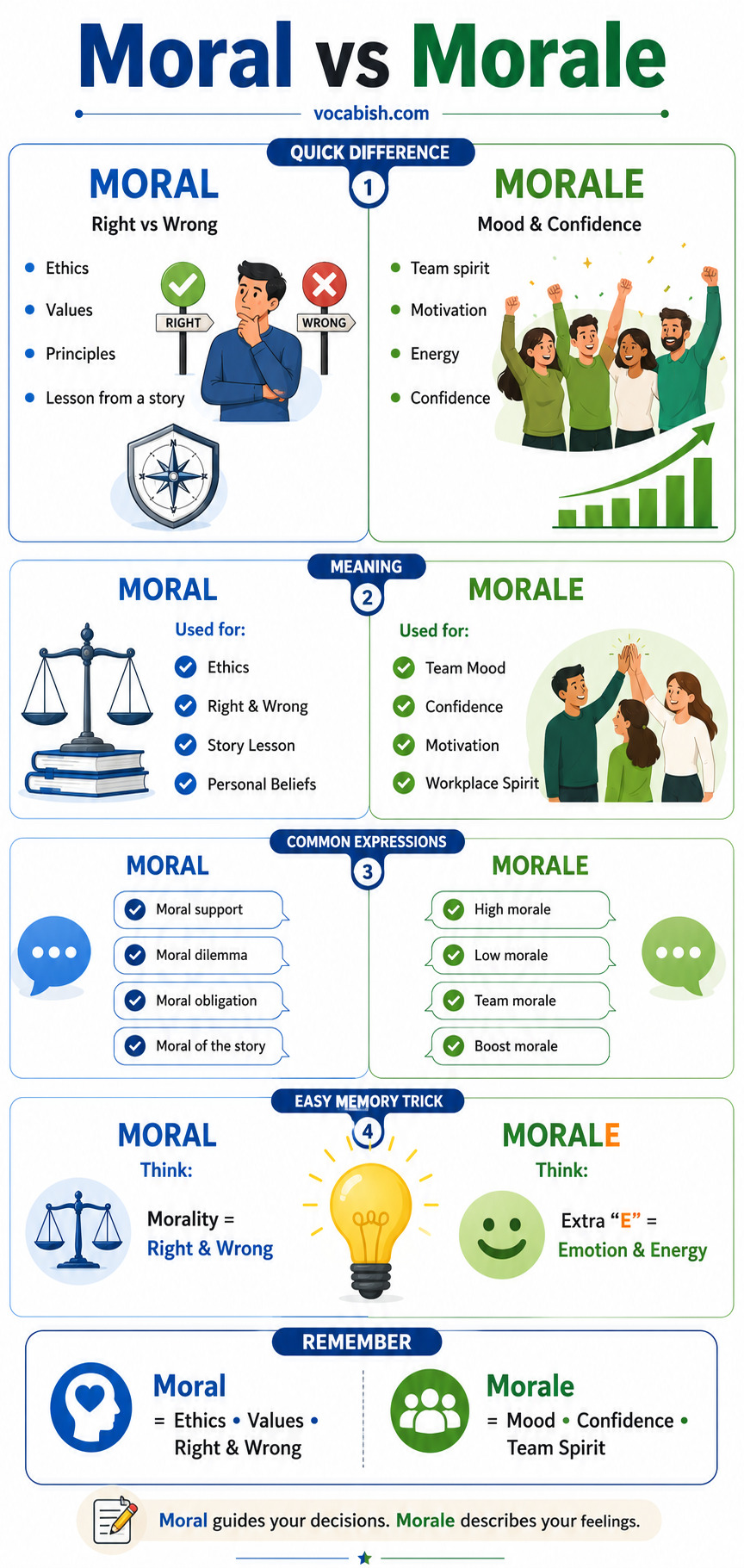
Here is the quick answer to know the difference between moral and morale in seconds:
- Moral is about ethics—knowing the difference between right and wrong.
- Morale is about emotion—the mood, confidence, or energy level of a person or a group.
Quick Tip: Think of the extra “e” in morale as standing for emotion or energy.
Meaning and Usage of Moral
The word moral can work as either an adjective or a noun, depending on how you build your sentence.
1. As an Adjective
The meaning and usage of moral as an adjective describes something related to right and wrong behavior. It describes actions, decisions, or people who do the right thing.
How to use moral in a sentence (Adjective):
- “She has a strong moral compass.” (She naturally knows what is right.)
- “The company has a moral obligation to clean up the pollution.” (It is the right thing to do.)
2. As a Noun
When used as a noun, it usually means the lesson learned from a story or experience. If you use it in the plural form (morals), it refers to a person’s personal beliefs about right and wrong.
How to use moral in a sentence (Noun):
- “The moral of the story is to never give up.”
- “He is a man of high morals.”
Meaning and Usage of Morale
The word morale is entirely different. The meaning and usage of morale as a noun relates to the psychological state of a group or an individual. You will not see this word used as an adjective.
It answers the question: How is everyone feeling? Are they motivated or depressed?
How to use morale in a sentence (Noun):
- “After the manager announced the bonus, the team’s morale went through the roof.”
- “Losing three games in a row really damaged the players’ morale.”
Quick Tip: We almost always pair this word with adjectives that describe a level or size, like high, low, good, or bad morale.
Main Difference Between Moral vs Morale
The main difference between moral and morale comes down to rules vs. feelings.
Feature | Moral | Morale |
Focus | Right vs. Wrong (Ethics) | Confidence and Mood (Feelings) |
Part of Speech | Adjective or Noun | Noun only |
Plural Form? | Yes (morals) | No (morales is not a standard English word) |
Pronunciation Guide: How to Say Them Right
For ESL learners, pronunciation is the best way to keep these words separate in your brain. The stress is on completely different syllables.
- Moral: Stress the first syllable. Say it like MORE-uhl.
- Morale: Stress the second syllable. Say it like muh-RAL.
If you say them out loud, you will realize they don’t actually sound similar in normal conversation!
When to Use Morale and Moral
Native English speakers tend to use these words in specific, predictable phrases (collocations). Memorizing these chunks is much easier than translating word-by-word.
Common Pairings with Moral:
- Moral support (giving someone encouragement, not necessarily helping them do the work)
- Moral high ground (claiming your actions are more ethical than someone else’s)
- Moral dilemma (a tough choice between two difficult ethical options)
Common Pairings with Morale:
- Boost morale (to improve the team’s mood)
- Low morale (a bad, unmotivated mood in a workplace or team)
- Team morale (the collective attitude of a group)
Real-Life Conversations: Seeing Them in Action
Let’s look at how these words naturally pop up in everyday dialogue.
Conversation 1: At the Office
Sarah: “How is the sales team doing after the budget cuts?”
David: “Not great. Morale is really low right now. Everyone is worried about their jobs.”
Sarah: “We should order lunch for everyone on Friday to help boost morale.”
(Notice we are talking about the team’s mood and energy.)
Conversation 2: Asking for Advice
Tom: “I saw a coworker stealing office supplies. Should I tell the boss?”
Lisa: “That’s a tough situation. You have to do what feels right to you.”
Tom: “I know, it’s a real moral dilemma. I don’t want to get him fired, but stealing is wrong.”
(Notice we are talking about right versus wrong.)
How do you use the word morale in a sentence?
Morale is a noun that describes the mood, confidence, or level of enthusiasm of a person or a group. You use it when talking about how motivated or happy a team, workforce, or individual is feeling.
Examples:
- “The manager bought lunch for everyone to help boost office morale.”
- “After losing three games in a row, the team’s morale was incredibly low.”
- “Working long hours without extra pay will eventually ruin employee morale.”
- “The general visited the troops to check on their morale before the mission.”
How do you use the word moral in a sentence?
Moral can be used as an adjective to describe things related to right and wrong (ethics). It can also be used as a noun to mean the lesson of a story, or (in the plural) a person’s core beliefs about good behavior.
Examples:
- “She faced a tough moral choice when she found a wallet full of cash on the street.” (Adjective – ethics)
- “My brother came to my job interview just to give me moral support.” (Adjective – common idiom)
- “The moral of the fable is that slow and steady wins the race.” (Noun – the lesson)
- “He is a person of high morals and would never cheat on a test.” (Noun – personal beliefs)
- “The company has a moral duty to ensure its products are safe for children.” (Adjective – right vs. wrong)
Common Mistakes: Watch Out for These
Even advanced learners (and sometimes native speakers) make mistakes with these two. Here are the top errors to avoid:
Mistake 1: “Moral support” vs “Morale support”
- Wrong: “I went to his presentation to give him morale support.”
- Right: “I went to his presentation to give him moral support.”
- Why: Even though you are boosting their mood, the correct English idiom is always moral support.
Mistake 2: Dropping the ‘e’ when talking about teams
- Wrong: “The staff moral is high today.”
- Right: “The staff morale is high today.”
- Why: You are talking about their mood, so you need the ‘e’.
Test Yourself: Moral or Morale?
Let’s do a quick check to see if the rules stuck. Choose the right word for each blank.
- Throwing a pizza party is a great way to improve office __________.
- It is hard to know the __________ thing to do in this situation.
- The __________ of the movie is that money cannot buy happiness.
- The coach gave a great speech to lift the players’ __________.
Answers:
- morale (talking about mood/energy)
- moral (talking about right/wrong)
- moral (talking about the lesson of a story)
- morale (talking about team confidence)
FAQs About Moral vs Morale
Moral refers to beliefs about right and wrong behavior. Morale describes the emotional mood, confidence, or enthusiasm of a group.
The correct phrase is always “moral support.” It means giving someone psychological encouragement or comfort, rather than providing direct physical help.
You use morale to describe feelings. For example, you can say that a pizza party helped boost the office team’s morale.
No, morale is strictly used as a noun in English. It always represents the mental state or emotional attitude of people.
Yes, the plural form is morals. It refers to a person’s specific set of personal beliefs regarding right and wrong behaviors.
Moral stresses the first syllable, sounding like MORE-uhl. Morale stresses the second syllable, sounding like muh-RAL, making them sound completely different.
High morale means a group of people feels very confident, cheerful, and highly motivated to work together toward a shared goal.
You May Also Like:
