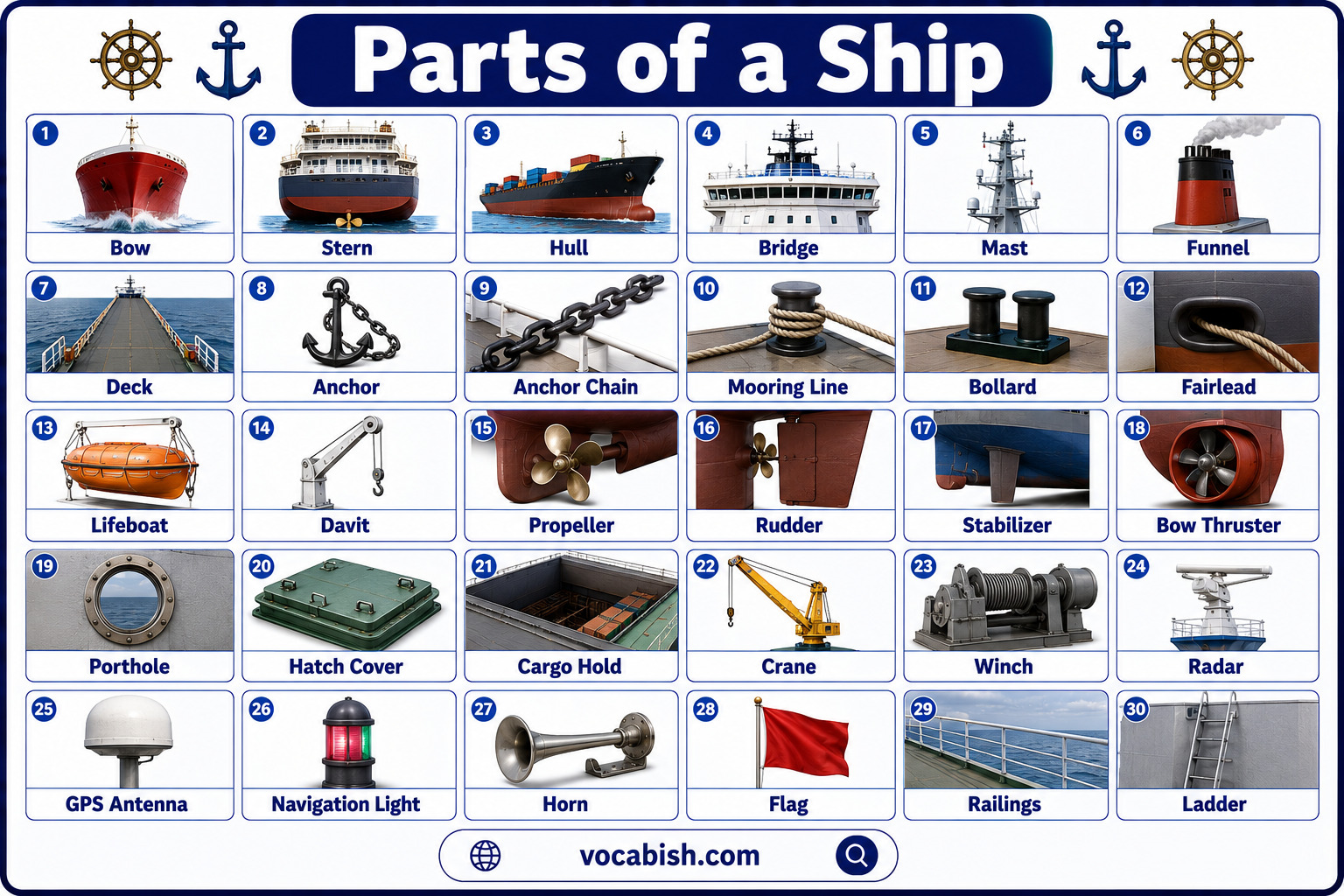

A ship is a large watercraft used for transporting people, goods, and equipment across oceans, seas, rivers, and other waterways. In this blog post, you will learn the parts of a ship with their functions and a labeled diagram to understand how each section of a ship works. From the hull and deck to the bridge and anchor, every part has a specific role in navigation, safety, movement, and cargo handling. Learning the names of ship parts helps readers understand English vocabulary related to marine transportation, naval structure, shipping, and maritime activities commonly used in books, schools, and technical learning.
Main Parts of a Ship
Below are the most important parts of a ship and their functions.
Bow
The bow is the front part of a ship. It cuts through the water when the ship moves forward.
- Helps the ship move smoothly
- Reduces water resistance
- Faces the direction of travel
Stern
The stern is the back part of a ship.
- Holds steering equipment
- Supports the propeller
- Helps control movement
Hull
The hull is the large body of the ship.
- Keeps the ship floating
- Protects the inside parts
- Supports cargo and passengers
Deck
The deck is the flat floor area on a ship.
- People walk and work here
- Holds equipment and containers
- Covers the inside sections
Bridge
The bridge is the control room of the ship.
- The captain controls the ship here
- Navigation tools stay here
- Workers watch the sea from this area
Cabin
A cabin is a room inside the ship.
- Passengers sleep here
- Workers rest here
- Stores personal items
Mast
The mast is a tall vertical pole on a ship.
- Holds lights and antennas
- Supports sails on sailing ships
- Helps communication systems
Anchor
The anchor is a heavy metal object.
- Stops the ship from moving
- Drops into the sea floor
- Keeps the ship stable
Propeller
The propeller is a spinning metal blade under the ship.
- Pushes the ship forward
- Works with the engine
- Helps movement in water
Rudder
The rudder helps the ship turn left or right.
- Controls direction
- Works near the stern
- Connected to steering systems
Engine Room
The engine room contains the ship’s engines.
- Produces power
- Runs the ship
- Controls mechanical systems
Keel
The keel is the bottom center line of the ship.
- Supports the structure
- Keeps balance in water
- Prevents rolling
Funnel
The funnel is the tall pipe on top of a ship.
- Releases smoke and gases
- Connected to engines
- Helps air flow
Lifeboat
A lifeboat is a small emergency boat.
- Saves people during danger
- Used in emergencies
- Carried on large ships
Cargo Hold
The cargo hold stores goods and containers.
- Carries products and supplies
- Found inside large ships
- Protects cargo during travel
Port Side
The port side is the left side of the ship.
- Important for navigation
- Used in directions at sea
- Opposite of starboard
Starboard Side
The starboard side is the right side of the ship.
- Helps sailors give directions
- Used in communication
- Opposite of port side
Gangway
The gangway is a movable staircase or platform.
- People enter and leave the ship here
- Connects the ship to land
- Used in ports and docks
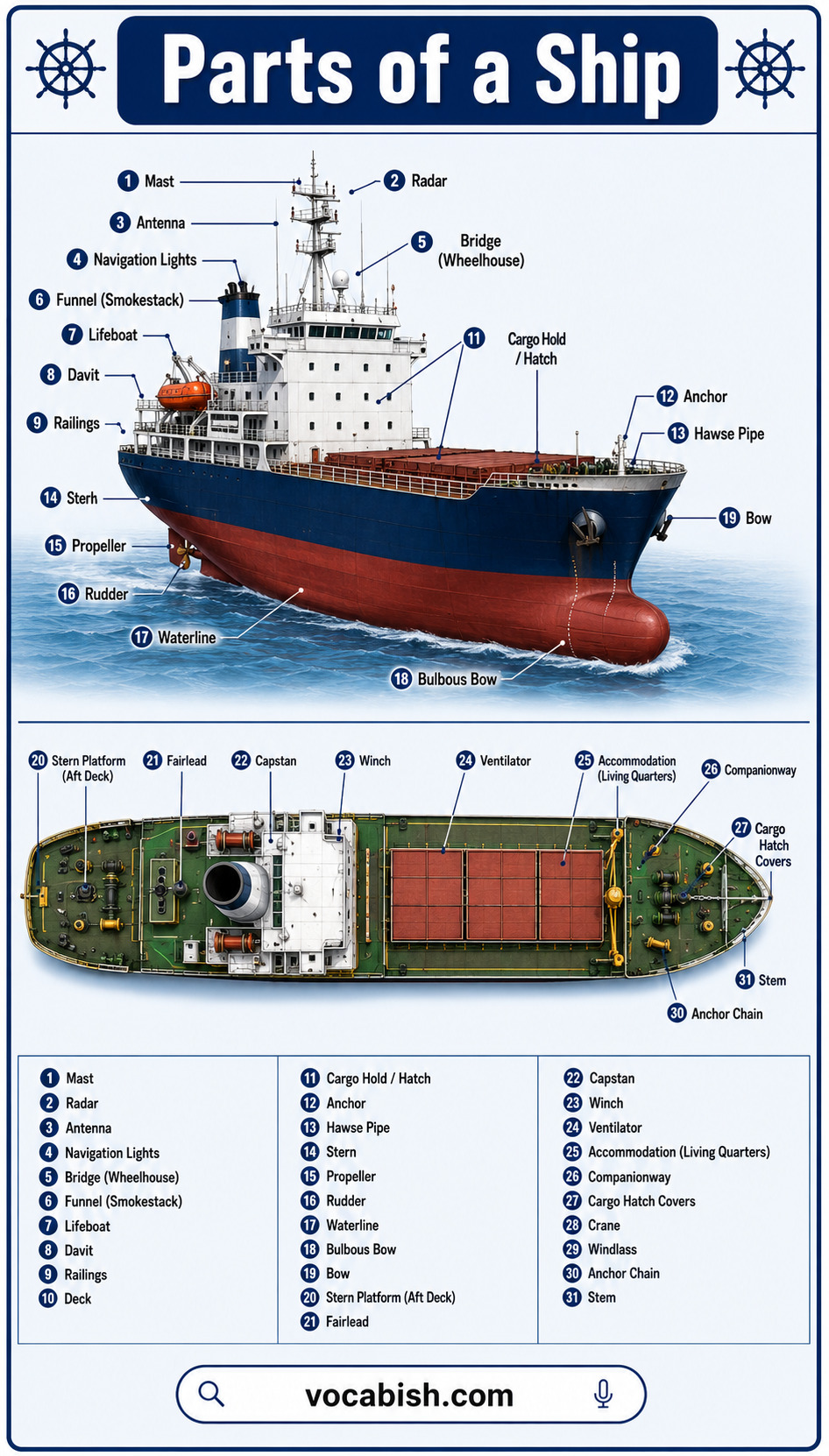
Front Parts of a Ship
These parts are mainly found near the front area:
- Bow
- Anchor
- Forward deck
- Chain locker
These parts help the ship move safely through water.
Middle Parts of a Ship
The middle section contains many working areas.
- Bridge
- Cabin
- Engine room
- Cargo hold
This area supports daily ship operations.
Back Parts of a Ship
The rear section controls movement and direction.
- Stern
- Rudder
- Propeller
These parts help the ship turn and move properly.
Upper Parts of a Ship
The upper section stays above water.
- Deck
- Funnel
- Mast
- Lifeboat
Crew members work here during travel.
Lower Parts of a Ship
These parts stay underwater or near the bottom.
- Hull
- Keel
- Propeller
- Rudder
They help with balance, movement, and safety.
Navigation and Safety Parts
Ships use special equipment for safety and direction.
- Compass — shows direction
- Radar — detects nearby objects
- Lifeboat — saves passengers
- Radio — supports communication
- Navigation lights — help ships travel safely at night
List of Important Ship Vocabulary Words
Here are common ship vocabulary words with their meanings:
- Bow — front of the ship
- Stern — back of the ship
- Hull — main body
- Deck — floor area
- Bridge — control room
- Cabin — room for people
- Anchor — stops movement
- Mast — tall pole
- Rudder — controls direction
- Propeller — pushes ship forward
- Keel — bottom support
- Funnel — smoke outlet
- Lifeboat — emergency boat
- Cargo — goods carried by ship
- Port — left side
- Starboard — right side
- Gangway — entrance platform
- Engine room — power section
- Sail — cloth that catches wind
- Compass — navigation tool
Why Learning Ship Vocabulary Is Useful
Ship vocabulary improves English reading and speaking skills. These words often appear in:
- School books
- Travel conversations
- Science lessons
- Geography topics
- Movies and documentaries
The parts of a ship each have an important function. Some parts help the ship move, while others improve safety and navigation. Learning these words builds strong English vocabulary and helps learners understand real-life topics more easily.
FAQs about Parts of a Ship
The main parts of a ship are the bow, stern, hull, deck, bridge, rudder, propeller, keel, mast, and anchor. Each part helps the ship move and stay safe.
The hull is the main body of a ship. It keeps the ship floating, protects the inside sections, and supports passengers, cargo, and equipment.
The front part of a ship is called the bow. It helps the ship move smoothly through water and reduces water resistance during travel.
The back part of a ship is called the stern. It contains important steering parts like the rudder and propeller.
The bridge is the control center of a ship. The captain and crew use it to navigate, monitor the sea, and control the ship.
An anchor stops the ship from drifting in water. It drops to the sea floor and keeps the ship stable in one place.
Port is the left side of a ship, while starboard is the right side. Sailors use these words for clear direction and communication.
Related Articles: